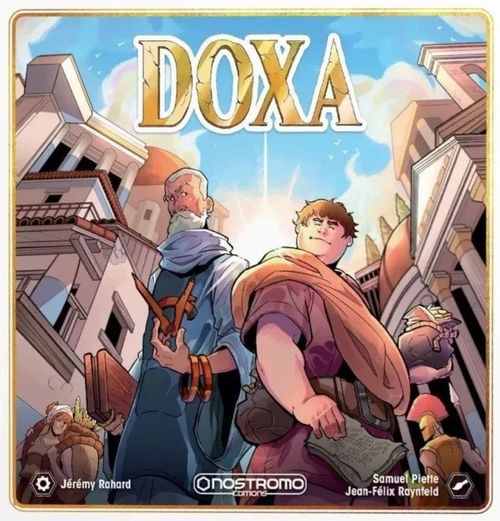
Doxa
Doxa Rulebook
Table of Contents
Table of Contents
Introduction and Objective
There are 4 ways to win a game of Doxa:
- Military supremacy
- Scientific supremacy
- Civil supremacy (by winning the 7 glory tokens of your color, the "Doxa")
- The fall of the opposing city (by fomenting revolts)
As soon as a player fulfills one of these 4 conditions, they instantly win the game.
* One of the three meanings of DOXA in Greek is "Glory".
Components
- 2 City boards (1 orange and 1 purple)
- 40 cards, including:
- 10 Base cards (5 per player)
- 30 Progress cards
- 12 cubes (Resource markers), including:
- 6 orange cubes
- 6 purple cubes
- 8 Revolt markers (4 orange and 4 purple)
- 14 Doxa tokens (7 orange and 7 purple)
- 2 double-sided player aids
1. Component Overview and Set-Up
-
Each player takes 1 player aid and 1 City board of the color of their choice and places it in front of them, along with the 7 Doxa tokens of the corresponding color (orange or purple).
-
Place the Doxa tokens on their respective slots: 5 Doxa tokens on your own City board and 2 Doxa tokens on the opposing City board.
-
Take 5 cubes of your color, 1 cube of your opponent's color, and 4 Revolt markers and place them on your board.
-
Take the 5 Base cards that make up your starting Deck (**): Merchants, Citizens, Architects, Soldiers and Peasants, one of each. Shuffle them and place them face down to the left of your City board. This pile is called "the Player's Deck". Provide space to the right of the City board for the future "Personal Discard Pile" (cards played by the player, placed face up in a stack).
(**) The Player's Deck is the pack of cards available for the game. It can be improved by buying other cards and used throughout the game.
-
Shuffle the Progress cards and form a face-down pile accessible to both players, called the "Common Draw Pile". Provide space next to this draw pile for the future "Common Discard Pile" (Progress cards not kept by players, placed face up in a stack).
-
Reveal the first 5 Progress cards from the Common Draw Pile and place them face up in the center of the table. These represent the "River" (i.e., the available cards).
-
Each player draws the first 4 cards from their Deck to form their starting hand (leaving 1 card in the deck).
The player able to recite the most letters of the Greek alphabet is designated the 1st player (if neither player knows it or in case of a tie, you may choose to: name Greek deities, engage in a verbal joust, play Rock-Paper-Scissors, or simply draw lots).
The game can now begin!
Example of Orange tray setup (printed in the set-up section of the rulebook).
Card Overview
- Base card: Name, Illustration, Effect, Doctrine (the resource symbol shown in the card's doctrine slot).
- Progress card: Name, Illustration, Cost, Effect.
2. Gameplay
In Doxa, players take turns completing 3 game phases until one of the 4 victory conditions is met.
On each turn, the player plays 2 cards: one from the River and one from their hand.
Cards may have a cost (Progress cards) or be free (Base cards), but always grant 1 or more effects.
Effects primarily influence the movement of markers on the player's various tracks, but also on those of the opponent.
Depending on whether it is a cost or an effect, markers will be moved in one direction or the other on their respective tracks.
Indeed, Doxa is a "tug-of-war" style game, which means players will constantly move markers to their advantage to reach or prevent one of the following immediate victory conditions:
1. Military Supremacy
When a player's military marker reaches the last space of the track, their army invades the opposing city and they win the game. Reminder: a player's military marker is located on their opponent's board.
2. Scientific Supremacy
When a player's scientific marker reaches the last space of the track, their city reaches its scientific pinnacle: they win the game!
3. Civil Supremacy
When a marker (resource or revolt*) reaches or exceeds 1 Doxa token, this token is collected by its owner. The owner places it on the empty space furthest to the left on the Doxa track. As soon as a player collects their 7th and final Doxa token, they win the game!
Note that two of the Doxa tokens on your board are not your color (one is on your Trade track and the other is on your Military track). This means that if your marker reaches one of these two tokens, your opponent collects it. Similarly, two of your tokens can be collected from your opponent.
* Note: the Trade track has a Doxa token between the Revolt marker and the Resource marker. It is therefore the only track where a Doxa token can be collected, regardless of whether the Resource or Revolt marker reaches or passes it.
4. The Fall of the Opposing City
When a Revolt marker reaches or crosses a Resource marker, that player instantly loses the game! The citizens have rebelled, the city is overthrown: this is the downfall. Victory goes to the opponent!
As you have understood, in Doxa, you must manage your city and attempt to overthrow the rival city, all while defending against military attacks and other revolts fomented by your opponent!
It is therefore essential to acquire and use your cards to create a balance between generated resources and spent resources!
Note: with the exception of Base cards which are free, the player MUST pay the cost of each card during its acquisition (p. 6) or its activation (p. 7).
Costs and Effects
Costs
Progress cards may have costs in: Population, Food, Engineering, Gold.
To pay the cost of a Progress card, the player moves the relevant marker(s) to the left on their respective tracks by the amount indicated on the card (1 notch per resource).
Reminder: Base cards have no cost, only effects.
Effects
Effects are bonuses or penalties for you or your opponent. This can include resource gains (Gold, Population, Food, and Engineering on Base and Progress cards), Scientific resource gains, Military resource gains, or other effects such as exchanges, general revolts, attacks, etc. (on Progress cards only).
List and details of effects are given in "Effect Details & Tips" below.
3. Game Phases
On their turn, the player must perform 3 phases, in this order:
- Phase 1: Apply Doctrine (if possible)
- Phase 2: Purchase a Progress card from the River (mandatory)
- Phase 3: Play a card from your hand (mandatory)
Phase 1: Apply Doctrine
This phase is triggered only if you have placed a Base card in the Doctrine slot of your City board during Phase 3 (this is therefore not possible on the 1st turn). In this case, you immediately gain the indicated resource once. See Phase 3: Play a Card From Your Hand to better understand Doctrines.
If you do not have a card in this slot, skip directly to Phase 2.
Typesetting note: the printed text reads "gain1 the indicated resource once"; the stray "1" is treated as a layout artifact.
Phase 2: Purchase a Progress Card From the River
You must select one of the Progress cards still present in the River (refill it if necessary) and leave it face up, temporarily, above your City board. Whether it suits you or not, you MUST pay the full cost.
Note: Progress card costs vary (from 1 to 2 resources) as well as the number of effects (from 1 to 3 effects).
After paying the full cost, you must choose between these 2 options:
- Keep the card for later: choose and apply 1 effect and only 1 from those on the card (if there is only one, the choice is simple!). AFTER applying the chosen effect, place the Progress card face down on TOP of your Deck. This way, you know what you will draw when the time comes.
- Discard the card after applying all effects: apply ALL the card's effects, in the order of your choice, THEN place the Progress card face up on top of the Common Discard Pile. This card will not return to the game unless the common discard pile must be reshuffled to form a new Progress draw pile.
Note: if one of a card's effects cannot be applied, that specific effect is lost but the other effects still apply.
Example: If you decide to discard the "Fishing Port", you can inflict a General Revolt on your opponent, + decrease one of your Revolt markers by 1, + gain 1 Food. If your Food marker is at maximum, this effect is lost but you apply the rest of the card's effects. Similarly, if all your Revolt markers are at minimum, you have nothing to decrease. However, you might still want to inflict effects such as a General Revolt on your opponent! Choosing such a card deliberately could even lead you to victory, who knows?
Phase 3: Play a Card From Your Hand
You MUST play a card from your hand by choosing one of these 2 options: activate a card or apply/modify a Doctrine.
A doctrine is a direction, often political, given to an institution or a country. It constitutes the rules of thought or conduct chosen by its leaders. In Doxa, applying a Doctrine consists of emphasizing a specific caste to specialize your city. For example, by choosing Merchants, your city focuses its efforts on trade and will obtain 1 "gold" resource at the beginning of every turn (in Phase 1).
Activate a Card
To do this, first pay the full cost (reminder: Base cards are free) then apply ALL effects before placing the card, face up, on top of your personal discard pile.
Reminder: if an effect is not applicable, it is lost.
Important: after playing a card from your hand, do not draw a new one immediately. You may only refill your hand when it is empty. If you have just played the last card from your hand, draw 4 new ones from your deck. Certain effects require players to always have at least 1 card in hand. It is therefore advisable to refill your hand immediately after emptying it.
If there are not enough cards in your Deck, shuffle your Personal Discard pile, place it face down to the left of your board, and complete your hand so that you have 4 cards again.
Apply a Doctrine
This action is free and is only possible with the 4 Base cards featuring a Doctrine symbol (the Military card and Progress cards cannot be used to apply a Doctrine).
To apply a Doctrine, simply slide the chosen card into the designated slot on your city board. You gain no resources. Starting only from the NEXT turn, gain the resource indicated by your Doctrine during Phase 1, for as long as the card is in place.
Modify the Doctrine
This action is performed only in Phase 3.
To modify a doctrine, simply replace the previously chosen card with another Base card from your hand, without gaining a resource this turn. The removed card is placed in your personal discard pile.
4. End of Turn
Once these 3 phases are completed, your turn ends. Keep any cards in your hand.
It is then your opponent's turn to play their game turn and perform these same 3 phases.
THE RIVER IS NOT REFILLED BETWEEN PLAYERS' TURNS. It is only replenished once it is empty. When a player starts their turn, if the river is empty, they reveal 5 new cards face up. If there are not enough cards in the common draw pile, reshuffle the common discard pile to form a new face-down draw pile and complete the river so that there are 5 Progress cards.
End of Game
Take turns as before until a player imposes their hegemony!
Reminder of victory conditions:
- Military supremacy
- Scientific supremacy
- Civil supremacy (by winning your 7 Doxa tokens)
- Fall of the opposing city (revolts)
Effect Details & Tips
Doxa
Move one of the Doxa tokens of your color by one space on any city board.
This effect allows you to move your Doxa tokens closer to markers to accelerate their capture for Civil supremacy victory. If the movement causes it to immediately reach one of the board's markers, the Doxa token is reclaimed and placed on the player's Doxa track.
Planning
Draw the first card from your Deck then discard a card from your hand. The discarded card can be the one you just drew. You do not pay the cost and do not apply the effects.
This allows you to "cycle" your Deck. That is, to draw previously acquired cards faster or to immediately have a more interesting card in your hand than those remaining at that moment and be able to play it in Phase 3.
Science
Move your scientific marker up by one space.
This allows you to move closer to Scientific supremacy victory. Note: this effect does not apply to the opponent's city board to move their Science marker down. It's up to you to be attentive to the cards you leave available to your opponent! Letting the other player obtain all the cards with a Science effect can be fatal (especially since this marker never moves down...).
Commerce
Take two different resources from an opponent (they move their two corresponding cubes one space to the left and you move your corresponding cubes one space to the right). They then choose one of the two resources you did not select. They increase their corresponding track and decrease yours.
General Revolt
Force your opponent to move ALL their Revolt markers one space to the right.
This is a maneuver to foment trouble within the rival city and attempt to overthrow it! If this action causes at least one of these markers to immediately reach a Resource marker on your opponent's board... it's victory for you! It is therefore important to be vigilant, once again, on the Progress cards that each person acquires. Monitor your Revolt markers, force your opponent to spend resources bringing them dangerously close to their downfall, and remember to "calm" your citizens thanks to offerings of bread... (see below).
Military
Repel the enemy: increase your opponent's Military marker by one notch (on your board) or Attack: decrease your Military marker by one notch (at your rival's).
Sabotage
Consult your opponent's hand and choose one of their cards that they MUST discard into their personal discard pile. They do not benefit from any effect and do not pay the cost.
Windfall
If cards remain in the River, you may copy the effect of your choice from one of them. Note: you only copy one of a card's effects, even if it has several. The copied card remains in the River.
If a player plays a Copy effect as their last card in Phase 3 but has just "emptied" the river in Phase 2, the Copy effect cannot be applied! Similarly, if the player in Phase 2 wishes to discard the last card from the river to apply all its effects and among them is the Copy effect, this latter is "lost". In this case, it might be wiser to keep the Progress card for later and only apply one other effect at that moment. Players can therefore decide to voluntarily "leave" such a card so that their opponent's turn cannot be optimized! After all, your goal is supremacy... not sympathy!
Opportunity
Reveal the 1st Progress card from the top of the common draw pile. You may either:
- Discard it WITHOUT applying any of its effects and WITHOUT paying the cost, or
- Pay its full cost then choose between:
- keeping it and applying only 1 of its effects of your choice (possible even if there is only one effect on the card), or
- applying all its effects (if possible) then discarding the card.
Barter
Lose 1 resource in Population, Engineering, Food, or Treasure to increase another of your resources by 1.
Bread
Decrease one (and only one) Revolt marker by one space.
A way to calm your citizens and delay or avoid the downfall of your city! It's up to you to evaluate on which track the downfall threatens you! Think of the resources you must spend, use your doctrine, accumulate offerings of "pain"... Appeasing a revolted people takes time.