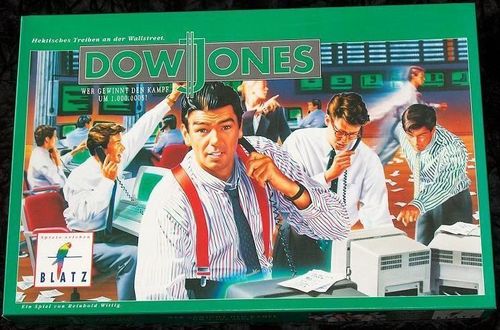
Dow Jones
Dow Jones Rulebook
Table of Contents
Table of Contents
Game Idea and Objective
Hectic activity on Wall Street. The fight for one million dollars. Whoever skilfully avoids the falling of prices by dodging the Baisse, and instead lets prices rise and reaches the Hausse, and there collects the most share packets, wins DOW JONES.
But beware of price fluctuations: if a stock-market player throws a Baisse stick, the Hausse is far away and the crash is very near.
Besides nerves of steel for the Hausse and the Baisse, the players of DOW JONES need the same as the brokers on New York's Wall Street. While the Hausse signals rising stock prices, the Baisse warns of falling prices. Shrewd shareholders therefore take care not to let a fellow player throw a Baisse stick and so cause a price crash.
Components
Apart from courage for risk and a good nose for share prices, DOW JONES requires:
- 1 stock-exchange game board,
- 14 small stock-market players (Börsianer) in 7 colours,
- the dollar sign (the Hausse),
- 21 Baisse sticks,
- 20 playing cards (the share packets),
- 2 special dice (12-sided and 20-sided),
- 1 normal die.
Setup
- Each player receives 2 small stock-market players (their playing pieces) in one colour and 3 Baisse sticks.
- Place the two stock-market players on any two spaces of the game board.
- Shuffle the playing cards and place them face down on the board. Place the three 30,000-dollar share packets on top, then continue evenly up to the 460,000-dollar share packet, which lies at the very bottom.
- Decide who starts. The stock-exchange adventure can begin.
Game Play: Buying, Buying, Buying
Whoever begins rolls the two special dice and thereby determines the starting space of the Hausse. The 20-sided die always gives the long row of the board, and the 12-sided die, as the second coordinate, always gives the short row of the board. The Hausse (the dollar sign) is placed on the intersection point.
Diagram caption: "This is how the Hausse stands when the 20-sided die shows 4 and the 12-sided die shows 3." The dollar sign sits on the intersection of row 3 and column 4 of the board grid.
Now the player rolls the normal die and moves one of his two stock-market players according to the number rolled. The aim of moving is to reach the Hausse. Whoever hits the Hausse's space exactly (!) with the number rolled receives the top share packet from the card stack.
Diagram caption: "The stock-market player must hit exactly the space on which the Hausse stands."
Turning at right angles (also several times) is allowed. Moving forward and back onto the same space is forbidden. Other playing pieces may not be moved over; they must be gone around.
Whenever a player has won a share packet, which is not so easy, the location of the Hausse must be determined anew with the two special dice. If the Hausse happens to land on another player's piece, that player may rejoice over the top share packet, but must then also determine the location of the Hausse anew with the special dice.
When Prices Fall: The Baisse Sticks
Before another player rolls, each player may throw a Baisse stick. The stick (which is then removed from the game) entitles the thrower to determine the location of the Hausse anew with the special dice, immediately and out of turn. This prevents a fellow player who stands near the Hausse from possibly collecting the next share packet straight away. Of course this only pays off if that fellow player already holds dangerously many share packets.
When the Hausse stands on its new location, speculation continues.
Insider tip (printed in the rulebook): since the share packets keep rising in value (the largest share packet lies at the very bottom), the savvy stock-market player does not use up his Baisse sticks right at the start, but deploys them only when there is really a lot of money at stake on the exchange.
End of Game: Stock Exchange Closing
DOW JONES ends when the share packets have been used up. Now everyone counts their dollars. Whoever was so thrifty with their Baisse sticks that they still have some left may count them in as a reward. One stick counts 50,000 dollars.
The broker with the most dollars is the winner of DOW JONES.
Counting tip (printed in the rulebook): because brokers always have their heads full of important matters, counting the share packets can also be simplified: lay the cards so that the white areas are covered. The striped areas then form a continuous stretch.
Closing line of the rulebook: "Plunge into the hectic bustle and win the fight for $1,000,000!"
Dow Jones at a Glance
The rulebook's brief summary of the rules.
- Object: Collect the most share packets.
- Setup: Per player, place 2 stock-market players on any spaces of the board. Arrange the playing cards and lay them face down on the board. Start play.
- Game play: Reach the Hausse as often as possible and collect share packets there. But: if a Baisse stick is thrown, the Hausse gets a new location.
- End of game: The game is over when the share packets have been used up. Now count the dollars. The broker with the most dollars is the winner of DOW JONES.
Small Stock-Market Lexicon (A to Z)
- Share (Aktie): A security (certificate) through which a stake in the share capital of a joint-stock company (AG, Aktiengesellschaft) is acquired.
- Baisse: Denotes the falling of stock-market prices (downturn).
- Börse (stock exchange): Named after the Dutch merchant van der Burse, in whose house well-known merchants met in the 14th century. Today the term stock exchange means a market held on all working days for "fungible" goods, i.e. goods that need not be physically present at the exchange in order to be traded (e.g. securities, shares, foreign currencies).
- Broker: Term for a professional securities dealer and adviser.
- Courtage: Fee of the stock-exchange broker, which the buyer has to pay.
- Devisen (foreign currency): In the wider sense, all foreign banknotes and coins.
- Dividende (dividend): The share of a joint-stock company's annual profit attributable to one share.
- Dow-Jones-Index: Share-price index published in the Wall Street Journal. It calculates the average value of the 30 most important industrial stocks in the USA.
- Floating: The temporary abandonment of fixed exchange rates in favour of a free play of supply and demand.
- Hausse: Denotes the rising of stock-market prices (upswing).
- Kurs, Kurswert (price, market value): The prices formed at various exchanges for traded securities, foreign currencies or goods.
Mister Dow, Mister Jones and the Year 1896: The History of the Dow Jones Index
As the New York stock exchange, the "New York Stock Exchange", developed at the end of the 19th century on the well-known Wall Street into the largest stock exchange in the world, the stock-market events, previously manageable, became ever more impossible to survey for brokers and shareholders.
The owners of the firm Dow, Jones & Co. recognised the signs of the times and in 1896 published the Dow-Jones Index for the first time.
The index, which today appears in the Wall Street Journal, calculates the average value of the 30 most important industrial stocks in the USA every day. It serves exchanges and financial markets worldwide as an orientation and is at the same time a reduced picture of the American economy. Thus the Dow-Jones Index (short: DJ) fell on 24 October 1929, through the world economic crisis, to its historic low of under 200 points. The DJ's best year was 1972, when for the first time it broke the 1000-point barrier.