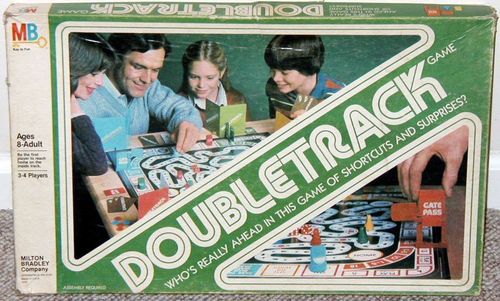
Doubletrack
Doubletrack Rulebook
Table of Contents
Table of Contents
Object
Be the first player to reach home on the inside track.
Contents
- 1 gameboard
- 30 cards
- 48 plastic chips (some extra chips may be included)
- 4 cardboard gate passes
- 4 cardboard screens
- 2 red dice
- 4 large plastic pawns
- 4 small plastic pawns
- 4 plastic gates
How to Set Up the Game
-
Open up the gameboard and place it on a flat surface so it's accessible to all players.
-
Each player chooses two pawns of the same color to move: a large pawn and a small pawn. The small pawns move on the inside track and are placed on the large inner START circle. The large pawns move along the outside track and are placed on their matching color spaces that say "Take The (Color) Gate Pass".
-
Players position themselves around the gameboard near the large pawn they chose to move.
-
4 PLASTIC GATES: 4 gates must be assembled and attached to the gameboard before play can begin. The gates actually open and close and control entry to the matching color shortcut routes along the outside track.
How to assemble the gates
A. Each gate is made up of 3 parts: the post, the door and the press-on retainer, as shown in Figure 1.
[Figure 1: a post with PEG HOLE, TRACKS and FOOT; a door with a PEG; and a PRESS-ON RETAINER.]
B. To assemble a gate correctly, the door and post of the same color are attached to each other by a press-on retainer of the same color. Here's how it's done: insert peg of door into the peg hole of the gate post as shown in Figure 2. Press the retainer onto the peg to secure the post to the door.
[Figure 2: INSERT PEG IN PEG HOLE.]
C. Assemble the 3 other gates as above and attach all of them to the gameboard by slipping the feet of the gates under the outer edge of the gameboard to secure them in place. Place each gate just after its matching color space that says "Take The (Color) Gate Pass" and just before the numeral space on the outside track. See box top for picture of proper placement.
-
GATE PASSES: the 4 cardboard gate passes are used to open and close their matching color gates.
How to use the gate passes
How to Play the Game
-
Shuffle the deck of 30 cards. Deal 3 cards facedown to each player. You may look at the cards dealt to you. Keep them facedown in front of you until you're ready to use them.
-
Place the remaining cards facedown in a pile near the gameboard.
-
HOW TO MOVE: on your turn, roll the dice and move your large pawn clockwise around the outside track the number of spaces shown on the dice. Wherever your large pawn lands on the outside track will determine the position of your small pawn on the inside track... your small pawn could move ahead, move back or stay exactly on the same space!
Here's some important information you should know before you roll the dice. The outside track has 4 special shortcut routes protected by 4 plastic gates. See Figure 4, for position of a shortcut route.
[Figure 4: POSITION OF GATE; OUTSIDE CORNER ROUTE; SHORTCUT ROUTE.]
Shortcut routes contain numeral spaces that are very good to land on. If your large pawn lands on one of these spaces, your small pawn can then move ahead many spaces on the inside track. Since the shortcut routes contain so many get-ahead spaces, you can only take such paths under the following circumstances:
A. when you own a gate pass that controls a particular gate, you must take the shortcut route that the gate controls.
B. when you want to travel on a shortcut route controlled by an opponent's gate, ask permission for entry from your opponent. If permission is granted, take the shortcut route. You must ask permission, however, BEFORE YOU ROLL THE DICE. Here's how you ask permission.
-
Ask permission to enter your opponent's shortcut route before you roll the dice on your turn.
-
Once you ask permission, an opponent may let you pass onto the shortcut route free of charge... or an opponent may charge you an entry payment of a chip or chips... or an opponent may refuse you entry and so you would have to use the outside corner route instead.
-
The 30 Cards and What They Mean
-
"Number" cards: there are 18 number cards which say "Ahead" and then a number. If you play one of these cards, move your small pawn ahead on the inside track the number of spaces shown on the card.
-
"Trade Places With Any Player" cards: if you play one of these cards, your small pawn must trade places with any other small pawn on the inside track.
-
"Take The Lead" cards: if you play one of these cards, place your small pawn on the space directly ahead of the leading pawn on the inside track. If you are already in the lead, stay there.
-
"Back 10" cards: if you play one of these cards, move your small pawn back along the inside track 10 spaces.
-
"Oh No! Go Farthest Back" cards: if you play one of these cards, move your small pawn back along the inside track and place it behind the small pawn that is the farthest back. If you are already farthest back, stay there.
-
"Steal A Gate Pass" cards: if you play one of these cards, take a gate pass of your choice from any opponent so you may control its matching gate. Your small pawn does not move ahead or back on such a play but rather stays where it is on the inside track.
-
"This Is A Worthless Card" cards: if you play one of these cards, no pawn (large or small) is moved and nothing is gained.
C. SELL A CARD SPACES: When you land on these spaces with your large pawn, you must sell any one of the 3 cards in your hand to your opponents. The highest bidding opponent is awarded the card and you'll receive all the money (chips) bid. You may auction off any card for the identity of the card is kept secret during the bidding.
Here's how to sell a card and how your opponents bid on it
-
Announce aloud you're selling a card. Place the card to be sold facedown in front of you.
-
Your opponents then bid for the card. To bid, a player secretly takes some chips from the supply of chips behind his or her screen and makes a fist around them—then holds his or her fist out over the table. When all the bidding players have done so, they open their fists and drop their bids on the table all at the same time.
-
The highest bidder is awarded the card and must play it immediately. The seller of the card is awarded all the chips that were bid from all players. IMPORTANT: in case there is a tie to determine the highest bidder, the seller of the card is awarded both the card and all the money. The card still must be played immediately!
-
The seller of the card then draws another card from the deck, so he or she again has 3 cards in his or her hand.
IMPORTANT BIDDING NOTE: in the case of selling a card, the player who sells the card does not bid but ALL OTHER PLAYERS MUST BID. The minimum amount of money one can bid is a red $5 chip. If you have no money, you may fake a bid by putting your fist out over the table and opening it with no chip bet!
D. SELL A PASS SPACE. When you land on such a space with your large pawn, you must sell one of your gate passes. All of your opponents must bid following the same procedure as outlined above. If you do not have a gate pass to sell, ignore the instruction and your turn is over. In case of a tie to determine the highest bidder, the seller gets to keep the gate pass and the money that was bid.
E. SELL THE LEAD! SPACE. This is a very special space. When you land on such a space, the lead on the inside track must be auctioned off (the lead is one space ahead of the pawn who's farthest ahead). ALL PLAYERS MUST BID, even the player who landed on the "Sell The Lead!" space. Bid as outlined above under "Sell A Card space". Whoever bids the highest wins the lead and moves his or her small pawn one space ahead of the small pawn who's farthest ahead on the inside track. The owner of the small pawn who is then farthest back on the inside track collects all the money that was bid as a special "Loser's Bonus", in case of a tie to determine highest bidder, [the tie-break sentence here is cut off at the scan's right edge and could not be fully read; the player who landed on the "Sell The Lead!" space is involved in the tie-break, as the printed text indicates, but the exact wording is unverified]. IMPORTANT, if the highest bidder already owned the lead on the inside track, his or her pawn remains on the same space, retaining the lead and the owner of the small pawn who's farthest back still gets all the money (the "Loser's Bonus"). PLEASE NOTE: sometimes deciding who's farthest back can be tricky! If two or more players' small pawns are on the START circle after the lead is sold, they are considered the "farthest back". To decide which of them will get the "Loser's Bonus", have each of them roll the dice. The low roller gets the money in the "Loser's Bonus".
F. TAKE THE (WHATEVER COLOR) GATE PASS SPACE. When you land on one of these spaces, take the particular color gate pass you're directed to from whomever owns it. You then control the operation of that gate. If you already own the gate pass you're directed to take, then nothing happens and your turn is over.
G. TAKE $25 FROM AN OPPONENT SPACE. When you land on one of these spaces, take $25 in chips from the opponent of your choice. If your opponent does not have the full $25 to give you, he or she gives you as many chips as he or she has!
-
THE SPACES ON THE INSIDE TRACK AND WHAT THEY MEAN: in addition to the START and HOME Circles, two other spaces must be explained:
A. White circle spaces... move your small pawn along the white spaces in the direction of the arrows as many spaces as you're directed by your play on the outside track with your large pawn. Two or more pawns cannot be on the same white space on the inside track. If you land on another player's small pawn, advance your small pawn to the next open space.
B. Purple Shortcut Spaces... these are special spaces to try to land on at the end of your move. See Figure 5, for a close-up look at them. When you end your move by exact count on a Shortcut Space, your small pawn sits there until it is able to move again. When directed to move your small pawn again, then you must use the shortcut by following the arrow across the track to the Get-Ahead Space and continue your move from there. The purple Shortcut/Get-Ahead space route allows your small pawn to skip over many white path spaces... a smart strategy to speed you on your way HOME and a big win!
[Figure 5: PURPLE SHORTCUT SPACES; GET-AHEAD SPACE (two labels).]
-
SOME IMPORTANT GAME PLAY RULES YOU SHOULD KNOW:
A. Two or more pawns can never be on the same space on the inside track or the outside track. If you land on an opponent's pawn, move your pawn ahead to the next open space. IMPORTANT: when moving, if your small pawn lands on pawn occupying a Purple Shortcut space, your small pawn advances to the next open space but not to the Get-Ahead space.
B. How to determine the lead: The player whose small pawn is the farthest advanced along the inside track is considered in the lead. If a small pawn is sitting on a Purple Shortcut space that could put it in the lead if it were moved to the Get-Ahead space it is still not considered "in the lead" at that point.
C. In a 3-player game, one gate pass is considered out of play until someone lands on its matching color "Take A Gate Pass" space and claims the gate pass! The gate then can open and close and its shortcut route can be used!
How to Win the Game
The first player who brings his or her small pawn to the HOME Circle on the inside track wins the game! Exact count is not needed to enter the HOME Circle.