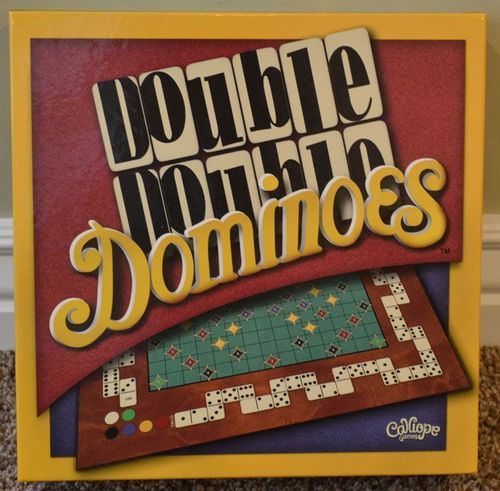
Double Double Dominoes
Double Double Dominoes Rulebook
Table of Contents
Table of Contents
Setup
Double Double Dominoes includes one game board, 56 dominoes and 4 score pieces. Place one score piece for each player on the matching colored dot in the starting position in the lower left-hand corner of the game board. Place all dominoes face down on the table and mix them up. Each player draws three dominoes to make up their hand. The remaining dominoes make up the boneyard, or draw pile, for the game. (NOTE: Playing Double Double Dominoes with 5 or 6 players requires additional dominoes, sold separately.) Each player shows the domino in their hand with the lowest number of dots on it; the player who has the domino with the lowest total number of dots is the first player. In case of a tie, the oldest player plays first.
Taking a turn
Each turn, a player draws a domino from the boneyard into their hand, and then plays a domino on the board. If they cannot play, they discard a domino from their hand face-down into an area on the table designated as the pit. Dominoes in the pit cannot be used for the rest of the game.
Placing a domino
The first domino of the game must be placed on the star at the center of the board. Every domino must be placed next to one and only one domino already on the board so that one end (the tail) has a number of dots that matches the domino it is placed next to. The other end of the domino (the head) may not touch any other domino, unless placing the domino connects two lines of dominoes, with the head matching one end and the tail matching the other. See diagram 1. If a domino from your hand can be placed somewhere on the board, you must play a domino during your turn. When you play a double domino (a domino on which both ends are the same number of dots), you may choose to immediately place another domino from your hand onto the board, but it must be placed next to that double domino. If the second domino is also a double domino, you may choose to play another domino next to the second double domino played. You may continue to place dominoes as long as you can place each new domino next to the last double domino played. Your turn ends when you choose to not place any additional dominoes, or you place a domino that is not a double domino. You can only play the dominoes you have in your hand at the beginning of your turn (including the domino you draw to begin your turn). You cannot draw additional dominoes during your turn. See diagram 2 and 3.
When you are done placing dominoes, draw dominoes from the boneyard until you have three dominoes in your hand.
Discarding a Domino
If, after you have drawn a domino at the beginning of your turn, none of the dominoes in your hand can be placed anywhere on the board, discard one domino from your hand face down into the pit. This ends your turn. If you have more than three dominoes in your hand at the end of your turn, you must discard dominoes into the pit until you have only three.
Scoring
The score track occupies the outside border of the game board. Whenever you score points, immediately move your piece on the score track a number of spaces equal to the number of points you scored. If you play a double domino, move your piece for that score before playing a second domino.
There are two ways to score points:
- There are colored diamonds on the board that each contain a number from 1–5. When you place a domino and it covers a square containing a numbered diamond, you score the number of points indicated by the number in the diamond. If you play a double domino, then you score double the points!
- You score 3 bonus points every time any player plays a domino that matches the space your score piece occupies on the score track. For example, if your score piece is on a space with 4 dots, and you or another player places a domino on the board whose tail or head has 4 dots, you move your score piece three spaces. Bonus points are only scored once for each domino played.
Winning the game
The game ends immediately when a player reaches the victory total for the number of players in the game; at the end of a player's turn when that player draws the last domino from the boneyard; or when there are no spaces remaining on the board where any domino can be placed.
When the game ends before any player scores the victory total, the player with the most points recorded on the score track is the winner. If two players are tied for the most points, count the dots on the dominoes remaining in their hand; the player with the most dots is the winner.
Victory totals:
- 2 players – 100 points
- 3 or 5 players – 75 points
- 4 or 6 players – 50 points
Diagrams
Diagram 1 (a board example; the squares are a grid with the board's numbered diamonds and dominoes shown on it). Caption as printed: The white dominoes in this diagram represent dominoes on the board at the beginning of a turn. The green dominoes in Diagram show various ways to correctly place new dominoes. The red dominoes show incorrect placement of new dominoes, and you cannot place dominoes in these ways. (In the image, the incorrect placements are drawn in purple rather than red.)
Diagram 2: The player placed a double domino, and added a second domino that matched the tail of the double domino.
Diagram 3: The player placed a double domino, and added a second double domino, then added a third domino that matched the head of the second double domino.