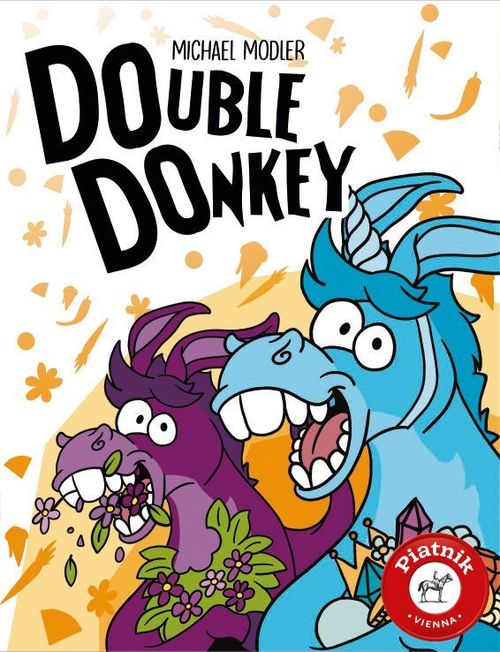
Double Donkey
Double Donkey Rulebook
Table of Contents
Table of Contents
Contents
59 cards, among which:
- 51 Double Donkeys, showing two donkeys of different colors
- 6 Angry Donkeys
- 1 Biggest Donkey
- 1 Hay card
- 6 Dice of different colors
- 1 Rulebook
Goal of the Game
The goal is to obtain the lowest possible card values, by choosing the dice wisely and taking the necessary risks in order to get rid of your own cards as quickly as possible.
Setup
- Place the Hay card and the Biggest Donkey card in the middle of the table.
- Thoroughly shuffle the remaining Double Donkey cards and Angry Donkey cards together, creating a face-down draw pile.
- Deal 10 cards to each player. Place your cards face down in front of you: this is your personal pile. Each player draws the top 3 cards from their personal pile to create their starting hand.
- The youngest player receives the 6 dice.
How to Play
The game consists of several rounds, and each round consists of 2 phases:
- Choosing dice
- Playing cards
1. Choosing dice
The player with the 6 dice rolls them, and from the result chooses 1 die, placing it on the Hay card in the middle of the table. They are not allowed to change the number of pips.
Then, the next player in clockwise order rolls the 5 remaining dice, and chooses 1 to place on the Hay card.
Keep the following in mind:
- The die you choose must have a value that's different from the other dice on the Hay card.
- Exception: if all dice show a value that's already on the Hay card, you may choose any die.
Keep going until there's only 1 die left. The last player may decide whether or not to roll the remaining die one last time before placing it on the Hay card. Then, proceed to the next phase.
Example round in a 4-player game: Olivia is the starting player. She rolls and chooses the light blue 2. Fran rolls and chooses the orange 5 (she could have also chosen the dark blue 4 or the yellow 3). Jan rolls and chooses the purple 1 (he could have also chosen the yellow 4 or the green 6). Margaret rolls and may choose any die, because she only rolled numbers that are already on the Hay card. She chooses the green 2. Olivia rolls and must choose the dark blue 3. Fran chooses not to reroll the final die and places the yellow 2 on the Hay card. This phase is now over.
2. Playing cards
When all 6 dice are on the Hay card, all players simultaneously choose 1 to 3 cards from their hand, placing them face down in front of themselves. Once all players are ready, everyone reveals their cards and checks whether any Angry Donkeys were played.
Flip the dice in the colors shown on the Angry Donkeys to their opposite face.
Next, determine which player has played the highest value card. The numbers of the dice on the Hay card determine the value of the cards.
Which values do my donkeys have?
Double Donkey: check the 2 colors of your Double Donkey, and add up the pips of the corresponding dice. Their sum determines the value of your Double Donkey. (Illustrated example: value 6.)
Angry Donkey: check the color of your Angry Donkey. Its value corresponds to the number of pips on the corresponding die. (Illustrated example: value 5.)
The player with the single highest value on one of their played cards places the Biggest Donkey card in front of them. In case of a tie, the card goes to the player with the fewest cards remaining in their personal pile. If there's still a tie, all players involved roll a die until the tie is broken: whoever rolls the higher number receives the Biggest Donkey card.
End of the Round
Place all the cards that were played on a shared discard pile. Each player refills their hand to 3 cards by drawing cards from their personal pile.
Important: if you have the Biggest Donkey card, don't draw cards from your personal pile, but from the draw pile in the middle of the table instead! Serves you right, donkey brains!
The Biggest Donkey now receives all 6 dice. Play a new round, starting in phase 1. Choosing dice.
Note: players who are unable to refill their hand to 3 cards start the next round with fewer cards.
If the draw pile in the middle of the table runs out, take all the cards from the discard pile and shuffle them into a new draw pile.
End of the Game
The game ends as soon as someone has no hand cards left and their personal pile is empty. That player wins.
If several players manage to get rid of their final cards during the same round, they share the victory.
Source note: official English rulebook published by Piatnik (2022), English translation by Jo Lefebure for The Geeky Pen. Illustrated examples in the original (dice values on the Hay card, card value examples) are described in text only.