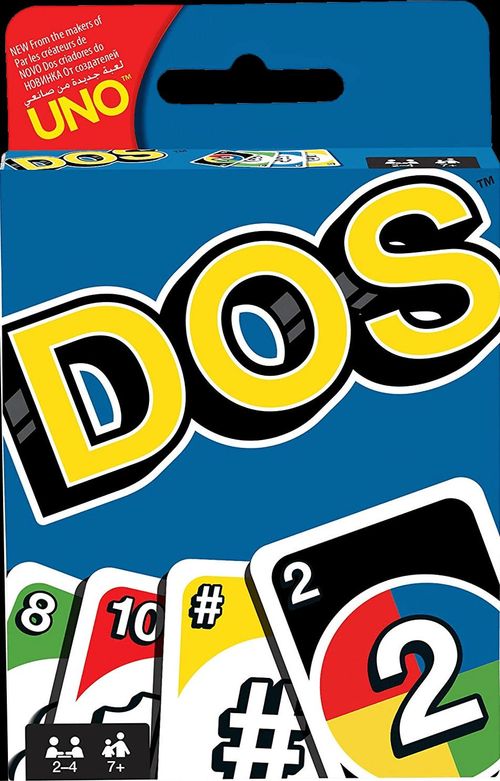
DOS
DOS Rulebook
Table of Contents
Table of Contents
Contents
The game contains 108 cards, which include:
- 24 blue cards: three each of 1, 3, 4, 5; two each of 6, 7, 8, 9, 10; and two "wild #" cards
- 24 green cards: three each of 1, 3, 4, 5; two each of 6, 7, 8, 9, 10; and two "wild #" cards
- 24 red cards: three each of 1, 3, 4, 5; two each of 6, 7, 8, 9, 10; and two "wild #" cards
- 24 yellow cards: three each of 1, 3, 4, 5; two each of 6, 7, 8, 9, 10; and two "wild #" cards
- 12 "DOS™ wild cards"
Object of the Game
Earn points by being the first to get rid of all of your cards in each round.
Setup
- Each player draws one card from the deck. The player with the highest card deals (all cards with symbols count as zero).
- The dealer deals 7 cards to each player.
- The dealer places 2 cards from the deck face up in the middle of the play area, forming the "centre row". NOTE: DURING PLAY THE CENTRE ROW MAY GROW TO MORE THAN THE FIRST TWO CARDS. MORE ON THIS LATER...
- Place the deck beside the centre row, leaving room for a discard pile.
Let's Play
The player to the left of the dealer starts the game.
On your turn you must either (1) match one or two cards from the centre row to the cards in your hand, or (2) draw a new card from the deck.
Number Match
You may play cards from your hand that match the numbers on the cards in the centre row in one of two ways:
Single match: Play one card whose number matches one of the cards in the centre row, regardless of colour.
Example: if you have a 7 in your hand and one of the cards in the centre row is a blue 7, you may play your card.
Double match: Play two cards whose face values add up to the number of one of the cards in the centre row.
Example: if there is a 7 in the centre row, you may play any TWO cards that add up to seven, such as 5+2, 3+4 or 6+1, regardless of colour.
If you can, make a single match or a double match for each card in the centre row, but only one match is possible per card.
Number and Colour Match
If the card you play is the same colour as the centre-row card you are matching against, you earn a colour-match bonus for each match.
Single colour match: If the card you play matches both the number AND the colour of a card in the centre row, you earn a bonus at the end of your turn.
BONUS: at the end of your turn you may add one of your cards to the centre row face down.
Example: if you have a red 7 in your hand and one of the cards in the centre row is a red 7, you earn the single colour-match bonus when you pair these cards.
Double colour match: If the two cards you play both match the number AND the colour of a card in the centre row, you earn a double bonus.
BONUS: at the end of your turn you (1) may add one of your cards to the centre row face down, and (2) all other players must draw one card from the deck.
Example: if the card in the centre row is a red 7 and you play TWO red cards that add up to seven, you earn the double colour-match bonus.
NOTE: IF ONLY ONE OF THE CARDS MATCHES THE COLOUR OF THE CARD IN THE CENTRE ROW, YOU DO NOT EARN A COLOUR-MATCH BONUS.
Drawing a New Card
If you cannot (or do not want to) make a match, you must draw a card. If, after drawing a new card, you can make a match, you may make your play.
If, after drawing a new card, you still cannot (or do not want to) make a match, place one of your cards face up in the centre row.
NOTE: IF THERE ARE MORE THAN TWO CARDS IN THE CENTRE ROW, YOU MAY MATCH ANY ONE OR ALL OF THEM. The number of cards in the centre row is not limited. However, there must always be at least two cards in the centre row. (In the source, the final sentence of this note is printed twice in a row; it is transcribed once here.)
Ending Your Turn
IMPORTANT: FOLLOW THIS ORDER OF ACTIONS WHEN ENDING YOUR TURN.
- Take all the cards you played, including the centre-row cards you played them against, and place them in the discard pile.
- If the centre row has fewer than two cards, top it up from the deck so that it has two cards.
- Then, if you earned colour-match bonuses this turn, place one of your cards into the centre row for each colour-match bonus you earned.
Special Cards
DOS™ wild card: A DOS™ wild card counts as two cards of any colour, which is especially useful for double matches. You decide what colour the DOS™ wild card is when you play it. If a DOS™ wild card is face up in the centre row, you decide its colour when you match against it.
Example: if there is a red 7 in the centre row and you have a red 5 and a DOS™ wild card, you may combine these cards for a double colour match. If the 5 in your hand is NOT red, you can still combine it with the DOS™ wild card for a double match.
"#" wild card: A "#" wild card counts as any number from 1 to 10 in the colour of that card. You decide which number your "#" wild card represents. If a "#" wild card is face up in the centre row, you decide which number it represents when you match against it.
Example: if there is a red 7 in the centre row, you may assign your "#" wild card the number 7 for a single match. If your "#" wild card is red, this also counts as a single colour match.
Example: if you have a blue 3 and a yellow "#" wild card, you may combine them by assigning the yellow "#" wild card the number 4 and playing it as a red 7 for a double number match. If BOTH of these cards are red, you may play a double colour match. (Transcribed as printed; the source's colour treatment of the "#" wild card in this example is not fully explicit.)
DDOS Rule
(Heading printed as "DDOS RULE" in the source; the rule itself is the "DOS!" call described below.)
If exactly two cards remain in your hand, you must shout "DOS!" (meaning "two"). If you forget to do so and another player shouts "DOS!" before you do, you must immediately draw two cards from the deck. If this happens on your turn, do not draw cards from the deck until your turn is over.
End of the Round
The round ends when one player gets rid of all of their cards. That player scores points for the cards remaining in the other players' hands.
NOTE: IF A PLAYER EARNED DOUBLE COLOUR-MATCH BONUSES IN THE TURN IN WHICH THEY WENT OUT, REMEMBER: OTHER PLAYERS MUST DRAW CARDS FROM THE DECK BEFORE SCORING.
Scoring
- All number cards (1, 3–10): scored at face value.
- DOS™ wild card: 20 points.
- "#" wild card: 40 points.
Record each player's score on a separate sheet of paper (not included).
The winner of the previous round becomes the dealer in the next round.
Winning the Game
The winner is the first player to reach 200 points.