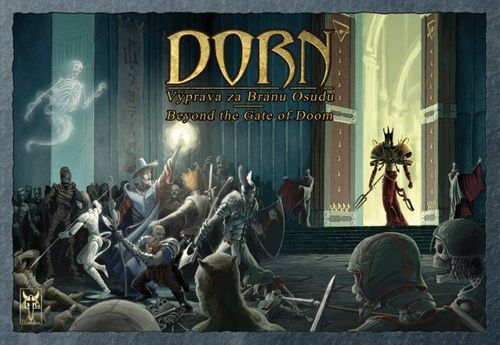
Dorn
Dorn Rulebook
Table of Contents
Table of Contents
Object of the Game
In this game, two sides stand against each other – a group of heroes and a dark necromancer, Zorkal the Dornkeeper, who summons monsters to do his bidding.
The heroes' quest is to get to the center of the dark underground labyrinth called Dorn and kill Zorkal before he manages to destroy the hamlet of Argos. In order to fight Zorkal, the heroes must first open the Gate of Doom by retrieving three of the ancient Artifacts, which are scattered across the Dorn.
The Dornkeeper's quest is to complete a dark ritual, which would destroy the hamlet of Argos by opening an abyss under it. For this he needs to fill the Ritual Chamber with monsters and keep it full for more than a day to complete the sacrifice. The Dornkeeper can also win the game by eliminating all the heroes who could ruin his plan.
Setup of the Heroes
Choosing Sides
One to five players can play for the heroes, while usually only one person plays the Dornkeeper. In your first game, the Dornkeeper should be played by the oldest or the most experienced player. In subsequent games, you can draw lots by using character sheets.
Hero Selection
First, the players must decide which five heroes they will choose for the game. One player can play for two or more heroes. For the first game we recommend choosing Kaerdrak the paladin, Choros the dwarf warrior, Almanor the mage, Ragnar the swordsman, and Eleanor the elven princess. Other heroes include Gor the cleric, Guelin the ranger, Riel the archer, and Vargen the werewolf. You will find the heroes' characteristics and special abilities on their sheets (see appendix Hero Sheet Description).
You can assemble the figures of the heroes (as well as of Zorkal) by inserting the cards with their name and picture into the small plastic stands. The color of the hero should more or less correspond to the color of the plastic stand. The figures of the five selected heroes should be placed on the game board into the hamlet of Argos (see appendix Map of the Dorn).
Hero Sheet Setup
Each hero starts the game on the first level. At the beginning of the game, place a white playing stone on the number 1 on the sheet of each selected hero. This stone marks the hero's current level and corresponding abilities.
The red playing stones (also called Blood Drops) mark the actual hit points of the hero. The number of hit points on each hero's sheet represents the starting and the maximum number of hit points the hero can have on the given level. Corresponding amount of red playing stones should be placed on the left side of the hero's sheet. The remaining Blood Drops will be placed next to the game board as a reserve.
Each player draws one Blessing card (blue cards with a drawing of a figure between stones) for each the heroes he controls, looks at the card, and puts it on the table face down. Each player knows only his own Blessing and cannot discuss it with the other players.
Game Board Setup
The hero players place 6 blue tokens of Artifacts on the blue spaces with a rune symbol on the game board (spaces with letter A in appendix Map of the Dorn).
The players then place 24 yellow tokens of Treasures on the yellow spaces with brown framing on the game board (spaces with letter P in appendix Map of the Dorn).
Setup of the Dornkeeper
The player who represents the Dornkeeper places the figure of Zorkal on Zorkal's throne in the room behind the Gate of Doom (see appendix Map of the Dorn). Then he places 4 green playing stones next to Zorkal's sheet. The stones represent the starting and maximum number of Zorkal's hit points until he levels up. The white playing stone is placed on the number 1 on Zorkal's sheet, marking his actual level.
All red tokens representing strong monsters are put into the drawing bag.
The Dornkeeper then places his starting monsters on the six black spaces on the game board (the spaces are marked with letter N in appendix Map of the Dorn). The starting monsters are 2 zombies, 1 giant rat, 1 bog beast, 1 skeleton (all brown tokens) and 1 strong monster randomly selected from the drawing bag. For monster symbols and characteristics, see the appendix Monster Lexicon. All strong monsters and bog beasts start the game with two hit points. Their tokens should therefore be face up with the image of two skulls under the monster symbol.
The Dornkeeper places the token of Day and Night behind his throne with the picture of sun face up, as the game starts during the Day. At the end of each of his turns, the Dornkeeper turns this token upside down, which also signals to the heroes that they can start their turn.
Finally, the Dornkeeper draws 6 Ritual cards (red cards with a symbol of a skull) that he keeps in secret until the moment they are used.
Gameplay
Both sides (the Dornkeeper and the heroes) take turns throughout the game. Each turn is composed of several phases. It is impossible to change the order of phases during the turn. Before the next phase of a turn starts, all heroes and all monsters must complete the previous phase. The Dornkeeper starts the game.
The Dornkeeper's Turn
- One Ritual can be played, but only if the Dornkeeper acquired enough Blood Drops (see Chapter Ritual Cards)
- Summoning of monsters, their number varies depending on Day or Night (see Chapter Summoning Monsters)
- Movement of all monsters (see Chapter Movement)
- Attack of all monsters (see Chapter Attack of Monsters)
- End of Dornkeeper's turn – the token symbolizing Day and Night is turned upside down
After the Gate of Doom is open, Zorkal moves and attacks in the same phase as monsters and rules for monsters apply to him as well.
The Heroes' Turn
- The Blessings can be played by the heroes (see Chapter Blessing Cards)
- Movement of all heroes, including collecting Treasures and Artifacts, dropping them, using items, and handing them to others (see Chapter Movement, Chapter Treasure Cards and Chapter Artifacts)
- Attack or casting of spells by all the heroes (see Chapter Attack of Heroes and Chapter Magic)
- Healing of heroes – in Healing Fountains, in the hamlet of Argos, or at the Herbalist (see Chapter Game Board)
The heroes can choose the order in which they will perform each phase of a turn (e.g. who moves first, who attacks first). If the players can't come to an agreement, the heroes perform the phase in alphabetic order of their character names.
Ritual Cards
At the beginning of his turn, the Dornkeeper may play one of his Ritual cards. To play the card, the Dornkeeper needs to pay a number of the Blood Drops specified on each Ritual card. He acquires Blood Drops each time a hero loses a hit point.
Each Ritual card can be used only once and its effect will last only until the end of turn, unless it's specified otherwise on the card. If the Dornkeeper starts a turn having cast all 6 Ritual cards, he may then use 4 Blood Drops each turn to summon 1 additional strong monster, according to the rules for summoning.
When in conflict, effects of Ritual cards are stronger than effects of spells or items (for example monsters frozen by Ice Storm can move and attack if the Sinister Shift Ritual card is cast on them).
Blessing Cards
At the beginning of the heroes' turn, each one of the heroes can play his Blessing card. If more than one hero wants to play their Blessing card during the same turn, the card that was first turned up on the table will take effect first. Each Blessing card can be used only once per game. The heroes are not allowed to give each other their Blessing cards, not even if one player controls more than one hero. Each player keeps his Blessing card in secret from the Dornkeeper and the other players.
When in conflict, effects of Blessing cards are stronger then effects of Ritual cards.
Summoning Monsters
The Dornkeeper fights the heroes mainly through the monsters that he remotely controls by necromantic magic. The Monster Lexicon containing descriptions of the monsters' symbols and abilities is a separate appendix to the game rules.
During the Day (every odd turn), the Dornkeeper can summon one weak monster. At Night (every even turn), he can summon either two weak or one strong monster.
If he summons a weak monster, the Dornkeeper can select the type of that monster. Giant rats have to be summoned to the Sewers, skeletons need to be summoned to the Crypt, zombies to the Graveyard, and bog beasts to the Black Moor (see appendix Map of the Dorn).
Strong monsters (vampire, mummy, ghost, gorgon) must always be summoned to the Dark Temple (see appendix Map of the Dorn). The Dornkeeper cannot choose which type of strong monster he will summon. Instead, he must draw the monster randomly from the drawing bag.
Bog beasts and all strong monsters always enter the game with 2 hit points. Their tokens should therefore be face up with the image of two skulls under the monster symbol.
The Dornkeeper may move and attack with the summoned monsters in the same turn they were summoned. The bog beasts from the Black Moor are an exception; they can start moving and attacking only on the Dornkeeper's next turn. The bog beasts also cannot be summoned to spaces that are adjacent to any of the heroes, but other monsters are allowed to do so.
New monsters cannot be summoned to spaces that are already occupied by monsters or heroes. The Dornkeeper chooses the exact space within the summoning location where the monster appears.
The Dornkeeper can control only eight weak monsters of each type on the game board. After that, he has to summon other types of monsters. In case he runs out of tokens for a specific monster, the Dornkeeper can exchange tokens of weak and strong monsters that the heroes keep for tracking experience points (see Chapter Advance to Higher Levels).
Movement
During their turn, all heroes and all monsters can move up to the number of spaces written on their sheets or in the Monster Lexicon. They are not allowed to move diagonally across square spaces.
Both heroes and monsters can interrupt their movement and continue with it later in the same phase of the turn. It is thus possible for one monster to move 3 spaces, let another monster pass, and then finish its move.
The monsters and the heroes are not allowed to stop on the same space or pass through each other. Passing by one hero through another is possible only on the Outside trails (with round spaces).
Some skills require the hero not to move. They can be used even if the hero is teleported or transported to another location.
Both heroes and monsters can enter spaces where monsters are summoned and spaces where Dornkeeper's starting monsters are placed. The Sewers are the three separate spaces in a row. Heroes and monsters may enter spaces with a Treasure or an Artifact. They may also enter the Healing fountains.
Monsters are not allowed to enter the Outside trails with round spaces (one such space is also in front of the Herbalist), nor can they be transported to them in any way. The heroes, the monsters, nor Zorkal can by any means pass through the Gate of Doom before it is opened.
While teleporting, the distance is counted as if the hero had to move the distance. Teleporting through monsters and other heroes is possible. Obstacles like walls in the Abandoned Mines cannot be teleported through.
Combat
Attack of Heroes
If a hero stands on a space adjacent to a monster, he can attack the monster by using the active ability that has the sword symbol next to it on his character sheet. All attacks take place after all heroes have already finished their movements. The hero can use as many attacks per turn as he has on his actual level (on the first level, all heroes usually have only one attack). Some heroes have special abilities that improve their attacks, such as the Round attack of Choros or the Piercing attack of Eleanor.
Each attack by a hero deals one hit point of damage to a monster, which means that one attack will kill all weak monsters except bog beasts. The hero keeps the token of the slain monster as a counter of experience points (see Chapter Advance to Higher Levels). Strong monsters and bog beasts are only wounded by one attack of a hero, as they have 2 hit points. In such a case, the token of the monster is turned upside down so the side with only one skull is face up. This means that the monster only has 1 hit point left. If the wounded monster is attacked again, it is killed and the hero keeps the token of the slain monster as a counter of experience points (see Chapter Advance to Higher Levels).
Attack of Monsters
If a monster stands on a space adjacent to a hero, it may attack him. Each hero can parry one attack by a monster during each Dornkeeper's turn. Additional attacks cannot be parried. For every attack that has not been parried, the hero loses one hit point. The Dornkeeper has to declare how many monsters are attacking the hero, who can then decide which attack he wants to parry.
Weak monsters only have 1 attack per turn. Several strong monsters have 2 attacks per turn.
One attacking weak monster will thus not harm the hero (he can parry this one attack). Two weak monsters attacking at the same time hit the hero for 1 hit point (he can parry the first, but not the second attack). Three weak monsters attacking at the same time hit the hero for 2 hit points. A vampire (2 attacks per turn) attacking together with a weak monster hits the hero for 2 hit points. Two vampires attacking together hit the hero for 3 hit points. (For other specific situations, see the appendix Game Examples.)
Shooting
Some of the heroes (Guelin and Riel) and monsters (gorgons) can shoot. A shooting attack is like a regular attack, but from a distance. Shooting at adjacent spaces is also possible. The distance is calculated as the path the hero would have to go if he were to reach the target space.
It is not possible to shoot over obstacles. Obstacles are all the places on the game board that are not possible to pass through. Heroes and monsters cannot shoot an opponent diagonally across from him if there is a pillar or wall in the way, unless they can legally shoot through one of the adjacent spaces. If it is not clear whether it is possible to shoot from one space to another, connect a straight line from any part of the space that the shooter stands on to the center of the target space. If this straight line does not cross any obstacles, shooting is possible. In borderline situations, shooting is still possible (see the appendix Game Examples).
A hero can shoot over other heroes, but not over monsters, which are considered as obstacles. Monsters can shoot over other monsters, but not over heroes, who are considered as obstacles.
Pike
Certain heroes (Eleanor) and monsters (skeletons) fight using pikes. The attacking distance with a pike is 2 spaces only. If 2 square spaces are connected diagonally, it is possible to attack with a pike as the distance is considered to be 2 spaces. It is not possible to attack over obstacles. All the same rules as for shooting apply to pikes. Thus, a hero can attack with a pike over another hero, but not over a monster. A monster can attack with a pike over another monster, but not over a hero (see the appendix Game Examples).
Magic
Some of the heroes (Almanor, Gor) attack by using magic. During the attack phase, they can use one of their abilities that has a star symbol next to it on their character sheets. When casting more difficult magic spells (with a symbol of Blood Drop), heroes lose 1 hit point due to exhaustion. The lost Blood Drop is handed to the Dornkeeper.
It is possible to target spaces around corners with magic spells. The distance is calculated as the path the hero would have to go if he were to reach the target space. It is not possible to cast spells over a wall or other obstacle. It is possible to cast magic over other heroes, but not over monsters (see the appendix Game Examples).
Blood Drops
If a hero loses one or more hit points for whatever reason, he must give the same number of Blood Drops to the Dornkeeper. The Dornkeeper may then use them at the beginning of his turn to play one of the Ritual cards. In such a case, the used Blood Drops are put back in the reserve. Zorkal's own hit points cannot be used to play Ritual cards. The Dornkeeper cannot use the Blood Drops to heal himself and he can have a maximum of 16 Blood Drops at one time. Additional Blood Drops are immediately put in the reserve.
Death of a Hero
If a hero loses his last Blood Drop, the game is over for him and his figure is removed from the game board. The Treasure cards that he had in his possession are destroyed and are also removed from the game. If the hero carried an Artifact, it is placed on the space where the hero fell. That Artifact can be then picked up by another hero (see Chapter Artifacts). Remember that any artifact that is not found on an A can be assumed to have been dropped by a dead hero.
Advance to Higher Levels
Each hero keeps the tokens of the monsters he has killed. A weak monster counts as one experience point, a strong one as two experience points. Wounding a strong monster or a bog beast does not yield any experience; only the hero that deals the final blow gets the experience points. If a hero kills a monster using a Blessing card or an item from the Treasure card, he still gets the experience points.
If a hero has collected tokens of monsters worth 5 experience points, at the end of his turn he gives the tokens back to the reserve (strong monsters back to the drawing bag) and advances to the second level. The white gaming stone on the hero's sheet moves to number 2 and the hero is immediately able to use his additional new abilities. If the maximum number of a hero's hit points increases when advancing to a higher level, he immediately gets the extra hit point, as if he has just healed one hit point. If he still has some experience points left, he keeps them in the form of available monster tokens. Tokens of strong monsters can be exchanged for two tokens of weak monsters.
For advancing to the third level, it is necessary to have 7 additional experience points. A hero on the third level cannot advance any higher and does not keep the tokens of the killed monsters anymore.
Zorkal can advance to higher levels in the same way as the heroes, but he uses Blood Drops as experience points. He needs 7 Blood Drops to advance to the second level and 9 additional Blood Drops to advance to the third one. He cannot use his own green hit points to advance to higher levels.
Treasure Cards
If a hero enters a space with a Treasure token, he can draw one of the Treasure cards (cards with a yellow back side and a symbol of a chest). A hero can find useful items, but sometimes a monster may appear instead. Once the Treasure card has been drawn, the token is removed from the space and no other Treasure cards can be drawn on this space. Monsters cannot draw Treasure cards nor move Treasure tokens.
If there is an item on the Treasure card, the hero keeps the card so other players and the Dornkeeper can see it. Each hero can only use 1 item per turn. All items can be used only once. Then they are removed from the game. If the heroes are standing on adjacent spaces, they can pass any number of items to each other during the movement phase.
Artifacts
The Artifacts don't provide the heroes with any special abilities, but the heroes need to collect at least three of them in order to open the Gate of Doom and face the Dornkeeper. If a hero enters a space with an Artifact token, he may pick it up and place it on his sheet. If the heroes are standing on adjacent spaces, they can pass Artifacts to each other during the movement phase. Monsters cannot pick up nor move Artifacts.
Each time an Artifact is picked up for the first time, the magical equilibrium inside the Dorn shifts. The Dornkeeper may therefore summon one extra strong monster on his following turn. All rules for summoning monsters apply.
Game Board
Gate of Doom – It is not possible in any way to pass through the closed Gate of Doom (not even by teleportation or Blessing cards). If at least three Artifacts are in the Ritual Chamber (see appendix Map of the Dorn) at the same moment, whether carried by Heroes or dropped by heroes who have left, the Gate is unlocked and will open at the start of the Dornkeeper's next turn. It is not possible to close the Gate of Doom once it has been opened. The Gate is considered as one space.
Black Moor – The Dornkeeper may summon bog beasts to any space in the Black Moor, even to spaces with a Treasure or an Artifact token (but not to the Teleport). Exact borders of the Black Moor are shown in appendix Map of the Dorn. The lake in the middle of the Black Moor, trees, and hills all count as impassable obstacles.
Healing Fountains – If a hero stands on one of the two Healing fountains at the end of his turn, he can heal up to two of his lost hit points. Monsters can attack a hero standing on a Healing fountain.
Hamlet of Argos – If there are heroes in the hamlet of Argos at the end of the heroes' turn, the local healer will heal up to two lost hit points to each one of them. The hamlet is the only space in the game that can be occupied by more than one hero at the same time. The only way to leave the hamlet is to go through the main gate; it is not possible to go directly to the Black Moor or to the Abandoned Mines.
Outside trails – Monsters cannot enter the round spaces on the Outside trail; they cannot be in any way transported there either. Heroes can attack monsters in reach from the Outside trail, but the monsters cannot in any way attack heroes standing on the Outside trail.
Teleports – There are two Teleports on the game board, one from the Black Moor to the Dorn (T1 on Map of the Dorn) and the other from the Abandoned mines to the Dorn (T2 on Map of the Dorn). Monsters and heroes can pass through the Teleports there and back. The spaces of the Teleport with the same symbol are identical, which means that the hero standing on a Teleport is present on both spaces at the same time. He can thus be attacked by monsters from both sides at once.
After passing through a Teleport, it is possible to continue moving. It is not possible to shoot, attack with a pike or cast magic through the Teleport. Effects of magic spells, Blessing cards, and items do not pass through the Teleport.
Herbalist – If a hero stands at the round space in front of the Herbalist's house at the end of his turn, the Herbalist will heal two of his lost hit points. Rules for the Outside trail apply for this space as well. It is not possible to enter the Herbalist's house.
Victory
If the game situation is hopeless, it is possible to surrender. The side that does so loses the game.
Victory for the Heroes
The only way for the heroes to win is to kill Zorkal. If he loses his last hit point (not Blood Drop from the heroes!), the Dornkeeper loses the game.
Only when the Gate of Doom is open (see Chapter Game Board) can the heroes directly fight Zorkal. He moves and attacks in the same phase as monsters and rules for monsters apply to him as well.
Victory for the Dornkeeper
The Dornkeeper wins when he successfully performs the Ultimate Ritual that opens an abyss under the hamlet of Argos. For the Ultimate Ritual to be successful, the central Ritual Chamber (see appendix Map of the Dorn) has to be completely full of monsters at the end of each of Dornkeeper's turns for three turns in a row. Composition of the monsters inside the Ritual Chamber may vary in each of these turns. If there is a hero instead of a monster on one of the spaces, the Ritual will be successful too.
If the Dornkeeper eliminates all the heroes, the Dornkeeper is victorious, as there is nobody to prevent him from performing the Ultimate Ritual.
Variants for More Advanced Players
Before the start of the game, players may agree that they will play with some of these additional rules that give the game more variability, but do not significantly favor either of the sides.
Random Group
Players draw heroes randomly at the beginning of the game.
Missing Artifact
When setting up the game, players place tokens of Artifacts randomly on the blue spaces with a rune back side up. Then they turn the Artifact tokens face up and the one with a picture of an axe is removed from the game.
The Cave-in
When setting up the game, the Dornkeeper places two Cave-in tokens on the game board. These are considered as impassable obstacles, so teleportation over them is not possible. First the Dornkeeper draws two out of six Cave-in tokens. He places them on the game board so that the number on the Cave-in token corresponds with the number of the Cave-in space on the Map of the Dorn (Z1–Z6). The Cave-in can be attacked in the same way as a monster or a hero, but Blessing cards and Ritual cards do not affect it, nor can it be moved in any way. Each Cave-in has 3 hit points, so place two more Cave-in tokens on the token that was already placed on the game board and take one away with each loss of a hit point. If the Cave-in loses its last hit point, it is removed from the game. Heroes do not gain any experience points for removing it.
Tactics and Flight
If a hero comes to a space adjacent to a monster, he has to stop moving. If a monster comes to a space adjacent to a hero, it has to stop moving. This restriction doesn't apply to heroes and monsters that have the ability of passing freely through spaces that are occupied by other heroes or monsters.
If a hero starts his turn on a space adjacent to a monster, he can either fight on or flee. While fighting, the hero can move only one space and still has to remain adjacent to the same monster. If he chooses to flee, he does not have to stop on spaces adjacent to monsters, but he cannot use items from Treasure cards, attack or cast magic spells in this turn. The same rule applies to monsters – if they are fleeing from a hero, they do not have to stop on spaces adjacent to heroes, but they cannot attack in the same turn.
Real Day and Night
Players can agree that both the heroes and the Dornkeeper have a certain time limit for their turns, approximately 2–5 minutes. After the time runs out, the other side starts playing.
Four Heroes
It is possible to play the game with only four heroes. Increase the starting number of hit points and number of hit points on higher levels by 1 for each hero. The Dornkeeper starts the game with one zombie, one giant rat and one skeleton. He places them on the starting black spaces he chooses. For playing a Ritual card and for advancing to higher levels, the Dornkeeper needs one additional Blood Drop. All other rules remain the same.