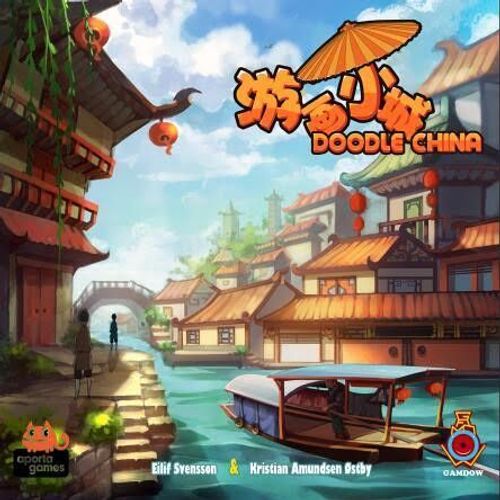
Doodle China
Doodle China Rulebook
Table of Contents
Table of Contents
Doodle China: Suzhou
1 Before you start
Use the blue die and one white die more than the number of players (e.g. 4 white dice in a 3 player game). Unused dice are returned to the box. Each player takes a SU ZHOU play sheet and uses the blue pencils. The player who last went shopping will be starting player for the first round. All players draw starting riverways in the green house squares as shown below:
- The starting player rolls the blue die. All players draw the corresponding riverway in the house square in column 1 of their sheet.
- Starting player rolls again for the house square in column 2. Again all players draw the corresponding riverway.
- Repeat for columns 3-5. Now, all players should have the same five starting riverways.
Goal of the game: The game is played over several rounds. In each round you must take a die and draw a riverway in the corresponding square on your sheet. Try to score points for your shops, hotels and boats, in order to be the player with the highest score when the game ends.
Playing the game
At the beginning of each round, the starting player rolls all the dice. The blue die can then be placed in front of the starting player as a reminder of who is starting player.
Beginning with the starting player, now go clockwise around the table. Each player in turn takes one of the white dice and draws in the indicated square on their sheet (see "Drawing"). When you have chosen a die, place it in front of you. No other player may choose this die during this round.
After each player has taken a die, all dice are collected. The player sitting to the left of the current starting player becomes starting player for the next round.
2 Drawing
All players must draw in the column given by the blue die. The white die you take indicates a row. In the intersecting square, you must draw a riverway (exception: see House squares). The riverway can be a straight line (vertical or horizontal) or a curve, connecting two sides of the square. Roads do not have to be connected to riverways in adjacent squares. You cannot choose a white die that points to a square where you have already drawn a road!
House squares: In house squares you cannot draw riverways, but must instead cross out one house. Since each house square has two available houses, you can draw up to two times in each house square. Note that each house square comes with 1-2 houses already crossed out.
Important: You must choose a die that points to a square in which you can draw. In the event that all available white dice point to squares where you have already drawn riverways or crossed out all houses, do not take a white die but instead cross out one tree at the bottom of your sheet!
Die = 6
- If the blue die shows a 6, each player may freely choose in which column they would like to draw (the row is still determined by the white die).
- If you choose a white 6; cross out one tree at the bottom of your sheet. You may then draw in any square in the column indicated by the blue die. If the blue die is also a 6, you may choose any square on your sheet!
3 Scoring
Hotel and shop squares are scored immediately when you draw in them, while boats and trees are scored at end of game (see next page).
Hotel scoring
When you draw a riverway in a hotel square, immediately calculate the length of the riverway passing through the hotel (total number of squares the riverway runs through). If this number is equal to, or above, an available hotel score, circle that score in the hotel scoring section on your sheet. You may only circle one score per hotel, and each score may only be used once. If there are no available scores, no points are awarded for this hotel.
Example: Length of riverway is 5.
Shop scoring
When you draw a riverway in a shop square, immediately count the number of crossed out houses along the entire length of this riverway. Circle this number (or an available lower number) in the shop scoring section. If there are no available scores, no points are awarded for this shop.
Note: Hotels and shops can only be scored the moment you draw in the space. No points are scored for later extending the hotel's riverway or connecting new houses to the shop.
Example: 5 houses connected to the shop, but as the 5 has already been scored, the 4 is circled instead.
4 First player bonus for Shops
The first player to score at least 3, 5, 7, or 10 shop points, also circles the corresponding first player bonus. All other players must then cross out this bonus on their sheets.
Example 1: Player A completes a shop with 8 houses, and circles the 7-bonus.
Example 2: Later, player B completes a shop with 9 houses, but as the 7-bonus has been taken, he can only circle the 5-bonus.
Game End & Final Scoring
When one of the following things happen, the game ends at the end of the round:
- A player scores the highest hotel score (15 points)
- A player scores the highest shop score (10 points + 10 bonus points)
- A player crosses out their last tree.
All players then sum up their total score (see example in Figure 1 at end of booklet):
- Value inside all circled hotel points.
- Value inside all circled shop points and bonus points.
- 4 points per boat that is connected to at least one other boat (see Figure 2).
- The player with the most crossed out trees loses 4 points, while the player with the least crossed out trees scores 4 points. In case of a tie, all tied players score or lose the full points.
The player with the highest total wins. In case of a tie, the tied player with fewest crossed out trees wins.
Variants
More control: Instead of taking a die, players may choose to pass and cross out one tree.
Solo game: Use 3 white dice. No points are scored for trees. Compare your score with the table under Achievements at the end of this booklet.
Doodle China: Shanghai
"Doodle China: Shanghai" is played with the basic rules from "Doodle China: Suzhou", but with a few changes:
Shanghai has a 6 x 6 grid instead of 5 x 5. The 6's do no longer let you choose a row or column freely. In "Doodle China: Shanghai", players will draw roads instead of riverways, so the black pencils will be used. Players draw starting roads in the green park squares as shown.
Hotel
When you draw a hotel space, the hotel is scored as normal: Count the number of road segments of the road passing through the hotel, and circle this value (or any lower available number) in the hotel scoring section on the right side of your player sheet. Important: All other players must cross out this value on their sheets. This means that each value can only be scored once by any player.
Example: Frank draws a road in a hotel square. The length of the connected road is 7. Since number 7 is already crossed out, Frank must instead circle the next lower available number, which is 6. All other players cross out value 6 on their sheets.
Sky scraper
When you draw in a sky scraper space, you must choose to EITHER build another floor in the sky scraper (cross out a box), OR draw a road in the space and score the sky scraper. Once you have drawn a road and scored the sky scraper, you cannot add more floors to this sky scraper later.
When you score a sky scraper, multiply the number of floors in this sky scraper with the number of parks that are currently connected to this sky scraper. Circle this value (or any lower available number) in the sky scraper section on the right side of your player sheet. Important: All other players must cross out this value on their sheets.
Each sky scraper comes with 2 floors, and you can add a maximum of three more floors. The third time you draw in a sky scraper space, you have to draw a road and score it.
Example: Ani draws a road in a sky scraper space and scores it. The sky scraper has 3 floors and is connected to 2 parks. Anni could score 3 x 2 = 6 points, but since both the 6 and the 5 are already taken, Anni instead circles the 4. All other players cross out the 4 on their sheets.
Parks
When you take a die that points to a park, you must cross out a tree, and then you must draw in any one space in the same row as the park.
Passing
Instead of taking a die, you may choose to cross out a tree.
Game end
The game ends after the round in which one of the following occurs:
- A player scores a hotel or sky scraper of value 18.
- A player crosses out their last (12th) tree.
Players now score their taxis, buses and trees:
Taxi & Bus scoring
Taxis are scored in the same way as boats in "Doodle China: Suzhou", except that each taxi connected to at least one other taxi is worth 3 points instead of 4. Buses are scored in the same way as taxis, and each bus connected to at least one other bus is worth 5 points.
Tree scoring
The player(s) with most remaining trees score +7 points, while the player(s) with the least remaining trees loses 7 points. In case of a tie, all tied players score (or lose) the full points.
The player with the most points wins!
Achievements (Solo Game)
Compare your solo score with the rank table below. Each achievement is also listed with its condition.
Rank:
| Score | Rank |
|---|---|
| <30p | Try again! |
| 30-49p | Tenant |
| 50-69p | Landlord |
| 70-89p | Entrepreneur |
| 90-104p | Mayor |
| 105-119p | President |
| >=120p | World Power |
Achievements:
- Environmentalist (all trees intact at game end)
- City Planner (one riverway through all squares)
- Hotel Magnate (42 hotel points)
- Capitalist (74 shop points)
- Shopping Spree (score a shop with 16 houses)
Figure 1 (end-of-booklet example of final scoring) and Figure 2 (example of boats connected for scoring) are diagrams and are not transcribed. Figure 2 shows five connected boats scored as 5 x 4 points = 20.