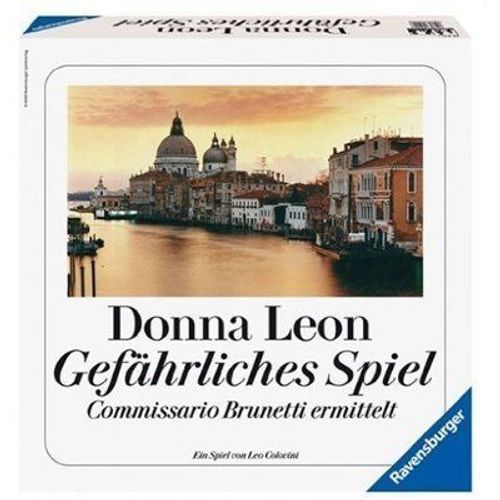
Donna Leon: Gefährliches Spiel
Donna Leon: Gefährliches Spiel Rulebook
Table of Contents
Table of Contents
Contents
The locations of the case:
- 1 game board of Venice
- 1 "Piazza" player board
- 1 "Wache" (Police Station) player board
The people involved:
- 4 figures: the police officers Commissario Brunetti (green), Vice-Questore Patta (yellow) and Ispettore Vianello (blue), and Brunetti's wife Paola (white)
- 36 character cards of supposedly law-abiding citizens
- 36 character chips of the same people
The investigation material:
- 4 dice in the colours of the figures (with pips 1–3)
- 54 investigation cards
- 4 screens
- 8 point chips
- 8 crime-scene chips
Dear players! Before you read these instructions, first set up the game as shown on the enclosed overview sheet.
Game Idea and Goal
In Venice a murder has been committed! The players slip into the roles of Commissario Brunetti & Co. to solve the crime. To do so, they search all over Venice for informants and question them. The informants show them the way to the suspects. For successful questioning of informants and for arresting suspects, the players earn investigation points.
If the murderer is caught, the game ends. Whoever has the most investigation points now wins Donna Leon's "Gefährliches Spiel".
Game Sequence
The player who was most recently in Venice begins. Play then proceeds clockwise.
On their turn, the active player carries out the following 3 actions one after another:
- Roll dice and choose a figure
- Draw investigation cards
- Investigate:
- Move the figure
- Questioning and interrogations
- Play investigation cards
Then the next player takes their turn and carries out the same actions, and so on.
1. Roll Dice and Choose a Figure
Preliminary: In this game the players have no figure of their own. When it is their turn, the player chooses with which of the 4 figures they want to make their turn.
This is how it works:
- First, the player rolls all 4 dice at the same time.
- Then the player chooses one die, and with it one figure. The colour of this die determines which figure the player moves in this turn. The remaining dice are no longer needed in the turn.
Example: Player A rolls all 4 dice. He chooses the green die and with it the green figure (Commissario Brunetti). This means that in his turn he moves only the green figure.
When Player B's turn comes later, B also rolls all 4 dice and then chooses any of the 4 figures for the turn — B could also take Brunetti. Player A, in his next turn, also chooses from all 4 figures after rolling, so he is not fixed on Brunetti.
2. Draw Investigation Cards
The player may then draw investigation cards. How many cards the player receives depends on the pip value of the chosen die:
| Pip value of chosen die | Number of investigation cards |
|---|---|
| 1 | 2 |
| 2 | 1 |
| 3 | 0 |
The player takes the investigation cards from the draw pile directly into hand. They may use them immediately. Their use is explained under "Play investigation cards" (page 7). A player may hold any number of investigation cards in hand.
3. Investigate
Third, the player moves the chosen figure from place to place (see "Move the figure", page 3), carries out questionings/interrogations there (page 4), possibly moves the figure again, and so on. Meanwhile, the player may play suitable investigation cards at any time (page 7).
Move the Figure
Figures generally move in any direction along the network of routes from place to place.
The pip value of the chosen die shows how many movement points this figure has, i.e. how many moves the player can make with this figure. One movement point is always used when the figure stops on a place. Sometimes the figure must stop, and sometimes it may stop voluntarily:
When must the figure stop?
- If, along the route network, the figure reaches a place with a chip, it must stop there. This costs 1 movement point.
- If it is a character chip, the figure meets that person there and questions/interrogates them. How this works is explained later.
- If it is a crime-scene chip, the figure calmly inspects a crime scene — otherwise nothing happens.
When may the figure stop?
- On places without chips the player may stop. This costs 1 movement point.
- Stopping makes sense in order to then use the vaporetto or police boat (see investigation cards, page 8).
- On places without chips the player may also pass through for free (skip the place).
In both cases the player may then continue moving the figure, if it still has movement points left or if the player plays suitable investigation cards.
If the player has used all movement points and does not want to play any more investigation cards, their turn ends. Only in exceptional cases does the turn end earlier. These are marked in the rulebook with a red STOP sign.
Example: The player moves Commissario Brunetti in this turn. The green die shows 3 movement points. Brunetti starts on the place Santa Maria Formosa.
- 1st movement point: The player moves Brunetti to Ca' Farsetti. There he must stop because of the character chip. He then questions/interrogates the person (see page 4).
- 2nd movement point: Afterwards he moves Brunetti to La Fenice. On the way he skips one place. This is allowed and costs no movement point, because no chip lies there. At La Fenice he must stop because of the character chip. He then questions/interrogates the person (see page 4).
- 3rd movement point: Afterwards he moves Brunetti to Harry's Bar. He could skip this place for free, because no chip lies there. He may, however, stop there, which costs his third movement point. Afterwards he could, for example, take the vaporetto from there (see investigation cards, page 8).
Questioning and Interrogations
Important: After every move onto a place with a character chip, the figure questions the person it meets there. This means the player secretly looks at the character chip. Then the player checks whether that person's character card is lying face up.
There are 4 possibilities. The character card of the person:
- a) lies face up on the Piazza board: the person is an informant.
- b) lies face up on the Wache (police station) board: the person is a suspect (Verdächtiger).
- c) lies face up on the missing-persons notice (Vermisstenanzeige): the person is the victim (Opfer).
- d) lies face up nowhere: the person is not wanted.
Example: The people shown here are wanted as informants (Piazza) and suspects (Wache).
a) Informant
The person is an informant when their character card lies face up on the Piazza. The informant can help to identify suspects! Whether the questioning succeeds depends on the colour of the character chip and of the figure.
Same colours: success. If the colours of the informant and the figure match, the questioning is successful: The player therefore shows the character chip, takes it from the game board, and takes the character card from the Piazza. The player places them together behind their screen (each informant counts 3 investigation points at the end of the game). Then the player continues the turn, if applicable.
Note (yellow box): The people of one colour have something in common with the policeman of the same colour: they are known to him, come from the same class, the same neighbourhood or something similar. That is why this policeman is particularly good at getting information out of them ...
Different colours: failure. If the colours of the informant and the figure do not match, the questioning was not successful: The player places the character chip face down back on its place (and remembers it well — perhaps it will turn up later in the investigations). Then the player continues the turn, if applicable.
Exception: The investigation card "Vorladung!" (Summons) allows the colour of the character chip to be ignored (see page 8).
Special cases:
- Paola (white) has a neutral colour. She therefore questions informants of all colours successfully: the player receives the character chip and card and places both behind their screen.
- STOP — Paola's turn ends automatically after a successful questioning of an informant. (She therefore cannot play any more investigation cards either.) Only exception: the investigation card "Unermüdlich" (Tireless), see page 8.
- Example: The museum director is an informant (see below). The colours of figure and chip are the same. The player therefore receives the character chip and card.
- Example: The ecologist is an informant, but the colours of figure and chip are not the same. The chip therefore goes back face down to its place.
- Example: The bank director is an informant. For Paola the colour of the informant has no significance. The questioning is therefore successful. The player receives the character chip and card. Her turn ends immediately.
Piazza and Wache
As soon as one of the two informant rows on the Piazza is empty, there are enough clues about a suspect. In this case the player immediately does the following:
- Reveal a suspect: The player draws a character card from the face-down stack. They show the new suspect and lay the card face up on the Wache: it is placed face up on the first empty interrogation room at the level of the empty informant row. The point chip of that interrogation room is placed on the character card.
- Reveal new informants: Afterwards the player immediately refills the empty informant row on the Piazza completely with new character cards from the draw stack, laying a character card face up on each space.
Special case: If no further suspect can be laid out because all interrogation rooms of the corresponding row are already occupied (whether or not the suspects have already been arrested!), the newly drawn character card is placed on the cell (Zelle). This is the murderer! From this moment on, all investigations concentrate on the murderer. This means that from now on no informants and no suspects are laid out any more. The remaining character cards that still lie on the Piazza and Wache can, however, still be obtained by the players through successful questionings and interrogations.
Afterwards the player continues the turn, if applicable.
Example:
- The museum director was successfully questioned as the last informant of the row. The player interrupts the turn briefly ...
- ... and draws a character card from the stack, which they lay as a new suspect on the Wache. It belongs in the suspect row that corresponds to the empty informant row. The player places the card on the first free interrogation room. On the card the player places the point chip of the interrogation room.
- Afterwards the player lays new informants on all spaces of the empty informant row from the character card stack. Then the player continues the turn.
b) Suspect (Verdächtiger)
The person is a suspect when their character card lies face up on the Wache.
Important: Only the three policemen can arrest suspects by virtue of their office. Paola (white) is not a policewoman and can therefore never arrest suspects. If she meets a suspect, the player places the character chip face down back on its place. The player then continues the turn, if applicable.
Whether the interrogation provides enough grounds for an arrest depends on the colour of the policeman's figure.
Same colours: success. If the colours of the suspect and the policeman match, the interrogation is successful: there are enough suspicious moments and the suspect is arrested. As a sign of the arrest, the player places the character chip in the corresponding interrogation room of the Wache. From there the player receives, as a reward, the character card and the associated point chip, which they place together behind their screen. On the game board the player places a crime-scene chip (Tatortchip) on the place of the arrest.
STOP — Attention: After a suspect is arrested, the player's turn ends automatically. The player therefore cannot play any investigation cards either.
Different colours: failure. If the colours of the suspect and the policeman do not match, the player places the character chip face down back on the place. Then the player continues the turn, if applicable.
Exception: The investigation card "Vorladung!" (Summons) allows the colour of the character chip to be ignored (see page 8).
Example: The head of the municipal office is wanted as a suspect (see below). The colours of figure and chip match. The player therefore receives the character chip and card, and the point chip of the interrogation room.
Example: The singer is wanted as a suspect (see below). The colours of figure and chip do not match. The chip therefore goes back face down to its place.
Special point: The murderer is questioned and arrested according to the same rules as the suspects.
c) Victim (Opfer)
The person is the victim when their character card lies face up on the missing-persons notice (Vermisstenanzeige). The victim can be found with all figures.
- The player receives the character card of the victim and places their character chip on the missing-persons notice as a reminder of the crime. The player places the card behind their screen.
- On the game board the player places a crime-scene chip (Tatortchip) on the place of the crime.
- As a reward, the player takes 3 investigation cards from the draw pile into hand. The player may already play them in the same turn.
The player may then continue the turn, if applicable.
Example: The nun is wanted neither as an informant nor as a suspect (see below). The chip goes back face down to its place.
d) Not Wanted
The person is not wanted when their character card lies face up nowhere.
The player places the character chip face down back on the place. At the same time the player tries to remember the place and the person, because perhaps the person will turn up later in the course of the investigations.
The player then continues the turn, if applicable.
Playing Investigation Cards
Investigation cards make the investigation easier. They show the figure they belong to and allow special actions. They are explained individually on page 8. In general:
- A player may only play investigation cards of the figure that they move in this turn. If a player moves Brunetti in this turn, they may only play cards that also show Brunetti.
- Joker: If a card shows all 4 figures, it may be played in any case.
- During the investigation action, the player may play any number of suitable investigation cards at any point in time.
- Some investigation cards allow movements. Movements made through investigation cards cost no movement points.
- Played cards form an open, shared discard pile next to the game board. As soon as the draw pile is used up, the discard pile is shuffled and laid down again as a new face-down draw pile.
End of the Game
If the murderer is arrested, the game ends immediately. Each player now totals their investigation points:
- For each character chip (= informants) behind their screen, the player receives 3 points.
- For each point chip (= suspects/murderer), the player receives the points shown on it.
Whoever has collected the most investigation points wins the game. If there is a tie, the tied players who found the victim win. If none of them has found the victim, the winner among them is the one who has the most character cards in total. If there is still a tie, there are several winners.
Tips, Tricks and Special Cases
Choosing the figure Tip: To find out whether a particular figure is especially suited to the turn, the following questions help:
- Are many character cards lying in the colour of the figure?
- Can I reach promising character chips from the starting place of the figure?
- Is the dice roll interesting (many / few movement points)?
- Do I have suitable investigation cards for the figure in hand?
Movement rules in detail
- Several figures may stand on the same place.
- The player may not let movement points lapse.
- On-site investigation: If a chip lies on the starting place of a turn's movement, that person can be questioned/interrogated. This costs 1 movement point.
- The figure may move back to a place that it has already visited during the turn, e.g. because a person just visited and not identified is now wanted. This also costs, of course, 1 movement point.
Questionings and interrogations Tip: After a success, the player is not obliged to "arrest" an informant or suspect. In rare cases it makes sense to put them back face down anyway.
Tactics Whoever often chooses a figure with many movement points has good chances of "lucky hits" and quickly learns where many people are to be found. For that, however, their memory is especially required. Whoever, on the other hand, plays more investigation cards (= figures with fewer movement points) can act very purposefully. For this, however, they know the whereabouts of fewer people.
Note: For reasons of playability, not all 38 locations shown are depicted exactly at the place where they lie within Venice.
Appendix: Investigation Cards
In general:
- Only investigation cards of the figure that the player moves in this turn may be played.
- Joker: If a card shows all 4 figures, the player may play the card in any case.
- Movements made through investigation cards cost no movement points.
Abgetaucht / Submerged (Patta only) Swap 2 character chips of the same colour with each other, without looking at them. This also applies if you exchange the chip on the place where Patta stands (unless you spend a movement point for it, see "Investigation on site", page 7). Other figures are irrelevant for this action.
Elettra (Brunetti only) Secretly look at a character chip of any colour on any place and then put it back again. Only if Brunetti is on the same place as the person can he question/interrogate them.
Polizeiboot / Police Boat If the selected figure stands on a place with the police symbol, you may move it from there for free to any other place with a police symbol. If a character chip lies on the target place, you may look at it and, if applicable, successfully question/interrogate the person.
Vaporetto This card works exactly like the "Polizeiboot" card, but both the starting place and the target place must show a Vaporetto symbol.
Tauschhandel / Exchange (Vianello only) Place this card and any number of further investigation cards from your hand on the discard pile. Then draw from the draw pile as many investigation cards as you placed. You may use the newly drawn cards immediately, following the rules.
Treffen / Meeting You may move the selected figure for free to any other figure. If a character chip lies on the target place, you may look at it and, if applicable, successfully question/interrogate the person.
Unermüdlich / Tireless (Paola only) You may only play this card after Paola has successfully questioned an informant. With the card she may continue her turn. You can thus still use remaining movement points and play further investigation cards. The card gives no additional movement points. It applies to exactly one successful questioning.
Vorladung / Summons A questioning/interrogation is also successful if the character chip and the policeman do not have the same colour. You can therefore ignore the colour of the character chip. Example: Brunetti (green) meets Dirigent Wellauer (yellow) at a place. Wellauer is wanted as an informant. Since figure and chip have different colours, the questioning would not actually succeed. If the player plays the Brunetti card "Vorladung", the questioning is nonetheless successful.