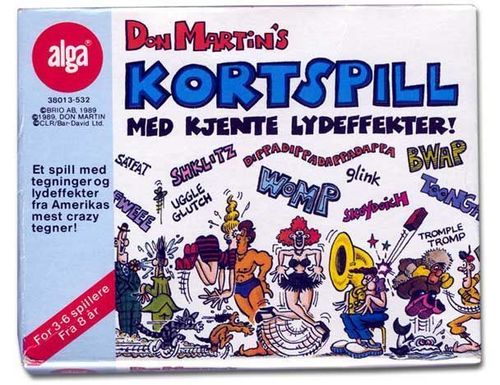
Don Martin's Kartenspiel
Don Martin's Kartenspiel Rulebook
Table of Contents
Table of Contents
Contents
84 cards, made up of 64 sound-effect cards (in colour), 18 special sound-effect cards (in black and white) and 2 advertising cards (the same on front and back).
For 3 to 6 players, ages 8 to 99.
Setup
- The player who, according to the others, most resembles a Don Martin caricature becomes the dealer.
- The dealer breaks the plastic wrap around the cards, removes the 2 advertising cards, and shuffles the remaining 82 cards thoroughly. Then the cards are dealt: with three players each player gets 15 cards; with four players each gets 13 cards; with five or six players each gets 10 cards.
- The remaining cards are placed in a pile on the table, back side up. This pile is the draw pile (talongen).
- The player to the left of the dealer makes the first lead. The turn order is clockwise to begin with. The very first card played must not be a black-and-white card (that is, one of the special sound effects).
Playing the Game
First note that for each sound effect (other than the black-and-white ones) there are 8 cards: two blue, two green, two purple and two orange. (You will find the colours on the sound effects themselves.) These are the four colours in the game.
After the first lead has been made, the next player has four options: he can take the trick (ta sticket), he can ignore the trick (strunta i sticket), or he can add to the trick (fylla på sticket). His fourth option is to play a black-and-white card; more about this below.
To take the trick, the player plays a sound-effect card of the same colour as the card on the table (that is, blue, green, purple or orange), and then takes both cards into his hand. Note that he may use whichever picture with a sound effect he likes, as long as the colour of the sound effect matches.
To ignore the trick, the player simply draws the top card of the draw pile into his hand, but after that he may not do anything more. It is then the next player's turn.
To add to the trick, the player plays out a sound-effect card of a different colour from the card on the table, and then it is the next player's turn.
If the second player chose to add to the trick, the third player faces the same options, but with the difference that he can now take the trick by playing a card of the same colour as one of the two earlier cards on the table. If he too chooses to add to the trick, he must play out a sound-effect card in a new colour, that is, one that is not the same as any of the cards already played.
If the second, third and fourth players have all added to the trick, the fifth player must take the trick if he plays a sound-effect card, since it must necessarily have the same colour as one of the first four cards.
Example of play: A opens with an orange card. B adds to the trick with a green card. C ignores the trick and draws the top card of the draw pile. D takes the trick with a green card. (D could have taken the trick with either a green or an orange card, since both colours are on the table.)
Another example: (Three players.) A opens with a blue card. B draws from the draw pile. C also draws from the draw pile. A adds to the trick with a purple card. B draws again from the draw pile. C adds to the trick with a green card. A adds to the trick with an orange card, and now B can either once more ignore the trick and draw from the draw pile, or take the trick with whichever colour he likes, since all four colours are on the table.
The important principle is that you take a trick (that is, the cards that are on the table at that moment) by playing a card of the same colour as some card on the table. But you add to a trick by playing a card in some other colour than the cards on the table.
As soon as a player has taken a trick (and laid down any groups on the table), that same player opens the next trick by playing out a new card, whichever it may be. Once he has done so, it is the next player's turn.
When the draw pile runs out, play continues with the cards the players have left in hand.
Laying Down Groups
When a player takes a trick, and only then, he may lay down one or more groups.
A group consists of at least three sound-effect cards with the same picture on them (the colours do not matter now). The group is placed on the table in front of the player, fully visible with the face up. A player may lay down as many groups as he wants, but only when he has taken a trick. Once a group is on the table, it may not be added to with more cards, even if one should later get more cards with the same picture during the game.
As soon as a player has laid down one or more groups and played out a new card, it is the next player's turn.
Of course a player may lay down groups on several different occasions during the game, whenever he has taken a trick.
The Special Sound Effects
There are four of these (black-and-white cards). A black-and-white card may be played whenever you like, except as the very first play of the game. You may not collect black-and-white cards into groups. As soon as a black-and-white card has been played, it is used up and leaves the game (it is thrown away; do not pick it up from the table again).
Note on the printed card count: the rulebook's contents line says 18 black-and-white cards, while the special-effects section describes four black-and-white sound effects and does not say how many copies of each there are. This is transcribed as printed.
ARRARGH! When this card is played, the next player in turn must pick up the cards on the table, but he may not then lay down any groups or play out any card. The next player after him must then play out a card as usual. If there are no cards on the table at that moment, the card means that the next player is skipped in the turn order (he loses his turn).
SPLABBADAP! When this card is played, all the other players must immediately each play out a sound-effect card onto the table, regardless of the cards that are already there. The player who played Splabbadap! then picks up all the cards on the table, lays down one or more groups if he wants to, and then plays out again.
The other players must play out ordinary sound-effect cards, not black-and-white cards. If someone has only black-and-white cards left in hand (the hand must then be shown), or if someone has only one card left in hand, that player must not play out a card.
GA-PWEEN! When this card is played, the player either draws two cards from the draw pile himself, or points at any other player, who must draw two cards. No groups may be laid down and no card is played out. The turn passes to the next person in turn order (after the one who drew the two cards).
INKLE DINKLE GLINK GLONK! When this card is played, the turn order is reversed immediately: from clockwise to anticlockwise, or vice versa.
End of the Game
The game ends at the same moment as one of the players gets rid of all his cards in hand. This can happen in one of three ways.
- When the player took a trick, he may lay down all of his cards in hand in groups.
- When the player took a trick, he may lay down all of his cards in hand except one in groups, and then play out that last card (the last card played must be a sound-effect card in colour; it may not be a black-and-white card).
- The player may simply play out his last card so that it adds to a trick. (Here too, this last card may not be a black-and-white card.)
Scoring
As soon as a player has got rid of all his cards in hand, the game ends at once. No one else may lay down any cards in groups, but all players must show which cards they have left in hand. Points are given to everyone as follows:
For groups on the table: a group of three matching cards gives 10 points, four matching cards give 20 points, five cards 40 points, six cards 80 points, seven cards 160 points, and eight cards 320 points.
Note how the cards must be gathered into groups. If you have laid down a group of 3 cards, and later another group of 3 cards with the same picture as in the first group, you get only 10 + 10 = 20 points for these six cards. Had you been patient and waited until all six cards were in one group, you would have got 80 points.
For cards left in hand: an ordinary sound-effect card gives minus 5 points per card, and a black-and-white card gives minus 10 points per card. Note that it is entirely possible for a player to end a game with minus points on the score sheet.
Bonus: the player who goes out first gets a bonus of 1 point for each card that all the other players still have in hand. If a player can also go out by laying down groups only once during the whole game, he gets an extra bonus of 100 points.
Who Wins?
The player who has the most points has won. If you want, you can play several rounds and keep a score sheet, competing to be the first to reach 500 or 1000 points.
Alternative Extra Rule
If you really want to play in Don Martin's spirit, we recommend that you say the sound effects aloud when you play out the cards! If not, the people nearby will wonder what is going on...
Have lots of fun!