Domitrio
Domitrio Rulebook
Table of Contents
Table of Contents
Components
36 tiles, a die, a bag, rules.
Object of the Game
Lay out all of your tiles.
Tiles
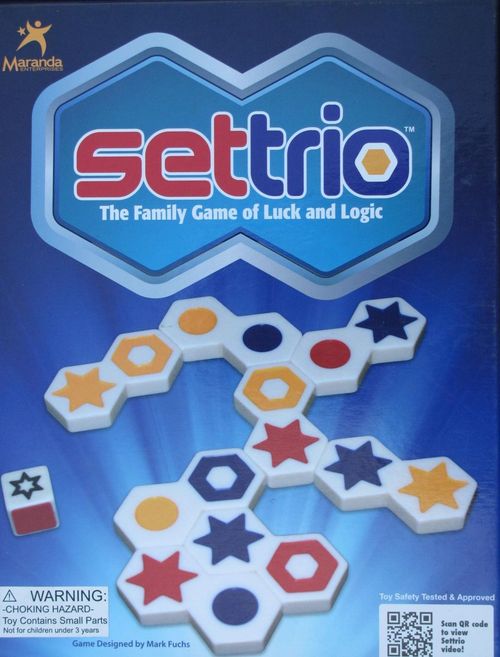
Look carefully at the set of tiles. They are all different, and each one shows two symbols. Symbols come in three kinds: hexagon, circle or star. Symbols are coloured in one of three colours: red, blue or yellow.
Setup
- Create a pool of tiles: place them face down on the table and mix them thoroughly. Then you may leave them on the table or put them in the bag.
- Each player must take five tiles from the pool and stand them on edge with the face towards themselves, so that opponents cannot see what is shown on them.
- Place one tile from the pool on the table face up — the game will begin from it.
Sets
You need to lay out tiles so that they touch along their edges and form sets of three symbols in a row. There are 3 kinds of sets:
- different colours, different symbols
- different colours, same symbols
- same colours, different symbols
Figure 1 — 3 kinds of sets: (yellow star, red hexagon, blue circle) Colours: all different, Shapes: all different; (yellow star, red star, blue star) Colours: all different, Shapes: all the same; (yellow star, yellow hexagon, yellow circle) Colours: all the same, Shapes: all different.
Note That...
- if you have a row of three symbols, only two of which are the same in colour or shape, this does not count as a set;
- if you have more than three symbols or fewer than three symbols in a row, this also does not count as a set.
How to Play
Choose the first player. When your turn comes, roll the die.
- The result rolled indicates the colour or shape of the symbol on the playing area next to which you must lay your tile so that a set of three symbols is formed.
- The set formed does not have to include the symbol next to which you laid the tile after rolling the die. For example, if a "star" was rolled, you must lay the tile so that it touches a "star", but that "star" need not take part in the set (see Figure 2).
- You cannot lay a tile if it does not form a set.
- You may not lay a tile where it would form a combination not allowed by the rules for sets (see Figure 3).
- If you cannot lay a tile, take one tile from the pool and end your turn. The turn passes to the next player clockwise.
Figure 2: Tiles already laid; the tile laid on the current turn.
Figure 3: A player decides to lay a tile to complete a yellow set diagonally. However, the tile laid would also touch the symbol of a red circle. Both yellow symbols do not form a set with the red "circle", so this move is impossible. ("YES!" — This is a correct combination. It makes a yellow set and a start for further sets. "NO!" — the placement touching the red circle.)
Victory
If you lay out all of your tiles before the others, you become the winner!