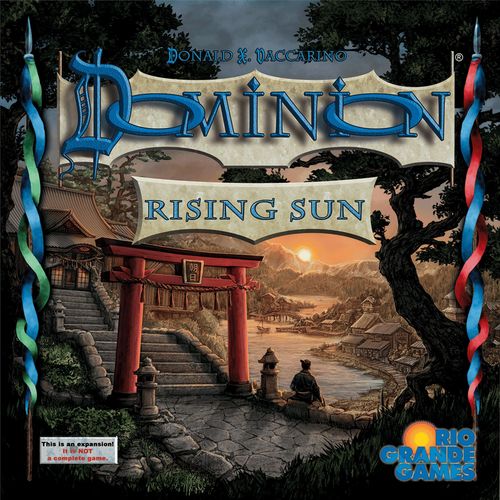
Dominion: Rising Sun
Dominion: Rising Sun Rulebook
Table of Contents
Table of Contents
Contents
300 cards
- 250 Kingdom cards: 10 each of Alley, Aristocrat, Artist, Change, Craftsman, Daimyo, Fishmonger, Gold Mine, Imperial Envoy, Kitsune, Litter, Mountain Shrine, Ninja, Poet, Rice, Rice Broker, River Shrine, Riverboat, Ronin, Root Cellar, Rustic Village, Samurai, Snake Witch, Tanuki, Tea House
- 25 Randomizer cards
- 10 Event cards: Amass, Asceticism, Continue, Credit, Foresight, Gather, Kintsugi, Practice, Receive Tribute, Sea Trade
- 15 Prophecy cards: Approaching Army, Biding Time, Bureaucracy, Divine Wind, Enlightenment, Flourishing Trade, Good Harvest, Great Leader, Growth, Harsh Winter, Kind Emperor, Panic, Progress, Rapid Expansion, Sickness
- 13 Sun tokens
- 40 Debt tokens
- 1 Plastic organizer tray
- 1 Organizing Inlay
- 1 Rule Booklet
Preparation
Dominion: Rising Sun includes 25 randomizer cards (one for each Kingdom card pile). Players will need the Treasure cards, Victory cards, Curse cards, and Trash mat/card from either Dominion or Base Cards (or older editions of Intrigue) and the rules from Dominion to play with this expansion. As with previous Dominion games, players must choose 10 sets of Kingdom cards for each game. If players choose the random approach for choosing sets, they should shuffle the randomizer cards from this expansion with those of any other Dominion games they choose to play with.
Events can be shuffled into the randomizer deck (despite having a different back). They are not part of the 10 Kingdom cards used in a game; when an Event is turned over, put it on the table but keep turning over cards until you get 10 Kingdom cards. For normal play we recommend using at most 2 such cards; with other expansions that includes Events, Traits, Landmarks, Projects, and Ways. Skip any further landscape-oriented cards turned over. Also skip Events when using a randomizer card to determine whether or not to use Platinum/Colony (from Prosperity), or Shelters (from Dark Ages) in a game, or to determine the bane for Young Witch (from Cornucopia). Another approach some people may prefer is to shuffle Events (and Landmarks, Projects, Traits, and Ways) separately into their own deck, and always play with one or two of them.
In games using an Omen, shuffle the Prophecies, and deal out one to be used this game. Put a number of Sun tokens on it based on the player count; see the Omens and Prophecies section. If the Prophecy is Approaching Army, add an Attack card pile to the game (even if there already is one).
In games using Riverboat, choose a non-Duration Action card costing exactly 5 coins that is not being used, and set a copy of it aside.
Debt Tokens
Rising Sun has Debt, which first appeared in Empires. There are Debt tokens to track the Debt, and a Debt symbol, which indicates amounts of Debt.
- Having Debt tokens prevents a player from buying cards or Events or Projects (from Renaissance); Debt tokens do nothing else (for example they have no effect at the end of the game).
- Buying a card or Event with Debt in its cost gives the player that many Debt tokens.
- An ability with +Debt causes you to take that many Debt tokens. For example +2 Debt means you take 2 Debt tokens.
- A player can remove Debt tokens at any point in their turn by paying 1 coin per Debt token to remove it. This does not use up a Buy or an Action, and can be done multiple times in a turn. This does not let players play Treasures at any time.
- Debt amounts are not coin amounts. Math involving coin amounts does not affect Debt amounts.
- Some cards look for a cost in a range. "Up to 4 coins" means "0 coins, 1 coin, 2 coins, 3 coins, or 4 coins"; it does not include costs with Debt in them.
- Some cards compare costs. A card costing 8 Debt costs more than one costing 6 Debt, just like one costing 8 coins costs more than one costing 6 coins. However Debt and coins are not comparable. With a card costing 4 coins and a card costing 6 Debt, neither costs more than the other. 6 Debt does however cost more than 0 coins; there is an implicit 0 coins in all pure Debt costs, so 6 Debt costs the same amount of coins as 0 coins, and more Debt.
- Players cannot take Debt for no reason.
- Players cannot overpay with Debt (for Guilds cards).
- Debt is not counter-limited; players should use a replacement if they run out.
Examples:
- Kate has 4 coins and buys Daimyo, which costs 6 Debt. She takes 6 Debt, then immediately pays off 4 Debt with her 4 coins. She still has 2 Debt. On her next turn, in her Buy phase, she has 5 coins. She pays off the remaining 2 Debt and has 3 coins left, with which she buys a Silver.
- Craftsman can't gain a Mountain Shrine, because 5 Debt is not "up to 5 coins." Poet cannot draw a Mountain Shrine, because 5 Debt is not "up to 3 coins." Change can't gain a Mountain Shrine, no matter what you trash, because Mountain Shrine doesn't cost any coins.
- Flourishing Trade lowers coin costs, but has no effect on the cost of Daimyo.
- Tanuki trashing an Artist can gain a Daimyo, because Daimyo does cost "up to 2 coins and 8 Debt."
Omens and Prophecies
Rising Sun has Omens and Prophecies. Prophecies are rules that will eventually apply to the game; Omens provide a way to tick down time until the Prophecy.
- In every game with one or more Omen cards, deal out one Prophecy for it. Only use one Prophecy no matter how many Omens you have.
- Put 5 Sun tokens on the Prophecy for 2 players, 8 for 3 players, 10 for 4 players, 12 for 5 players, and 13 for 6 players.
- "+1 Sun" means, remove a token from the Prophecy. Then if it was the last token, the rules text on the Prophecy becomes active, right then and for the rest of the game.
- "+1 Sun" always appears first on Omens, before anything else the card does.
- "+1 Sun" does nothing else once all the tokens are removed.
- Prophecy text does nothing until the last Sun token is removed.
Shadows
Rising Sun has five Shadow cards. These cards all have unique backs, and can be played from your deck.
- When shuffling Shadow cards, put them on the bottom. If you have multiple Shadow cards, they can go in any order at the bottom. They can also be mixed with any other cards you specifically put on the bottom, such as Fated cards from Plunder.
- You may wish to turn your Shadow cards sideways at the bottom of your deck, so that it is easy to remember that they are there.
- Shadow cards will not necessarily stay on the bottom of your deck; they are just put there when shuffling them.
- Shadow cards are not put on the bottom when gained, or at any time other than when shuffling them.
- You can look through your deck at the card backs at any time, and see where your Shadow cards are.
- Whenever you can normally play an Action card, you can play a Shadow card from your deck. It can be anywhere in your deck. You play it exactly as if playing it from your hand; it goes into play and you follow its instructions.
- When a card like Throne Room tells you to play a card from your hand, you can use that opportunity to play a Shadow card from your deck.
- You can play Shadow cards from your deck as if in your hand, but this does not mean the Shadow card is in your hand; for example you cannot discard it to an ability like Alley's (unless it is actually in your hand).
Events
Rising Sun has Events, which first appeared in Adventures. In your Buy phase, when you can buy a card, you can buy an Event instead. You pay the cost indicated on the Event and then do its effect.
- Events are not Kingdom cards; they sit on the table and provide an effect you can buy. There is no way for you to gain one or end up with one in your deck.
- Buying an Event uses up a Buy; normally you can either buy a card, or buy an Event. If you have two Buys, such as after playing Fishmonger, you can buy two cards, or buy two Events, or buy a card and an Event (in either order).
- The same Event can be bought multiple times in a turn if you have the Buys and coins available to do it.
- You cannot play further Treasures that turn after buying an Event.
- Buying an Event is not buying a card, for things that care about that, like Haggler (from Hinterlands).
- Costs of Events are not affected by cards like Flourishing Trade.
Durations
Rising Sun has a few Duration cards. Duration cards are orange, and have abilities that can happen on future turns. Duration cards are not discarded in Clean-up if they have something left to do on a future turn; they stay in play until the Clean-up of the last turn that they do something. Additionally, if a Duration card is played extra times by a card such as Daimyo, that card also stays in play until the Duration card is discarded, to track the fact that the Duration card was played extra times. Keep track of whether or not a Duration card was played on the current turn, such as by putting your cards into two lines.
Kingdom Card Notes
Alley: See the Shadows section. When you play Alley, you draw a card, get +1 Action, and discard a card.
Aristocrat: What matters is how many Aristocrats you have in play, not how many you played that turn. For example if you play Daimyo and then Aristocrat, you'll get +3 Actions for each play. If you have zero or 9 or 10 Aristocrats in play, it doesn't do anything.
Artist: This costs 8 Debt; see the Debt section. This counts itself, if you have exactly one Artist in play. This counts cards played on other turns that are still in play, such as a Samurai from a previous turn.
Change: Remember you can repay Debt at any point during your turn, which can sometimes let you choose which thing Change will do. If you have any Debt, Change gives you +3 coins; otherwise you trash a card from your hand, gain any card costing more coins than it, and take Debt equal to the difference. For example you could trash a Copper, gain a Province, and take 8 Debt. You can't gain a card costing the same amount of coins or less coins. This ignores other special aspects of cost; for example you could trash an Estate and gain an Alchemist, from Alchemy, which costs 3 coins and a Potion.
Craftsman: You gain a card even if you already had Debt; see the Debt section.
Daimyo: This isn't optional; whatever that next non-Command Action card is, Daimyo replays it. It replays it even if the card trashed itself. Command cards, such as Daimyo itself, are not replayed; Daimyo waits for a non-Command Action card (or fails to do anything more if the turn ends before you play one). If you play two Daimyos and then e.g. a Craftsman, you'll play the Craftsman three times total - once normally and once for each Daimyo. Daimyo costs 6 Debt; see the Debt section.
Fishmonger: See the Shadows section. When you play Fishmonger, you get +1 Buy and +1 coin.
Gold Mine: You can gain a Gold even if you already have Debt; see the Debt section. You can't gain a Gold without taking 4 Debt.
Imperial Envoy: This works even if you already had Debt; see the Debt section.
Kitsune: First the +1 Sun happens, which may trigger a Prophecy; then you choose two different options, and do them in the order listed.
Litter: This works even if you already had Debt; see the Debt section.
Mountain Shrine: This costs 5 Debt; see the Debt section. It doesn't matter who trashed an Action or when, just that there is one in the trash. The Action in the trash can be one you just trashed with the same play of Mountain Shrine.
Ninja: See the Shadows section. When you play Ninja, you draw a card, and each other player discards down to 3 cards in hand.
Poet: Cards with Debt in their costs do not cost "3 coins or less." The card goes back on top of your deck if it doesn't get put into your hand.
Rice: For example, if you had a Daimyo, a Litter, a Fishmonger, three Coppers, and Rice in play, the types would be Action, Command, Shadow, and Treasure, so Rice would make +4 coins.
Rice Broker: If you trash a card that's both a Treasure and an Action, you get +2 Cards and then +5 Cards. If you trash a card with neither type, such as Province, you don't draw any cards.
River Shrine: It doesn't matter if you gained cards in your Action phase, only if you did in your Buy phase. If you play multiple River Shrines, they can all gain a card, provided you don't gain a card in your Buy phase. Trashing cards with this is optional; you can gain a card even if you didn't trash any cards. If you have multiple Buy phases, such as via Continue, River Shrine only gains you a card if you didn't gain a card in any of those Buy phases.
Riverboat: In setup, choose a non-Duration Action card costing exactly 5 coins that isn't being used this game, and set a copy of it aside. You can use the randomizers to find such a card. If that card also requires setup, do that setup too. When you play Riverboat, it plays the set aside card at the start of your next turn. This doesn't move the set aside card; it stays set aside, even if it has instructions on it that would move it. Riverboat is normally discarded in your next turn's Clean-up, but it stays in play as long as the card it plays would have, which sometimes is longer (such as a Crown, from Empires, used on a Duration card).
Ronin: See the Shadows section. When you play this, you draw cards one at a time until you have 7 cards in hand, or can't draw any more; if you already had 7 or more cards in hand, you don't draw any.
Root Cellar: This works even if you already had Debt; see the Debt section.
Rustic Village: First the +1 Sun happens, which may trigger a Prophecy; then you get +1 Card, +2 Actions, and may discard 2 cards (including the one just drawn) for another +1 Card.
Samurai: When you play a Samurai, each other player discards down to 3 cards in hand. After that the Samurai stays in play, and produces +1 coin at the start of each of your turns for the rest of the game. It doesn't make players discard again.
Snake Witch: Revealing your hand, if all of the cards in it have different names, is optional. If you do, you return Snake Witch to its pile, and if you did, each other player gains a Curse. If you can't return Snake Witch to its pile for some reason, the other players do not gain a Curse. Note that you reveal your hand after getting the +1 Card from Snake Witch. If you have no cards in hand, you have no duplicates.
Tanuki: See the Shadows section. When you play this, you trash a card from your hand, and gain a card costing up to 2 coins more than it, like when playing Remodel.
Tea House: First the +1 Sun happens, which may trigger a Prophecy; then you get +1 Card, +1 Action, and +2 coins.
Prophecy Notes
Approaching Army: The Attack card added in setup is in addition to the usual 10 Kingdom cards, even if those already included an Attack card. For split piles (from Allies and Empires), a pile is an Attack pile if the randomizer card for it is an Attack. The added pile is a regular Kingdom card pile, and can be gained from like other piles. This setup occurs at the start of the game, and so affects the game even if the Prophecy never happens. Once the Prophecy has happened, you get +1 Sun from each Attack card you play; for Duration Attacks, this applies only on the turn the Duration Attack was played. The +1 Sun is the last thing the Attack card does when it's played. You get the +1 Sun even if you didn't follow the instructions on the Attack card; for example if you used a Way (from Menagerie).
Biding Time: Instead of discarding unplayed cards in Clean-up, you set them aside, and put them back into your hand at the start of your next turn.
Bureaucracy: This includes cards gained from outside the Supply (such as Loot, from Plunder). Cards with Debt costs don't cost exactly 0 coins, and so come with a Copper.
Divine Wind: The 10 Kingdom card Supply piles used this game are removed, as well as an 11th pile if something added one (such as Young Witch's Bane pile, from Cornucopia). Ruins (from Dark Ages), Potions (from Alchemy), and Platinum and Colony (from Prosperity) are not removed. Deal out 10 new Kingdom cards. Do any Setup for them that they require, including things like putting out the Potions if necessary. Do not give out Heirlooms (from Nocturne). Do not re-determine whether or not to use Shelters (from Dark Ages) or Platinum and Colony. Deal out an Ally (from Allies) if you get a Liaison and didn't already have one. The removed piles are gone; they no longer count as empty piles if empty, and cards can't be returned to those piles. Players can continue playing with cards they got from those piles though. Tokens on the removed piles are no longer on them (such as tokens from Teacher, from Adventures). Traits (from Plunder) and Obelisk (from Empires) still affect their removed piles, and the Bane (for Young Witch) is still the Bane. Search (from Plunder) does not trigger when piles are removed. "In games using this" abilities, like Shaman's (from Plunder), continue to function for removed piles.
Enlightenment: Treasures are Actions for all purposes. For example if you use Rice Broker to trash a Copper, it's an Action and still a Treasure, so you draw 7 cards total. Treasures can still be played in the Buy phase to do what they normally do, but if played in the Action phase, they produce +1 Card and +1 Action rather than everything they normally do. You can turn these Treasures sideways to remind yourself that they didn't make coins. Since Treasures are Actions, they can be used with Ways (from Menagerie) to get something other than +1 Card and +1 Action. Highwayman (from Allies) can't stop your first Treasure from being used in an Action phase for +1 Card and +1 Action.
Flourishing Trade: The cost lowering applies to all cards everywhere, including cards in the Supply, in hands, and in Decks. It's cumulative with other things that lower costs, like Bridge from Intrigue. If you have Action plays left in your Buy phase, you can use them as Buys instead. For example if you play no Actions at all, you have one Action play you didn't use, and so can use that as an extra Buy. What's relevant here is Action plays, not Action cards; you get one Action play per turn normally, and can increase that with cards like Rustic Village.
Good Harvest: For example if you play 4 Coppers and a Silver, you'd get +2 Buys and +2 coins total from Good Harvest. If you played a Treasure in the same turn before removing the last Sun token from Good Harvest, it doesn't retroactively give you +1 Buy and +1 coin.
Great Leader: Since every Action card you play gives you at least +1 Action, you'll always be able to play all of your Action cards, barring explicit exceptions like Snowy Village (from Menagerie).
Growth: This can chain; you could gain a Rice, gain a Gold due to Growth happening for Rice, gain a Silver due to Growth happening for Gold, then gain an Estate due to Growth happening for Silver. This is not optional; if you gain a Treasure, you have to gain a cheaper card if you can.
Harsh Winter: This applies to both Supply piles and non-Supply piles. Cards gained from the trash affect the pile the card is from, if any. Coppers and Estates are "from" their piles, even if they're cards the players started with in their decks. When it's not your turn, gaining a card neither puts Debt on the pile nor removes Debt from the pile.
Kind Emperor: You gain any Action to your hand, regardless of cost. This is not optional. When the last Sun is removed, this applies immediately, in the middle of resolving the Omen, and only the player who removed the Sun gains an Action then.
Panic: This makes Treasures into one-use cards. This can return Treasures to non-Supply piles, but can't return cards with no piles, e.g. Heirlooms (from Nocturne). Loot (from Plunder) is returned to the top of the pile.
Progress: This is not optional; all gained cards go onto your deck. This includes cards gained when it's not your turn.
Rapid Expansion: This is not optional. You can order playing each card at the start of your next turn, relative to other such cards and also anything else that happens at the start of that turn.
Sickness: You can choose to gain a Curse even if the Curse pile is empty, or to discard cards even if you have fewer than 3 cards in hand (in which case, discard as many as you can).
Event Notes
Amass: Duration cards in play that were played on previous turns will stop Amass from gaining an Action card. Cards you played this turn but which are no longer in play, such as Horse from Menagerie, will not.
Asceticism: For example you could pay an additional 3 coins - so 5 coins total - and trash 3 cards from your hand.
Continue: You can only buy this once per turn. When you do, you gain an Action card costing up to 4 coins, that isn't an Attack card; you return to your Action phase; and you play the Action card you gained. This doesn't use up any of your Action plays for the turn. You also get +1 Action and +1 Buy. Returning to your Action phase doesn't cause "start of turn" abilities to repeat; however when your Buy phase happens again after that, "start of Buy phase" abilities can repeat.
Credit: This can't gain cards with Debt in the cost.
Foresight: The card is added to your hand after drawing your next hand.
Gather: You gain the three cards in the order listed; none are optional. If you can't gain one - for example if nothing in the Supply costs exactly 4 coins - you still gain the others.
Kintsugi: You have to remember if you gained a Gold this game. If you have, buying Kintsugi will both trash and gain a card, even if you no longer have the Gold.
Practice: If you use this on a Duration card, you may wish to tilt the card to remind you that you played it twice.
Receive Tribute: The Action cards you gain need to all have different names from each other and from cards you have in play. You gain them one at a time, in any order. You don't have to gain the full three.
Sea Trade: First count how many Action cards you have in play. Draw that many cards, then trash up to that many cards from your hand. Drawing cards is not optional, but trashing cards is. If you have no Action cards in play, you won't draw any cards, and then won't be able to trash. While this draws cards, it's too late to play more Treasures in this Buy phase.
Kingdom Card Text
The printed text of each Kingdom card, as it appears on the card itself. Costs in coins unless marked Debt.
- Alley - Cost 4. Action - Shadow. +1 Card, +1 Action, Discard a card. You can play this from your deck as if in your hand.
- Aristocrat - Cost 3. Action. If the number of Aristocrats you have in play is: 1 or 5: +3 Actions; 2 or 6: +3 Cards; 3 or 7: +1 coin; 4 or 8: +3 Buys.
- Artist - Cost 8 Debt. Action. +1 Action. +1 Card per card you have exactly one copy of in play.
- Change - Cost 4. Action. If you have any Debt, +3 coins. Otherwise, trash a card from your hand, and gain a card costing more coins than it. +Debt equal to the difference in coins.
- Craftsman - Cost 3. Action. +2 Debt. Gain a card costing up to 5 coins.
- Daimyo - Cost 6 Debt. Action - Command. +1 Card, +1 Action. The next time you play a non-Command Action card this turn, replay it afterwards.
- Fishmonger - Cost 2. Action - Shadow. +1 Buy, +1 coin. You can play this from your deck as if in your hand.
- Gold Mine - Cost 5. Action. +1 Card, +1 Action, +1 Buy. You may gain a Gold and get +4 Debt.
- Imperial Envoy - Cost 5. Action. +5 Cards, +1 Buy, +2 Debt.
- Kitsune - Cost 5. Action - Attack - Omen. +1 Sun. Choose two different options: +2 Actions; +2 coins; each other player gains a Curse; gain a Silver.
- Litter - Cost 5. Action. +2 Cards, +2 Actions, +1 Debt.
Event Card Text
The printed text of each Event card. Events cost coins unless marked Debt.
- Amass - Cost 2. If you have no Action cards in play, gain an Action card costing up to 5 coins.
- Asceticism - Cost 2. Pay any amount of coins to trash that many cards from your hand.
- Continue - Cost 8 Debt. Once per turn: Gain a non-Attack Action card costing up to 4 coins. Return to your Action phase and play it. +1 Action and +1 Buy.
- Credit - Cost 2. Gain an Action or Treasure costing up to 8 coins. +Debt equal to its cost.
- Foresight - Cost 2. Reveal cards from your deck until revealing an Action. Set it aside and discard the rest. Put it into your hand at end of turn.
- Gather - Cost 7. Gain a card costing exactly 3 coins, a card costing exactly 4 coins, and a card costing exactly 5 coins.
- Kintsugi - Cost 3. Trash a card from your hand. If you've gained a Gold this game, gain a card costing up to 2 coins more than the trashed card.
- Practice - Cost 3. You may play an Action card from your hand twice.
- Receive Tribute - Cost 5. If you've gained at least 3 cards this turn, gain up to 3 differently named Action cards you don't have copies of in play.
- Sea Trade - Cost 4. +1 Card per Action card you have in play. Trash up to that many cards from your hand.
Prophecy Card Text
The printed text of each Prophecy card. Prophecy text does nothing until the last Sun token is removed, except where a Setup line applies at the start of the game.
- Approaching Army - Setup: Add an Attack kingdom card pile to the Supply. After you play an Attack card, +1 Sun.
- Biding Time - At the start of your Clean-up, set aside your hand face down. At the start of your next turn, put those cards into your hand.
- Bureaucracy - When you gain a card that doesn't cost 0 coins, gain a Copper.
- Divine Wind - When you remove the last Sun, remove all Kingdom card piles from the Supply, and set up 10 new random piles.
- Enlightenment - Treasures are also Actions. When you play a Treasure in an Action phase, instead of following its instructions, +1 Card and +1 Action.
- Flourishing Trade - Cards cost 1 coin less. You may use Action plays as Buys.
- Good Harvest - The first time you play each differently named Treasure each turn, first, +1 Buy and +1 coin.
- Great Leader - After each Action card you play, +1 Action.
- Growth - When you gain a Treasure, gain a cheaper card.
- Harsh Winter - When you gain a card on your turn, if there's a Debt token on its pile, take it; otherwise put a Debt token marked 2 on its pile. (The card prints this second token as a Debt symbol with a 2 on it; the rulebook's notes do not otherwise name it.)
- Kind Emperor - At the start of your turn, and when you remove the last Sun: Gain an Action to your hand.
Recommended Kingdom Card Sets
Players can play Dominion with any set of 10 Kingdom cards, but these sets have been specially picked out to be entertaining and show off card interactions and strategies.
Rising Sun alone:
- Heading East: Progress • Alley, Artist, Craftsman, Fishmonger, Litter, Rice, River Shrine, Rustic Village, Samurai, Tea House
- Dawn of an Era: Kind Emperor, Practice • Aristocrat, Change, Daimyo, Gold Mine, Imperial Envoy, Kitsune, Mountain Shrine, Ninja, Rice Broker, Ronin
Rising Sun & Dominion:
- Spring Forward: Rapid Expansion • Gold Mine, Mountain Shrine, Riverboat (Market), Root Cellar, Tanuki • Artisan, Harbinger, Smithy, Throne Room, Workshop
- Money to Burn: Panic, Gather • Change, Craftsman, Poet, Ronin, Snake Witch • Bureaucrat, Cellar, Festival, Merchant, Poacher
Rising Sun & Intrigue:
- Solving the Puzzle: Enlightenment • Artist, Gold Mine, Mountain Shrine, Riverboat (Upgrade), Ronin • Conspirator, Courtier, Ironworks, Lurker, Wishing Well
- Cold Calculation: Harsh Winter, Amass • Craftsman, Ninja, Snake Witch, Tea House, Tanuki • Baron, Diplomat, Duke, Secret Passage, Shanty Town
Rising Sun & Seaside:
- Invasion Fleet: Approaching Army • Alley, Kitsune, Ninja, Rice Broker, Riverboat (Bazaar) • Blockade, Corsair, Outpost, Salvager, Sea Chart, Treasure Map
- Island People: Great Leader, Kintsugi • Craftsman, Imperial Envoy, Rice, River Shrine, Snake Witch • Caravan, Haven, Pirate, Sea Witch, Tide Pools
Rising Sun & Alchemy:
- Fast Track: Progress • Fishmonger, Imperial Envoy, Riverboat (Apprentice), Root Cellar, Rustic Village, Samurai • Alchemist, Golem, University, Vineyard
- Lazy Mischief: Biding Time, Receive Tribute • Alley, Aristocrat, Change, Kitsune, Litter, Ninja • Apothecary, Familiar, Herbalist, Transmute
Rising Sun & Prosperity: [use Platinum / Colony]
- River Trade: Flourishing Trade • Craftsman, Litter, River Shrine, Riverboat (City), Root Cellar • Anvil, Collection, Crystal Ball, Grand Market, War Chest
- Autumn Harvest: Good Harvest, Continue • Aristocrat, Change, Imperial Envoy, Ninja, Rustic Village • Bank, Investment, Magnate, Quarry, Watchtower
Rising Sun & Cornucopia & Guilds:
- Winter Solstice: Harsh Winter • Change, Daimyo, Gold Mine, Snake Witch, Tea House • Advisor, Baker, Farrier, Hunting Party, Jester
- From the Shadows: Rapid Expansion, Gather • Alley, Artist, Fishmonger, Poet, Tanuki • Carnival, Farmhands, Horn of Plenty, Infirmary, Shop
Rising Sun & Hinterlands:
- Swift Hands: Progress • Alley, Ronin, Rustic Village, Samurai, Snake Witch • Cauldron, Haggler, Oasis, Scheme, Weaver
- Paperwork: Bureaucracy, Foresight • Craftsman, Imperial Envoy, River Shrine, Riverboat (Witch's Hut), Tanuki • Border Village, Crossroads, Spice Merchant, Tunnel, Wheelwright
Rising Sun & Dark Ages: [use Shelters]
- Pandemic: Sickness • Aristocrat, Fishmonger, Litter, Mountain Shrine, Rice Broker • Catacombs, Procession, Rogue, Scavenger, Vagrant
- Distant Hordes: Approaching Army, Asceticism • Poet, Rice, Ronin, Samurai, Snake Witch • Armory, Forager, Hermit, Hunting Grounds, Knights, Squire
Rising Sun & Adventures:
- Wanderers: Flourishing Trade, Ball • Imperial Envoy, Litter, Poet, Ronin, Tanuki • Amulet, Caravan Guard, Guide, Hireling, Miser
- Hero's Journey: Biding Time, Kintsugi • Aristocrat, Artist, Kitsune, Root Cellar, Samurai • Artificer, Distant Lands, Dungeon, Duplicate, Page
Rising Sun & Empires:
- Summer Castles: Kind Emperor, Museum • Aristocrat, Change, Rice, River Shrine, Snake Witch • Capital, Castles, City Quarter, Forum, Patrician/Emporium
- Swept Clean: Divine Wind, Sea Trade • Artist, Kitsune, Mountain Shrine, Rice Broker, Root Cellar • Chariot Race, Charm, Crown, Overlord, Temple
Rising Sun & Nocturne:
- Priceless Rice: Growth • Alley, Daimyo, Rice, Samurai, Tea House • Blessed Village, Cursed Village, Devil's Workshop, Faithful Hound, Shepherd
- Dark Corners: Sickness, Amass • Artist, Gold Mine, Litter, River Shrine, Tanuki • Changeling, Conclave, Sacred Grove, Skulk, Werewolf
Rising Sun & Renaissance:
- Mountain of Money: Bureaucracy, Guildhall • Alley, Gold Mine, Kitsune, Rice Broker, Riverboat (Seer) • Ducat, Experiment, Hideout, Scholar, Treasurer
- Fresh Start: Divine Wind, Receive Tribute • Change, Daimyo, Ninja, Poet, Tea House • Border Guard, Cargo Ship, Inventor, Patron, Sculptor
Rising Sun & Menagerie:
- Become the Ox: Enlightenment, Way of the Ox • Aristocrat, Artist, Fishmonger, Poet, Samurai • Animal Fair, Camel Train, Destrier, Livery, Wayfarer
- Alternatives: Panic, Sea Trade • Alley, Craftsman, Daimyo, Ronin, Rustic Village • Bounty Hunter, Coven, Paddock, Sleigh, Supplies
Rising Sun & Allies:
- Expert Traders: Enlightenment, Crafter's Guild • Daimyo, Fishmonger, Rice Broker, Riverboat (Barbarian), Rustic Village • Augurs, Contract, Courier, Hunter, Swap
- Feverish Crafting: Rapid Expansion, Credit • Aristocrat, Craftsman, Fishmonger, Snake Witch, Tea House • Capital City, Clashes, Innkeeper, Marquis, Skirmisher
Rising Sun & Plunder:
- Buried in Booty: Growth, Prosper • Gold Mine, Ninja, Poet, Rice Broker, Tanuki • First Mate, Flagship, King's Cache, Pendant, Taskmaster
- Shiny Things: Good Harvest, Credit • Daimyo, Litter, Rice, River Shrine, Root Cellar • Cabin Boy, Cutthroat, Jewelled Egg, Pilgrim, Tools