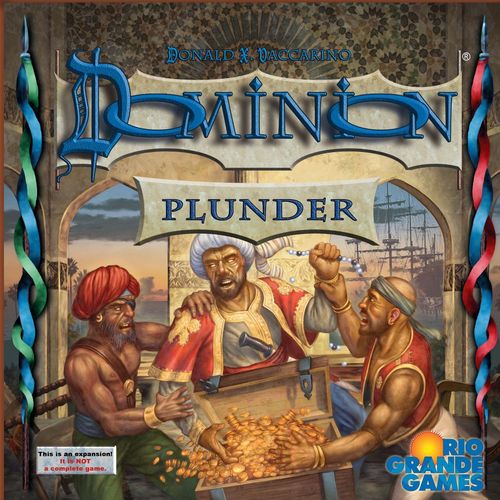
Dominion: Plunder
Dominion: Plunder Rulebook
Table of Contents
Table of Contents
Components
500 cards
400 Normal Kingdom cards: 10 each of Abundance, Buried Treasure, Cabin Boy, Cage, Crew, Crucible, Cutthroat, Enlarge, Figurine, First Mate, Flagship, Fortune Hunter, Frigate, Gondola, Grotto, Harbor Village, Jewelled Egg, King's Cache, Landing Party, Longship, Mapmaker, Maroon, Mining Road, Pendant, Pickaxe, Pilgrim, Quartermaster, Rope, Sack of Loot, Search, Secluded Shrine, Shaman, Silver Mine, Siren, Stowaway, Swamp Shacks, Taskmaster, Tools, Trickster, Wealthy Village
30 Loot cards: 2 each of Amphora, Doubloons, Endless Chalice, Figurehead, Hammer, Insignia, Jewels, Orb, Prize Goat, Puzzle Box, Sextant, Shield, Spell Scroll, Staff, Sword
40 Randomizer cards
15 Event cards: Avoid, Bury, Deliver, Foray, Invasion, Journey, Launch, Looting, Maelstrom, Mirror, Peril, Prepare, Prosper, Rush, Scrounge
15 Trait cards: Cheap, Cursed, Fated, Fawning, Friendly, Hasty, Inherited, Inspiring, Nearby, Patient, Pious, Reckless, Rich, Shy, Tireless
1 Plastic organizer tray
1 Organizing Inlay
1 Rule Booklet
Preparation
Dominion: Plunder includes 40 randomizer cards (one for each Kingdom card pile). Players will need the Treasure cards, Victory cards, Curse cards, and Trash mat/card from either Dominion or Base Cards (or older editions of Intrigue) and the rules from Dominion to play with this expansion. As with previous Dominion games, players must choose 10 sets of Kingdom cards for each game. If players choose the random approach for choosing sets, they should shuffle the randomizer cards from this expansion with those of any other Dominion games they choose to play with.
Events and Traits can be shuffled into the randomizer deck (despite having a different back). They are not part of the 10 Kingdom cards used in a game; when an Event or Trait is turned over, put it on the table but keep turning over cards until you get 10 Kingdom cards. For normal play we recommend using at most 2 such cards; with other expansions that includes Events, Traits, Landmarks, Projects, and Ways. Skip any further landscape cards turned over. Also skip Events and Traits when using a randomizer card to determine whether or not to use Platinum/Colony (from Prosperity), or Shelters (from Dark Ages) in a game, or to determine the bane for Young Witch (from Cornucopia). Another approach some people may prefer is to shuffle Events and Traits (and Landmarks, Projects, and Ways) separately into their own deck, and always play with one or two of them.
In games using cards that refer to Loot, shuffle the Loot pile and place it face down where everyone can reach it. In games using a Trait, pick a random Treasure or Action from the dealt-out Kingdom cards and put the Trait under it, so the text is showing; do not put two Traits on the same pile.
Durations
Plunder has Duration cards. Duration cards are orange, and have abilities that can happen on future turns. Duration cards are not discarded in Clean-up if they have something left to do on a future turn; they stay in play until the Clean-up of the last turn that they do something. Additionally, if a Duration card is played extra times by a card such as Flagship, that card also stays in play until the Duration card is discarded, to track the fact that the Duration card was played extra times. Keep track of whether or not a Duration card was played on the current turn, such as by putting your cards into two lines.
Many Duration cards in Plunder are Treasures. These are just like normal Treasures, except that they stay in play until they're done doing things, like other Durations do.
Some Duration cards in Plunder do something the "next time" a certain thing happens. That thing could happen the same turn, or many turns later; these may sit in play turn after turn until finally the thing happens. For example you could play a Secluded Shrine and two Coppers, buy a Silver, and immediately trash two cards from your hand, discarding Secluded Shrine that turn. Or you could buy a Stowaway instead, and leave Secluded Shrine in play for next turn.
Loot
There are 15 Loot cards, with 2 copies of each. Shuffle them into a face-down pile before the game if any cards refer to Loot. During the game, "gain a Loot" means, you gain the top card of the Loot pile. When you gain a Loot, reveal it to all players. Then put it into your discard pile as usual. Players can't look through the Loot pile during a game. The Loot pile isn't in the Supply; players can't buy or gain from it, except with cards that specifically gain Loot.
Events
Plunder has Events, which first appeared in Adventures. In your Buy phase, when you can buy a card, you can buy an Event instead. You pay the cost indicated on the Event and then do its effect.
- Events are not Kingdom cards; they sit on the table and provide an effect you can buy. There is no way for you to gain one or end up with one in your deck.
- Buying an Event uses up a Buy; normally you can either buy a card, or buy an Event. If you have two Buys, such as after playing Sack of Loot, you can buy two cards, or buy two Events, or buy a card and an Event (in either order).
- The same Event can be bought multiple times in a turn if you have the Buys and available to do it.
- You cannot play further Treasures that turn after buying an Event.
- Buying an Event is not buying a card, for things that care about that, like Haggler (from Hinterlands).
- Costs of Events are not affected by cards like Bridge (from Intrigue).
Traits
Plunder has Traits, which are a new kind of landscape card that affects a single Action or Treasure pile. At the start of a game with a Trait, choose a random Action or Treasure Kingdom card pile to put the Trait on; then during that game, cards from that pile are affected as indicated on the Trait.
- Traits are not Kingdom cards, and are never bought or gained.
- Traits only go on Kingdom cards, not on e.g. Silver or the Ruins pile (from Dark Ages).
- Don't put two Traits on the same pile.
- Traits refer to the pile using the name of the Trait; for example Pious refers to "Pious cards." That just means, any card from that pile.
- A Trait on a split pile (from Empires and Allies) affects all of those different cards.
- Traits continue to affect the cards from a pile even after the pile is empty.
Kingdom Cards
The printed text of each Kingdom card, as it appears on the card itself. The printed coin symbol is written as "coins". A Treasure's printed coin value is given as "Worth N coins"; where the card shows "?" as its value, the booklet gives no fixed value and this is written as "coin value shown as ?".
Abundance — Cost 4. Treasure - Duration. The next time you gain an Action card: +1 Buy and +3 coins.
Buried Treasure — Cost 5. Treasure - Duration. At the start of your next turn, +1 Buy and +3 coins. When you gain this, play it.
Cabin Boy — Cost 4. Action - Duration. +1 Card, +1 Action. At the start of your next turn, choose one: +2 coins; or trash this to gain a Duration card.
Cage — Cost 2. Treasure - Duration. Set aside up to 4 cards from your hand face down (on this). The next time you gain a Victory card, trash this, and put the set aside cards into your hand at end of turn.
Crew — Cost 5. Action - Duration. +3 Cards. At the start of your next turn, put this onto your deck.
Crucible — Cost 4. Treasure. Coin value shown as ?. Trash a card from your hand. +1 coin per 1 coin it costs.
Cutthroat — Cost 5. Action - Duration - Attack. Each other player discards down to 3 cards in hand. The next time anyone gains a Treasure costing 5 coins or more, gain a Loot.
Enlarge — Cost 5. Action - Duration. Now and at the start of your next turn: Trash a card from your hand, and gain one costing up to 2 coins more.
Figurine — Cost 5. Treasure. Worth 2 coins. +2 Cards. You may discard an Action card for +1 Buy and +1 coin.
First Mate — Cost 5. Action. Play any number of Action cards with the same name from your hand, then draw until you have 6 cards in hand.
Flagship — Cost 4. Action - Duration - Command. +2 coins. The next time you play a non-Command Action card, replay it.
Fortune Hunter — Cost 4. Action. +2 coins. Look at the top 3 cards of your deck. You may play a Treasure from them. Put the rest back in any order.
Frigate — Cost 5. Action - Duration - Attack. +3 coins. Until the start of your next turn, each time another player plays an Action card, they discard down to 4 cards in hand afterwards.
Gondola — Cost 4. Treasure - Duration. Coin value shown as ?. Either now or at the start of your next turn: +2 coins. When you gain this, you may play an Action card from your hand.
Grotto — Cost 2. Action - Duration. +1 Action. Set aside up to 4 cards from your hand face down (on this). At the start of your next turn, discard them, then draw as many.
Harbor Village — Cost 4. Action. +1 Card, +2 Actions. After the next Action you play this turn, if it gave you +coins, +1 coin.
Jewelled Egg — Cost 2. Treasure. Worth 1 coin. +1 Buy. When you trash this, gain a Loot.
King's Cache — Cost 7. Treasure. You may play a Treasure from your hand 3 times.
Landing Party — Cost 4. Action - Duration. +2 Cards, +2 Actions. The next time the first card you play on a turn is a Treasure, put this onto your deck afterwards.
Longship — Cost 5. Action - Duration. +2 Actions. At the start of your next turn, +2 Cards.
Mapmaker — Cost 4. Action - Reaction. Look at the top 4 cards of your deck. Put 2 into your hand and discard the rest. When any player gains a Victory card, you may play this from your hand.
Maroon — Cost 4. Action. Trash a card from your hand. +2 Cards per type it has (Action, Attack, etc.).
Mining Road — Cost 5. Action. +1 Action, +1 Buy, +2 coins. Once this turn, when you gain a Treasure, you may play it.
Pendant — Cost 5. Treasure. Worth 2 coins. +1 coin per differently named Treasure you have in play.
Pickaxe — Cost 5. Treasure. Worth 1 coin. Trash a card from your hand. If it costs 3 coins or more, gain a Loot to your hand.
Pilgrim — Cost 5. Action. +4 Cards. Put a card from your hand onto your deck.
Quartermaster — Cost 5. Action - Duration. At the start of each of your turns for the rest of the game, choose one: Gain a card costing up to 4 coins, setting it aside on this; or put a card from this into your hand.
Rope — Cost 4. Treasure - Duration. Worth 1 coin. +1 Buy. At the start of your next turn, +1 Card and you may trash a card from your hand.
Sack of Loot — Cost 6. Treasure. Worth 1 coin. +1 Buy. Gain a Loot.
Search — Cost 2. Action - Duration. +2 coins. The next time a Supply pile empties, trash this and gain a Loot.
Secluded Shrine — Cost 3. Action - Duration. +1 coin. The next time you gain a Treasure, trash up to 2 cards from your hand.
Shaman — Cost 2. Action. +1 Action, +1 coin. You may trash a card from your hand. In games using this, at the start of your turn, gain a card from the trash costing up to 6 coins.
Silver Mine — Cost 5. Treasure. Gain a Treasure costing less than this to your hand.
Siren — Cost 3. Action - Duration - Attack. Each other player gains a Curse. At the start of your next turn, draw until you have 8 cards in hand. When you gain this, trash it unless you trash an Action from your hand.
Stowaway — Cost 3. Action - Duration - Reaction. At the start of your next turn, +2 Cards. When anyone gains a Duration card, you may play this from your hand.
Swamp Shacks — Cost 4. Action. +2 Actions. +1 Card per 3 cards you have in play (round down).
Taskmaster — Cost 3. Action - Duration. +1 Action, +1 coin, and if you gain a card costing exactly 5 coins this turn, then at the start of your next turn, repeat this ability.
Tools — Cost 4. Treasure. Gain a copy of a card anyone has in play.
Trickster — Cost 5. Action - Attack. Each other player gains a Curse. Once this turn, when you discard a Treasure from play, you may set it aside. Put it in your hand at end of turn.
Wealthy Village — Cost 5. Action. +1 Card, +2 Actions. When you gain this, if you have at least 3 differently named Treasures in play, gain a Loot.
Event Cards
Avoid — Cost 2. Event. +1 Buy. The next time you shuffle this turn, pick up to 3 of those cards to put into your discard pile.
Bury — Cost 1. Event. +1 Buy. Put any card from your discard pile on the bottom of your deck.
Deliver — Cost 2. Event. +1 Buy. This turn, each time you gain a card, set it aside, and put it into your hand at end of turn.
Foray — Cost 3. Event. Discard 3 cards, revealing them. If they have 3 different names, gain a Loot.
Invasion — Cost 10. Event. You may play an Attack from your hand. Gain a Duchy. Gain an Action onto your deck. Gain a Loot; play it.
Journey — Cost 3. Event. Once per turn: If the previous turn wasn't yours, you don't discard cards from play in Clean-up this turn, and take an extra turn after this one.
Launch — Cost 3. Event. Once per turn: Return to your Action phase. +1 Card, +1 Action, and +1 Buy.
Looting — Cost 6. Event. Gain a Loot.
Maelstrom — Cost 3. Event. Trash 3 cards from your hand. Each other player with 5 or more cards in hand trashes one of them.
Mirror — Cost 3. Event. +1 Buy. The next time you gain an Action card this turn, gain a copy of it.
Peril — Cost 2. Event. You may trash an Action card from your hand to gain a Loot.
Prepare — Cost 3. Event. Set aside your hand face up. At the start of your next turn, play those Actions and Treasures in any order, then discard the rest.
Prosper — Cost 10. Event. Gain a Loot, plus any number of differently named Treasures.
Rush — Cost 2. Event. +1 Buy. The next time you gain an Action card this turn, play it.
Scrounge — Cost 3. Event. Choose one: Trash a card from your hand; or gain an Estate from the trash, and if you did, gain a card costing up to 5 coins.
Loot Cards
Amphora — Cost 7. Treasure - Duration - Loot. Coin value shown as ?. Either now or at the start of your next turn: +1 Buy and +3 coins.
Doubloons — Cost 7. Treasure - Loot. Worth 3 coins. When you gain this, gain a Gold.
Endless Chalice — Cost 7. Treasure - Duration - Loot. Worth 1 coin. Now and at the start of each of your turns for the rest of the game: +1 Buy.
Figurehead — Cost 7. Treasure - Duration - Loot. Worth 3 coins. At the start of your next turn, +2 Cards.
Hammer — Cost 7. Treasure - Loot. Worth 3 coins. Gain a card costing up to 4 coins.
Insignia — Cost 7. Treasure - Loot. Worth 3 coins. This turn, when you gain a card, you may put it onto your deck.
Jewels — Cost 7. Treasure - Duration - Loot. Worth 3 coins. +1 Buy. At the start of your next turn, put this on the bottom of your deck.
Orb — Cost 7. Treasure - Loot. Coin value shown as ?. Look through your discard pile. Choose one: Play an Action or Treasure from it; or +1 Buy and +3 coins.
Prize Goat — Cost 7. Treasure - Loot. Worth 3 coins. +1 Buy. You may trash a card from your hand.
Puzzle Box — Cost 7. Treasure - Loot. Worth 3 coins. +1 Buy. You may set aside a card from your hand face down. Put it into your hand at end of turn.
Sextant — Cost 7. Treasure - Loot. Worth 3 coins. +1 Buy. Look at the top 5 cards of your deck. Discard any number. Put the rest back in any order.
Shield — Cost 7. Treasure - Reaction - Loot. Worth 3 coins. +1 Buy. When another player plays an Attack, you may first reveal this from your hand to be unaffected.
Spell Scroll — Cost 7. Action - Treasure - Loot. Trash this to gain a cheaper card. If it's an Action or Treasure, you may play it.
Staff — Cost 7. Treasure - Loot. Worth 3 coins. +1 Buy. You may play an Action from your hand.
Sword — Cost 7. Treasure - Attack - Loot. Worth 3 coins. +1 Buy. Each other player discards down to 4 cards in hand.
Trait Cards
Cheap Cheap cards cost 1 coin less.
Cursed When you gain a Cursed card, gain a Loot and a Curse.
Fated When shuffling, you may look through the cards and reveal Fated cards to put them on the top or bottom.
Fawning When you gain a Province, gain a Fawning card.
Friendly At the start of your Clean-up phase, you may discard a Friendly card to gain a Friendly card.
Hasty When you gain a Hasty card, set it aside, and play it at the start of your next turn.
Inherited Setup: You start the game with an Inherited card in place of a starting card you choose.
Inspiring After playing an Inspiring card on your turn, you may play an Action from your hand that you don't have a copy of in play.
Nearby When you gain a Nearby card, +1 Buy.
Patient At the start of your Clean-up phase, you may set aside Patient cards from your hand to play them at the start of your next turn.
Pious When you gain a Pious card, you may trash a card from your hand.
Reckless Follow the instructions of played Reckless cards twice. When discarding one from play, return it to its pile.
Rich When you gain a Rich card, gain a Silver.
Shy At the start of your turn, you may discard one Shy card for +2 Cards.
Tireless When you discard a Tireless card from play, set it aside, and put it onto your deck at end of turn.
Kingdom Card Notes
Abundance: This triggers when you gain an Action card due to buying it, or gain one some other way. If it happens during another player's turn, the +3 coins and +1 Buy won't be useful.
Buried Treasure: When you gain this, you have to play it; it's not optional.
Cabin Boy: You can trash a Cabin Boy to gain another Cabin Boy.
Cage: The cards go to your hand after drawing your regular hand of 5 cards for next turn. For example you might set aside two Estates and two Coppers on a Cage on an early turn; then on a late turn, buy a Province, trash the Cage, and add the two Estates and two Coppers to your hand at end of turn.
Crew: Putting this onto your deck isn't optional.
Crucible: For example if you trash an Estate, which costs 2 coins, you get +2 coins. If you trash a card with a potion or a debt in its cost (from other expansions), you get nothing for those symbols.
Cutthroat: Loot itself is a Treasure costing 5 coins or more, so a player gaining one will trigger Cutthroats.
Enlarge: Once you've played Enlarge, trashing a card at the start of your next turn is mandatory.
Figurine: This is a Treasure, and so is played in your Buy phase, but draws cards. This means that usually if it draws you an Action card, that card won't be useful that turn, except that Figurine itself lets you discard one Action card for +1 Buy and +1 coin.
First Mate: If you don't have any Action cards to play, you'll still draw up to 6. If the Action card you play draws you another copy of itself, you can play that copy, and so on. First Mate can play First Mates; keep careful track of which card you're resolving, as you would with multiple Throne Rooms.
Flagship: This isn't optional; whatever that next non-Command Action card is, Flagship replays it. It replays it even if the card trashed itself, and even if it isn't your turn. Command cards, such as Flagship itself, are not replayed; Flagship waits for a non-Command Action card. If you play two Flagships and then e.g. a Harbor Village, you'll play the Harbor Village three times total - once normally and once for each Flagship.
Fortune Hunter: Completely resolve playing the Treasure before putting the other cards back on top; for example if the Treasure is a Figurine, the two cards you draw won't be the other ones you looked at with Fortune Hunter.
Frigate: This applies each time another player plays an Action, until your next turn. That includes later on during your turn, if they manage to play an Action then (for example a Stowaway). They completely resolve playing the Action before discarding.
Gondola: When playing Gondola, choose whether to get +2 coins immediately, or at the start of your next turn. If you choose "immediately," Gondola will be discarded in the same turn's Clean-up; if you choose "next turn," Gondola will be discarded that turn. If you play Gondola multiple times, such as with King's Cache, you choose each time whether to get the +2 coins now or next turn, and Gondola only stays in play if at least one of the plays was for next turn (in which case the King's Cache also stays in play).
Grotto: For example you could set aside 3 cards from your hand, and at the start of your next turn, discard those 3 cards, then draw 3 cards.
Harbor Village: This only cares if the Action itself gave you +coins, not if you otherwise got +coins due to playing it (such as due to Training, from Adventures, or due to receiving Forest's Gift, from Nocturne). It's okay if you no longer have the coins (such as due to Storyteller). +Coffers (from Guilds and Renaissance) is not +coins. +1 coin doesn't get you the bonus. Using a Way (from Menagerie) to get +coins (e.g. Way of the Sheep) does get you the bonus. If you Throne Room a Harbor Village and then play a Militia, you played Harbor Village, then Harbor Village, then Militia, so you get nothing for the first play of Harbor Village and +1 coin for the second play of it.
Jewelled Egg: The player trashing Jewelled Egg gets the Loot, regardless of which player played the card that caused them to trash it.
King's Cache: If you King's Cache a King's Cache, you will play three more Treasures three times each. If you King's Cache a Treasure - Duration card, King's Cache will stay in play as long as that card does.
Landing Party: Resolve the Treasure before putting Landing Party on your deck; for example if the Treasure is Figurine, you'd draw 2 cards before putting Landing Party on top. It's okay if the Treasure has more types, including Action (like Spell Scroll).
Longship: Playing this gives you +2 Actions then, and +2 Cards at the start of your next turn.
Mapmaker: If you have fewer than four cards (after shuffling), you just look at what's left. You may play this when someone (including you) gains a Victory card due to buying it, or some other way. When you play Mapmaker in response to someone gaining a Victory card, you can immediately play another Mapmaker afterwards - even one you just got via the first Mapmaker.
Maroon: Types are the words on the bottom banner of cards - Action, Attack, and so on. For example if you trash a Cage with Maroon, you'll draw 4 cards, since it's a Treasure and a Duration, 2 types.
Mining Road: Playing the Treasure is optional. This ability is cumulative; if you play two Mining Roads, then twice that turn you may play a Treasure when you gain one. However two Mining Roads can't play the same gained Treasure twice. Mining Road applies to Treasures gained due to being bought, or gained other ways. It works in your Action phase if you gain a Treasure then.
Pendant: This counts itself. For example if you had three Coppers, a Gondola played last turn, and the Pendant in play, it would make +3 coins.
Pickaxe: Trashing is mandatory, if you have any cards left in hand. Remember that you have to reveal the gained Loot.
Pilgrim: The card you put on top doesn't have to be one of the 4 you just drew.
Quartermaster: Quartermaster stays in play for the rest of the game. Each turn you either gain a card and put it on the Quartermaster, or take one of the cards you've already gained with that Quartermaster and put it into your hand. If you play two Quartermasters, they each have their own set of cards. However if you Throne Room a Quartermaster, you just have one set of cards for it, and twice on each of your turns, either add one or take one.
Rope: When you play this, you get +1 coin and +1 Buy, and at the start of your next turn, you first draw a card, then may trash a card from your hand.
Sack of Loot: When you play this, you get +1 coin and +1 Buy, and gain a Loot.
Search: If you Throne Room a Search, Throne Room will stay out with Search until a pile empties, and then you'll trash Search once but gain two Loots (and discard Throne Room that turn).
Secluded Shrine: This can trigger on any player's turn. It triggers even if the player can't or doesn't want to trash anything; they don't have to trash anything, but Secluded Shrine is done, and is discarded that turn.
Shaman: In games using Shaman, for the whole game, at the start of each of your turns (including extra turns), you gain a card from the trash costing up to 6 coins. This is mandatory. If there's no such card, you don't gain one. This applies even on your first turn (relevant with Necromancer, from Nocturne). It applies even if no-one ever gets a Shaman. The gained card goes into your discard pile. It's a card you gained, and can trigger things that care about that; for example gaining an Estate would trigger Cage's ability.
Silver Mine: This can gain Silver, but also other Treasures costing less than Silver Mine, when in the Supply: Gondola, Jewelled Egg, and so on.
Siren: When you gain a Siren, it's immediately trashed unless you trash an Action card from your hand. However if you manage to move the Siren from where it was gained (whether it was gained to your discard pile or somewhere else) before resolving this ability - for example putting it on top of your deck with Insignia - then it will fail to be trashed (though you can still trash an Action card if you want).
Stowaway: You may play this from your hand when you personally gain a Duration card, or when another player does.
Swamp Shacks: This counts the Swamp Shacks itself, and Duration cards played on previous turns that are still in play. It counts Treasures if you have some in play, such as Treasure Duration cards, or due to Fortune Hunter. It does not count set aside cards, such as cards on a Quartermaster. Round down the number of cards you draw; if you have 8 cards in play, you draw 2.
Taskmaster: Taskmaster can end up making +1 Action and +1 coin turn after turn, as long as you keep gaining at least one card costing 5 coins. It only matters what the card cost when you gained it, not what it costs at other times. Taskmaster does not count cards gained before playing it.
Tools: This can gain a copy of a card any player has in play; other players may for example have Duration cards in play. Tools itself is in play, so you can gain a copy of that.
Trickster: This is cumulative; if you play two Tricksters, then you can set aside up to two Treasures you discard from play and put them into your hand at end of turn, after drawing.
Wealthy Village: The 3 differently named Treasures can include Duration Treasures you played on a previous turn, and Loots themselves.
Trait Card Notes
The booklet prints this heading as "SPLIT PILE CARD NOTES"; it is shown here under the heading the notes actually cover.
Cheap: This lowers the cost of a pile for the entire game (including when scoring). Costs can't go below 0 coins. This doesn't reduce non-coin costs like potion and debt; for example this does nothing on the Engineer pile (from Empires). This does not apply during setup; it can't for example cause a card costing 4 coins to be used as Young Witch's Bane (from Cornucopia).
Cursed: When you gain a card from the Cursed pile, you also gain a Loot and a Curse. If there are no Curses left, you still gain a Loot.
Fated: Each time you shuffle, you can choose to put Fated cards on the top or bottom of your deck, while shuffling the other cards normally. If for example you had five Fated cards, you could put two on top, one on the bottom, and leave the other two to be shuffled in. In games with Fated, you can look through your deck before shuffling, even if you're sure you don't have any Fated cards.
Fawning: This is mandatory.
Friendly: You may only discard one Friendly card per turn this way.
Hasty: If this plays a card that can't normally be played, like Territory (from Allies), that card goes into play but doesn't do anything else then.
Inherited: If they care, players decide which card to replace in turn order. Replaced Coppers go back to the pile; replaced Estates go back to the box. Replaced other cards (Shelters from Dark Ages, Heirlooms from Nocturne) go back to the box. If the Inherited pile is a split pile (from Empires or Allies), players take cards from the pile in turn order. So in a 6-player game with the Townsfolk pile, the first four players get a Town Crier, and the next two get a Blacksmith. Cards starting in your deck due to Inherited were never "gained" and did not trigger "when you gain this" effects.
Inspiring: When you play an Inspiring card, after resolving it, you can play an Action card from your hand, provided that you don't have a copy of that card in play. Duration cards that you played on previous turns that are still in play, are in play; cards that have left play somehow, like a Mining Village (from Intrigue) trashing itself, are not in play. An Inspiring card can sometimes play a different Inspiring card (when Inspiring is on a split pile, like those in Empires and Allies), but can't normally play another copy of itself.
Nearby: Each time you gain a Nearby card, you get +1 Buy.
Patient: You can set aside multiple Patient cards at once; play them all at the start of your next turn, in any order. If this plays a card that can't normally be played, like Territory (from Allies), that card goes into play but doesn't do anything else then.
Pious: Each time you gain a Pious card, you may optionally trash a card from your hand.
Reckless: Reckless does two things, at different times. When you play a Reckless card, you follow its instructions an extra time - follow them entirely, then follow them again - and when you discard one from play, you return it to its Supply pile. With Duration cards those may not happen on the same turn. If you skip following the instructions of the card - for example by using a Way (from Menagerie) instead - then you don't follow them an extra time, but still return the card when discarding it from play.
Rich: Each time you gain a Rich card, you also gain a Silver.
Shy: You can only discard one Shy card per turn this way.
Tireless: This is mandatory. You draw your next hand before putting the card onto your deck.
Loot Card Notes
The booklet prints no heading above these notes; the heading is added for navigation.
Amphora: When playing Amphora, choose whether to get +3 coins and +1 Buy immediately, or at the start of your next turn. If you choose "immediately," Amphora will be discarded in the same turn's Clean-up; if you choose "next turn," Amphora will be discarded that turn. If you play Amphora multiple times, such as with King's Cache, you choose each time whether to get the +3 coins and +1 Buy now or next turn, and Amphora only stays in play if at least one of the plays was for next turn (in which case the King's Cache also stays in play).
Doubloons: When you gain this, you also gain a Gold.
Endless Chalice: Once played, this stays in play for the rest of the game.
Figurehead: When you play this, you get +3 coins, and at the start of your next turn, you get +2 Cards.
Hammer: Each time you play this, you get +3 coins, and gain a card costing up to 4 coins. This isn't optional.
Insignia: If you gain multiple cards, this applies to each of them - you can put any or all of them on top of your deck.
Jewels: When you play this, you get +3 coins and +1 Buy, and at the start of your next turn, put this on the bottom of your deck.
Orb: First look through your discard pile; then choose either to play an Action or Treasure from it, or to get +1 Buy and +3 coins.
Prize Goat: Trashing a card is optional.
Puzzle Box: If you set aside a card, the Puzzle Box itself is still discarded normally that turn. The set-aside card goes into your hand after drawing for the next turn.
Sextant: You can put all 5 cards back, or discard all 5, or anything in between.
Shield: You can reveal this when another player plays an Attack card to be unaffected by it, exactly as with Moat. You do this before the Attack card has done anything, and can use Shield against multiple Attacks in a turn. Shield stays in your hand and can still be played for +3 coins and +1 Buy on your turn.
Spell Scroll: You can play this in your Action phase or Buy phase; if played in your Action phase, it uses up an Action play for the turn. However playing the card you gain from Spell Scroll does not use up an Action play.
Staff: Playing an Action card from your hand is optional.
Sword: This is an Attack, and so cards like Moat and Shield protect from it.
Event Card Notes
The booklet prints no heading above these notes; the heading is added for navigation.
Avoid: If you don't end up shuffling this turn, this does nothing. If you do shuffle, you first look through the cards and pick up to 3 to put into your discard pile. Shuffle the other cards normally, but don't shuffle those 3 in. Avoid is cumulative; if you Avoid 3 times, you will pick up to 9 cards to not shuffle in. You might leave so many cards in your discard pile that you don't have enough to draw; this does not trigger another shuffle, you just draw what you can.
Bury: Once you buy this, the ability is mandatory.
Deliver: Buying this more than once doesn't do anything extra. The set aside cards go into your hand after drawing your usual 5 cards.
Foray: If you didn't have 3 cards to discard, you don't gain a Loot.
Invasion: You do the four things in that order. Playing an Attack card is optional; the rest are mandatory.
Journey: You can only buy this once per turn. When you do, if the previous turn was not yours - if it was another player's turn before this turn - you don't discard cards from play this turn, and you take another turn after this turn ends. You still discard your hand. The extra turn is completely normal except that it doesn't count for the tiebreaker. The cards left in play don't do anything special on the extra turn; a Copper left in play doesn't make +1 coin on the extra turn and so on. Cards with "while this is in play" abilities can continue to function, and the cards are in play for things that care about that, such as Swamp Shacks; otherwise, the cards being in play just means you won't draw them that turn. Cards that would have stayed in play anyway (e.g. a Longship played on the turn you bought Journey) stay in play for that reason, and do whatever they normally do.
Launch: This ends your Buy phase and returns you to your Action phase. This does not cause "start of turn" abilities to repeat; however when your Buy phase happens again after that, "start of Buy phase" abilities can repeat.
Looting: You simply gain a Loot.
Maelstrom: This isn't optional for the other players; they must trash a card if they have 5 or more cards in hand.
Mirror: This is cumulative; if you buy Mirror three times and then buy an Action, you'll gain three extra copies of it.
Peril: You only gain a Loot if you trashed an Action card.
Prepare: Once you've set the cards aside, playing all of those Actions and Treasures next turn is mandatory.
Prosper: Gain the Loot first. Then, one at a time, you can choose differently named Treasures to gain, resolving each gain in turn. You don't have to gain any Treasures you don't want (after the Loot). For example in a game with Gondola, you might choose to gain Gondola, resolve its "when gain" ability to play a Trickster, then choose to gain a Gold and a Silver and then stop.
Rush: If you Rush twice in a row, you'll still only play the Action once. You can however Rush, buy an Action and play it, Rush again, and buy another Action and play it.
Scrounge: You may either trash a card from your hand, or may gain an Estate from the trash. If you gained an Estate, you then also gain a card costing up to 5 coins from the Supply.
Suggested Kingdoms
Players can play Dominion with any set of 10 Kingdom cards, but these sets have been specially picked out to be entertaining and show off card interactions and strategies. In the booklet, a Trait written as "Trait->Pile" is put on that Kingdom card's pile; here it is written as "Trait on Pile". A "•" separates groups of cards as printed.
Plunder alone:
- Flotsam: Abundance, Crucible, Hasty on First Mate, Fortune Hunter, Jewelled Egg, Landing Party, Mining Road, Secluded Shrine, Silver Mine, Wealthy Village
- Jetsam: Prepare • Crew, Cutthroat, Gondola, Pious on Grotto, Longship, Pickaxe, Quartermaster, Search, Siren, Stowaway
Plunder & Dominion:
- Basic Looting: Frigate, Tireless on Harbor Village, Maroon, Pilgrim, Sack of Loot • Cellar, Market, Mine, Moat, Vassal
- Voodoo: Maelstrom • Buried Treasure, First Mate, Flagship, Gondola, Shaman • Artisan, Bureaucrat, Cursed on Festival, Moneylender, Remodel
Plunder & Intrigue:
- Breaking Eggs: Buried Treasure, Jewelled Egg, Mapmaker, Reckless on Maroon, Quartermaster • Courtier, Harem, Mining Village, Nobles, Replace
- Landlubbers: Avoid • Cutthroat, Fortune Hunter, Pendant, Pilgrim, Wealthy Village • Friendly on Conspirator, Mill, Pawn, Secret Passage, Wishing Well
Plunder & Seaside:
- Wine-dark Seas: Cabin Boy, Cage, Enlarge, Cheap on Frigate, Rope • Astrolabe, Caravan, Fishing Village, Sailor, Sea Witch
- Treasure Island: Launch • Abundance, Buried Treasure, Crew, Longship, Stowaway • Corsair, Island, Lookout, Sea Chart, Inherited on Treasure Map
Plunder & Alchemy:
- Special Delivery: Deliver • Flagship, Jewelled Egg, Mining Road, Swamp Shacks, Tools, Trickster • Alchemist, Apothecary, Cursed on Golem, Transmute
Plunder & Prosperity: [use Platinum / Colony]
- Pretty Trinkets: Figurine, Jewelled Egg, King's Cache, Fated on Rope, Silver Mine • Bank, Crystal Ball, Investment, Tiara, War Chest
- Buying Happiness: Looting • Cage, Mining Road, Pendant, Stowaway, Swamp Shacks • Anvil, Bishop, Clerk, Fawning on Magnate, Worker's Village
Plunder & Mixed Box:
- Of Heralds and Hunters: Cabin Boy, Flagship, Inspiring on Fortune Hunter, Pendant, Pickaxe • Doctor, Fairgrounds, Herald, Soothsayer, Stonemason
- Through the Swamp: Journey • Cage, Patient on Pilgrim, Swamp Shacks, Taskmaster, Tools • Baker, Hamlet, Horn of Plenty, Menagerie, Merchant Guild
Plunder & Hinterlands:
- Desert Dreams: Enlarge, Grotto, Harbor Village, Mapmaker, Pendant • Haggler, Reckless on Nomads, Oasis, Souk, Weaver
- Viking Schemes: Scrounge • Cabin Boy, Crew, Crucible, Frigate, Wealthy Village • Rich on Berserker, Cauldron, Fool's Gold, Scheme, Stables
Plunder & Dark Ages: [use Shelters]
- Dad's Rats: First Mate, Maroon, Rope, Search, Shaman • Death Cart, Poor House, Inherited on Rats, Squire, Vagrant
- Ravagers: Invasion • Cutthroat, Enlarge, Grotto, King's Cache, Trickster • Counterfeit, Tireless on Forager, Ironmonger, Pillage, Storeroom
Plunder & Adventures:
- Set Sail: Ferry • Figurine, First Mate, Fortune Hunter, Mapmaker, Search • Patient on Artificer, Distant Lands, Port, Ratcatcher, Treasure Trove
- Rush Job: Rush • Quartermaster, Secluded Shrine, Stowaway, Swamp Shacks, Tools • Coin of the Realm, Gear, Haunted Woods, Hireling, Shy on Wine Merchant
Plunder & Empires:
- City Builders: Museum • Abundance, Crucible, Frigate, Taskmaster, Tools • City Quarter, Farmers' Market, Groundskeeper, Nearby on Patrician/Emporium, Wild Hunt
- Plenty: Prosper • Friendly on Figurine, Landing Party, Mining Road, Rope, Wealthy Village • Charm, Crown, Enchantress, Gladiator/Fortune, Sacrifice
Plunder & Nocturne:
- Night of the Loot: Cabin Boy, Figurine, Pendant, Sack of Loot, Pious on Taskmaster • Blessed Village, Crypt, Faithful Hound, Tragic Hero, Werewolf
- Skeleton Isle: Foray • Cutthroat, King's Cache, Longship, Pilgrim, Secluded Shrine • Devil's Workshop, Ghost Town, Hasty on Idol, Skulk, Tracker
Plunder & Renaissance:
- Circle of Life: Cathedral • Frigate, Jewelled Egg, Pickaxe, Search, Shaman • Acting Troupe, Patron, Experiment, Inspiring on Scholar, Swashbuckler
- Mirror Masters: Mirror • Crucible, Gondola, Quartermaster, Taskmaster, Trickster • Border Guard, Cargo Ship, Flag Bearer, Seer, Fated on Spices
Plunder & Menagerie:
- Going Home: Way of the Squirrel • Gondola, Landing Party, Mapmaker, Secluded Shrine, Silver Mine • Barge, Cheap on Gatekeeper, Kiln, Snowy Village, Supplies
- Going Big: Peril • Enlarge, Grotto, Harbor Village, Sack of Loot, Siren • Nearby on Animal Fair, Camel Train, Mastermind, Sanctuary, Sheepdog
Plunder & Allies:
- Shipmates: Cave Dwellers • Crew, Flagship, Harbor Village, Sack of Loot, Shaman • Broker, Forts, Innkeeper, Modify, Fawning on Sycophant
- Buried and Sunk: Bury • Abundance, Buried Treasure, King's Cache, Landing Party, Maroon • Courier, Highwayman, Shy on Merchant Camp, Odysseys, Skirmisher