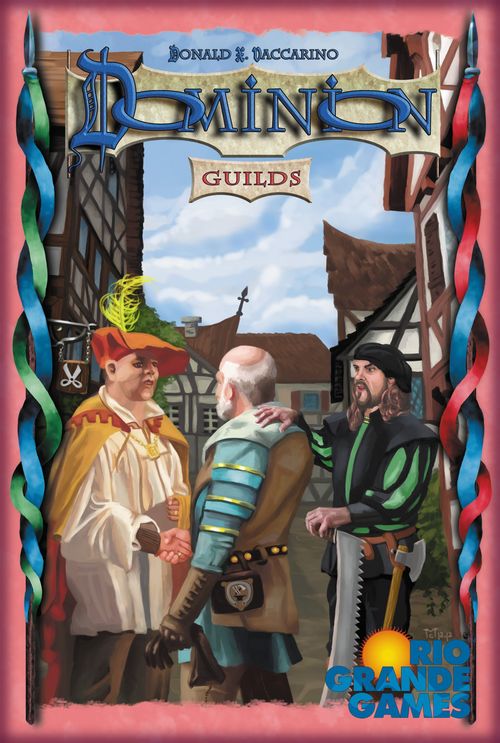
Dominion: Guilds
Dominion: Guilds Rulebook
Table of Contents
Table of Contents
Components
Dominion: Guilds contains 150 cards and 25 Coin tokens:
- 130 Kingdom cards, 10 each of the 13 Guilds Kingdom cards: Advisor, Baker, Butcher, Candlestick Maker, Doctor, Herald, Journeyman, Masterpiece, Merchant Guild, Plaza, Soothsayer, Stonemason, and Taxman.
- 13 Randomizer cards (one for each Kingdom card in Guilds).
- 7 blank cards.
- 25 Coin tokens.
To play with Guilds, you need a complete Dominion game such as the original Dominion or Dominion: Intrigue. These provide the Basic cards (Treasure, Victory, and Curse cards), as well as the full rules for setup and gameplay. Dominion: Guilds can also be combined with any other Dominion expansions you have.
Preparation
Guilds includes 13 randomizer cards (one for each Kingdom card in Guilds). Players will need the Treasure cards, Victory cards, Curse cards, and Trash card from either Dominion, a standalone expansion to Dominion (e.g., Dominion: Intrigue), or the Base Cards set to play with this expansion. As with previous Dominion games, players must choose 10 sets of Kingdom cards for each game. If players choose the random approach for choosing sets, they should shuffle the randomizer cards from this expansion with those of any other Dominion games they choose to play with.
If Baker is being used this game, each player starts the game with a single Coin token. Otherwise, each player starts with no Coin tokens.
The printed sample game setup shows Treasure cards (Copper, Silver, Gold), Victory cards (Estate, Duchy, Province), a Curse card, a Trash card, and 10 Kingdom cards from the base set and Guilds, with a supply of Coin tokens.
Additional Rules for Guilds
"In play" - Action cards and Treasure cards played face-up to a play area are in play until they are moved somewhere else - usually until they are discarded during a Clean-up phase. Only played cards are in play; set aside cards, trashed cards, cards in the Supply, and cards in hands, decks, and discard piles are not in play. Reaction abilities do not put those cards into play.
Some cards in Dominion: Guilds give players Coin tokens. Coin tokens always come from the supply of tokens, not from another player. In a player's Buy Phase, before buying any cards, that player may spend any number of Coin tokens; each Coin token spent gives that player +1 coin. Spent tokens are returned to the supply of tokens. Coin tokens are not component-limited; players may use a substitute if they run out. They are the same tokens that come with Dominion: Seaside and Dominion: Prosperity, but abilities that give players Coin tokens cannot be used to put them on Pirate Ship mats or the Trade Route mat. They can only be spent in a Buy Phase; they cannot be spent when buying a card via the promotional card Black Market.
Some cards in Dominion: Guilds can be "overpaid" for. The costs for these cards have a "+" next to the coin symbol. A player may pay any additional amount for such a card, and then gets an effect based on how much extra was paid. Potions (from Dominion: Alchemy) may be used in overpaid amounts if desired, although this is not always meaningful. A player may choose not to overpay, even if she has extra coins, but cannot choose to overpay 0 coins; to overpay, a player has to actually pay more than the cost. The coins used to overpay are gone after spending them to overpay; they cannot be then used to buy something else. Overpaying happens when a card is paid for, which is before it is gained. Players can only overpay for a card when buying it, not when gaining it some other way. The "+" is just a reminder; a card with "+" in the cost still has its normal cost for all purposes. For example if a player plays Haggler (from Dominion: Hinterlands), then buys a Masterpiece, overpaying, Haggler will still gain her a card costing less than 3 coins, the cost of Masterpiece. Similarly, Masterpiece could be the Bane card for Young Witch (from Dominion: Cornucopia), since it costs 3 coins. Reducing the costs of cards via cards like Bridge (from Dominion: Intrigue) or Highway (from Dominion: Hinterlands) does not interact with overpay; for example, if you play five Bridges and have 5 coins total to spend, Herald would cost 0 coins, but if you bought one the most you could overpay for it would still be 5 coins.
When two things happen to a player at the same time, that player picks the order to do them. For example, if a player with Merchant Guild in play buys a Masterpiece, she chooses whether to take a Coin token first, or overpay for Masterpiece first (in this case the order would not actually matter, since it is too late to spend the Coin token). When two things happen to different players at the same time, go in turn order, starting with the player whose turn it is. For example, if a player plays Soothsayer with only one Curse left in the Supply, the player to her left gets it.
At any point in the game, if a player has to do anything regarding her Deck (draw, reveal, set aside, look at, or trash cards), and she needs more cards than are remaining in her Deck, she must do as many as she can and then shuffle her face-up Discard pile to form a new face-down Deck. Then, she does the things with the remaining number of cards from her newly shuffled Deck. If a player's Deck is empty, she does not shuffle her Discard pile until she needs to do something with cards from her Deck and cannot.
Recommended Sets of 10
Players can play Dominion with any set of 10 Kingdom cards, but these sets are intended to highlight some interesting card interactions and game strategies.
Guilds & Dominion:
Arts and Crafts: Stonemason, Advisor, Baker, Journeyman, Merchant Guild / Laboratory, Cellar, Workshop, Festival, Moneylender
Clean Living: Butcher, Baker, Candlestick Maker, Doctor, Soothsayer / Militia, Thief, Moneylender, Gardens, Village
Gilding the Lily: Plaza, Masterpiece, Candlestick Maker, Taxman, Herald / Library, Remodel, Adventurer, Market, Chancellor
Guilds & Intrigue:
Name That Card: Baker, Doctor, Plaza, Advisor, Masterpiece / Courtyard, Wishing Well, Harem, Tribute, Nobles
Tricks of the Trade: Stonemason, Herald, Soothsayer, Journeyman, Butcher / Great Hall, Nobles, Conspirator, Masquerade, Coppersmith
Decisions, Decisions: Merchant Guild, Candlestick Maker, Masterpiece, Taxman, Butcher / Bridge, Pawn, Mining Village, Upgrade, Duke
Kingdom Card Descriptions
Advisor: If there are not three cards in your deck, reveal what you can, then shuffle your discard pile into your deck to get the other cards. If there still are not enough, just reveal what you can. No matter how many you revealed, the player to your left chooses one for you to discard, and the remaining cards go into your hand.
Baker: When you play this, you draw a card, get +1 Action, and take a Coin token. In games using this card, each player starts the game with a Coin token. This includes games using the promo card Black Market in which Baker is in the Black Market deck.
Butcher: First take two Coin tokens. Then you may trash a card from your hand and pay any number of Coin tokens (returning them to the pile). The number of Coin tokens you pay can be zero. Butcher itself is no longer in your hand and so cannot trash itself (though it can trash another copy of Butcher). If you trashed a card, you gain a card costing up to the cost of the trashed card plus the number of Coin tokens you paid. For example, you could trash an Estate and pay six Coin tokens to gain a Province, or you could trash another Butcher and pay zero Coin tokens to gain a Duchy. You can pay the Coin tokens you just got. Paying Coin tokens for this ability does not get you coins to spend, it just changes what cards you can gain with this ability.
Candlestick Maker: You get +1 Action and +1 Buy, and take a Coin token.
Doctor: When you play this, you name a card, reveal the top three cards of your deck, trash each of those cards that has that name, and put the other cards back on your deck in any order. You do not have to name a card being used this game. If there are fewer than three cards left in your deck, reveal the remaining cards, and shuffle your discard pile (which does not include those cards) to get the remainder needed to reveal. If there are still not enough cards, just reveal as many as you can. When you buy this, for each extra 1 coin you pay over the cost, you look at the top card of your deck, and either trash it, discard it, or put it back on top. If there are no cards left in your deck, shuffle your discard pile into your deck (including any cards already discarded to this overpay ability this turn), and if there still are no cards in it, you do not look at one. If you overpay more than 1 coin, you may do different things for each card you look at, and you will look at the same card again if you put it back on top. For example if you bought Doctor for 7 coins, you would look at the top card four times; you might end up first trashing a Copper, then discarding a Province, then putting a Silver back on top, then putting that Silver back on top again.
Herald: When you play this, first draw a card and get +1 Action, then reveal the top card of your deck. If it is an Action card, play it; this is not optional. Playing the Action card does not "use up" one of your Action plays for the turn. Cards with multiple types, one of which is Action (such as Great Hall from Dominion: Intrigue), are Action cards. If Herald plays a Duration card (from Dominion: Seaside), the Herald is still discarded normally at end of turn, as it is not needed to track anything. When you buy this, you put one card from your discard pile on top of your deck for each extra 1 coin you pay over the cost. For example, if you buy Herald for 6 coins, you will put two cards from your discard pile on top of your deck. This card lets you look through your discard pile; normally you cannot. You cannot look through your discard pile first to see how much you want to overpay, and once you overpay you must put the appropriate number of cards on top of your deck if possible. If you overpay enough to put more cards on your deck than there are cards in your discard pile, you just put all of your discard pile onto your deck. You may not look through your discard pile if you buy Herald without overpaying for it. When you put multiple cards on your deck due to overpaying for a Herald, put them on your deck in any order.
Journeyman: This draws you three cards that are not a particular card. First name a card. It does not have to be a card being used this game. Then reveal cards from the top of your deck until you have revealed three cards that are not the named card. If you run out of cards without finding three, shuffle your discard pile into your deck and continue. If you still cannot find three, stop. Put the cards you found that were not the named card into your hand and discard the rest.
Masterpiece: This is a Treasure worth 1 coin, like Copper. When you buy it, you gain a Silver for each extra 1 coin you pay over the cost. For example, if you buy a Masterpiece for 6 coins, you gain three Silvers.
Merchant Guild: When you play this, you get +1 Buy and +1 coin. While this is in play, any time you buy a card you also take a Coin token. Remember that you may only spend Coin tokens prior to buying cards, so you will not be able to immediately spend that Coin token. This ability is cumulative; if you have two Merchant Guilds in play, each card you buy will get you two Coin tokens. However if you play a Merchant Guild multiple times but only have one in play, such as with Throne Room (from Dominion) or King's Court (from Dominion: Prosperity), you will only get one Coin token when you buy a card.
Plaza: First you draw a card and get +2 Actions; then you may discard a Treasure. You can discard the card you drew if it is a Treasure. If you discarded a Treasure card, you take a Coin token. Cards with multiple types, one of which is Treasure (such as Harem from Dominion: Intrigue), are Treasures.
Soothsayer: The Gold and Curses come from the Supply and go into discard piles. If there is no Gold left, you do not gain one. If there are not enough Curses left to go around, deal them out in turn order, starting with the player to your left. Each player who gained a Curse draws a card. This is not optional. A player who did not gain a Curse, whether due to the Curses running out or due to some other reason, does not draw a card. A player who uses Watchtower (from Dominion: Prosperity) to trash the Curse did gain a Curse and so draws a card; a player who uses Trader (from Dominion: Hinterlands) to gain a Silver instead did not gain a Curse and so does not draw a card.
Stonemason: When you play this, trash a card from your hand, and gain two cards, each costing less than the card you trashed. Trashing a card is not optional. If you do not have any cards left in your hand to trash, you do not gain any cards. The two cards you gain can be different or the same. For example you could trash a Gold to gain a Duchy and a Silver. Gaining cards is not optional if you trashed a card. The gained cards come from the Supply and are put into your discard pile; if there are no cheaper cards in the Supply (for example if you trash a Copper), you do not gain any. If there is only one card in the Supply cheaper than the trashed card, you gain that one. The cards you gain are gained one at a time; this may matter with cards that do something when gained, such as Inn from Dominion: Hinterlands. When you buy this, you may choose to overpay for it. If you do, you gain two Action cards each costing exactly the amount you overpaid. The Action cards can be different or the same. For example, if you buy Stonemason for 6 coins, you could gain two Heralds. The Action cards come from the Supply and are put into your discard pile. If there are no cards with the appropriate cost in the Supply, you do not gain one. Overpaying with a Potion (from Dominion: Alchemy) will let you gain cards with Potion in the cost. Cards with multiple types, one of which is Action (such as Great Hall from Dominion: Intrigue), are Action cards. If you choose not to overpay, you will not gain any cards from that ability; it is not possible to use it to gain Action cards costing 0 coins.
Taxman: You may trash a Treasure card from your hand. This is optional. Cards with multiple types, one of which is Treasure (like Harem from Dominion: Intrigue), are Treasures. If you do trash a Treasure, each other player with at least five cards in hand discards a copy of it from her hand if she can, or reveals a hand with no copies of it, and you gain a Treasure costing up to 3 coins more than the trashed Treasure, putting it on top of your deck. If there are no cards in your deck, it becomes the only card in your deck. You do not have to gain a more expensive Treasure; you may gain a Treasure with the same cost, or a cheaper Treasure. You have to gain a card if you trashed one though, if possible. The gained Treasure comes from the Supply.
Turn Example
At the start of Natalie's turn in a game between Natalie and Todd, Natalie has a hand of Butcher, Candlestick Maker, Estate, Copper, Silver. She also has three Coin tokens gained on earlier turns. She plays the Candlestick Maker, getting +1 Action, +1 Buy, and a 4th Coin token. Then she plays Butcher. She gains two more Coin tokens, then trashes the Estate from her hand. She chooses to spend one Coin token to gain a Silver, which goes to her discard pile. Now she has five Coin tokens. She is ready for her Buy phase. She plays her Copper and Silver and has 3 coins to spend. She decides to spend three of her Coin tokens, going down to two Coin tokens but up to 6 coins to spend. She buys a Stonemason, paying 6 coins for it. She overpaid by 4 coins, so she picks a card costing 4 coins. She chooses Herald and gains two of them. She does not get to overpay on the Herald, since she is not buying it, merely gaining it. She puts the Heralds and Stonemason in her discard pile. She has another buy but only 0 coins to spend, and chooses not to use it. She discards her hand and her cards from play. She draws a new hand of five cards and is done.