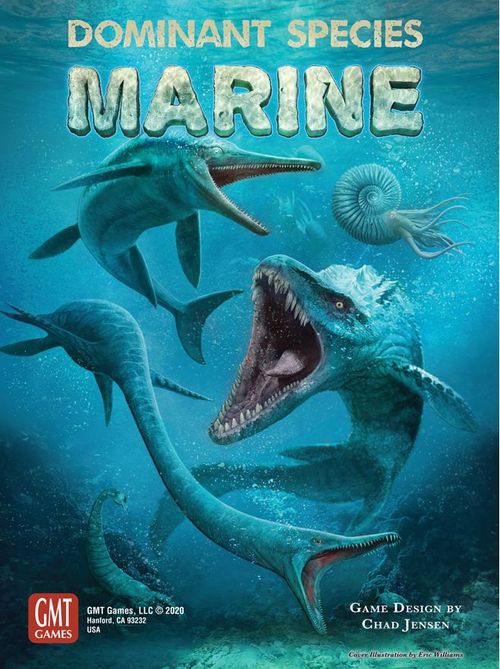
Dominant Species: Marine
Dominant Species: Marine Rulebook
Table of Contents
Table of Contents
Game Overview
The large hexagonal tiles are used throughout the game to create an ever-expanding interpretation of the main ocean on earth as it might have appeared tens of millions of years ago. The smaller Hydrothermal Vent (or just "Vent") tiles will be placed atop some of the larger tiles throughout play, converting them into Vents in the process.
The cylindrical action pawns (or just "pawns") drive the game. Each pawn allows a player to perform the various actions that can be taken—such as speciation, environmental change, migration or evolution. When placed on the action display, a pawn will immediately trigger that particular action for its owning player.
Generally, players will be trying to enhance their own animal's survivability while simultaneously trying to hinder that of their opponents'—hopefully collecting valuable victory points ("VP"s) along the way. The various cards will aid in these efforts, giving players useful one-time abilities, ongoing benefits, or an opportunity for recurring VP gains.
Throughout the game species cubes will be added to, moved about on, and removed from the tiles in play ("earth"). Element disks will be added to and removed from both animals and earth.
When the game ends, players will conduct a final scoring of each tile—after which the player controlling the animal with the highest VP total wins the game.
Throughout the rules you will see numerous indented sections such as this one. These sections are filled with examples, clarifications, play hints, design notes, and other assorted wisdom in order to help ease you along.
Inventory
- this 24-page rulebook
- 1 game board
- 4 animal displays
- 54 cards
- 7 sheets of die-cut tiles
- 140 wood cubes in four player colors
- 32 wood cylinders in four player colors
- 6 white wood cylinders
- 2 cloth bags
- 1 sheet of die-cut stickers
Important: Before your first game, apply two identical stickers to the top and bottom of each of the white cylinders.
Game Components
Boards & Bags
Main Board. The large board consists of three main areas:
- The action display on the right, where players will place their pawns to perform various actions;
- The hex grid in the center called "earth" where player actions will be executed;
- The evolution card row on the left which gives players powerful options during play and acts as the game's clock, determining when the endgame will occur.
The board also contains a Victory Point Track, several tables, and spaces for pending terrain tiles.
Animal Displays. The four smaller animal display boards sit in front of the players. Each has an area to collect element disks, a place for the animal's trait card, a Gene Pool to hold the animal's pending species, and an abbreviated rules section for all the player actions that can be taken.
Draw Bags. When not on the board or on an animal display, the element disks are kept in the black bag in order to be drawn at random during play. Similarly, when not on the board the terrain markers are kept in the red bag for random draw during play. Whenever they are removed from play, always put elements and terrain markers back into their respective bags.
Wood
Action Pawns ("Pawns"). The set of wooden cylinders are used by the players to take actions on the action display portion of the board. Pawns are "basic" if they match the animal's color, or "special" if they are white.
Species. Each small wooden cube represents one species. Each like-colored set of cubes represent the various species belonging to a single animal.
Markers & Tiles
Element Disks. Algae, worms, plankton, sponges, gastropods and sun. These are the six element "types" which represent the resources the various animals require to thrive. Individual element disks are placed on the animal displays to show need and on earth to show supply. When on earth, elements are placed on the corners of tiles—in this manner, a single element disk can be present on up to three different tiles simultaneously.
Victory Point Track Markers. Each animal has a marker to track its current VP total throughout the game. If an animal's score exceeds 100, flip its VP marker to its +100 side and continue around the track. Each element type has a square marker used on the Victory Point Track to mark its current "target number." Players can acquire an element type's special pawn during a Domination action by exceeding its current target number.
Terrain Tiles. Hydrothermal Vent, Open Ocean, Sand Plain, Seagrass Meadow, Seamount, Coral Reef, Kelp Forest or Land. These hexagonal pieces are used to initially create – then during the game to expand – the earth's play area in the center of the board.
Terrain Markers. Each terrain type has two square markers. These sixteen markers are used on the Competition and Evolution sections of the action display to determine where those actions can take place each round.
Control Markers. The six larger square markers each have a depiction of one of the special action pawns. These markers begin on the board. When a player acquires a special pawn, they will also take the matching control marker to keep in front of them for as long as they control that special pawn.
Cards
Evolution. A rotating selection of Evolution Cards are displayed on the board throughout play. Players will choose from among them when taking an Evolution action. Evolution cards may have an ongoing effect while in play or have a one-time effect when they first enter play. One of these cards – "Asteroid" – will trigger the end of the game.
Trait. The Trait Cards are assigned one per animal at the start of the game, giving each one a unique benefit during play.
Survival. The Survival Card generally passes from player to player throughout the game. It acts as a mnemonic device to indicate which player 'controls' the Vent tiles and what their reward will be during Survival events.
IMPORTANT—Whenever a card's text contradicts a rule in this booklet, the card always takes precedence. Clarification of card effects can be found in the Card Notes section.
Game Setup
Stickers—Before your first game, apply two identical stickers to the top and bottom of each white wooden cylinder.
A. Board—Place the board in the center of the table.
B. Tiles—Place five Land tiles, five Ocean tiles, and one each of the other five large tile types into their assigned positions in the center of the hex grid. (Note the two Land and two Ocean tiles that are shown underneath smaller Hydrothermal Vent tiles.)
C. Flip the remaining 21 large tiles face-down and shuffle them. Create three stacks of 7 tiles each. Place these stacks on the three Wanderlust Tiles sections of the board. Turn the top-most tile of each stack face-up.
D. Place a small Vent tile (smoker side face-up) atop the bottommost Ocean tile. Place another Vent (geyser side face-up) atop the topmost Land tile. Put the remaining 10 Vent tiles in a stack on the Vent Tiles section of the board.
E. Elements—Gather one round marker of each of the six element types and place them around the central Reef tile as indicated on the board.
Place them so that they slightly overlap each of the tiles that meet at that intersection.
F. Place the rest of the element markers into the black cloth bag.
G. Randomly draw 4 elements from the bag. Place these on the board into the four (jellyfish) circles next to the Abundance tag. Draw another 4 for the circles next to Adaptation, 4 more for the circles associated with Speciation, and finally 4 more for the circles next to Wanderlust.
H. Terrain Markers—Put the 16 square terrain markers into the red cloth bag. Randomly draw 3 from the bag and place them into the three (starfish) squares next to the Competition tag.
I. Draw 5 more terrain markers and place them into the squares next to Evolution, arranging them in left-to-right order by type as indicated underneath the spaces.
J. Animals—Have players choose the animal they would like to play. Give each player the animal display matching their choice: use the side showing three pre-printed elements in the upper left corner.
K. Pawns—Each player gathers up the following number of wood cylinders matching their animal's color:
- 4 players – 4 cylinders
- 3 players – 5 cylinders
- 2 players – 7 cylinders
Put the remaining colored cylinders back in the box.
L. Place the six square markers with white cylinder icons into their matching spaces near the bottom left of the board. Place the six special pawns (the white wooden cylinders) atop their matching markers.
M. Place the six smaller square markers showing element icons on the "1" space of the Victory Point Track.
N. Place each animal's VP marker on the "0" space of the Victory Point Track (+100 side face-down).
O. Species—Each player puts the 35 cubes matching their animal's color into the Gene Pool area of their animal display.
P. Players take 1 cube from their Gene Pool to use as a Reseed marker: place it in the box to the left of that animal's icon on the Food Chain.
Q. Players then place 3 cubes from their Gene Pool onto the central Reef tile.
R. Trait Cards—Shuffle the 18 Trait Cards together face-down. Deal 3 to each player then put the rest back in the box unseen. Each player looks at their own cards, secretly selects one to keep, then puts the remaining two back in the box. Players then reveal their chosen trait, placing it face-up in the space alloted on their animal display.
Clarifications of these card's effects can be found in the Trait Card Notes.
S. Evolution Cards—Remove the "Asteroid" card from the deck of Evolution Cards. Shuffle the remaining 34 cards together face-down. Remove 10 of them and put them back in the box unseen. Remove 4 more cards, shuffle the Asteroid card into these, then place this stack of five cards face-down next to the board. Put the 20 remaining evolution cards face-down atop this stack to form a draw pile.
T. Draw the top five cards of the evolution draw pile and place them face-up into the five slots of the "Evolution Cards" section of the game board.
Watch for any "When this card enters play" text on any of these five cards and act accordingly.
U. Survival Card—Place the Survival card to the side of the board for now.
V. Begin Play—The animal lowest on the food chain begins the game by taking the first turn.
Important Game Terms
Animal
One of the four animal classes that each player will be representing throughout the game: Reptile, Cephalopod, Crustacean or Fishes. Each animal class is represented on earth by a set of like-colored species cubes. Each animal also has an animal display and a set of like-colored pawns.
Bonus VPs
Some actions and card effects call for a player to earn "bonus VPs." To earn bonus VPs, refer to the Bonus Points Table located in the bottom left of the board. The top row of this table lists the count that the action or card effect is checking – for example, how many Vent tiles are occupied by an animal during the Survival action – while the square directly below this number in the bottom row gives the amount of VPs gained based on that count.
Event
At various times during the game one or more of three different events will occur: Extinction, Survival or Reseed. Extinction and Survival are triggered by the appearance of fish icons on new evolution cards. Reseed events are triggered each time every player has retrieved their pawns from the action display.
Food Chain
From top-to-bottom, this chart is used to break ties when scoring a tile during an Evolution action, among other things. From bottom-to-top, the food chain indicates the order of play throughout the game. The food chain is:
- Reptile
- Cephalopod
- Fishes
- Crustacean
Earth
The large and small hexagonal tiles will, when added to the game board's hexagonal play area, make up the "earth"—the playing surface that much of the game will be focused on.
Throughout the rules and components you will notice the names of the tiles being abridged: "Vent" instead of Hydrothermal Vent or "Sand" instead of Sand Plain. This is intentional in order to save room. Both the full and the abbreviated names are always functionally identical.
The species belonging to each animal will be placed on earth tiles from their respective Gene Pools. Species removed from earth for any reason (unless specifically instructed otherwise) are placed back in the box, out of play—not back into the Gene Pools.
Elements will occupy the corners of the earth tiles when not on an animal display, on the action display, or awaiting deployment from the element draw bag.
New (large) Land, Seagrass, Seamount, Kelp, Reef, Sand and Ocean tiles will be added to the outskirts of earth when players perform the Wanderlust action. These are taken from the top of the three large tile draw stacks.
New (small) Vent tiles are taken from the Vent draw stack and placed onto existing large tiles when players perform the Tectonics action. This converts that large tile into a Vent tile for the remainder of the game.
Tiles that touch along a common edge are said to be "adjacent" to one another.
Even though a Vent tile is slightly smaller than the tile it sits upon – and therefore will not physically touch the tiles that might surround it – it is still considered adjacent to those tiles as it converts the tile underneath it into Vent: which does physically touch the tiles next to it.
Elements
These are the round markers that make up the six element types used in the game: sun, worms, plankton, gastropods, sponges and algae. When placed on a tile of earth, an element represents supply; when on an animal display, an element represents need. Taken together, these provide for an animal's "matching" elements as well as its overall survivability across earth.
NOTE: the term "element" by itself always refers to a single disk, while the phrase "element type" will specifically mean any and all disks of one of the six types.
Endangered & Thriving
A species in play is said to be "thriving" if at least one element on the tile it occupies matches an element on its animal display. Conversely, any species occupying a tile where its animal matches exactly zero elements is said to be "endangered."
In other words, it is endangered if none of the elements on that animal's display match any of the elements on the tile.
Endangered species are vulnerable to elimination during an Extinction event and can't claim an evolution card during Domination actions.
Dominance & Matching Elements
The Domination action calls for a player to determine their animal's "matching" elements. To determine your animal's matching elements for a particular element type, do the following:
- count the number of that element type on your animal display (both default and added disks);
For example, at start the Reptiles count 2 sun, or 1 sponges, or 0 of each of the other four element types.
- multiply this count by the number of tiles on earth that contain (a) at least one of your species and (b) at least one of that element;
So the more tiles you occupy that contain that element the higher your matching value will be. Note that if either value is zero your total value will be zero, and thus worthless.
- compare this value to the element's current target number, as indicated by the position of its associated target marker on the VP Track. If your count exceeds that target number, you are considered to dominate that element. Multiple animals can dominate the same element simultaneously.
Here we see the sponges element type with a current target number of 4; sun is still at 1. You as the Reptiles above would dominate the sponges if you occupied at least 5 tiles containing sponges (1x5=5). You would also dominate the sun with just 1 shared tile (2x1=2). You wouldn't currently dominate any of the other four element types (0 x any number = 0).
Dominance Example: Crustaceans have a total count of 6 matching worms elements - 2 worms on their display (A) times 3 tiles on earth with at least one worm and at least one Crustacean (B). The worms' current target number is 4, as indicated by its marker on the VP track. Therefore, Crustaceans dominate the worms element.
Note that more than one animal can dominate an element in this fashion at the same time.
Note also that if the worms element sitting on the corner of the Coral Reef, Sand Plain, and Open Ocean were to be removed, the Crustaceans would be endangered on the Coral Reef, as they would no longer match any elements there.
Species
The wooden cubes represent the "species" that each animal will use to represent itself on earth. Most species will begin the game in their owner's Gene Pool. Most or all of them will eventually occupy (be placed on) the tiles of earth.
Gene Pool
Prior to being placed on a tile of earth, species belonging to an animal are kept in a pile in the "Gene Pool" section of its animal display. Whenever a species is added to earth, it is always taken from that animal's Gene Pool. However, whenever a species is removed from earth for any reason (unless specifically instructed otherwise) it is always placed back into the box, out of play: not back into the animal's Gene Pool.
A player is never "out of the game," even if they manage to empty their Gene Pool and lose their last remaining species on earth. An animal caught in such a dilemma certainly has fewer options but they still maintain a VP total.
Survival Card
The Survival card is set aside at the beginning of the game. During play, players should keep track of how many of their species occupy Vent tiles. Any player with the sole highest count automatically and immediately takes possession of the Survival card. If two or more players are tied for most, no player controls the card (it remains uncontrolled and will not score points for any player).
During each Survival event, the player in control of the Survival card earns bonus VPs for the number of Vent tiles that are occupied by one or more of their animal's species.
Special Actions. The reverse side of the Survival card contains a cheat for the six actions that can be taken only with the special pawns.
Sequence of Play
Dominant Species: Marine is played in a series of turns in which a single animal takes one action. The order of play throughout the game is the reverse of the food chain:
- Crustaceans first
- Fishes next
- Cephalopods next
- Reptiles next
- back to Crustaceans and so on.
During each of their turns a player will place exactly one of their pawns into a "fossil" action space within the action display. Each pawn placement will trigger an immediate action to be taken by that player. Alternatively, players may retrieve their pawns instead of placing one for their turn.
Play continues from turn to turn in this manner until the game ends and final scoring occurs.
The Action Display
The action display is the large boxed area on the right side of the game board. This is the game's engine, so to speak, which will facilitate each player's wants and desires as far as furthering their animal's destiny on earth.
Pawns
The wooden cylinders are the pawns that players will use to take actions on the action display.
The cylinders in the four player colors are termed "basic pawns": players begin the game with a set of these but they have limitations in how they can be placed.
The white cylinders with the applied stickers are termed "special pawns": these are very flexible in how they can be used but can only be acquired – and lost! – during the course of play.
Player Turns
Player Options
During your turn, you must choose exactly one of two options:
- Placement—Place one of your available pawns – either a basic pawn in your animal's color that you began the game with or a white special pawn you acquired during the course of play – into a single action space (those with the fossil icons) of the action display and perform the associated action, or
- Retrieval—Retrieve all of your controlled pawns – both basic and special – from the action display, placing them on the table in front of you as available pawns for future turns.
Note that retrieval is your only option if you have no available pawns.
Pawn Placement
An "available" pawn is one that is both controlled by you and sitting in front of you—in other words, it's not already somewhere on the action display. Generally, one available pawn is placed into an empty action space, so it's "first come, first served," with two important exceptions:
- Some action spaces show an accompanying white cylinder (for example, the rightmost space of the Migration section). Only a special pawn – never a basic pawn – can be placed in such a space in order to perform the associated action.
So if you had only basic pawns available, those action spaces would be entirely unavailable to you.
- A special pawn can be placed on an action space currently occupied by an opposing animal's basic pawn. When this occurs, give the 'bumped' basic pawn back to its owner as an available pawn.
Basic Pawn Placement—Your basic pawns may only be placed in an empty, non-special action space that is after all of your previously-placed pawns. In this context, "after" means either:
- a section of the action display that is below all of your placed pawns (basic and special); or
- a space to the right of (in the same section as) your lowermost placed pawn (basic or special).
For example, if you had a single pawn on the action display occupying the "2" space of the Competition section, your next basic pawn could only be placed (a) to the right of it into the "3" space or (b) into a space below the Competition section.
Special Pawn Placement—Special pawns are not subject to the above restrictions for basic pawns: they may be placed (a) in any empty action space or (b) one that contains a basic pawn belonging to an opposing animal. This is regardless of the position of your previously-placed pawns.
From the previous example, if you had a single pawn on the action display occupying the "3-cube" space of the Migration section, for your next action a special pawn could be placed anywhere except (a) that "3-cube" Migration section or (b) a space containing any special pawn.
Actions
After placing a pawn, you immediately perform the associated action according to the tag to the left of the action space (for example, "Tectonics" or "Evolution").
Actions are never mandatory. You may choose to voluntarily forfeit the allowed action. If so, it must be skipped in its entirety.
You can't pick and choose which parts to ignore and which to resolve.
The various actions are described on the following pages in detail, and are presented in the same order in which they appear on the action display.
The actions are also presented in abbreviated form on each player's animal display.
Endgame
When the game end is triggered via the Asteroid card being played:
- Finish the remainder of the round—in other words, stop play when the next Reseed event would have occurred.
- Perform one final Extinction event followed by a final Survival event—see the Events section for procedure.
- Each player earns VPs equal to the sum total of the spaces occupied by the target markers associated with their controlled special pawns.
So a player controlling the algae pawn at target "7" and the sun pawn at "6" would earn 13 VPs.
- Score each and every tile of earth one last time.
Note: Since there's no active player during this final scoring it's not possible to execute any evolution cards that may still remain on the board.
Once final scoring is complete, the player in control of the animal with the highest VP total wins the game. In case of a tie for highest, the tied animal closest to the top of the food chain wins the game for its controller.
Actions
Retrieve
When you choose to retrieve pawns (instead of placing one) as the action for your turn, return all of your controlled pawns – both basic and special – from the action display to the table in front of you.
They are now available pawns for future turns.
Then, if not already there, slide your animal's cube on the food chain from the left box to the right box. Then, if all food chain cubes are in their rightmost box, the round ends and a Reseed event occurs immediately.
So a "round" is a series of player turns culminating in a Reseed event after each animal has retrieved at least once, after which a new round begins with the next player in turn order.
Important! — When the turn order comes around to you again, you take your turn as normal regardless of whether your food chain cube occupies the left or right box. The left boxes being empty merely indicate when a Reseed event will occur.
Retrieve example: On the Crustacean's turn, although she still has a basic pawn left, there are no spaces available for a legal placement of that pawn. She must choose the retrieve action, collect all of her pawns (basic and special) and place them in front of herself, and then slide her animal's cube to the rightmost box on the food chain.
As this is the last cube to enter the rightmost column of boxes, it triggers the end of a round and play pauses to conduct the steps of a Reseed event.
Abundance
Conduct an Abundance action by selecting one of the elements currently present in this section. The chosen element is removed from the action display and placed on a vacant corner of any tile of earth.
Elements can be placed on any vacant corner of a tile, even a corner shared by only one or zero other tiles (for example, those tile corners currently on the "edge" of known earth).
Abundance example: The Fishes player chooses the Abundance action and places their pawn on the first available fossil space (behind the Crustacean's pawn). They want to leave that third fossil space open, hoping they can select it on their next turn as the elements here are favorable to them. They choose the algae element which only they and the Crustaceans have right now.
They opt to place the algae at the bottom-left corner of the Open Ocean tile below the Coral Reef, looking to lead their fish into deeper waters.
Autotrophs
Conduct an Autotrophs action by choosing one of the following options:
- Remove 1 element from a Vent tile. The chosen element must match an element type currently in the Autotrophs Box, or
- Swap places between 1 element currently in the Autotrophs Box and any 1 element currently on a Vent tile.
In both cases the chosen Vent tile must match the type pictured next to the associated action space: either a smoker Vent (left space) or a geyser Vent (right space).
Note that the Autotrophs Box will be empty – and therefore the action rendered useless – until after the first Reseed event of the game.
Autotrophs example: It is later in the game and a gastropod and a sun element are in the Autotrophs box. It is the Cephalopod's turn and he would love to see more tasty gastropods on the board.
Placing one of his pawns on the fossil space with the geyser image, he selects a plankton element on a geyser vent tile, moves it to the Autotrophs box, and places the gastropod element on that same corner space.
His other option would have been to remove a sun element from a geyser vent tile and return it to the black draw bag.
Depletion
Conduct a Depletion action by selecting any one element on earth that matches an element type in the Depletion Box. The chosen element is removed from earth and placed back into its draw bag.
If none of the elements in the Depletion Box match any elements on earth, this action has no effect.
Note that the Depletion Box will be empty – and thus the action useless – until after the second Reseed event of the game.
Depletion example: The Crustacean player places her basic AP in the Depletion space and selects the lone sponges element there. She may remove any one sponge element from earth. She chooses the one straddling the Seagrass Meadow and the Seamount and returns it the black draw bag.
Note that, by her action, the Reptiles in the Seagrass Meadow and the Cephalopods on both tiles are now endangered.
Adaptation
Conduct an Adaptation action by selecting 1 of the elements currently present in this section. The chosen element is removed from the action display and placed on an empty (gray) element space on your animal display.
No animal may ever have more than six elements on its animal display (counting both the default and added elements). If your animal has no vacant gray spaces, this action is forfeited.
Animals are allowed to acquire multiple disks of the same element type.
Special Action Space—The rightmost action space gives you the option of having the new element replace one of your animal's existing element disks. If you do, put the replaced element back into the black bag.
When using this space you may still choose to place the selected element into an empty gray space instead of replacing an element.
Adaptation example: The Fishes want to take advantage of the multitude of gastropods currently present on earth. Both fossil spaces for basic pawns are full, so they must use one of their special pawns to take this action.
Using the special pawn gives the Fishes a lot of options:
- Place the pawn on the "special only" space, take the gastropod element and (a) place it on an empty element space on the animal display, or (b) remove an element on their display and place it back in the black draw bag and place the gastropod in its space. OR
- Return an opponent's basic pawn (it is immediately available) and place their special pawn in the basic action space to gain the gastropod element.
This has been a quick round and the Fishes want to delay the Reseed, so they choose to bump the Crustacean's basic pawn (as they cannot bump their own) and add the gastropod to an empty space on their animal display.
Regression
Conduct a Regression action by placing a cube from your Gene Pool into a vacant square to the left of the action spaces.
If you have no species remaining in your Gene Pool, this action is forfeit.
No further action is taken during your turn. However, during every Reseed event, Regression triggers as follows: for each element type present in the Regression Box, every animal without a cube in the Regression section must remove one element disk of the same type from its animal display. Then return all cubes in this section to their owners' Gene Pools.
So having a cube in Regression spares your elements from removal. A single animal is allowed to place two cubes here, but the redundancy has no effect other than to deny rival animals an opportunity to save their own elements.
No animal may ever have its default (pre-printed) elements removed. Animals possessing only their default elements are unaffected by Regression.
Regression example: A Reseed event has been triggered again and only Reptiles had placed a species cube in the Regression boxes.
Sun is the only element type currently in the Regression box. Each player except Reptiles must remove one sun disk from their animal display, if possible. The removed disks are returned to the black draw bag. The Reptiles removes his cube from Regression, returning it to his Gene Pool.
In this case, Crustaceans lose a sun disk from her display. Reptiles has two pre-printed sun element disks which cannot be affected and another sun disk which is saved by his earlier placement of his AP and cube in Regression. The Reptile's attempt at a super-sun strategy is safe… for now.
Speciation
Conduct a Speciation action by choosing any one element on earth that matches the element type associated with the action space onto which your pawn was placed. You then place new species from your Gene Pool onto any number of the adjacent tiles as follows:
- Up to 4 species if the tile is Ocean.
- Up to 3 species if the tile is Sand or Seamount.
- Up to 2 species if the tile is Reef, Kelp or Seagrass.
- Up to 1 species if the tile is Land or Vent.
Note that only one, two or three tiles can be populated at a time: those with a corner occupied by the chosen element.
Special Action Space—The rightmost action space allows speciation around an element of your choice. The chosen element need not be present next to any of the other action spaces.
Speciation example: The Cephalopods place an AP on the sun action space. They choose the sun element shown below (A). This allows them to place 2 more species in the reef (B), 4 in the ocean (C), and 1 more in the vent (D).
If using the special action space, they could choose any element on earth instead.
Wanderlust
Conduct a Wanderlust action by performing the following activities in the order shown:
- Select a large tile from atop one of the three Wanderlust Tiles stacks. Flip face-up the next tile underneath the chosen tile (if any).
- Select a vacant (empty blue) hex on the game board and place the new tile there. The hex selected must be adjacent to at least one existing tile of earth.
- You may select 1 available element in the Wanderlust section and place it on any vacant corner of the newly-placed tile.
- Gain bonus VPs based on the number of same-type tiles that are, or are adjacent to, the newly-placed tile.
In other words, count the tile that was just placed as well as every tile adjacent to it that is the same terrain type.
- In food chain order, every player may move all, some or none of their species that are currently adjacent to the newly-placed tile onto that tile.
- Special Action Space—Finally, if your placed pawn occupies the rightmost action space in this section, take another turn.
Wanderlust example: The Crustaceans choose to place a basic pawn on Wanderlust. She selects a face-up Seamount tile to place (A) along with an available algae element (B).
There exists 1 Seamount tile adjacent to the new Seamount tile (C): referencing the Bonus Points Table, this nets Crustaceans 3 VPs.
In food chain order, the Reptiles decline to move to the new Seamount. The Cephalopods move 3 species and the Crustaceans move 4 species onto the new Seamount tile (A).
Tectonics
If there are no Vent tiles remaining in the stack (all 12 are already out on earth) this entire action is forfeit.
Conduct a Tectonics action by performing the following steps in the order shown:
- Select a non-Vent tile on the edge of the hex grid.*
In other words, a tile in a hex that is not surrounded by six other hexes.
- Remove and temporarily set aside all species from the chosen tile.
- Place a new Vent tile (from the stack on the board) on top of the chosen tile.
That tile is no longer considered to be its former terrain type and is instead treated as a "Vent tile" for the rest of the game.
Vent tiles have two sides: one depicting a land-based geyser and the other a sea-based black smoker. Place the new Vent tile smoker side face-up if it is being placed in the bottom half of the play area, or geyser side face-up if being placed in the top half of the play area.
While mostly aesthetic, there is one action as well as a few card effects that care whether a Vent is 'geyser' or 'smoker.'
- Gain bonus VPs based on the number of Vent tiles that are, or are adjacent to, the newly-placed tile.
So you count the tile that was just placed as well as every Vent adjacent to it.
- From the pile of set-aside species, place 1 belonging to each animal back onto the tile. The remainder of the removed species, if any, are displaced back to their owners' Gene Pools (instead of being eliminated and put back in the box).
- Finally, place one species from your Gene Pool, or one of your eliminated species, onto the tile.
Design Note: Hydrothermal vents are often found to be the centers of entire ecosystems having enormous biomass and productivity. The prebiotic chemistry of these hot spots suggests that life may have originated at hydrothermal vents.
* Special Action Space—The rightmost action space allows you choose any tile during step 1, above: that is, the tile need not be on the edge of the hex grid.
If you choose a tile on one of the three centermost hexes that span the top and bottom half of the play area, you choose which side of the Vent will be face-up.
Tectonics example: The Reptiles player would love to vent the kelp as it would give him 6 bonus VPs for placement next to two existing vent tiles, but, because the Kelp is not on the edge of the hex grid, that requires use of a special AP which he doesn't have available.
So he instead chooses the ocean tile (Step 1) (A). He removes all species there (Step 2) then places a new vent tile, smoker side up as this is the bottom half of the play area, atop it (Step 3). In Step 4, he scores 3 bonus VP (for there being one existing vent tile adjacent to the new tile).
Then, of the species removed in Step 2 – 1 Reptile, 2 Fishes, and 4 Cephalopods – one of each is put back on the new smoker Vent with the remaining 1 Fish and 3 Cephalopods being put back into their respective Gene Pools (Step 5). Finally, the Reptiles place one species from either his Gene Pool or one of his eliminated species onto the new Vent tile (Step 6).
Migration
Conduct a Migration action by selecting up to X of your animal's species anywhere on earth, where X is the number of cubes associated with the space onto which your pawn was placed. Each chosen species is then moved onto an adjacent tile.
Migrating species that begin the action on the same tile may move together onto the same tile or be split up onto separate tiles.
A migrating species may only move onto an existing tile: no migrating into the unknown!
Special Action Space—The rightmost action space allows you to move any number of your species onto adjacent tiles.
Essentially, X = all.
Migration example: The Fishes select Migration and place their basic pawn in the "5 cube" space. They move 1 Fish from the Coral Reef to the adjacent Sand Plain (A). Being endangered on the geyser vent, they use their last 4 migrates to move their species out of there: 3 to the Coral Reef (B) and 1 to the Kelp Forest (C).
Competition
Conduct a Competition action by choosing any 1 tile on earth that matches the terrain type associated with the space onto which your pawn was placed. The tile chosen must contain at least one of your species.
Eliminate up to 1, 2 or 3 opposing species on the chosen tile, as indicated by the number associated with your action space. Eliminated species may belong to the same or different opposing animals.
Remember that eliminated species are placed back in the box, out of play (not back in their owners' Gene Pools).
Special Action Space—The rightmost action space allows you to choose up to 2 tiles, one after the other, instead of 1. The tiles may be of any terrain type(s), independent of what terrain types may be associated with the other three spaces. You then eliminate up to 1 opposing species on each tile chosen. The same tile can be chosen twice in a row, in which case you would eliminate up to 2 opposing species there (1+1).
Competition example: The Cephalopods are looking to thin the ranks of the Reptiles to bump them out of the race for dominance of the sponges element.
A good opportunity has arisen with the Reptiles spread thinly at one edge of the earth. Using a special pawn, the Cephalopods choose the special action space to eliminate opposing species on each of two tiles of any terrain type.
In this case, he eliminates a Reptile in the Kelp Forest and another from the Seagrass Meadow.
Evolution
An Evolution action is a two-step process: first, scoring a tile; second, possibly resolving an evolution card.
Evolution Scoring
Conduct an Evolution action by choosing exactly 1 tile on earth that matches the terrain type associated with the space onto which your pawn was placed. Score that tile by performing the following steps:
- The animal with the most species present on the tile gains X VPs, where X equals the first number listed for that terrain type on the Tile Scoring table on the game board.
- If the tile being scored is any terrain other than Vent, the animal with the second highest number of species present gains a number of VPs equal to the second number listed on the Tile Scoring table.
There must be another animal present—an animal alone on a tile cannot claim both first and second place.
- If the tile being scored is Land, Kelp, Reef or Seamount, the animal with the third highest number of species present gains a number of VPs equal to the third number listed on the Tile Scoring table.
There must be a third animal present—an animal claiming first or second place on a tile cannot also claim third place.
- If the tile being scored is Land and there is a fourth animal present, that animal gains 1 VP.
IMPORTANT—In all cases above, ties for number of species on the tile being scored are broken in descending food chain order—that is, Reptiles first, then Cephalopods, then Fishes break a tie.
The Crustaceans will have their day....
Evolution Card Play
Once the chosen tile has been scored, if you as the active player have at least one thriving (non-endangered) species on that tile, you must select and resolve one face-up card in the Evolution Cards section of the board. You may only choose a card that occupies a numbered slot at or below the value associated with the space onto which your pawn was placed.
For example, if you placed a pawn in the rightmost action space with a value of "5," you could pick any card. If you placed in the leftmost action space with a value of "1," you would have no choice but to execute the bottom evolution card.
You make any and all choices called for in the resolution of the chosen card. You must resolve all of the card's effects in their entirety and in the order those effects appear on the card. If this is impossible given the current game state, resolve as much as possible and skip the rest.
Clarifications of evolution card effects can be found in the Evolution Card Notes.
Note that when the Asteroid card is selected, the game will end at the conclusion of the current round.
Remember that whenever a card contradicts a basic rule in this booklet, the card always takes precedence.
After an evolution card is resolved, place it atop a face-up discard pile next to the board. Then slide all evolution cards above the now-empty card slot down one slot. All cards that were below the empty card slot remain where they are. Draw a new evolution card off the top of the draw pile (if any remain) and place it face-up into slot number 5.
Example: A player chose the card in slot 2 for their Evolution action. After resolving that card's effects and discarding it, the cards in slots 3 through 5 each slide down one slot, then a new card is revealed and placed into (the now empty) slot 5.
Play Note: Once the draw pile is depleted, no new cards will be placed for the remainder of the game—which won't be long in coming.
Evolution example: The Crustaceans are looking for points and have a good opportunity present on a Kelp Forest tile. There are two kelp to choose from and she selects the "4" space to give herself more options of cards to choose from in the next step.
First, however, is scoring. With the most species present on the selected Kelp Forest tile, the Crustaceans take the 7 VP for first place. Second place is a tie between Reptiles and Cephalopods which the Reptiles win by virtue of being higher on the food chain. So 4 VPs go to the Reptiles, 2 VP to the Cephalopods and the Fishes, although present, get no points.
Now the Crustaceans must select an Evolution Card and play it. Based on the placement of her AP, she can select any card in spaces 1-4.
Domination
Conduct a Domination action by choosing exactly one of the six element types that your animal currently dominates, then perform the following activities:
- Take control of the special pawn associated with the chosen element. If the pawn is in front of a player or still in its setup location, take it and put in front of you, available for future turns. If the pawn is on the action display, leave it where it is.
- Take that pawn's associated control marker from wherever it is and place it in front of you.
The control markers act as a visual aid as to who owns which special pawn at any given time.
- Move that pawn's associated target marker up the VP Track to the space that matches your domination value.
Note—The middle action space in this section is only playable if there are 3 or more players. The rightmost action space is only available in a 4-player game.
Domination example: The Reptiles are strong on sun with three sun elements on his animal display and he wants the special AP to allow himself more options on the action display, so he chooses Domination. He has species on five tiles containing sun, so his domination value for sun is 15. The sun's target number marker is on the 12 space, so Reptiles take control of the sun AP. It is currently on the action display, so the pawn remains where it is for now. Reptiles take the sun control marker from the other player and place it in front of himself. Then he moves the sun target marker to the 15 space of the VP track.
On his next retrieval action, he will collect the sun special pawn along with his basic pawns and any other special pawns he controls.
The Cards
Should a question arise during play, hints and clarifications for the various card effects are outlined on the following pages.
Evolution Cards
Throughout the game a small portion of the 35 evolution cards are available to the players. When a face-up evolution card is selected during an Evolution action, that player must resolve all of the card's effects, in the order given (or at least as much as possible given the current game situation). The card is then placed face-up to the side of the board atop a discard pile. Whenever an evolution card contradicts a rule, the card always takes precedence.
Adaptability. The element coming from your animal must go into the exact location the other element came from. This card has no effect if (a) you have no element disks on your animal or (b) there are no elements left on earth.
Annelids. It doesn't matter how many worms are on a tile: it's 1 VP for that tile. Worms need not also be present on your animal display.
Annelids are ringed or segmented worms.
Asteroid. The active player chooses which species to eliminate on the chosen tile. It is also that player's choice as to which single species to remove from adjacent tiles. The second part is mandatory, however, so if the active player is the sole occupant of an adjacent tile they will have to eliminate one of their own species there.
The game will end at the conclusion of the round in which this card is selected (when all food chain cubes occupy the rightmost boxes); but skip the ensuing Reseed event: instead, perform the endgame procedure then determine a winner.
Historically, in the oceans the Reptiles 'lost' the game as the K–T extinction killed off the giant marine lizards (Mosasauridae), though it also devastated fish and mollusks. With only a few exceptions, no species above around 25 kilograms survived.
Biodiversity. You don't receive additional VPs if a tile contains more than one opposing species—it's simply 1 VP per tile that you occupy that has any opposing species on it.
Biodiversity generally refers to the variety and variability of living organisms on earth. See also Ecodiversity.
Biomass. If your animal is alone on such an overcrowded tile you must eliminate one of your own species there. If multiple animals have species on an overcrowded tile, you choose which one dies out.
The total mass of living organisms in a given area. In this case it's indicating a temporary breakdown in the ecological pyramid because consumers outnumber producers. This event is usually far less of a disruption in aquatic environments (as compared to terrestrial ones) where biomass pyramids can be wholly or partially inverted, with more biomass at higher trophic levels.
Bountiful Habitat. The active player selects the order in which multiple tiles of the chosen terrain type are to be scored. The chosen terrain type need not be present in the Evolution section of the action display. The choice could cause the originally-scored tile to score again.
Carbon Cycle. It doesn't matter how many plankton are on a tile: it's 1 VP for that tile. Plankton need not also be present on your animal display.
This refers to the processes that exchange carbon within layers of the ocean as well as between the atmosphere, sea floor and the earth's interior. Plants and algae (primary producers) are responsible for the largest annual carbon fluxes.
Cladogenesis. If there are no evolution cards in the discard pile yet, skip the first part of this card. If there are no other face-up evolution cards, skip the second part of this card. Resolve the indicated cards exactly as if you had selected them as part of your Evolution action.
Cladogenesis is an evolutionary event where a parent species splits into two distinct species, forming a clade. This usually occurs when organisms end up in new, often distant areas.
Disease. An animal's default (printed) elements can never be removed. If the order of removal makes a difference, they are removed in food chain order. Place any removed elements back into the black draw bag.
Ecodiversity. Remember that "algae," for example, is a single element "type"—so if you have two algae elements on your animal they would only count once for this card's effect, not twice.
Ecodiversity refers to the variety and variability of the ecosystems in which living organisms are found across earth. See also Biodiversity.
Endosymbionts. It doesn't matter how many sponges are on a tile: it's 1 VP for that tile. Sponges need not also be present on your animal display.
Endosymbionts live within the body or cells of another organism in a symbiotic relationship with that host, not always to mutual benefit.
Extremophiles. Count your species on both geyser and smoker Vent tiles.
Extremophiles are organisms that thrive in physically or geochemically extreme conditions that would be detrimental to most life on earth.
Fecundity. You get only +1 per occupied tile; not +1 per species on that tile. If the number of species remaining in your Gene Pool is less than the number of tiles you occupy, you choose which tiles get the additional species and which are skipped.
Fertile. It's 1 VP for every species on the chosen tile—both yours and those belonging to opposing animals.
Gene Expression. Shuffle, then draw from, the trait cards that were put back in the box. Afterwards, your replaced trait as well as the rest of the unused traits go back in the box.
This is the process by which a genotype – the genetic makeup of a cell – gives rise to a phenotype, an observable trait.
Habitat. Note that the first ability is tied to any special pawn you don't control while the second ability is tied to one you do control. The new element is not drawn at random—the player may choose any element currently in the draw bag. Note that if you control all six special pawns the first part of this card is forfeit, and if you control no special pawns the second part is forfeit.
Invasive Species. If a particular terrain type appears twice in the Competition section, players do not lose a second species on those tiles.
Here come those upstart mammals....
Marine Snow. Since this isn't part of an Evolution action, no one gets an evolution card during the forced scoring.
A continuous shower of mostly organic detritus falling from the upper layers of the ocean. It is a significant means of transporting sources of food from the light-rich photic zone to the aphotic zone below.
Mass Exodus. The player choosing this card moves all species, even their opponents'. Species may be split up amongst any and all adjacent tiles as the player sees fit.
Metamorphosis. Note that you choose your element from the draw bag—you don't draw it at random. This card has no effect if you have no element disks on your animal.
A biological process in which an animal undergoes a conspicuous and relatively abrupt change in the its body structure through cell growth and differentiation.
Monotypic Habitat. The food chain is reversed for tie-breaking purposes (not for turn order!) as long as this card remains face-up in a card slot.
A habitat in which a single animal or plant species is so dominant as to virtually exclude all other species.
Niche Construction. The element may be moved to any vacant corner of earth, on the same or a different tile.
The process by which an organism alters its own (or another species') local environment.
Omnivore. You must remove exactly one element from the chosen tile if possible. If there are no opposing species on the tile, you'll have to eliminate one of your own. (Omnivores do that sort of thing.)
Omnivores are organisms able to extract energy and nutrients from both the plant and animal kingdoms; quite often algae, fungi and bacteria as well.
Population Explosion. Count all species there; yours and your opponents'. You can't place fewer than X species unless X is greater than the number of species remaining in your Gene Pool, in which case place what you can and ignore the remainder.
Predator. Note the word "opposing" on this card: you don't have to eliminate one of your own species on tiles containing only your species. You may choose a different opposing animal's species on each tile.
Producers. It doesn't matter how many algae are on a tile: it's 1 VP for that tile. Algae need not also be present on your animal display.
Also called autotrophs, these are organisms that produce complex organic compounds (fats and proteins, for example) from simple substances present in their surroundings. This is usually accomplished via photosynthesis (energy from light) or chemosynthesis (inorganic chemical reactions).
Profligate Carnivore. X will always equal 1, 2, 3, 4 or 5 depending on the card slot this card occupied as it was chosen. You may select species anywhere on earth to eliminate—you don't need to share a tile with a chosen species, for example. If you have fewer species remaining in your Gene Pool than you eliminated, place what you have and ignore the remainder.
Semi-Aquatic. It doesn't matter how many sun are on a tile: it's 1 VP for that tile. Sun need not also be present on your animal display.
This refers to the various types of animals that spend part of their time in water, part on land. Shore crabs and mudskipper fish excel at this for example, as do many modern mammals such as otters or seals.
Solar Radiation. X will always equal 1, 2, 3, 4 or 5 depending on the card slot this card occupied as it was chosen. If X is greater than the total number of species present on a tile, remove what you can and ignore the remainder. Note that you can, and sometimes you may be forced to, return your own species to your Gene Pool.
The 'in play' ability of this card only affects scoring due to an Evolution action, not scoring via any other means (such as the Marine Snow card).
Symbiotic. This effect counts default elements as well as added element disks.
A close and long-term biological interaction between two different biological organisms. For example, a clownfish feeds on small invertebrates that otherwise have potential to harm a sea anemone, and the fecal matter from the clownfish provides nutrients to the sea anemone.
Tectonic Shift. This is not a retrieve action so don't move any of the food chain cubes.
Terrestrial. Take the chosen element from the black draw bag. If there are no vacant corners on any Land or geyser Vent tile currently in play, the first part of this card is forfeit. If you have no species remaining in your Gene Pool, the second part of this card is forfeit.
In the current Cenozoic era Reptiles have done quite well on land but have become a minor player at sea. Fishes have certainly adapted to freshwater environments. While most crustaceans remain aquatic, there exist terrestrial varieties such as crayfish, woodlice and hermit crabs. Cephalopods remain exclusively marine, though players are free to try and rewrite ecological history in this regard.
Trophic Cascade. X will always equal 1, 2, 3, 4 or 5 depending on the card slot this card occupied as it was chosen. If X is greater than or equal to the total number of elements present on the chosen tile, remove them all and ignore any remainder. If X is less than the total number present, the active player chooses which elements to remove.
Trophic cascades are powerful indirect interactions that can control entire ecosystems, occurring when predators in a food web suppress the abundance or alter the behavior of their prey, thereby releasing the next lower trophic level from predation.
Univalves. It doesn't matter how many gastropods are on a tile: it's 1 VP for that tile. Gastropods need not also be present on your animal display.
An outdated term for what are now called gastropods, more commonly known as snails and slugs.
Volcanism. Other than the special rules for Seamounts, both abilities on this card follow all the normal rules for a Tectonics action.
Trait Cards
During setup players will choose 1 of 3 randomly dealt trait cards as their animal's special ability for that game. Trait cards should be placed face-up in their assigned space of the animal displays so that all players know each animal's capabilities. Whenever a trait card contradicts a rule, the card always takes precedence.
Ancient Lineage. You do this before the next player in turn order takes their turn and even before any Reseed event that may have been triggered by your retrieval.
Bottom Feeder. This personal action space is considered to be on the action display for all rules purposes.
Budding Intelligence. Take the extra pawn from those put back in the box during setup. If your VP total later drops below 20, or you later lose this card, you don't lose the extra pawn.
Camouflage. You can't use this ability during your own Wanderlust and Tectonics actions.
Cannibal. "Eliminated" means removed from the game. In other words, an effect such as the Tectonics action or the "Solar Radiation" evolution card that put species back into Gene Pools won't trigger this card's effect. Note also that if you eliminate your own species (due to the "Asteroid" or "Biomass" cards, for example) you still gain the VPs.
Cannibalism is especially prevalent in aquatic ecosystems, in which the vast majority of marine organisms engage in cannibalistic activity at some point in their life cycle.
Carnivore. The two opposing species may be of the same or different animals. If, during an Extinction action, enough opposing species on a tile are eliminated so that this condition no longer applies, your species there will immediately be subject to extinction.
Important Play Note—An Extinction event won't end until all endangered species have been eliminated, even if they became endangered during the event itself.
Carnivores are organisms able to extract energy and nutrients from mainly, or exclusively, animal tissue, whether through predation or scavenging.
Ecological Niche. During Speciation, your animal adds 1 to the value of every terrain type's allowed new species ("up to 2" becomes "up to 3," for example) if you choose an element matching one of your controlled special pawns. Conversely, your opponents subtract 1 from the value of those same elements. Yes, this means that sometimes an opponent will not be able to speciate onto an adjacent Land or Vent tile ("up to 1" being reduced to "up to 0").
An ecological niche describes how an organism or population responds to the distribution of resources and competitors and how it in turn alters those same factors.
Exaptation. For the first effect, you can't switch to a different copied trait once the game begins. For the second effect, immediately after the action that causes you to have 16 or fewer cubes in your Gene Pool, your animal loses the copied ability and all benefits/detriments derived from it and begins using its new trait for the remainder of the game.
If you were copying Phenotypic Plasticity and had any elements on this card when you lost it, put them back into the bag.
If you were copying Bottom Feeder and had a pawn on this card when you lost it, put it back in front of you (immediately available).
Exaptation describes a shift in the function of a trait during evolution. An example would be feathers, which served a particular function early on (temperature regulation) but evolved to serve another (enabling flight).
Flight. Basically this trait allows you to place each of your basic pawns either before or after all of your other placed pawns, but never in between.
Hadopelagic. The effect counts both your basic pawns and controlled special pawns. If your retrieval triggers a Reseed event, it occurs before you take the extra turn. If that Reseed event also triggered the end of the game (after the Asteroid card had been played), the game ends before you gain the extra turn.
Hadopelagic species are those living in open waters below 6000 meters depth. In contrast, hadobenthic species are those thriving at the same depth but predominantly on the bottom (or on the sides) of the ocean trenches.
Pack Hunters. The special pawn you choose will have its target marker begin on space 3 instead of 2. Remember to also take that pawn's control marker.
Phenotypic Plasticity. Treat the element spaces on this card exactly as if they were printed on your animal display.
This is the ability of an organism to change its outwardly observable characteristics in response to the environment.
Prey Switching. It's not 1 VP for each opposing species placed on a tile: it's 1 VP per tile if one or more are placed by an effect (such as Speciation). The new species must have come from an opposing Gene Pool not from another tile of earth.
Prey switching refers to the phenomena of predators preferentially consuming the most abundant type of prey in their environment.
Ram Feeder. This plankton element is treated for all rules purposes as if it were a seventh, pre-printed element on your animal display.
Also known as lunge feeding, ram feeding is an underwater technique in which the predator moves forward with its mouth open, engulfing the prey along with the water surrounding it.
Resilience. Essentially, your animal always has a cube in a phantom "third" space in Regression. You may still place real cubes here by taking the action, but the redundancy has no effect other than to possibly deny rival animals an opportunity to save their own elements.
This models the capacity of an organism to respond to a perturbation or disturbance by resisting damage and recovering quickly.
Seasonal Migrants. For the first part of this card, your animal adds 1 to the value of the Migration space you place a pawn into. For the second part, each of your species are able to migrate through an adjacent tile onto a second tile. They still can't migrate into or through blank hexes (those not yet containing a terrain tile).
Social. While your basic pawns do gain the 'bumping' ability of special pawns, they don't also gain the 'place before' ability.
Solitary. You also gain any VPs normally associated with the scoring of that tile.
Variant Rules
Many of these rules conflict with some of those found elsewhere in this rulebook. Where there is conflict, the rules in this section take precedence. Each variant can be used alone with the base game or in combination with any of the other variants.
2-Player Option
When playing with only 2 players, the following rules may be used which allow for each player to control two animals.
Note that this particular variant adds a great deal of strategic complexity and is not recommended for inexperienced players.
Multiple Animals. When assigning animals to the players during set up, assign all four animals. Thus each player will be in control of two different animals.
Players should assign one colored set of wooden bits to each of their animals. Each animal receives basic pawns as if it were a 4-player game. Each animal maintains its own separate VP total.
Actions. When one of a player's animals is acting, their other animal and its species are considered "opposing" for all purposes (exactly as if they were controlled by an opposing player). For example, when an evolution card refers to "your animal" it is referring only to the acting animal—in this case your other controlled animal would be treated as opposing.
Final Scoring. While all four animals will ostensibly gain VPs throughout the game, only one belonging to each player will count for the final score. At the end of the game, each player's animal with the lowest individual score will be that player's overall final score—animals with higher scores belonging to the same player are ignored.
Thus it behooves you to try to maintain a balance between your two animals throughout the game rather than sacrificing one for the benefit of the other.
For example, in a 2-player game Bob's animals have scores of 70 and 145—netting him 70 VPs. If Mark's animals had 75 and 85 points, his final score would be 75 for the win.
Alternate (Random) Earth Setup
The following alternate setup for earth will have the animals beginning the game unevenly matched but with varying starting VP levels to compensate.
Follow normal setup except as follows:
Tiles. The four starting tiles at the top are still Land (with a geyser Vent atop the topmost one) and the four starting tiles at the bottom are still Ocean (with a smoker Vent atop the bottommost one). Shuffle the remaining large tiles face-down. One at time, draw seven and place them face-up into the seven central starting spaces. (The remainder form the three draw piles as normal.)
Elements. One at a time, randomly draw a total of six elements from the bag, placing them onto the six tile corners normally allotted for starting elements. If any animal matches exactly zero elements on earth, put the six elements back in the bag and draw a new set of six. Repeat this process as many times as necessary to ensure that every animal's set of elements matches at least one starting earth element.
Species. Do not place 3 of each animal on the central starting tile. Instead, for each element disk on an animal, place 1 of their species onto the central tile for each matching element disk there.
Example: If using the default animal displays, the Reptiles would place 2 species on the central tile for each sun element there (since sun appears twice on their display) and 1 species there for each sponge element on the tile. If using the alternate animal display variant, any animal that happened to get three matching elements would place 3 of their species on the central tile for each matching element disk there.
Add together the first/second/(third)/(fourth) place scoring values of the central tile. Place every animal's VP marker into the space of the Victory Point Track equal to this sum total. Then each animal loses a number of starting VPs equal to the number of VPs it would gain (which could be zero) if the tile were to be scored immediately.
Thus animals that begin with the most species in play will start the game with a slight handicap compared with those animals less represented.
Alternate Animal Displays
The alternate animal displays will have the animals beginning the game with random elements instead of default elements.
Follow normal game setup except as follows:
Animals. Each player will place their animal display with its reverse side face-up (the side showing six gray element spaces).
Elements. Before placing the six elements on the board, each player draws 3 random elements from the bag and places them on their three gray element spaces with the "?" icon.
Obviously, the Regression action becomes much more important when using this variant. Be mindful not to lose all your elements or the next Extinction event will be quite painful.
Superheroes
This option has the animals beginning the game with extra abilities.
Follow normal game setup except as follows:
Trait Cards. Each player will keep 2 of their 3 trait cards instead of only 1 of the 3. Both will be active simultaneously.
The "Exaptation" trait card is particularly strong when using this variant due to having twice as many choices for the card's first ability. We recommend leaving this card in the box when using superheroes.
The Long & Short of It
This option varies the length of the game by manipulating the number of Evolution cards put back in the box during setup.
Follow normal game setup except as follows:
Evolution Cards.
- To play a shorter game, put 15 Evolution cards back in the box unseen instead of 10.
- To play a longer game, put 5 Evolution cards back in the box unseen instead of 10.
- To play an epic-length game, don't put any Evolution cards back in the box.
The epic game will of course mean that every card is in the draw deck, similar to the original game. In the long and epic games try not to empty your Gene Pool too quickly or you may find yourself without spare species long before the endgame. You can be a bit more cavalier with your Gene Pool in the short game.
Events
At various times during the game one or more of three different events will occur: Extinction, Survival or Reseed.
- An Extinction event is triggered by the appearance of a dead fish icon on a new evolution card. An Extinction event also occurs immediately prior to final scoring (see Endgame, below).
- A Survival event is triggered by the appearance of a live fish icon on a new evolution card. A Survival event also occurs immediately prior to final scoring (see Endgame, below).
- A Reseed event is triggered when all animal cubes occupy the rightmost boxes of the food chain (except immediately prior to final scoring).
If multiple events occur simultaneously, perform them in the order given above: Extinction → Survival → Reseed.
Extinction
During an Extinction event, eliminate all endangered species. Species eliminated this way are removed from earth and placed back into the box, out of play.
Survival
During a Survival event, make sure the player having the most species on Vent tiles is in possession of the Survival card. If there is a tie for most species, no player receives the card. The owning player, if any, then scores bonus VPs based on the total number of Vent tiles that are occupied by their animal's species (the quantity of species on each tile is irrelevant for the scoring).
Reseed
Note: You do not need to perform this event if this was the last round of the game (via play of the Asteroid card).
During a Reseed event perform the following activities, in the order given, in preparation for the next round of activities:
- Remove all elements from earth that are surrounded by exactly 3 Vent tiles.
- Perform the Regression action, then put all elements in the Regression section back into the black draw bag.
- Slide all elements in the Adaptation section down into the Regression Box.
- Put all elements in the Depletion, Speciation and Wanderlust sections back into the black draw bag.
- Slide all elements in the Autotrophs Box down into the Depletion Box, then slide all elements in the Abundance section down into the Autotrophs Box.
- Put all terrain markers in the Competition and Evolution sections back into the red draw bag.
- Draw 4 elements at random and place them into the four jellyfish spaces of the Abundance section. Do the same for the Adaptation, Speciation and Wanderlust sections.
- Draw 1 terrain marker at random for each of the three starfish spaces of the Competition section.
- Draw 5 terrain markers at random. Place these markers into the five starfish spaces of the Evolution section, arranging them in left-to-right order as shown underneath the spaces.
- Reset all cubes on the food chain to their leftmost boxes.
Play then proceeds to the next animal's turn.
Endgame Procedure
When the last round of the game is triggered via the Asteroid card being played:
- Finish the remainder of the round—in other words, stop play when the next Reseed event would have occurred.
- Perform one final Extinction event followed by a final Survival event.
- Score each and every tile of earth one last time.
- Finally, each player earns VPs equal to the sum total of the spaces occupied by the target markers associated with their controlled special pawns.
Then the player in control of the animal with the highest VP total wins the game. In case of a tie, the tied animal closest to the top of the food chain wins the game for its controller.
Official Errata & Clarifications
The following corrections are published by GMT Games separately from the rulebook.
Dominant Species: Marine (2nd printing)
Developer's Note: Resilience was initially supposed to be a lesser version of the Regression ability. It would still be the same 99% of the time as it is rare for a player to have to worry about more than one element in Regression anyway. A Regression cube saves all elements, but Resilience was supposed to automatically save one element at all times.
The text in the rulebook for Resilience should be: "Your animal is safe from one element of your choice being lost to Regression during a Reseed event. You may still place real cubes in Regression to either protect against multiple element losses or to possibly deny a rival animal an opportunity to save their own elements."
The card remains as it is. (This correction also applies to first printing.)
Dominant Species: Marine (1st printing)
- The markers for tracking the elements' domination values are misprinted (each marker has two different elements on its two sides). These should be identical front and back.
- The components list in the rulebook claims the element draw bag is black, but it's actually white. (White bags had been accidentally purchased the first time.) The bags should be black and red. This has no effect on game play.
- Tectonic Shift card: Change last sentence to read "Take another turn after this one."
- Phenotypic Plasticity card: Make element spaces match graphic from the player board.
- Box back, 3rd paragraph: "dinosaur" should be replaced with "reptile".
- Setup item B: "Place five Land tiles, five Ocean tiles, and one each of the other five large tile types into their assigned positions in the center of the hex grid. (Note the one Land and one Ocean tiles that are shown underneath smaller Hydrothermal Vent tiles.)"
- Bonus VPs: "The top row of this table lists the count that the action or card effect is checking – for example, how many Vent tiles are occupied by an animal during the Survival event –"
- Event, second sentence: "Extinction and Survival are triggered by the appearance of fish icons on new evolution cards as they first enter play."
- Endangered & Thriving, last paragraph: "Endangered species are vulnerable to elimination during an Extinction event and can't claim an evolution card during Evolution actions."
- Retrieve example: "She must choose the Retrieve action, collect all of her pawns (basic and special) and place them in front of herself..."
- Competition example: the example shows a previously-placed pawn on a space that has no terrain marker. Please add a Seagrass Meadow tile to the empty starfish space below the pawn in space 2.
- Monotypic Habitat: Remove this sentence: "The food chain is reversed for tie-breaking purposes (not for turn order!) as long as this card remains face-up in a card slot." In its place, please enter: "Count the number of tiles where your species is alone. The number of species on each of those tiles does not matter."
- Pack Hunters: Change to read "The special pawn you choose will have its target marker begin on space 2 instead of 1."
- Events, first and second bullets: underline "new" for "…new evolution card."