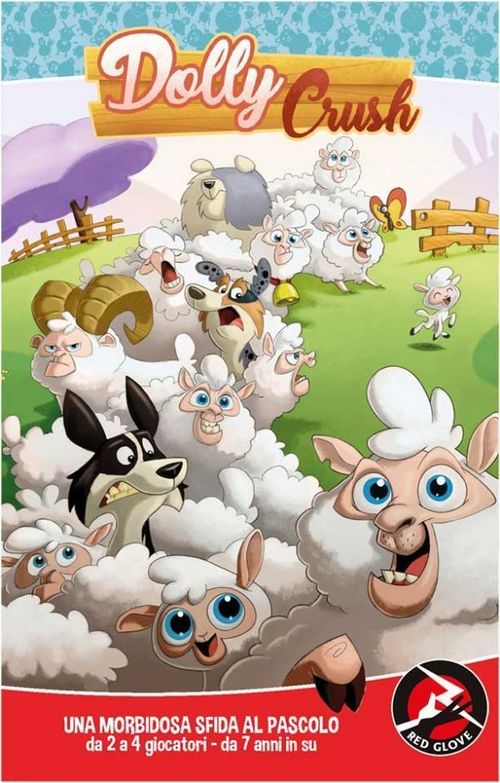
Dolly Crush
Dolly Crush Rulebook
Table of Contents
Table of Contents
Object of the Game
In Dolly Crush you are faced with a flock of wild sheep: you must herd as many of them as possible back to the sheepfold with the help of your sheepdog. How? By swapping two adjacent sheep, you try to line up three or more sheep of the same type so you can take them. The player who has collected the most sheep at the end of the game wins.
Contents
- 16 Dog cards, divided into 4 different breeds, one set of 4 per player:
- Pastore Maremmano
- Australian Shepherd
- Bobtail
- Border Collie
- 100 Sheep cards, divided into 5 different types:
- Campanella (Bell)
- Agnello (Lamb)
- Farfalla (Butterfly)
- Fiore (Flower)
- Montone (Ram)
Each Sheep can be white or black, independently of its type. When the rulebook speaks of sheep of the same type, colour is never meant: sheep of the same type are matched regardless of colour.
Setup
- Separate the Dog cards from the Sheep cards. Each player chooses their favourite breed of dog and takes the corresponding set of 4 cards.
- Shuffle the Sheep cards to form a deck (the Sheep deck) and place it face down on the table.
- Draw Sheep cards one at a time and place them face up on the table, next to each other, to form a 3 x 5 grid of cards as shown in the rulebook (page 2, figure 1). This grid is called the flock (Gregge).
- Check whether the flock contains a line of three or more Sheep of the same type (regardless of colour), horizontally or vertically (figure 2). If so, remove those cards from the flock (figure 3) and replace them with new cards from the Sheep deck (figure 4). Then shuffle the removed cards back into the Sheep deck.
- Repeat this step if, after replacement, three or more Sheep of the same type are again in line. Otherwise, you are ready to play.
Playing the Game
Dolly Crush is played in turns, one player at a time, clockwise. The starting player is the one who best imitates the bleat of a sheep.
On your turn:
- Choose a Dog card. Choose one of your four Dog cards and show it to all players. Each Dog card shows one or more swap icons. Each icon represents one swap.
- Swap. A swap means exchanging the positions of two adjacent Sheep cards in the flock, either horizontally or vertically (figure 5).
- It is allowed to swap the same card more than once.
- It is not allowed to perform fewer swaps than the number of icons shown on the Dog card played.
- Note: the number of swaps is taken from the icons printed on the breed's card art (figure 5 shows a 1-swap card). Pastore Maremmano: 1 swap. Australian Shepherd: 4 swaps. Bobtail: 1 swap. Border Collie: 1 swap.
- Take the combinations. When all the swaps are made, if the player has lined up three or more Sheep of the same type (regardless of colour), the player takes all the cards of every combination made. These are placed in a face-down pile together with the Dog card used (figure 6). Those Sheep are worth points at the end of the game: 1 point per white Sheep and 2 points per black Sheep.
- Note: a card may belong to more than one line. In that case the player takes all the cards in the lines. For example, figure 7 shows a case where the player takes 8 Sheep cards in total.
- Refill the flock. The player fills the empty spaces of the flock with new Sheep cards drawn from the Sheep deck (figure 8).
- If, during the refill, three or more Sheep of the same type are lined up, replace them with other cards from the deck, as explained under Setup.
- End the turn. Pass the turn to the player on your left.
End of the Game
The game continues until all Dog cards have been played (4 turns for each player), or until the Sheep cards run out.
Scoring
At the end of the game, each player takes the Sheep cards they have collected and counts their points:
- 1 point for each white Sheep;
- 2 points for each black Sheep;
- Dog cards are worth no points.
The player with the most points wins the game.
Example scoring from the rulebook (the printed sum for each set of cards):
- 8 Sheep worth 1, 1, 2, 1, 1, 1, 1, 1 points: 9 points in total.
- 7 Sheep worth 2, 1, 1, 2, 1, 2, 2 points: 11 points in total.