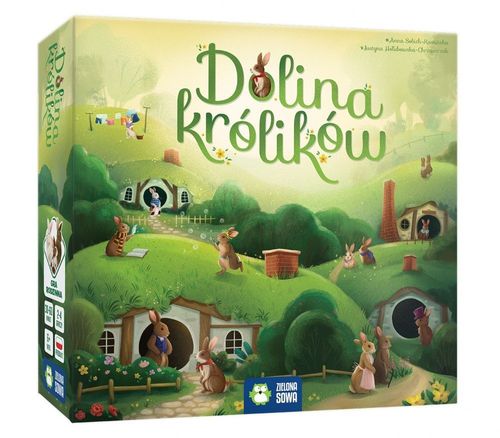
Dolina królików
Dolina królików Rulebook
Table of Contents
Table of Contents
Game Components
- 51 Rabbit cards
- 16 House cards
- 9 Forest cards
- 4 Help cards
- 1 Round marker
- 1 First Player marker
- 8 Position markers (numbered 1-8)
- 60 Resource tokens (20 Carrots, 20 Cabbages, 20 Cornflowers)
- 12 Player markers (3 purple, 3 red, 3 orange, 3 yellow)
- 1 Garden board (with a round track)
- 9 dice (3 orange, 3 green, 3 blue)
Game Setup
-
Place the Resource tokens on the Garden board: Carrot tokens on the carrot space, Cornflower tokens on the cornflower space, Cabbage tokens on the cabbage space (1).
-
Place the Round marker on the first space of the round track (2). The game lasts 8 rounds if 2 or 4 players are playing. A game for 3 players lasts 9 rounds.
-
Lay out the Position markers next to the board. Shuffle the Rabbit cards thoroughly, then place 8 face-up Rabbit cards next to the Position markers (3). Make a face-down stack from the remaining Rabbit cards (4).
-
Place the dice near the play area (5).
-
Shuffle the Forest cards and the House cards separately. Each player receives 2 Forest cards and:
- 4 House cards - in a 2-player game,
- 3 House cards - in a 3- or 4-player game.
Now, in secret, decide which cards you want to keep. Each player must discard 1 Forest card (a player may have only 1 such card) and may (but does not have to) discard 1 House card. Then decide whether you prefer to play with cards face down or face up (playing with face-up cards is recommended if you are playing with less experienced players). Place the chosen cards in front of you (6). Put the remaining Forest cards back in the box (they will not be needed any more), and make a face-down stack of the House cards (7).
If, after receiving the cards, a player notices that both of their Forest cards are mutually exclusive with their Houses, they may wait until the other players have discarded their Forest cards, then shuffle those with the ones that were left over and draw 2 more. The player must keep 1 of these cards.
-
Hand out the remaining components - each player receives a Help card (8) and 3 Player markers in one colour (9). Put the unused Help cards and Player markers back in the box.
-
Choose the first player (e.g. the player with the longest ears) - this player receives the First Player marker (10) and begins the game.
Object of the Game
The aim of the game is to score as many victory points (VP) as possible. Players earn VP for creating rabbit Families and for completed missions from Forest and House cards. Detailed information can be found in the sections: Creating a Family (Tworzenie Rodziny), Mission Cards (Karty Misji) and Ending the Game (Zakończenie).
ORANGE BOXES contain additional rules that are worth introducing only after playing a few games, especially if some of the players are only just starting their adventure with more difficult games. The additional rules concern creating a Family (section Creating a Family) and the final scoring (section Ending the Game). Introducing the additional rules increases the strategic potential of the game and makes winning a bigger challenge.
Course of the Game
Each round consists of 3 phases:
- DICE SELECTION.
- ACQUIRING A RABBIT.
- DISCARDING RESOURCES AND ENDING THE ROUND.
Dice Selection
- The first player rolls all the dice.
- Starting with the first player and then proceeding clockwise, each player chooses 1 die of their choice. The die must be used immediately. The player may:
- PLACE THE DIE ON A RABBIT CARD. The player places the die on the card of the chosen Rabbit and adds their marker. In this way they start acquiring the Rabbit. Details are in the section Acquiring a Rabbit. ATTENTION! PLAYERS MAY NOT PLACE THEIR DICE ON CARDS ON WHICH OTHER PLAYERS' MARKERS LIE.
- EXCHANGE THE DIE FOR RESOURCE TOKENS. The colour of the die indicates the type of resource, and the number of pips - the number of tokens to take from the Garden; e.g. a die showing 4 pips is 4 Carrot tokens. To take Resource tokens, the player places the die in the Garden and takes the proper number of tokens from the appropriate space.
- In the same order, players repeat the die selection action. If 2 players are playing, dice selection is made a third time. In a round a player will get a total of 3 dice (2-player game) or 2 dice (3- or 4-player game).
- After dice selection is finished, the first player takes 1 of the dice remaining on the table and decides whether to use its number of pips or its colour.
- If they choose the colour of the die, each player receives 1 Resource token from the Garden in the colour of that die. The number of pips on the die does not matter, players always receive 1 token.
- If they choose the number of pips on the die, they may, but do not have to, exchange 1 Rabbit card. They exchange the card that is at the position indicated by the number of pips on the die. Exchange applies to Rabbit cards marked with Position tokens from 1 to 6. A card can be exchanged only if no Player marker lies on it.
Acquiring a Rabbit
Players acquire Rabbits by choosing dice from the available pool. When acquiring a Rabbit, one must take into account the colour of the dice and the number of pips. Small Rabbits are acquired for 1 die, and Large Rabbits for 2 dice. If the dice on a card are separated by a "/", it means that the given Rabbit can be acquired in two ways. The results on the dice can be modified with Resource tokens, see section Modifying Dice.
Example. This Rabbit card can be acquired in two ways. First way: the player places on the card a blue die with 1 pip and a die of any colour with 2 pips. Second way: the player places on the card 2 dice with any number of pips, but both must be green.
LARGE RABBIT (white, brown, spotted).
SMALL RABBIT (white, brown, spotted).
After the Acquiring a Rabbit phase, players remove the dice and their markers from the Rabbit cards and take the acquired Rabbits, arranging them in their Houses so that the colour and type of the Rabbit are visible to other players. Resources that lay on the Rabbit cards return to the Garden.
ATTENTION! A RABBIT THAT HAS ALREADY GONE TO A HOUSE STAYS THERE UNTIL THE END OF THE GAME (RABBITS CANNOT BE MOVED BETWEEN HOUSE CARDS).
If a player did not acquire the Rabbit they were trying for, they remove from that Rabbit's card the die, their marker and the Resource tokens. The Resources go to the Garden (not to the player). The Rabbit card stays at its position, and in the next round the Rabbit can be acquired by any player.
Creating a Family
Players acquire cards of Small and Large Rabbits and then create Families from them. A player may have as many Families as they have House cards. A Family is at least 2 Rabbits, gathered according to the rules below. A Family is made up of:
- 2 LARGE RABBITS,
- 2 LARGE RABBITS AND ANY NUMBER OF SMALL RABBITS,
- 1 LARGE RABBIT AND 1 SMALL RABBIT,
- 1 LARGE RABBIT AND ANY NUMBER OF SMALL RABBITS.
ORANGE BOX (additional rule): IN EVERY FAMILY BOTH SMALL AND LARGE RABBITS MUST HAVE COLOURS COMPLYING WITH THE TABLE BELOW.
Table (read from the printed illustration). Rows and columns are the colours of the first two Rabbits in the Family (white, brown, spotted); each cell shows the colour(s) of Rabbits that may be added:
| white | brown | spotted | |
|---|---|---|---|
| white | white | spotted | white, spotted |
| brown | spotted | brown | spotted, brown |
| spotted | white, spotted | spotted, brown | brown, spotted, white |
Example. Koniczynka's Family consists of a white, a spotted and a white Rabbit (as shown). According to the colouring in the table, Koniczynka may add to the Family only: (the two icons shown) or white.
Mission Cards
Players also earn VP for completing missions from Mission cards. Mission cards are Forest cards and House cards.
Each player has 1 Forest card (main mission), which concerns all the Rabbits they have in Families, and several House cards (side missions), which concern only the Family living in the given House (e.g. all Rabbits in the House must be brown).
ATTENTION! AN UNCOMPLETED MISSION CARD MEANS NEGATIVE POINTS OR NO POINTS AT THE END OF THE GAME!
At the beginning of each round players may (but do not have to) draw new House cards. A player receives 2 House cards and chooses one of them. The discarded card returns to the House card stack, which must be shuffled. If 2 House cards are not available, the player receives only 1 card and cannot discard it.
Each player may have at most:
- 5 House cards (in a 2-player game).
- 4 House cards (in a 3- or 4-player game).
ATTENTION! PLAYERS DO NOT DRAW NEW FOREST CARDS DURING THE GAME.
Modifying Dice
If a player already has Resource tokens (Carrot, Cabbage, Cornflower tokens), then before choosing one of the rolled dice they may modify the result on that die so as to acquire the chosen Rabbit.
2 TOKENS OF THE SAME RESOURCE CHANGE THE COLOUR OF THE ROLLED DIE TO THE COLOUR OF THE RESOURCE, BUT DO NOT MODIFY THE NUMBER OF PIPS ROLLED.
Example. Szaruś needs a blue die with 4 pips. But an orange die with that result is available. So Szaruś places on the card a blue die and 2 Cornflower tokens. In this way he changes the colour of the die to the required one.
2 ANY RESOURCE TOKENS ADD OR SUBTRACT 1 PIP ON THE CHOSEN DIE, BUT DO NOT MODIFY ITS COLOUR.
Example. Szaruś needs a green die with 1 pip. But a green die with 2 pips is available. Szaruś places the green die on the card and adds to it 1 Carrot token and 1 Cornflower token. In this way he lowers the number of pips by 1.
A player may use any number of Resource tokens in one move, i.e. may e.g. modify both the colour and the number of pips on a die as needed. However, they must have the number of Resource tokens required for the modification.
ATTENTION! MODIFICATION WITH RESOURCE TOKENS IS POSSIBLE ONLY WHEN THE PLAYER IS ACQUIRING A RABBIT. A PLAYER MAY NOT USE RESOURCE TOKENS TO ACQUIRE MORE TOKENS.
Exchanging Wanderer Rabbit Cards
Players cannot exchange Rabbit cards that are already in Houses. If a player acquired a Rabbit card that they cannot attach to any of their Houses, they take it and place it in front of themselves - it becomes a Wanderer Rabbit card (Królik Włóczykij). If the player already has 2 such cards, they may exchange them for 1 Rabbit of their choice available on the table. An available Rabbit is one on which no player's marker lies.
Exchanging Wanderer Rabbit cards is an additional action that can be performed before one's normal move, i.e. before choosing a die. The cards of used Wanderer Rabbits go to the face-down deck of Rabbit cards (the deck must be shuffled).
A player may have only 2 Wanderer Rabbits at a time. Every further non-fitting Rabbit card goes straight to the face-down deck (shuffle the deck).
A player may add their Wanderer Rabbit only to a new House card, if they happen to draw one that it fits.
Markings on Rabbit Cards
The markings on the Rabbit cards specify which dice are needed to acquire a particular Rabbit.
- A die in the indicated colour, with any number of pips.
- A die in the indicated colour and with a specified number of pips.
- A die in any colour, but with a specified number of pips.
- 2 dice in the same, any colour, each with a different number of pips.
- 2 dice in different colours, but with the same number of pips.
Discarding Resources and Ending the Round
- Players must discard excess Resource tokens they hold. At the end of the round players may have only:
- 2 tokens of one type of Resource and a total of 6 tokens - if 2 or 3 players are playing,
- 3 tokens of one type of Resource and a total of 9 tokens - if 4 players are playing.
- The first player fills the empty Positions with new Rabbit cards from the Rabbit card stack, moves the Round marker to the next space and passes the First Player marker to the person on their left.
Ending the Game (Zakończenie)
The game ends after:
- 8 rounds - if 2 or 4 players are playing,
- 9 rounds - if 3 players are playing.
Then players count their VP according to the table below. The player who earned the most VP wins. In case of a tie, the player who additionally collected the most Resource tokens wins.
| Task | VP earned or lost | Advanced players (orange column) |
|---|---|---|
| 2 or 3 Rabbits in a Family | +1 | +1 |
| 4 Rabbits in a Family | +2 | +2 |
| 5 or more Rabbits in a Family | +3 | +3 |
| 2 Large Rabbits in a Family | +1 | +1 |
| Completed mission from a Forest card | +5 | +5 |
| Uncompleted mission from a Forest card | 0 | 0 |
| Completed mission from a House card | +2 | +2 |
| Uncompleted mission from a House card | 0 | -2 |
Example House/Forest card missions shown in the rulebook: at least 1 brown Rabbit in every Family (Large or Small); only brown Rabbits in a Family; at least 3 white Rabbits in a Family; only 3 Rabbits in a Family, each Rabbit in a different colour.
Example. Łatek earned:
- 5 points for a completed mission from a Forest card,
- 6 points for 3 completed missions from House cards,
- 1 point each for 2 three-Rabbit Families,
- 3 points for a five-Rabbit Family,
- 1 point for a Family with 2 Large Rabbits.
In total he scored 17 points.
5 + 6 + 2 + 3 + 1 = 17