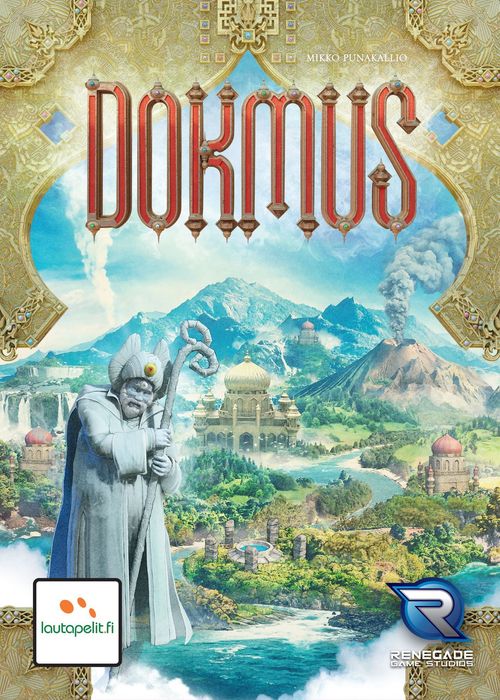
Dokmus
Dokmus Rulebook
Table of Contents
Table of Contents
Components
- 1 rule booklet
- 6 quick reference guides
- 8 double-sided map tiles
- 5 guardian cards
- 1 talisman (first player marker)
- 1 victory point track
- 1 score cube in each of 4 different colours
- 25 tokens in each of 4 different colours
Goal of the Game
The goal of the game is to get the most victory points. Players gain victory points by placing tokens on ruins or next to temples, and by sacrificing tokens.
Setup
Shuffle the eight map tiles and set them in a 3x3 grid, so that the middle space of the grid is left empty. This is the game board.
Each player chooses a colour and takes 25 tokens of the chosen colour.
Put the victory point track next to the game board. Take the score cube for each player and put them next to the track.
Choose a player to go first. You can select a random player by using the guardian cards. Give the talisman and all guardian cards to the chosen player. The player who has the talisman will be the first to choose one of the guardian cards on any given round. Note that the talisman can change owners during the game; it is possible for the turn order to change each round.
Each player chooses their starting position. The player sitting to the right of the player with the talisman chooses their starting position first. Continue counterclockwise, so that the player with the talisman chooses their starting position last. To choose a position, the player places one of their tokens on one of the four corner map tiles. The player cannot choose a map tile that already has a token on it. The starting token must be placed on a meadow or on a forest space on one of the outer edges (map tile edge that is not adjacent to another map tile).
Playing the Game
The game is played over 8 rounds. Each round consists of the following phases:
- Phase 1: Guardian card selection
- Phase 2: Player turns
- Phase 3: End of the round
After the 8th round players calculate their score and the winner is announced.
Phase 1: Guardian card selection
Starting with the player with the talisman, guardian selection proceeds clockwise around the table. The player secretly selects a guardian and passes the remaining cards to the next player. The selection continues in this way until all players have selected a guardian. The remaining cards are set aside, face down, so that the players cannot see which cards were not chosen.
Phase 2: Player turns
Players play their turns in the order specified by the selected guardian cards. The player with guardian card #1 reveals it and plays their turn first. If no player has card #1, the player with card #2 starts, etc. After a player's turn ends, the player with the next guardian card in order reveals it and plays their turn. After the last player has played their turn, the round ends.
Each player has three tokens to use during their turn, either to place on the board or sacrifice for terrain. Players also have one guardian action to use, as shown on the guardian card they selected. Players can perform the actions in any order they want. For example, a player can start by placing a token on the board, then play the guardian action and finally place the two remaining tokens on the board.
A player must use all three tokens each turn. The guardian action is optional. If a player does not use it, it is lost.
Phase 3: End of the round
Collect the guardian cards in a single pile and give the pile to the player with the talisman. After this, the next round starts.
Placing Tokens
Players have three tokens to use on each of their turns. A token can either be placed on the board or sacrificed for terrain.
Tokens are placed on the board one at a time. Each token has to be placed horizontally or vertically adjacent to one of the player's tokens already on the board. Players cannot place a token on a space that already contains a token, regardless of who owns the token on the board. A token can only be placed on a meadow, forest, ruin or volcano space.
A token can never be placed on a mountain, water or a temple space.
Adjacent space: any space horizontally or vertically (but not diagonally) adjacent to a given space.
Sacrificing a token: Take one of the player's three tokens for that turn and put it in the sacrifice area. The sacrifice area is part of the victory point track and it is shared by all the players.
If the player does not have tokens left for their turn, they can't place a token that requires sacrificing another token.
In the very rare case that a player can't place a token legally on any of the map tiles, that player can place their token on any empty meadow, forest, ruin or volcano space on any map tile.
Terrain Effects for Placing Tokens
Meadow: No special effects.
Mountain: A token cannot be placed on a mountain.
Volcano: A token that is on a volcano at the end of a player's turn is removed from the board and put into the sacrifice area. Players can use volcano spaces to reach places they couldn't otherwise reach or just to sacrifice tokens.
Temple (small or large): A token cannot be placed on a temple. Temple spaces act as connectors for the purpose of placing new tokens. Having a token adjacent to a temple allows that player to place tokens on other legal spaces that are adjacent to that same temple. Players can also move a token that is next to a temple to another space next to that temple with the Guardian action "Move a token". If two temples are adjacent to each other, players can move or place their token adjacent to either of them.
Forest: When placing a token on a forest, the player has to sacrifice one of their three tokens for that turn. The player does not have to sacrifice a token, if any of the following is true:
a) The player has a token on an adjacent forest space b) The player has a token on a forest space that is adjacent to a temple which is itself beside the forest space where the player is placing a token. c) The player is crossing a waterway d) The player is using the "Move a token" guardian action to move their token.
Water: A token cannot be placed on a water space. If the player has a token adjacent to a water space, the player can cross the waterway. To cross the waterway, the player sacrifices one of their three tokens for that turn and then places a token either:
a) On a space that is adjacent to any water space on that waterway b) On a space adjacent to a temple that is adjacent to the waterway the player is crossing
The waterway consists of all water spaces that touch horizontally or vertically, even if the water space is on a different map tile. The player cannot place a token on a mountain, temple, or water space this way. If the player places a token on a forest this way, that player does not have to sacrifice an additional token.
If the player has a token adjacent to a temple that is adjacent to a water space, the player can cross that waterway as if they were adjacent to the water.
Ruins: Players can place a token on ruins normally. A token that is placed on ruins can never be moved away from that space. When a player places a token on ruins, that player may immediately perform one extra guardian action. The player can choose:
- "Move a map tile": The player may move the map tile, on which they placed a token on ruins. The map tile can be moved in a straight line horizontally or vertically, so that it moves into the empty slot in the grid. The map tile can move over another map tile on its way to the empty slot. If the map tile can't be moved, meaning it doesn't lie on a straight line horizontally or vertically to the empty slot, the player can't choose this action. The map tile cannot be rotated during this action.
- "Move a token": The player may move one of their tokens from a meadow, forest or volcano to an adjacent empty space containing a meadow, forest, volcano or ruins. The token cannot be moved across a waterway. The token that is moved must be on the same map tile on which the player placed a token on ruins. The player can move a token to another map tile this way.
- "Rotate a map tile": The player may rotate the map tile on which they placed a token on ruins, either 90 degrees clockwise or counterclockwise.
The player can choose not to use the extra guardian action, in this case the extra action is lost.
Guardian Actions
Guardian #1: Take the talisman — The player takes the talisman and becomes the new first player.
Guardian #2: Move a map tile — The player may move one of the map tiles in a straight line horizontally or vertically, so that it moves into the empty slot on the grid. The map tile can move over another map tile on its way to the empty slot. This means that there are always four map tiles that can be moved and four map tiles that can't be moved. The map tile cannot be rotated during this action.
Guardian #3: Move a token — The player may move one of their tokens from a meadow, forest or volcano to an adjacent empty space containing a meadow, forest, volcano or ruins. The token cannot be moved across a waterway. If the token is on a space adjacent to a temple (or two temples adjacent to each other), the player can move to an empty legal space adjacent to the temple(s). If the player moves a token to a forest space, they do not sacrifice an additional token. The player can move a token to another map tile this way.
Guardian #4: Rotate a map tile — The player may rotate any one map tile 90 degrees clockwise or counterclockwise.
Guardian #5: Perform Guardian action 2/3/4 — The player may perform any one of the guardian actions numbered 2, 3, or 4.
End of the Game
The game ends after 8 rounds. Players will run out of tokens at the end of their 8th turn, so there is no need to keep track of turns in any other way. Players use the victory point track to calculate their scores. The player with the most victory points is declared the winner. In case of a tie, the player with more sacrificed tokens wins the tie.
End Scoring
Ruins
Token on a space with ruins: 1 VP
Temples
A temple is considered discovered if a player has a token on a space horizontally or vertically adjacent to that temple, even if the token is on a different map tile. A temple can be discovered by multiple players. Players get points per temple, not per token adjacent to a temple. Players get points for discovered temples in four different ways.
- Small temple discovered: 2 VP
- Large temple discovered: 3 VP
- Each map tile on which a player discovered all temples: 8 VP
- Count the amount of different map tiles on which the player has at least one discovered temple. Players get points based on the chart below:
| Number of map tiles with at least 1 discovered temple | 1 | 2 | 3 | 4 | 5 | 6 | 7 | 8 |
|---|---|---|---|---|---|---|---|---|
| Victory points | 1 | 3 | 6 | 10 | 14 | 18 | 22 | 27 |
Sacrificed tokens
Players get points for having sacrificed more tokens than others, according to the table below. A player scores zero VP in this category if they did not sacrifice any tokens. In case of a tie, players receive full points for their position.
Victory points based on the number of sacrificed tokens:
| Players | Most | Second | Third | Fourth |
|---|---|---|---|---|
| 2 | 3 | 0 | X | X |
| 3 | 4 | 2 | 0 | X |
| 4 | 5 | 3 | 1 | 0 |
Special Rules for a Two-Player Game
Setup and Game Play
Shuffle the eight map tiles and set five of them in a 2x3 grid, so that the middle space of the upper row on the grid is left empty. Starting positions can be chosen on any of the four corner map tiles.
Use the guardian cards numbered 2, 3, and 4 only.
The talisman is given to the other player at the end of each round.
End Scoring
Each map tile on which the player discovered all temples: 5 VP
All other rules remain unchanged.