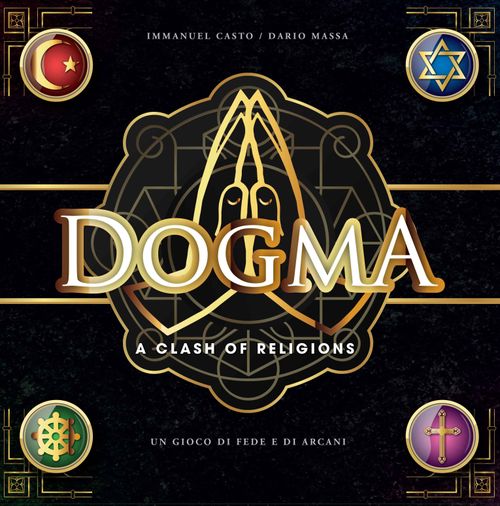
Dogma: A Clash of Religions
Dogma: A Clash of Religions Rulebook
Table of Contents
Table of Contents
1. Components
Prophets
Prophets are the protagonists of the game. Each Prophet has a set amount of Faith points, representing its resilience. When a Prophet's Faith is reduced to zero, that Prophet is defeated. Fervor instead determines how fast the Prophet acts relative to the opposing Prophet.
Prophets may have immunities and/or weaknesses, as well as a unique personal ability. Each card also states the restrictions for building its sleeve (bustina).
Example: in Al Jafar's sleeve it is possible to insert Islamic Cult cards of type Doctrine and Custom, and Buddhist Cult cards of type Doctrine.
Example card (Al Jafar, "Caliph Unifier"): Faith 120, Fervor 60. Unique ability, "Diplomatic Genius" (Genio diplomatico): Every time it returns to the rear guard, remove 50 damage from Al Jafar.
Cult cards
In each sleeve you may place up to 3 Cult cards. Each Cult card shows its type, its religion, its effect and, where applicable, the amount of damage the card inflicts on opposing Prophets.
Cult cards are divided into 4 types:
- Sacred Text (Testo sacro)
- Doctrine (Dottrina)
- Faithful (Fedeli)
- Custom (Usanza)
The card's labelled parts are: Type; Damage; Religion; Effect; and thematic text, which has no effect on the game.
Example card (Sunna): Damage 10. Effect: Revealed. If this Prophet has no damage markers on them, this Cult card inflicts 100 damage instead of 10.
Relics
Relics may be equipped by Prophets to strengthen them, protect them, or grant additional abilities.
Example card (Lancia di Longino, "Spear of Longinus"): Cult cards associated with this Prophet that inflict damage inflict 40 additional damage.
Orders
Orders are used by players to plan their actions in secret. Each Order is a token with a symbol, and the Order tokens carry the numbers I, II and III.
Orders are used in three steps: Place the Order (Posizionare l'ordine), Reveal the Order (Rivelare l'ordine), and Apply the Order (Applicare l'ordine).
Enhancement and weakening markers
Enhancement markers (Potenziamento) are marked +10; weakening markers (Indebolimento) are marked -10. They modify the printed value of certain cards, such as a Prophet's Fervor or the damage inflicted by Cult cards.
Damage markers
Damage markers represent damage inflicted on Prophets. One side shows 10 damage, the other side shows 40 damage.
Divine Interventions
Divine Interventions are cards with an instant effect which players may invoke during the clash.
Example card (Pioggia di Fuoco, "Rain of Fire"): Deal 20 damage to all opposing Prophets.
Malefic markers
Malefic markers (Segnalini malefici) represent negative effects that can strike Prophets during the game. There are four kinds, each shown with its own icon: Mystical Crisis (spiral), Fanaticism (bomb), Hysteria (lightning) and Withering (ring). They are explained under "Keywords and malefic markers" in section 4.
2. Setup
Before the clash, each player must assemble 5 packets of 4 cards each, called Arcana (singular: Arcanum). 4 Arcana will each contain 1 Prophet and 3 associated cards, in any combination of Cult cards and Relics. The remaining Arcanum will contain the Divine Interventions, which players may invoke during the battle.
Advice: to build the Arcana and make them easier to control during play, it is recommended to use one sleeve (bustina) for each Arcanum, holding its 4 cards. Dogma: A Clash of Religions can, however, be played without sleeves.
2.1 Construction modes
Building your Arcana is the strategic heart of the game. The outcome of the clash that follows will be largely determined by the choices the players make in this phase.
To build your team of 5 Arcana you may choose one of 3 construction modes:
- Chaos mode (Modalità Chaos): the main mode, in which players build their Arcana at the same time, with the cards available to them.
- Predestination mode (Modalità Predestinazione, introductory games): this mode does not let players build their own Arcana. It is recommended for learning the basic mechanics of the clash before tackling Arcana construction.
- Free Will mode (Modalità Libero Arbitrio, tournaments): players build their Arcana by freely choosing their preferred Prophets and the cards to assign to them from among all those available in the box, aiming to find the strongest combinations.
2.1.1 Chaos mode
Shuffle the Prophets together, and shuffle together the Cult cards, Relics and Divine Interventions.
Then lay out on the table 12 packets (mazzetti), each made of 2 Prophets and 7 other cards. Each packet is a random mix of Cult cards, Relics and Divine Interventions, with the card backs facing up.
Return the remaining cards to the box. They will not be used in this game.
Players take the first packet to their left, examine it and choose all the cards they want. Each selected card is immediately placed in one of the packets called Arcana, following the construction rules above (4 Arcana contain 1 Prophet and 3 associated cards, and 1 Arcanum contains 4 Divine Interventions).
Warning: once a card has been placed in an Arcanum, it can no longer be removed!
It is advisable to select your Prophets first and then look for Cult cards that can be associated with them, but nothing prevents you from starting to build an Arcanum from a Cult card. Remember, however, that you may then fail to find a Prophet able to use it.
When both players have examined the first packet, they place it on the table and move on to the next one. A player may not examine the next packet until the other player has finished examining the packet in hand.
When a player has completed all 5 of their Arcana, they declare their preparation phase concluded. The other player may then examine only one additional packet, besides the one in hand. If that player wishes to continue their preparation phase, they must place 20 damage in front of themselves for each additional packet they wish to examine. This player may also declare their preparation phase concluded even if their 5 Arcana are not complete, provided that they have selected at least 4 Prophets with 1 associated card each.
If a player has damage in front of them when the Opening phase begins (see the Opening section below), they must place it on the first Prophet they choose to deploy.
Note: for players not yet familiar with the cards, this construction phase will take some time. (Rome, after all, was not built in a day.)
2.1.2 Predestination mode
This mode, recommended only for the first games, does not let players build their own Arcana. Players instead choose one of the following Predestination options and build their Arcana as indicated. To make this easier, each card shows, at the bottom right, the matching symbol and the sleeve in which it is to be placed.
Each option below lists, for each of the four Arcana (numbered 1 to 4), one Prophet and three associated cards, and then the Divine Interventions for the fifth Arcanum.
Journey to "Mecca" (Viaggio a "La Mecca")
| Arcanum | 1 | 2 | 3 | 4 | Divine Interventions |
|---|---|---|---|---|---|
| Prophet and cards | Al Jafar, Hajj, Samsara, Vacuità | Maometto, Corano Hizb, Sunniti, Allah Akbar | Il Primo Shahid Dimenticato, Sawm, Ramadan, Guerra Santa | Shirin, Ibaditi, Sunna, Hadith | Pioggia di Fuoco; Tramutazione dell'acqua in sangue; Tramutazione dell'acqua in sangue; Esorcismo |
Storm of Miracles (Tempesta di miracoli)
| Arcanum | 1 | 2 | 3 | 4 | Divine Interventions |
|---|---|---|---|---|---|
| Prophet and cards | Khadija, Shahada, Salat, Purificazione | Chimera, Eucarestia, Masoreti, Reliquia: Santo Graal | Rabbì Akiva, Mishnah, Koan, Rabbi | Goffredo, Crociati, Movimento sacerdotale mariano, Penitenza | I Cavalieri dell'apocalisse; I Cavalieri dell'apocalisse; Diluvio Universale; Ruota del Dharma |
Unshakeable Faith (Fede incrollabile)
| Arcanum | 1 | 2 | 3 | 4 | Divine Interventions |
|---|---|---|---|---|---|
| Prophet and cards | Janami Raji, Tummo, Bodhisattva, Sangha | Il Saggio d'Oro, Arahant, 4 nobili verità, Karma | Giovanni Paolo IX, Antico Testamento, Salmi, Monaco Shaolin | Gesù, Trinità, Redenzione, Reliquia: Lancia di Longino | Urga Karma; Raggiungimento del Nirvana; Transustanzazione; Pioggia di Fuoco |
Knowledge and Madness (Conoscenza e follia)
| Arcanum | 1 | 2 | 3 | 4 | Divine Interventions |
|---|---|---|---|---|---|
| Prophet and cards | Agostino, Confessionum Libri XIII, Nevi'm, Sutra del Cuore | Hugues, Rogo, Martirio, Reliquia: Athar | San Francesco, Nuovo Testamento, Sutta Pitaka, Ketuvim | Cagliostro, Circoncisione, Esodo, Nobile Silenzio | Esorcismo; Urga Karma; Diluvio Universale; Ruota del Dharma |
2.1.3 Free Will mode
In this mode players build their Arcana by freely choosing their preferred Prophets and the cards to assign to them, from among all those available in the box, aiming to find the strongest combinations.
Note: this mode assumes that each player has their own copy of Dogma. To play this mode with only one copy of the game, randomly determine the player who will build their sleeves first; that player starts with 30 damage on the first Prophet they deploy.
3. Opening
Both players choose one Arcanum containing a Prophet and reveal its contents. That Prophet becomes their active Prophet (Profeta attivo). If a player accumulated damage during the preparation phase in Chaos mode, they must place it on this Prophet.
Cult cards are placed face down. The Arcana containing the other Prophets are placed in an area called the rear guard (retroguardia), with the card backs facing up.
The table layout is as follows:
- Relics: up to 3 Relics may be assigned to a Prophet.
- Active Prophet: the revealed Prophet chosen in the Opening.
- Cult cards: up to 3 Cult cards may be assigned to a Prophet. A Cult card may be kept face down until it is used, or until the players choose to reveal it for other game effects. Some Cult cards enter play already revealed, as explained later.
- Divine Interventions: the Divine Interventions Arcanum, kept face down.
- Discard pile (Pila degli scarti).
- Rear guard: the Arcana containing the Prophets who are still hidden, with their backs facing up.
- Order: the Order tokens (see Orders above).
4. The Clash: Orders
The mechanics of play are very simple. Each player secretly chooses their Order (ordine) by placing the matching Order token in front of them, face down. Then both players reveal the chosen Order simultaneously. The priority of the chosen Order determines which player resolves their Order first.
- If priorities are equal, the player whose active Prophet has the higher Fervor resolves their Order first.
- If Fervor is also equal, the Order effects are considered simultaneous.
- The players apply those effects in whatever way is most advantageous to them, without taking into account the Order chosen by the other player.
If one player's Order causes the defeat of the opposing active Prophet, or its withdrawal to the rear guard, the opponent may not use the Order they had programmed.
Each Order token has four symbols around a central numeral (I, II or III). The Order I token carries the "Priority" (Priorità) marker.
Phase I: Summoning (Convocazione) — Order I
With this Order, the player withdraws their active Prophet, placing it in the rear guard.
A Prophet in the rear guard keeps all the damage and Malefic markers accumulated during the clash, while any enhancement or weakening markers from its card and from its associated Cult cards are removed.
Prophets in the rear guard are not affected by any game effect, unless the text of a card specifies otherwise.
After moving the previous active Prophet to the rear guard, the player who chose the Summoning Order deploys as their new active Prophet the Prophet corresponding to the number chosen with the Order. The number corresponds to the position in which the Prophet was placed in the rear guard, counting from the left.
Example: the player has selected the Summoning Order and swaps their active Prophet with the second Prophet in the rear guard.
Since this action has priority over the others, it is particularly useful for saving your active Prophet from Cult cards to which it has a weakness.
Note: when a Prophet is placed in the rear guard, all the cards associated with it are gathered beneath its card.
Phase II: Divine Intervention (Intervento Divino) — Order II
This Order allows you to play the first card in the Divine Interventions sleeve, applying its effect.
The card cannot be chosen: only the first visible card in the Divine Interventions sleeve may be played.
Example: using the Divine Intervention Order, the player casts "Rain of Fire" (Pioggia di Fuoco). On the following turn, they may use the Divine Intervention that had been hidden beneath "Rain of Fire".
Appeal to Rationality (Appello alla Razionalità): only when the Divine Interventions sleeve has been emptied may this Order be played as an Appeal to Rationality. All active Prophets receive 30 damage. This extreme action may be useful when the forces in play have reached a stalemate.
The remaining symbols on the Order II token are not used in this phase, but only to pass a Fidelity Test (Prova di Fedeltà), explained under "Fidelity Test" in section 6.
Phase III: Cult Card (Carta Culto) — Order III
This Order activates the Cult card corresponding to the number chosen by the player (in the example, number 2), which corresponds to the position in which that Cult card was placed in front of the player, counting from the left.
That Cult card is revealed and its effect is described on the card itself.
Most Cult cards also inflict damage on the opposing Prophet, weakening its Faith. Damage is inflicted by placing the corresponding number of damage markers on the targeted Prophet. Immunities and weaknesses must be taken into account:
- A Prophet immune to a given type of Cult card cannot receive damage from that type of card.
- A Prophet with a weakness to a given type of Cult card receives double damage from that type of card.
Example: this Prophet is immune to damage from Doctrine Cult cards, but doubles the damage received from Sacred Text Cult cards. All other game effects (such as the assignment of malefic markers), by contrast, apply regardless of immunities.
When a Prophet receives an amount of damage equal to its Faith, that Prophet is defeated. Its card and all the cards associated with it must be placed in a discard pile.
If a player's active Prophet is defeated, that player must choose another Prophet to deploy at the start of their next turn, in the same way described in the Opening section.
Example: the player has selected the Cult card Order, activating the third card. They reveal that card and apply its effects.
Phase III: Special (Speciale) — Order III
With this Order it is possible to trigger the effect of a card bearing the atom icon, which is usually found in the ability of a Prophet or a Relic.
If a player controls several components bearing the atom icon, they may trigger only one of those effects, of their choice.
Keywords and malefic markers (Parole chiave e segnalini malefici)
- Revealed (Rivelata): a Cult card with the Revealed keyword is not placed face down; it is revealed immediately.
- Swift (Veloce): applies its effect before the opponent's action, even if, with equal priority of the chosen Orders, the opponent's active Prophet has a higher Fervor.
- Slow (Lenta): applies its effect after the opponent's action, even if, with equal priority of the chosen Orders, the opponent's active Prophet has a lower Fervor.
- Global (Globale): applies its effect to all revealed opposing Prophets, including those in the rear guard.
- Protection (Protezione): cancels all the damage received in the turn in which it is used.
- Arduous (Ardua): if a Cult card with the Arduous keyword is used during your turn, then in the following turn it is not possible to use any card with the Arduous keyword.
Malefic marker details
- Mystical Crisis (Crisi mistica, spiral icon): at the start of each turn, an active Prophet with this marker receives 10 damage to its Faith.
- Fanaticism (Fanatismo, bomb icon): the player who controls a Prophet with this marker may not select the "Divine Intervention" and "Summoning" Orders.
- Hysteria (Isteria, lightning icon): the player who controls an active Prophet with this marker selects and reveals their action before the opponent, allowing the opponent to take countermeasures.
- Withering (Struggimento, ring icon): when a Prophet receives this marker, its controller must place it on an associated Cult card of their choice. That card is considered out of the game and cannot be used or targeted by any effect. If the marker is removed, the card becomes usable again. If a Prophet affected by Withering is placed in the rear guard and later deployed again as the active Prophet, its controller must place the marker again on an associated Cult card of their choice.
5. End of the Game
The game ends when a player defeats all of the opponent's Prophets. The player who keeps at least one Prophet in play is the winner and may proclaim the birth of a new cult.
If the last Prophets in play of both players are defeated at the same time, the winner is the player whose last Prophet had the lower sum of initial Faith and Fervor. (Isn't it written that the last shall be first?)
5.1 Four-player games (2 vs 2)
Dogma can also be played with 4 people, divided into 2 teams of 2 players each. The rules remain unchanged, except for the following points.
Chaos mode construction: instead of laying out the 12 packets in 2 rows, arrange them in 4 rows of 3. Each player begins by examining the first packet of a row, then proceeds in the order shown in the layout diagram (Player 1 to Player 4).
End of game: the game ends when all the Prophets of one team have been defeated. Both members of the opposing team are declared winners, even if one of them has lost all of their Prophets.
Target selection (Scelta del bersaglio): during the Order selection phase, players must also place a second face-down token, called the Target (Bersaglio). This token indicates, at its two ends, which of the adjacent players the player intends to target: its ends are marked SX (left) and DX (right).
Members of the same team may consult each other freely to agree on which players to target.
When all 8 tokens have been placed (the 4 Order tokens and the 4 Target tokens), they are revealed simultaneously.
- If the Order is Summoning, the Target token has no effect, but it must still be placed.
- Otherwise, if the action undertaken targets an opposing player, that player is the one indicated by the Target token.
Example (in the diagram): the player has decided to target the opponent to their left.
6. Additional Rules
Fidelity Test (Prova di Fedeltà)
Some game effects require a Fidelity Test to be passed in order to be triggered, or allow the opponent to pass it in order to cancel them.
When a player attempts a Fidelity Test, the opponent takes the Order II token (the same one used to invoke a Divine Intervention) and selects one of three coloured spheres, face down, exactly as they would during the Order selection phase.
The rulebook's diagram labels three of the Order II symbols as Violence (Violenza), Rationality (Razionalità) and Blasphemy (Blasfemia).
The printed wording of this paragraph uses "the opponent" for both players' roles; the translation keeps that wording. The opponent has only one attempt to guess which path the opponent chose to test their faith. If the path named is the one that was selected, the test is passed.
Cancelling or copying Prophet abilities
Some game effects allow a Prophet's ability to be cancelled or copied. These effects never apply to abilities, or to the part of an ability, that concern the construction of the Prophet's Arcanum.
For example, if the ability of Elaine della Croce Bianca is cancelled, she does not discard the fourth Cult card, but she loses the ability to use it.
Defeated Prophets
When a Prophet is defeated, all the markers on it are discarded. If a game effect (for example the Relic "Sharira") returns a defeated Prophet to play, that Prophet returns without any of the markers it had before, unless the effect specifies otherwise.
7. Tips
Revealing the Order token
Since the token is perfectly symmetrical, it is important to reveal your choice precisely, to avoid ambiguity. The rulebook recommends revealing it in this way, in three steps:
- Place the Order (Posizionare l'ordine): place the token face down.
- Reveal the Order (Rivelare l'ordine): turn the token over around its vertical axis.
- Apply the Order (Applicare l'ordine): the selected sphere is marked as Selected Order (Ordine selezionato).
Using the Divine Interventions Arcanum
Like all Arcana, the Divine Interventions Arcanum does not need a sleeve to be assembled. In this case, take care to use the correct card, that is, the one at the bottom of the pile.
Example: the first Divine Intervention (the only one usable) is "Rain of Fire" (Pioggia di Fuoco).
Immunities and weaknesses
Immunities and weaknesses are a crucial aspect of the game. The Summoning Order, used to swap the active Prophet, is often used to nullify the action taken by the opponent. It is essential to take this into account when building your team.
8. Example of a Turn
Choosing the Order (Scelta dell'ordine): both players secretly choose which Order to execute, placing the Order token in front of them face down. When both tokens are placed, the players reveal them.
Reveal (Rivelazione): the players reveal the actions they have decided to take. Since the "Divine Intervention" action, chosen by player 2, has priority over the action that activates a Cult card, the player controlling Maisa executes their action first.
Divine Intervention (Intervento Divino): player 2 draws the first visible card in the Divine Interventions sleeve and applies its effects. In the example, the card is "Wheel of the Dharma" (Ruota del Dharma), which places 6 "+10" enhancement markers on the Fervor of their active Prophet.
Cult card I (Carta Culto I): player 1 activates their first Cult card, which inflicts 20 damage on the opposing active Prophet and adds a Mystical Crisis marker.
This action concludes the turn. The players move on to the next turn, starting again from the choice of the Order token.
9. Quick Reference (Breviario)
The rulebook closes with a summary of the Orders:
- Order I: Summoning (Convocazione): replace the active Prophet with the Prophet in the rear guard corresponding to the chosen number.
- Order II: Divine Intervention (Intervento Divino): use the first Divine Intervention in its Arcanum.
- Order II: Appeal to Rationality (Appello alla Razionalità): deal 30 damage to all Prophets in play. Usable only if the Divine Interventions Arcanum is empty.
- Order III: Cult Card (Carta Culto): activate the Cult card corresponding to the chosen number.
- Order III: Special (Speciale): activate an ability bearing the atom symbol.
Translator's note: the quick reference says the Appeal to Rationality deals 30 damage "to all Prophets in play", while section 4 says "all active Prophets receive 30 damage". Both wordings are transcribed as printed; section 4 is the fuller rule.