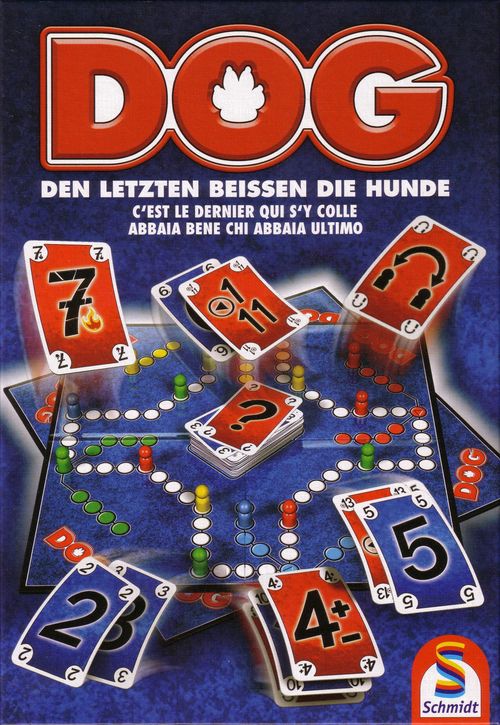
DOG
DOG Rulebook
Table of Contents
Table of Contents
Components
- Two-sided board, for 2-4 players on one side and 5-6 on the other
- 30 pawns – 5 each in 6 colors
- 110 cards – 8 each of blue standard movement cards: 2, 3, 5, 6, 8, 9, 10, 12
- 8 each of red special movement cards: 1/11, 4 ±, 7, 13, Swap
- 6 red Jokers (printed with '?' symbol)
- Rules in German, French and Italian
Preparation
Each player is assigned the color on the board closest to her seat and takes four pawns of that color, placing them on the four spaces in her kennel. Colors directly opposite one another are partners. Shuffle the entire deck and deal 6 cards to each player to be played in the first round. The remainder of the deck is set to the side of the board. Choose a starting player for the first round.
Playing the Game
The Round
The game is played in a series of rounds. A round consists of several turns for each player.
At the beginning of each round, each player is dealt a number of cards. As indicated above, in the first round players get six cards. In the next round, five cards are dealt, then four, then three, then two. After the round of two cards ends, six cards are dealt again and the cycle repeats in this manner throughout the game: 6, 5, 4, 3, 2, 6, 5, 4, 3, 2, 6, 5, 4, etc. It does not matter which player deals each round, but it is important that the role of starting player for each round pass clockwise.
Before any cards are played in a round, each player must choose a card from her hand to pass to her partner. The player selects a card and places it face down in front of her partner. A player may not look at the card passed to her until she has selected and passed a card herself. Players are not permitted to discuss what cards they would like to receive once they have looked at their own hands. Typically players pass cards that they can afford to give up and that will likely to be useful to their partners: for example, early in the game players often pass one of the cards that will allow movement out of the kennel (if they have another such card to keep for themselves). Once all players have taken their received cards into their hands, the starting player for the round takes her first turn.
The Turn
On a player's turn she chooses a card from her hand and plays it face up to the discard pile in the center of the board. She then moves a pawn (or for certain red cards, more than one pawn) according to the card played. Note that at any point during the game, in order for a player to move a pawn from her kennel to her start space, she must play a 1/11, 13, or Joker – see rules for cards below. After playing a card, she does not draw a new card – each round is played until all players' cards are played or discarded, after which cards are dealt for a new round.
If the player has at least one card in her hand that allows her to make a legal move (considering all options for movement of red cards), she must play a card, even if it is not to her advantage to do so. That is, she may not voluntarily forfeit her turn.
If she is unable to play any card, she must show the other players her hand to prove this. If any card is found to be playable, she must play it and the round continues normally. If she is correct that there are no playable cards, she discards her entire hand face up to the center of the board and sits out the remainder of the round. She will only be able to play cards and move pawns again once new cards are dealt for the next round.
Moving Pawns
Generally, cards allow movement of a player's own pawns a certain number of spaces. The entire number of spaces indicated must be moved if a card is played. If a player lands by exact count on another pawn, that pawn is returned to its kennel, even if it belongs to the moving player or the moving player's partner. Therefore, no two pawns may ever occupy the same space. Passing pawns is generally permitted without penalty to either pawn, with two exceptions: the 7 card "burns" passed pawns, and a pawn on its own start space is safe from capture and cannot be passed – see below.
The Cards
If pawns are referred to as "on the board" in the following instructions for cards, they are pawns that are neither in the kennel or the home area; in other words, on the common perimeter track used by all players. "Forward" refers to clockwise movement on the board (as indicated by the arrows on start spaces).
Blue cards (2, 3, 5, 6, 8, 9, 10, 12) – A blue card simply requires the player to move one pawn on the board exactly the number of spaces indicated on the card. If the player is unable to use the full movement of the card, it cannot be played.
All red cards have special movement abilities, as described below. A circled arrowhead on a card indicates that the card may be used to move a piece from the kennel to the start space.
1/11 card – The 1/11 card requires the player to move a pawn from her kennel to her start space, or move a pawn on the board 1 space forward, or move a pawn on the board 11 spaces forward.
4 ± card – The 4 ± card requires the player to move a pawn on the board four spaces forward or four spaces backward. If played when a pawn is 3 or fewer spaces beyond its start space, moving back 4 spaces greatly reduces the distance needed to get the pawn home.
7 card – The 7 card requires the player to move one pawn on the board 7 spaces, or to divide 7 spaces of forward movement among two or more pawns of her color. Any pawn that the player passes with any partial or full movement of the 7 card is sent back to its kennel, even if it belongs to the moving player or her partner (this ability to "burn" passed pieces is indicated by the flame symbol on the card). The 7 is the only card that can send pawns to the kennels without landing directly on them. The 7 may not be used to move a pawn out of the kennel.
13 card – The 13 card requires the player to move a pawn from her kennel to her start space, or move a pawn on the board 13 spaces.
Swap card – The Swap card requires the player to exchange one of the pawns of her color on the board with a pawn of another color (partner or opponent). She may not swap the pawn with another of her own color. Any pawn on its own start space (even if it belongs to the player whose turn it is) CANNOT be swapped.
Joker card – The Joker card is played to represent any other blue or red card of the player's choice. In other words, a player playing the Joker can move one pawn from her kennel to her start space; can move a pawn on the board any number of spaces from 1 to 13 (burning passed pawns if she moves 7); can move -4 spaces; can split moving 7 spaces among several pawns (burning passed pawns); or can Swap. In all cases, the player must follow all rules for the chosen card exactly as if she had played the card itself. A Joker can never be discarded, as a legal move will always be available to a player holding it.
End of a Round
When all players have played or discarded all cards in their hands, the round ends. The next round is dealt starting with the remainder of the deck from the previous round; the discard pile is not shuffled until its cards are needed to complete the current deal. Remember to deal the correct number of cards as detailed above, and that the role of starting player will pass to the left.
Special Board Areas
The Kennel consists of the four colored spaces leading to the start space. Pawns begin the game in the kennel, and can be moved to the start space by play of a 1/11, 13 or Joker card. Pawns in the kennel are considered to all be in the same position, so there is no significance to the order in which they exit.
The Start Space is the colored space with an arrowhead adjacent to the kennel. Any pawn that ended its previous turn on the start space must make its next forward move in the direction of the arrow, that is, it may not move into the home area. For this reason, a player after making a full circuit of the board should take care not to land directly on her own start space, as this will force the pawn to go around the board again, barring play of red cards.
A pawn on its own start space cannot be affected by other pawns in any way, and cannot be landed upon, passed or swapped by any player, including its owner. Therefore, a pawn on its own start space must be moved before another pawn of the same player can leave the kennel. Pawns on start spaces of other players are treated as if they were on any normal space, and can be landed upon (by, for example, a pawn moving out of that kennel), swapped, etc.
The Home Area consists of the colored spaces leading from the start space toward the center of the board. Each player is trying to fill the home area of her color with her pawns. The first team to get all four pawns of both players to their respective home areas wins the game. In order to move a pawn into the home area, a player must play a card that allows a pawn to move into an empty home area space by exact count from a space somewhere behind the home space. Pawns already in the home area may move forward to other empty spaces in the home area with play of an appropriately numbered card. It can happen that a player will be close to entering her home area, but only has cards in her hand that are too high to land her pawn in an empty home area space. In this case, she must play one such card and move past the starting space on the perimeter track, necessitating another circuit of the board.
Under no circumstances may a player's pawn enter an opponent's or partner's home area. Thus, all pawns in home areas are safe from being landed upon or swapped. Furthermore, if a player's only remaining playable card is a 4 ±, and all her pawns are either in the home area or the kennel, she is NOT required to move a pawn from the safety of the home area back out onto the board, but may instead discard her hand. This is the only situation in which a player may choose not to play a card when possible. Compiler's note: I am not positive of this rule – I was taught the game this way, but was unable to confirm it elsewhere – so I may have it wrong and a player is required to back out of the home area when it's the only option available. I think a case can be made for either way of playing.
When All Pawns of a Color Reach Home
Once one player of a partnership successfully moves all her pawns to her home area, she uses the remainder of her turns to help her partner get pawns home, by moving the partner's pawns on her turn as if they were her own. A player may use part of a 7 card to move her final pawn home, provided she can use the remainder of the 7 on a partner's pawn(s) in the same turn. When one or more teams have one partner with all pawns home, dealing and passing of cards continues normally. It is a great advantage to a team to have one partner finished, as the remaining player of the partnership now effectively has an extra play each turn. As in earlier stages of the game, partners may NOT disclose any information about cards they are holding to help their partners decide what card to play.
Winning the Game
The team that first moves all pawns of both players to the home areas wins!
Dog for 6 Players
The six-player game is usually played exactly as the four-player game, with 3 teams of 2 players each. Compiler's note: I have seen it suggested that six can play in 2 teams of 3, though I have not found rules governing how cards are passed in this arrangement. My house rule is to alternate passing between your left and right partners with each deal.
Dog for 2, 3 or 5 Players
A few different rules apply when playing the non-partnership game:
- Each player starts with five pawns: four in the kennel and one on the start space.
- At the beginning of each round, each player passes a card of her choice to the player on her left.
- If a player cannot play any of her cards on her turn, she is NOT forced to sit out the rest of the round as in the partnership game. Instead, she shows her hand to the other players to prove she cannot play, then discards one card of her choice and draws another. If this card can be played, she must now play it. If not, she again chooses one card to discard (so that she has the same number of cards as the other players), and her turn ends.
- The first player to get four of her five pawns home wins.