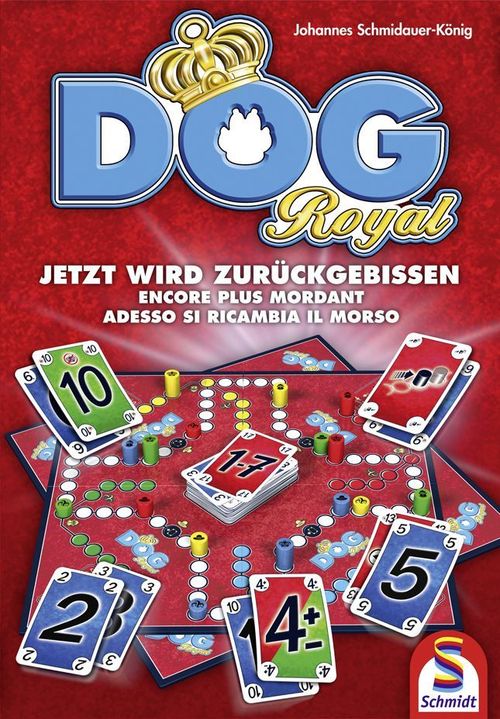
DOG Royal
DOG Royal Rulebook
Table of Contents
Table of Contents
Game Equipment
- 1 game board (double sided)
- 110 cards (10 cards 11, 10 and 13, 7 Cards 2, 3, 4, 5, 6, "1-7", 8, 9, 10, 12, "=" and "switch", 6 cards "magnet")
- 24 pieces (4 pieces per color: king, knight, citizen and jester)
Aim of the Game
For 4 or 6 players, form teams that play one against the other. Two players facing each other form a team (see end of the rule book for Special rules for 2, 3 or 5 players).
Each player tries to get their 4 pieces home as soon as possible, moving the pieces using cards. It is not possible to win the game individually. When a player reaches the home area with all of his pieces, he helps his partner also reach the home area with their pieces. Once a team has reached the home area with all 8 pieces, they win. During the game, teammates may not communicate about their cards or actions.
Set Up
Place the game board in the middle of the table so as to that all players can easily reach it. For 1-4 players use the 4 player side. For 5 or 6 players use the 6 player side. Players place their pieces on the starting spaces that match their color, the unprinted side of piece up (the printed side is used to play variant "Royal", otherwise it remains hidden). Players seated opposite each other form a team and play together.
Playing the Game
Move and Take
One player is chosen to shuffle the deck, then he deals five cards to each player face down. He then passes the deck to his left for the next round. For the moment it sits to the side. Once the cards are dealt, the two partners on each team exchange a card face down. Players may not look at the card received before giving one of their own cards to their partner. Partners should use this opportunity to help each other. If, for example, your partner has no piece on the track, you can help with a "departure" card for him to start with.
Move the pieces by playing cards. If a player plays a 5, for example, he must move one of his pieces exactly 5 spaces along the track in a clockwise direction. Moving a piece, you can pass your own pieces and pieces from other players (except the spaces blocked by pieces on spaces of their own color).
Only one piece may be on any space. If a player reaches a space which is already occupied he takes the piece (even if it is one of his own pieces) and places it back into the starting area of the appropriate color.
At the beginning of the game, players may each place one piece on their arrival space.
The player who has the deck begins play. He places one of his cards in the middle of the board, face up, and moves a piece as indicated on the card played. They do not draw a new card. Play moves clockwise, with players revealing their cards and moving pieces appropriately. If a player can not move any of his pieces, he must show his cards. They may no longer use their cards and place them in the discard pile. The player sits out the rest of the round. A round is finished when all cards are played or discarded.
In the second round, the player who has the deck deals 5 cards to each player and passes the deck to the player on his left who begins this round. In this way, the role of dealing cards and beginning a new round moves from one player to another, following a clockwise direction. If you run out of cards when dealing shuffle the discard pile to create a new deck and resume the deal.
After the cards are dealt each round, partners exchange one card face down.
Leaving Start Area
In order to bring a piece out of the start area, you need a card "departure" (any card with the symbol). "Departure" cards moves the piece to the arrival space of its color. When on the arrival space of its color a piece blocks other pieces including its own coloured pieces regardless of whether the piece is there because it was out of the starting area or because it has been around the track.
As long as a piece is on the space of its color, this piece is protected and can not be taken or switched. It can not be passed, either by a piece of another player or by one of its own pieces.
Obligation
Players must use the full movement of each card. Players are obligated to use all movement points on the card. It is therefore possible, for example that a player who could reach the home area with 5 spaces and has only a card with greater than 5 in his hand is forced to go through the arrival space and make a new circuit of the track with his piece.
Home
In the home spaces, pieces are safe. Here, we can not pass take, or move backwards. Pieces must always enter the home area through the arrival space and advance through the 4 home spaces. However, it is not possible to reach the home area starting directly from the arrival space (even if the piece has already toured the track).
Illustration caption: With 8, piece reaches the last home space.
Cards Blue Background
When you play a card with a blue background, you advance your piece according to the number indicated on the card.
Cards With Red and/or Green Background and Their Special Functions
"1-7" card: With this card, the player advances a piece 1 to 7 spaces.
"1/11" card: This is a "Departure" card, which can be used to move a piece that is still in the starting area to the arrival space. Alternatively, this card may advance a piece 1 or 11 spaces.
"13" card: This is a "Departure" card, which can be used to move a piece that is still in the starting area to the arrival space. Alternatively, this card may advance a piece 13 spaces.
Switch: When played you must switch one of your own pieces with a piece belonging to an opponent or partner - even if this works against you. You may not switch protected pieces (pieces that are on the arrival space of their color), or pieces that have already reached the home area. If there are only your own pieces or pieces protected on the course, this card may not be played.
Magnet: With this card, you advance a piece to the space behind the next piece on the track (regardless of the color). This may represent a significant advancement. The piece must be moved so as to be directly behind another piece. It is not possible to stop earlier. The magnet can only be used along the track. A player can not use the magnet to reach the home area or to advance a piece that is already inside the home area.
Copy: Copy the card last played (though not necessarily based on how it was used). For the player who used the card, it is as if he himself played the previous card as well. For example, if a "copy" card is used after "1-7" (with which a piece was advanced 3 spaces) the player can also move to 1-7 spaces (6 spaces for example). "Copy" may not be played as the first card of a new round (when each player has just received 5 cards). Because of the special spaces which allow players to draw cards ("Royal DOG" variant), it may happen that at the end of a round, one player still has cards and plays one after another because the other players have no more cards. In this case, it is possible that a "copy" card, may copy of one of that player's own cards.
"4" card: When a player plays this card, he can decide whether he wants to move a piece forward or backward 4 spaces. The 4 is the only card with which pieces may go backwards. It is particularly interesting for a piece on the arrival space to move back 4 spaces. In this way, we can bring directly in the home region with the next card (a "1-7", a 5, 6 or 8) - as long as another player does not take the piece! When moving backwards, you can skip other pieces.
"10" card: With this card, you may move a piece 10 spaces. Special ability only used in variant "Royal" (see "Royal" rules section).
Example
The green player has in hand a 4, 1-7 and a magnet. With the 1-7 or the magnet, the player could advance his piece furthest, (A) to the black space located behind the red piece, or move six spaces 1-7 taking the red piece. They could also move piece (B) one space with 1-7 to fill the gap in the home area. Additionally they could use the 4 to move piece (C) back 4 spaces (up to the space before the red piece), to enter directly into the home area with 1-7 in the next round. This would be a dangerous gamble, risking the red player taking piece (C) with an ill-timed 1/11 or 1-7.
Partners
Once a player has brought all his pieces in the home area, he helps his partner and moves one of their pieces when he plays a card. The player continues to receive cards. Now, the team tries to reach home with the last pieces. During this final phase, as with the rest of the game, the partners must not communicate on their cards or actions.
Once a team has entered their last piece in the home area by completely using the movement action of a card (it must use all points of the card being played), this team is declared the winner. Players discard all cards they still have in hand. It is possible that the last piece may make several turns before reaching the home area.
End of the Game
The first team to bring their eight pieces in the home area wins the game.
Special Rules for 2, 3 or 5 Players
The rules are identical to those described above, with the following changes and additions:
- Players do not play as a team, but each for themselves.
- If a player can not move any piece with his cards, they must discard one of their cards and draw a new one. If they still can not move a piece, they must pass their turn and discard one of their remaining cards (so that all players have the same number of cards).
- Exchange cards: at the beginning of each round, each player gives a card of their choice to their left neighbor.
- The first player to get all 4 of their pieces in their home area wins the game.
Royal
To play "Royal" DOG, pieces are used with printed side facing up (king, knight, citizen and jester). The number of cards distributed does not change (unlike the original DOG rules). We always deal 5 cards at the beginning of a round.
At the beginning of the game, once partners (each team) exchange a card, each player - beginning with the starting player and continuing in a clockwise direction - place one of his pieces their arrival space. Each player starts with a piece on its arrival space. The player gets to choose what to place, hierarchy (see below) has no importance. This special departure takes place at the beginning of the game, not before each new round.
Hierarchy
A hierarchy is established between the pieces. The piece at the top of the hierarchy is the king, followed by the knight and then the citizen and finally the jester, the piece which is the lowest in the hierarchy. This hierarchy is show on the game board. In principle, a player may always move any piece. However if a player wants to pass another piece, he must take into account the hierarchy. A piece may only pass a piece of the same or lower rank. A citizen may only pass other citizens or jesters. To pass a piece of higher rank, a green card is required.
With green cards, the hierarchy between pieces is canceled. Thus, a piece can pass a piece of higher rank. But a space occupied by a piece of its same color continues to block all other pieces (except the knight). No piece may pass a piece in their home area under any circumstances.
Special Spaces
A player that moves a piece to a special space (see illustration at left) may immediately draw an additional card. The player can reach this space with any numbered card or with a magnet. If the player makes a switch between two pieces (one of which is on a special space), they do not receive an additional card.
Take
His Majesty the King can only be taken by other kings! Otherwise, a piece can take any other piece (even one of higher rank).
Special rule concerning arrival space: On the arrival space of their own color, a player may take a piece of any other player using any piece coming from the start area. For example, on my own arrival space, I can take a piece from another player - even a king - with a jester from my starting area (including a jester having completed a full lap of track). It is therefore not possible to block a player's arrival space.
Special Powers
Each piece has a special power, use them wisely:
King: The king is slow but steady because the king can only be taken by another king. However, the king can only be moved with a card numbered 1 to 7. All cards with which you can not move the king bear a symbol of a crossed-out crown. "Departure", "switch" or "magnet" cards can be used with a king or applied to a king. Note: a "copy" card may only be played for a king if the previously played card may also be used for a king.
Knight: For the knight, starting spaces occupied by a piece of the same color represent no barrier. It can not stop there, but can move past. However, to do so, it must respect the hierarchy. It can pass the King's space, but for this he needs a green card. All other pieces placed on a space can be passed by the knight with blue or red card of his choice (except for the magnet). The knight is the only piece able to reach the home area by passing a piece of its own color on the space.
Citizen: When the citizen arrives on a special space, it may, after drawing a card go directly to the next unoccupied special space in a clockwise direction. By using this power, it can pass pieces including those of higher ranking and spaces that are otherwise blocked.
Jester: When it reaches the home area, the jester may choose not to use all the points of the card: it can ignore up to 2 points. On the track however, the jester - like all other pieces - is obliged to use all the points by moving the number of spaces on a card on the track.