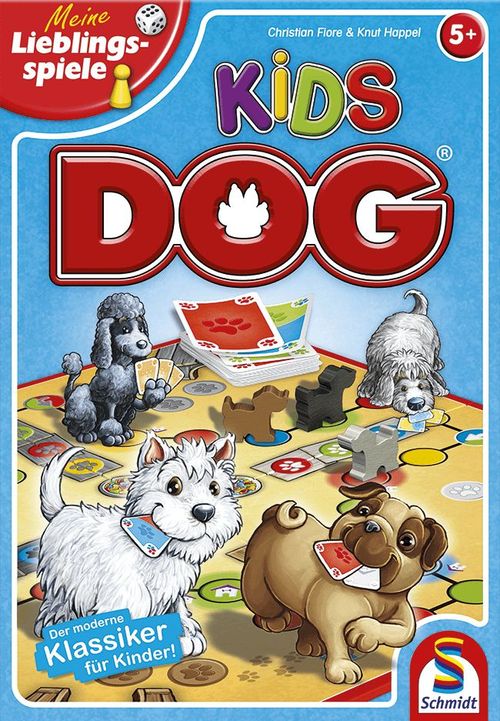
DOG Kids
DOG Kids Rulebook
Table of Contents
Table of Contents
Components
- 1 game board
- 88 cards:
- 48 single-colour cards
- 16 single-colour double-step cards
- 12 two-colour cards
- 6 bone cards
- 6 dog-swap cards
- 12 dog pawns, 3 each in white, grey, brown and black
Setup
Place the game board in the middle of the table where everyone can reach it. Each player chooses 3 pawns of one colour and places them on the 3 paw spaces next to the dog of the chosen colour.
Shuffle all 88 cards and deal 3 cards to each player. Place the remaining cards face down next to the game board as the draw pile.
Gameplay
The player who can bark the loudest begins the game.
On your turn, you must first move one of your pawns onto the two-colour start space. If you have a card in one of the two colours of the start space in your hand, you play it and place your pawn on the start space.
Place all played cards face up on a discard pile next to the game board. Then draw a card from the draw pile so that you again have 3 cards in your hand. Then the next player clockwise takes a turn.
Once one of your pawns has reached the start space, you may, on your next turn, play any card from your hand to move that pawn clockwise according to the card played.
Note: If you cannot or do not want to make a move with the cards in your hand, discard all of your hand cards and draw 3 new cards from the draw pile. After each turn, you always draw back up to 3 hand cards. If you ever forget to draw, you may make up for it at any time. If the draw pile runs out, shuffle the cards that have been played and discarded and use them as the new draw pile.
The Cards
Single-colour card (with 1 paw print): You may move one of your pawns clockwise to the next space in the colour played.
Double-step card (with 2 paw prints): Choose one of your pawns that may jump over the next free space of the colour played, to move immediately to the space after that, the next free space of this colour.
Two-colour card: Choose one of the two colours and move one of your pawns to the next space of this colour.
Dog-swap card: If you play this card, one of your pawns may swap its place with any pawn of another player. Pawns that are on the goal or still on the paw spaces may not be swapped.
Bone card: Place one of your pawns on the next free bone space. Dogs that tuck into the tasty bone on a bone space are protected there and may not be knocked out. An occupied bone space is therefore jumped over.
Example: You play a blue card and move one of your pawns to the next blue space. Your own and other players' pawns on spaces of other colours are always jumped over.
Special Rules
Even small dogs can bark loudly! If you move one of your dogs onto a space that is already occupied, special rules apply.
Knocking out: If another player's pawn is already on a space, you may knock it out. Only pawns that have already reached the goal or are on a bone space are protected and may not be knocked out.
All knocked-out pawns are returned to one of the 3 paw spaces next to that other player's dog and must start again from the beginning.
To get back onto the start space, a card in one of the two colours of the respective start space must be played, as at the beginning of the game. However, the start space may not be occupied by one of your other pawns at that moment. If another player's pawn is on it, that pawn is knocked out.
Note: The start spaces are especially risky for all other players, because a pawn can be knocked out there with two different colours.
Bone space: Pawns on a bone space are protected and may not be knocked out. You may therefore jump over the occupied bone space and move your pawn on to the next space of the card played.
Jumping ahead: If a space is occupied by one of your own dogs, you may make a big jump and move your pawn to the next space in the colour of the card played.
End of the Game
The first player to bring their 3 dogs into their dog house wins the game.
To bring a pawn into the dog house, a card in the colour of one of the free goal spaces must be played. Your own pawns may also be jumped over in the goal.
Team Variant for 4 Experts
(Recommended from age 6)
If you are four players, you can also play DOG Kids as a team game. Two players play together as a team. As a two-person team, help each other and try to bring your 6 dogs to their dog houses as quickly as possible, without showing your hand cards to your team-mate.
The rules of the game described above apply with the following changes:
Swapping hand cards: At the start of the game, team-mates may swap one of their 3 hand cards with each other. This can help you move onto the start space. The cards may only be looked at by both players after the swap.
If you cannot or do not want to make a move with your hand cards, discard all of your hand cards and draw 3 new cards from the draw pile. After that you may again swap a card with your team-mate.
Jumping ahead: If you move one of your pawns onto a space occupied by a pawn of your team-mate, that pawn is "bumped" and may move on to the next space of the same colour.
End of the game: Once you have all of your pawns on the goal, you may help your team-mate bring their dogs to the goal as well. On your turn, you move your team-mate's pawns with your cards. The team only wins together once all 6 dogs of the team have arrived in their dog houses.