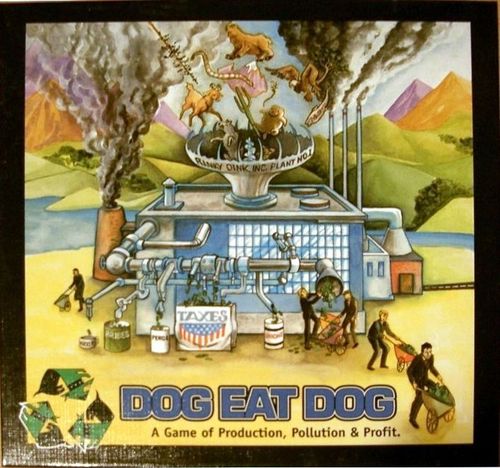
Dog Eat Dog
Dog Eat Dog Rulebook
Table of Contents
Table of Contents
Introduction
Congratulations on your new assignment as Division Manager/CEO at Rinky Dink, Inc. As you know, each of our divisions produces a different product (steel, plastic, paper, etc.) and requires a different combination of raw materials (iron, coal, wood, etc.). As a Division Manager, your only task is to make money, as quickly as possible and by any means available. You must have no scruples on your way!
You may pollute and poison the environment, bribe government officials and friendly players alike, destroy endangered species, dodge taxes, exploit and endanger your underpaid workers, buy and sell influence, take advantage of back doors in the bankruptcy laws, and use a few dirty tricks you may possess.
It will be your fiduciary responsibility to devastate the environment before it can be protected, to bribe, blackmail and coerce, all in a day's work. Of course, in agreement with your fellow division managers, who are blackmailed and murdered, they may help you get ahead just as you help them.
Of course, the consumer advocates and municipal officials you will encounter are hypocritical, petty, narrow-minded, corrupt, bureaucratic demagogues who would rather do nothing than disembowel your company for self-satisfied and selfless reasons. Your workers are a mindless, flighty, greedy, lazy, thieving, lustful mob, loyal and firmly rooted in corrupt union politics. Public opinion is the usual collection of ignorant, unstable, superficial, stupid, self-seeking, moody, decadent, simple-minded gullible people, fools and freeloaders. They all deserve what they get, and you give it to them!
Here at RDI we think of business as a game. And Rule #1 of this game is that the one with the most money wins. We do not care how you get it. Embezzle it from your joint account, blackmail your fellow managers, and skim some off the top. That is why, when all is said and done, there is no prize for second place.
So let us begin the game, and the division manager with the most money in his Swiss bank account wins.
Components
- 1 game board.
- 1 Public Laws/Marketplace sheet.
- 1 rulebook.
- 2 dice.
- 6 Division cards.
- 16 Pollution markers.
- 18 Control markers (three for each player).
- 32 Natural Square cover tiles.
- 32 Workers.
- 40 Red Tape cards (9 Corrupt Officials and 31 Current Events).
- 48 Products (10 Fuel, 10 Paper, 10 Plastic, 10 Steel and 8 Recyclable products).
- 96 Raw Materials (20 Chemicals, 20 Coal, 18 Iron, 20 Oil and 18 Wood).
- 240 bills of Q.E.D. currency (60 each of $1 million, $5 million, $10 million and $20 million).
Setup
1.) Open the board and lay it in front of you. 2.) Set up the Bank. All money belongs to the bank. 3.) Set up the five stacks of Raw Materials: Coal, Chemicals, Iron, Oil and Wood. 4.) Set up the five stacks of Products: Fuel, Paper, Plastic, Steel and Recyclable. 5.) Place the sheet marked Public Laws/Marketplace in an easily accessible place. 6.) Shuffle all 40 Red Tape cards. The game begins with a Public Law on the books. To find out which law, draw until the first Corrupt Official appears, and place it, picture side up, on the Public Laws/Marketplace sheet. Shuffle the remaining 39 cards and place them in a single stack, picture side down. 7.) Separate the 32 Natural Square cover tiles, which correspond to the 16 squares on the Inner Map. 8.) Set aside the Pollution markers and Workers in separate stacks.
Start of Game
1.) Lay out the Division cards so that everyone can see them. If there are four or fewer players, remove Waste Mismanagement, Inc. from the game. 2.) Each player rolls two dice. 3.) The highest roll chooses a Division card first. Then all players choose divisions in clockwise order. 4.) Give each player the three matching control markers, $25 million and two workers. 5.) Each player places one control marker on his home city, to be used as his "game piece," and another on the starting Natural Square of his division (shown on his Division card). Set the remaining control marker aside for later use. 6.) Each player receives the following raw materials to begin with:
- Georgia Horrific: one wood, one coal.
- Goo Pont Plastics: one oil, one chemical.
- D.K. Mart: one oil.
- W.E. Steel: one iron, one chemical.
- Substandard Oil: one oil, one coal.
- Waste Mismanagement, Inc.: two pollution markers. 7.) Each player should also have the cover tiles that match the Natural Squares he controls. Place the remaining cover tiles beside the board, for players to refer to during play. 8.) Roll to see who begins. The highest roll begins, and play continues clockwise.
Overview
The outer edge of the board has 20 spaces, including the cities. The Inner Map of the board consists of 16 Natural Squares, depicting the idyllic landscape teeming with natural beauty, endangered species and vital raw materials.
Each Natural Square has two cover tiles, which depict that square in different phases of degradation.
For example: Natural Square A is A1 on the board, A2 as the Stage 2 cover tile and A3 as the Stage 3 cover tile.
Each Natural Square bears three icons. These icons represent the raw materials available on that square.
You may extract these raw materials to produce products, which you eventually sell on the Open Market. Once you have destroyed your Natural Squares, you may give them up and acquire control over "healthy" ones. But beware! Meddling bureaucrats may stand in your way. (If they do, do the right thing: bribe them!)
When you extract the riches from the earth while pollution and toxic waste are spewed out, cover the square with cover tiles to represent the environmental destruction and urban expansion.
The more money you make, the more you can embezzle. You may embezzle up to half of your corporate account each turn. If you are the first player to accumulate $150 million in your Swiss bank account, you win the game!
Your Turn
Your turn looks like this:
- Phase 1: Movement. Roll two dice and move clockwise around the outer edge of the board. Follow the instructions on the space where you land. (See Order of Event Resolution, p. 6.)
- Phase 2: Sales. Sell products and unwanted raw materials on the Open Market.
- Phase 3: Payroll. Take care of your payroll.
- Phase 4: Hiring/Firing. Hire or fire workers.
- Phase 5: Production/Pollution. Produce products and pollute. (Waste Mismanagement, Inc. does not pollute.)
- Phase 6: Extraction/Sale. Extract raw materials or buy them.
You may embezzle once during your turn, even before rolling the dice. When you embezzle, you may move up to half the money in your corporate account to your Swiss bank account. (See pp. 10 and 16.)
Each worker may perform only one task per turn (either production or extraction). Sales and purchases require no workers.
If for any reason a player forgets to do something during his turn, he loses the opportunity. (So remember to hire that extra worker or perform that extra task when you land in the Management Washroom. Use them or lose them. And watch your competitors to be sure they meet their own obligations and follow the rules.) Exception: this rule does not cover pollution or the enforcement of Public Laws. These MUST be carried out as soon as anyone points out the omission. (See Breaking the Law, p. 8, and Pollution and Degradation, p. 10.)
During each player's turn, go through the phases one at a time, in strict order. You may not deviate from the turn sequence.
Other Actions
- You may attempt at any time to bribe any Corrupt Official on the Public Laws/Marketplace sheet, as often as you wish. (See Bribery, p. 14.)
- You may attempt at any time to bribe a Corrupt Official belonging to another player, whenever that player tries to use this particular card against you. (See Bribery, p. 14.)
- Whenever a player determines a market value for a raw material or product, you may also sell that raw material or product at that price, even if it is not your turn.
- You may conduct business with other players at any time. Workers and Division cards may not be sold or traded, but almost everything else is! This includes trading or selling raw materials and products between players. (See Trade Between Players, p. 15.)
Note: Corporate dealing is extremely critical to getting ahead. Hoarders and protectionists are destined to lose most games. Free entrepreneurs will sail past them by trading early and often with one another for mutual advantage, easily outmaneuvering the cumbersome opposition. Remember, here at Rinky Dink, Inc. our motto is "Damn the torpedoes! Full speed ahead!"
Turn Sequence
Phase 1: Movement
Movement
Roll two dice and move clockwise around the outer edge of the board. Follow the instructions on the space where you land. (See Order of Event Resolution, p. 6.)
If you PASS (or land on) the Tax space, you must pay any taxes you owe immediately, before reacting to the space where you end.
If you PASS (or land on) your home city, you have the opportunity to buy a new Natural Square before reacting to the space where you end.
A doubles roll has no special significance. It counts like any other roll. The management of Rinky Dink, Inc. is proud to announce that we neither discriminate against a dice roll nor hold any prejudice that happens to count it differently.
Order of Event Resolution
Sometimes you will be affected by more than one space during your Movement phase. For example, you pass your home city, then pass the Tax space, and finally land in another player's home city, all in one turn. Resolve these "events" one at a time, in exactly the order in which you encounter them. So you would first bid (or not) on a new Natural Square, then pay your taxes (if any), and finally draw a Red Tape card.
Taking Control of New Natural Squares
Each time you pass or land in your home city, you may try to take control of an uncontrolled Natural Square on the Inner Map, either by Public Auction or by Sealed Bid.
You may control a maximum of two Natural Squares at any one time. If you acquire control of a third Natural Square, you must immediately give up control of one of those three squares.
When you gain control of a Natural Square, place one of your control markers on it. Take possession of the cover tiles bearing the letter on the Natural Square.
To attempt to gain control, choose a method:
A.) Public Auction. Choose an uncontrolled Natural Square and make a bid of at least $1 million. Other players may join in and try to outbid your "auction offer." The highest bidder gains control over that Natural Square.
B.) Sealed Bid. 1.) Choose an uncontrolled Natural Square and make an offer between $2 million and $10 million. You may not make a sealed bid you cannot pay! 2.) Roll two dice. If the roll is equal to or less than your offer, you are successful. The money you offered goes to the bank, and you now control this Natural Square. 3.) If the roll is higher than your offer, the sealed bid fails, and you must wait until you next land on or pass your home city before you may try again. You do not lose the money of your sealed bid, however.
Note: Look around and see which other player already has two Natural Squares or is on the verge of collapse. These players have less incentive or ability to bid against you in a Public Auction. Sometimes you can make a deal or down payment that your "friends" cannot outbid. But if you think they will fight you, choose the sealed bid. If you cannot find a square that has the raw materials you need, take one that is good for someone else, and make a trade! Remember, here at Rinky Dink, Inc. our motto is "There is more than one way to skin a dog."
Taxes
If you pass or land on the Tax space, and your corporate account holds $26 million or more, you must pay one third of it to the bank as taxes.
Although you may embezzle before you roll, if your movement roll takes you onto or past the IRS and you have not yet embezzled, you may not embezzle again this turn until AFTER your taxes have been paid!
Note: Always keep an eye on how far you are from taxes. Make sure you embezzle enough to keep your corporate account at $25 million or below when you pass or land on the Tax space. You may embezzle before rolling to move. Do not sell so much at once that you have no time to embezzle quickly enough and get caught by the tax collector. Timing is everything! Remember, here at Rinky Dink, Inc. our motto is "Only fools pay taxes."
Geneva
If you land exactly on Geneva, you may freely transfer some or all of the money between your Swiss bank account and your corporate account, as much as you like, for as long as you are physically on that space!
This does not count as embezzlement, so you are safe from the Red Tape cards that would otherwise stop you.
Your Swiss Bank Account and Embezzlement
At the start of the game no player has anything in his Swiss bank account. You may not spend money in your Swiss bank account. It simply accumulates until it wins the game.
Once per turn, at any point during your turn, even before rolling, you may embezzle up to half of the money in your corporate account and move it to your Swiss bank account. You need not show how much money is in your Swiss bank account, nor how much money you have embezzled (unless a specific Red Tape card forces you to do so).
However, you may NOT take more than half the money from your corporate account. Doing so is fraud!
Although you may embezzle before rolling, if your movement roll takes you onto or past the IRS and you have not yet embezzled, you may not embezzle again this turn until AFTER your taxes have been paid!
To embezzle, proceed as follows: 1.) Take the amount you wish to embezzle into your hand. Keep it concealed. (Remember that you may not embezzle more than half of what is currently in your corporate account.) 2.) Declare that you are embezzling, but do not say how much. 3.) If no Red Tape cards are played that would prevent the embezzlement, it succeeds. Place the money in your Swiss bank account.
Note: Embezzlement is your main tool for keeping your division from falling victim to the tax collector. Rinky Dink, Inc. would much rather see our hard-earned money land in your Swiss bank account than in the greedy hands of the IRS. Be sure to keep your corporate account at $25 million or less when you pass this space! Always know how far you are from taxes so that you are not caught unexpectedly! Remember, you can embezzle before you roll to move. It is your last chance to avoid taxes this turn. You may also hire an extra worker or two, or buy raw materials (if any are available on the Public Laws/Marketplace sheet), to keep your corporate account under $26 million. Remember, here at Rinky Dink, Inc. our motto is "Collecting more taxes than absolutely necessary is legalized robbery."
Red Tape Cards
When you land on any city other than your own home city, draw a Red Tape card and read it aloud. Follow what the card says, then discard it if it so instructs. (Follow the cards, even when what they say would normally violate the rules.)
There are two types of Red Tape cards, Current Events and Corrupt Officials, all shuffled together in a single Red Tape stack.
You may not keep a Current Events card for use on a future turn unless it says otherwise.
Corrupt Officials and Public Laws
When not bribed, Corrupt Official card(s) go onto the Public Laws/Marketplace sheet. The powers of the Corrupt Official become Public Law, and it applies to all players at all times! (Note: there is a Public Law on the books at the start of the game.)
When you draw a Corrupt Official, you receive the first bribe attempt. (See Bribery, p. 14.) If you decide not to bribe, or your bribe attempt is unsuccessful, place the card on the Public Laws/Marketplace sheet. If you succeed, take the card into your possession.
Note: Corrupt Officials can be very useful. If you do not protect them, they usually endanger someone else. So make sure to buy them early and often! Think of them as "immediate revenge." Even if you never use them, merely possessing one "encourages" the other players to treat you sensibly! Remember, here at Rinky Dink, Inc. our motto is "Money cannot buy happiness, but it is certain that the devil can buy misery."
Breaking the Law
When a player breaks any Public Law on the Public Laws/Marketplace sheet, he must return all the raw materials (or whatever else) involved and pay an additional fine of $10 million (paid to the bank) as soon as another player notices. The player who noticed receives a $3 million bonus from the bank! If you break the law and carry it through a complete turn, up to your next turn, without being caught, the "Statute of Limitations" has expired and you get away with it. If you catch yourself and return the goods, you are entitled neither to the fine nor to the bonus.
Phase 2: Sales
You may sell any of your raw materials or products on the Open Market at the current market value. You determine the market value by rolling dice as explained below. The procedure is repeated on your Division card to ease play.
A player may determine the current market value of a specific type of raw material or product only once per item per turn, and the value holds only for that player's turn.
Sale of Raw Materials
Roll two dice to determine the current market value, in millions of dollars, of the raw material you wish to sell. (You may determine the market value only of a raw material you currently own.)
Once a player has determined the market value of a raw material, all players may immediately sell that item at that price, even though it is not their turn, and regardless of whether the player who rolled sells the item(s) in question.
Example: You play Substandard Oil and want to sell some iron. The listed price is "two dice x $1 million." So you roll two dice. If you roll a four, the current market value for iron this turn is $4 million per unit. Each player who has iron may now decide to sell it for $4 million per unit (or not), including you.
Place all raw materials you sell on the Open Market on the Public Laws/Marketplace sheet. Each player may buy these during Phase 6 of his turn for $12 million each.
Sale of Products
Roll two dice and add 20 to the roll to determine the current market value, in millions of dollars, of the product you wish to sell. (You may determine the market value only of a product you currently own.)
Each time a player determines the market value of a product, all players who have that product may immediately sell it at that price, even though it is not their turn, and regardless of whether the player who rolled sells the item(s) in question.
Example: You play Goo Pont Plastics and want to sell a plastic. The listed price is "two dice + 20 x $1 million." So you roll two dice and add 20 to the result. If you roll a seven, the current market value for plastic this turn is $27 million per unit. Each player who has plastic may now decide to sell it for $27 million per unit (or not), including you.
Each time you sell products, return them to the appropriate stack and take the market value from the bank.
Phase 3: Payroll
Pay each worker in your division $1 million, whether or not they worked this turn, unless Red Tape cards or board spaces order otherwise.
Phase 4: Hiring/Firing
Hire or fire workers as you see fit. For each worker you hire, pay $3 million and take one worker from the supply. To fire workers, simply return them to the tableau.
There are only 32 workers in the game. If no workers are available, you cannot hire any.
Phase 5: Production/Pollution
Once you have acquired raw materials (during Phase 6 of a previous turn), you may produce products from them. Your Division card tells you what you can produce and how. (You may produce only the product or products listed on your Division card.)
It takes one worker to produce each product. (A worker who produces this turn may not be used again until the next turn.)
Note that Phase 6: Extraction/Sale comes after Phase 5: Production/Pollution. This is intentional. You will therefore have to hold your extracted or purchased raw materials for at least one turn before you can turn them into valuable products.
Production of Products
Each division uses different raw materials to produce different products:
W.E. Steel combines an iron and a coal to produce a steel product. Goo Pont Plastics combines an oil and a coal to produce a plastic product. Georgia Horrific combines a wood and a chemical to produce a paper product. Substandard Oil combines an oil and a chemical to produce a fuel product. D.K. Mart may produce steel, plastic, paper or fuel, as above, but may produce only one product type per turn. Waste Mismanagement, Inc. combines any raw material with TWO pollution markers to produce a recyclable product.
Pollution
Each time you produce a product, you must pollute the Inner Map. Two pollution markers on a Natural Square mean that the square must be degraded.
Producing one or two products in a single turn creates one pollution marker. Three or four products create two pollution markers, five or six create three, and so on. That is, place one pollution marker for every two products produced, with fractions rounded up. (Waste Mismanagement, Inc. pollutes nothing. See p. 15.)
Pollution and Degradation
You must place pollution on a Stage 1 or Stage 2 Natural Square directly adjacent (not diagonally) to your home city, or directly adjacent (not diagonally) to urban area connected to your home city.
You may not place pollution on a Stage 3 Natural Square.
It does not matter, if at all, who controls the Natural Square being polluted. If there is already a pollution marker on the Natural Square you wish to pollute, degrade that Natural Square to its next level (from Stage 1 to Stage 2, or from Stage 2 to Stage 3).
Important: If you must place more than one pollution marker during the same turn, you must spread them out evenly. You may not place two markers on the same square in the same turn unless you have no other choice. (Pollution markers placed during previous turns do not count for this consideration.) The effects of each pollution marker take place immediately, as it is placed.
Example: You produce five products this turn, so you create three pollution markers.
- You must place all three on different Natural Squares if possible (regardless of whether there is pollution there from the last turn). Remember, you may not place pollution on a Stage 3 Natural Square.
- If there are only two Natural Squares you can pollute, you must place two pollution markers on one Natural Square and one pollution marker on the other.
- If there is only one Natural Square you can pollute (not likely, but possible), all three pollution markers go onto that Natural Square.
When a Natural Square is degraded, remove all pollution markers already on it and return them to the stack. (Waste Mismanagement, Inc. may NOT collect this "discarded" pollution!)
If the Natural Square was at Stage 1 (its natural state, as described on the board), place the corresponding Stage 2 cover tile on top of the square. If the Natural Square has already been degraded to Stage 2, place the Stage 3 cover tile on top of the Stage 2 cover tile.
You are obligated to choose which square(s) to pollute and place the pollution before proceeding to Phase 6 of your turn. If you fail to place the appropriate pollution during Phase 5 of your turn, you are subject to a fine of $10 million (paid to the bank), and you must place the pollution on the board as soon as the error is noticed. The player who noticed receives a $3 million bonus from the bank. There is no Statute of Limitations on pollution violations. If you forget to pollute but catch yourself before anyone else does, you may place the pollution at that time and are not subject to the fine. (You do not receive a bonus, however.)
Note: You will sometimes have the opportunity to pollute your neighbor and endanger his raw materials. Trading to avoid this is not uncommon. Remember, here at Rinky Dink, Inc. our motto is "Do it to others before they do it to you."
Urban Fringe
When any Natural Square on the outer edge of the Inner Map (A, B, C, D, E, H, I, L, M, N, O, P) is degraded to Stage 3, it is affected by the Urban Fringe:
An expansion occurs in any city or Urban Fringe to which it is directly adjacent. (The Urban Fringe is described on the Stage 3 cover tile.)
If pollution comes from a city connected to the Urban Fringe, you may distribute your pollution markers onto any Natural Square directly adjacent (not diagonally) to the Urban Fringe.
Phase 6: Extraction/Sale
(The German heading reads "Ausbeutung/Verkauf," but the phase as described covers the extraction of raw materials and the purchase of raw materials. Both are set out below.)
Extraction of Raw Materials
You may extract raw materials only from Natural Squares you control on the Inner Map. You need one unused worker for each raw material you extract. The icons on a Natural Square show which raw materials a player may extract from it. You may extract only one of each raw material per icon per turn.
There are five different raw materials available: Iron Coal Wood Oil Chemicals
Waste Mismanagement, Inc. may also extract pollution markers. (See p. 15.)
Extraction and Degradation
If you extract only one raw material per turn from a Natural Square, it is not degraded, "used up," or negatively affected in any way.
If you extract more than one raw material from a Natural Square in a single turn, that Natural Square is degraded immediately. Place the corresponding cover tile on the square (see Overview, p. 4). Note that Stage 1 and Stage 2 of the same Natural Square offer different raw materials; Stage 3 has no raw materials.
If the Natural Square was at Stage 1 (its natural state, as shown on the board), remove and return all pollution markers on it, and place the Stage 2 cover tile on top of the square. If the Natural Square has already been degraded to Stage 2, place the Stage 3 cover tile on top of the Stage 2 cover tile. (Waste Mismanagement, Inc. may not collect this discarded pollution.)
Example: You control Natural Square A, which has three icons: two iron and one coal (in Stage 1, its natural state). You have three workers not yet used for any task, so you decide to extract all three raw materials from the square. You receive two iron and one coal. Natural Square A is immediately degraded to Stage 2. Remove and return all pollution markers already on it. You must now place the Stage 2 cover tile directly on top of the newly degraded square.
Note: Deciding how fast to extract raw materials is a fine art, and one that must be cultivated. You must carefully control the situation from round to round.
- The idea is to get the most out of one Natural Square at exactly the right moment ("use it up") to buy control of an unspoiled square, while at the same time slowly bleeding a second Natural Square dry. Therefore you will often strive to maintain one square while extracting from another. To pull this off, you must be aware of how far you can go before you bid on another Natural Square, and be sure to extract massively in time. If it is likely that you will land on or pass your home city next turn, rip away the last layer of raw materials from one of your Natural Squares and get ready to take control of another.
- Bribe or pressure the politicians and/or players who stand in your way while extracting. They are cheap compared with what they can cost you! Remember, here at Rinky Dink, Inc. our motto is "What doesn't kill us makes us stronger."
Purchase of Raw Materials
You may buy any raw materials that lie on the Public Laws/Marketplace sheet for $12 million each during Phase 6 of your turn. This requires no workers.
Note: If you buy, you will be able to produce more in the next turn. It is usually advisable to pay the $12 million if you can afford it. Remember, here at Rinky Dink, Inc. our motto is "The most expensive opportunity is the one you failed to seize."
General Rules
Money
All money you pay that does not go to another player goes to the bank. All money you receive that does not come from another player comes from the bank. The money of each player must be kept either in his division's corporate account or in his Swiss bank account.
Your Corporate Account
At the start of the game, each division begins with $25 million in its corporate account. Players may spend only the money in their corporate account. If another player asks, you must answer truthfully about the amount in your corporate account. (You need not answer if you are in the middle of embezzling.)
Loans and Bankruptcy
If you are forced (for any reason) to pay more money than you have in your corporate account, and you cannot make a trade with another player on the spot to obtain it, you may borrow the amount from the bank until the end of Phase 2 of your current turn. However, you must pay 100% "interest" on the "loan" (that is, you repay double what you borrowed!).
If it is not Phase 1 or 2 of your turn and you owe more than you can pay (and you cannot make a trade), you must immediately declare Chapter 11 bankruptcy. You may leave the game at this point, or you may reorganize.
Reorganization
Place all Corrupt Official cards you hold on the Public Laws/Marketplace sheet. Discard all other cards and remove all your control markers. Your Swiss bank account is not affected.
In your next turn you receive $25 million from the bank and one worker. You begin without raw materials or a Natural Square. You may choose to play a different division, if one is unused. (Exception: you may not choose Waste Mismanagement, Inc. unless there are at least five players.) Move your control marker to the corresponding home city. You may begin this turn by attempting to gain control of an uncontrolled Natural Square.
Note: A harsh interpretation of this rule is strongly recommended! For example, if your resources run out and you are only a few million short of winning, embezzle and go bankrupt, then embezzle half of your reorganized money, go bankrupt again as soon as possible, and so on, until you have enough money to win! Remember, here at Rinky Dink, Inc. our motto is "You cannot squeeze blood from a stone."
Bribery of Corrupt Officials (from the Public Laws/Marketplace sheet)
You may attempt to bribe any Corrupt Official on the Public Laws/Marketplace sheet as often as you wish, whenever you wish, even if it is not your turn. (The player who has just drawn the card receives a single first attempt. Otherwise the card stays on the Public Laws/Marketplace sheet, and from that point on, "first come, first served.")
Since the game begins with a Corrupt Official on the Public Laws/Marketplace sheet, you may attempt to bribe only after the first player's movement roll.
If you successfully bribe a Corrupt Official, you own that card. The card is taken from the Public Laws/Marketplace sheet and comes into your possession. You are now immune to the effects of that card. Once you own a Corrupt Official card, you may also use the strength of that Corrupt Official (or not, as you choose) against other players, where possible, for as long as you own the card!
To bribe, proceed as follows: 1.) Make an offer between $2 million and $10 million. You may not offer a bribe you cannot pay! 2.) Roll two dice. If the roll is equal to or less than your offer, you are successful. You now own this Corrupt Official card. 3.) If the roll is higher than your offer, the bribe fails and you do not receive the card (no refunds!). Once you have rolled, the money goes to the bank regardless of the result.
Bribery of Corrupt Officials (between players)
You may not bribe a Corrupt Official away from another player unless that player attempts to use the power of that Corrupt Official against you. If this happens, you may attempt to bribe the Corrupt Official away from the other player, using the following procedure: 1.) Make an offer between $2 million and $10 million. You may not offer a bribe you cannot pay! 2.) Roll two dice. If the roll is equal to or less than your offer, you are successful. You now own the Corrupt Official card. 3.) If the roll is higher than your offer, the bribe fails and you do not receive the card (no refunds!). Once you have rolled, the money goes to the bank regardless of the result. 4.) If your bribe was successful, the other player may immediately attempt to bribe the Corrupt Official back! 5.) You may each, in turn, continue to bribe the official back and forth until one of you fails (or gives up the attempt). 6.) All bribe money goes to the bank, regardless of who receives the official. 7.) Whoever receives the official may use the card immediately.
Note: If other players have Corrupt Officials that can hinder you from extracting from your square, you may, if you have enough money, threaten to bribe the Corrupt Official away and so challenge them. Remember, here at Rinky Dink, Inc. our motto is "An honest politician is one who has been bought."
Trade Between Players
Players may freely make any kind of trade or agreement with one another, for whatever reasons. Any such trade need not follow the rules of the game. (So when you trade with your fellow players, be on your guard!)
Example 1: Player #1 agrees to trade a wood to Player #2 for an iron. They hand over the items to each other. Trade complete!
Example 2: Player #1 borrows money from Player #2 and promises to pay it back. Player #1 then changes his mind and refuses to repay it. Player #2 can do nothing about it. (But do not get angry. Wait!)
There are, of course, a great many possible trades. Only some of them include:
- Payment to other players so that they will not "turn" their Corrupt Officials against you.
- An agreement with other players to "chip in" to bribe a particularly obnoxious official.
- Sale of raw materials to other players, without any ado.
- Agreement during Public Auctions to keep the price of land down.
- "Not noticing," or turning a blind eye to violations of Public Laws (but beware of betrayal, which is often dangerous!).
Note: Players who can set up a mutually beneficial trade can often produce in their first turn. Holding back raw materials brings less capital to work with; selling them on the Open Market means that some player can buy them. It is usually better for you to move and trade. Remember, here at Rinky Dink, Inc. our motto is "He who does not go forward falls behind."
Winning
As soon as either of the following two conditions applies, the game ends:
1.) The first player to have $150 million in his Swiss bank account wins immediately.
2.) If every Natural Square on the board is completely destroyed, the game ends, with the exception of a special final bonus round. All players must immediately discard all Red Tape cards. Play this round as follows: A.) All players may process any of their raw materials into products (provided they have the workers). Trading between players is permitted and is recommended at this time. Workers may not be hired, and raw materials may not be extracted at this time. B.) Next, all players may sell their raw materials and products as follows: For each item to be sold, roll the dice only once (the roll applies to all who wish to sell that item) to determine the current market value. Beginning with the player whose turn ended the game and continuing clockwise, each player may roll for his products and materials (unless their final value has already been determined by a previous player who was legally allowed to determine that value). C.) Next, all players may embezzle up to half of their corporate account. D.) Finally, after everyone has had a turn, the player with the most money in his Swiss bank account wins the game!
Waste Mismanagement, Inc. Special Rules
(We recommend not using Waste Mismanagement, Inc. unless there are five or six players. Otherwise you will not be able to gather enough raw materials to be competitive.)
Rinky Dink, Inc. recognizes the importance of good public relations and the appearance of being a friend of Mother Earth. Recycling is "in," so Rinky Dink, Inc. has a new division: Waste Mismanagement, Inc. The division is led by dedicated environmental managers whose job is to make money out of pollution. Thanks to the unashamed integrity of management and the clever debt admissions that the ad men presented to the public, your sad, pitiful, inferior recyclables are sold alongside the best of them! If there are more than four players and you intend to be one of those high-minded, sticky-smooth moralists, here is your chance. All together now: "Here I stand, let us protect this tree...!"
Waste Mismanagement, Inc. uses workers during its turn to gather pollution markers from the board, regardless of who controls the square, and uses them as raw materials. This happens during Phase 6: Extraction/Sale. Waste Mismanagement, Inc. does not need the owner's permission to extract its pollution. All in all, Waste Mismanagement, Inc. helps Rinky Dink, Inc. avoid these annoying EPA regulations. You have a mandate from headquarters to skim off as much pollution as you can.
Waste Mismanagement, Inc. pollutes nothing when it produces.
Waste Mismanagement, Inc. may never degrade a Natural Square.
No other division may extract pollution markers, and pollution markers may never be sold on the Open Market. Whether or not Waste Mismanagement, Inc. is in the game, pollution markers are always used.
Note: Waste Mismanagement, Inc. must start slowly and build up a stock of raw materials. Then, when the other players begin to pollute, hire a lot of workers (up to eight or more) to keep production going without delays. Remember, here at Rinky Dink, Inc. our motto is "Waste nothing, want nothing!"
Additional Rules
Old Boys Network
At the start of the game, all players draw from the Red Tape stack until each of them receives a Corrupt Official. You begin the game in possession of that card. Shuffle the Red Tape stack again. Play then proceeds as normal. (Always be ready to consider how weak you are relative to your opponents at this point, for a small consideration. Overall, you want to make a profit without playing your Corrupt Official too hard!)
Advanced Planning
This revised turn order forces players to hire workers one turn before they are used, adding an extra layer of strategic complexity to the game. (Suggested for advanced players who want the challenge of additional uncertainties and careful planning!)
Use the following turn sequence:
Phase 1: Movement. Roll two dice and move clockwise around the outer edge of the board. Phase 2: Sales. Sell products and unwanted raw materials on the Open Market. Phase 3: Payroll. Keep an eye on your payroll. Phase 4: Production/Pollution. Produce products and pollute.* Phase 5: Extraction/Purchase. Extract or purchase raw materials. Phase 6: Hiring/Firing. Hire or fire workers.
- Waste Mismanagement, Inc. does not pollute. (See p. 15.)
Long Game
The victory sum is $200 million in your Swiss bank account.
Short Games
These should take about half an hour of playing time. Try one or both.
1.) The victory sum is $100 million in your Swiss bank account.
2.) The game lasts only six full turns. The player who has the most money in his Swiss bank account at that point wins.
Plants and Animals Depicted on the Board
- Square A: Saguaro cactus (Cereus giganteus)
- Square B: Gray wolves (Canis lupus)
- Square C: Mission blue butterflies (Icaricia icarioides missionensis)
- Square D: West Indian manatees (Trichechus manatus)
- Square E: American alligators (Alligator mississippiensis)
- Square F: Bald eagles (Haliaeetus leucocephalus)
- Square G: Grizzly bears (Ursus arctos)
- Square H: Winter-run Chinook salmon (Oncorhynchus tshawytscha)
- Square I: Woodland bison (Bison bison athabascae)
- Square J: Eastern cougars (Felis concolor couguar)
- Square K: Sierra Nevada bighorn sheep (Ovis canadensis californiana)
- Square L: California condors (Gymnogyps californianus)
- Square M: American peregrine falcons (Falco peregrinus anatum)
- Square N: New Mexico ridge-nosed rattlesnakes (Crotalus willardi obscurus)
- Square O: Northern spotted owls (Strix occidentalis caurina)
- Square P: Redwood trees (Sequoia sempervirens)