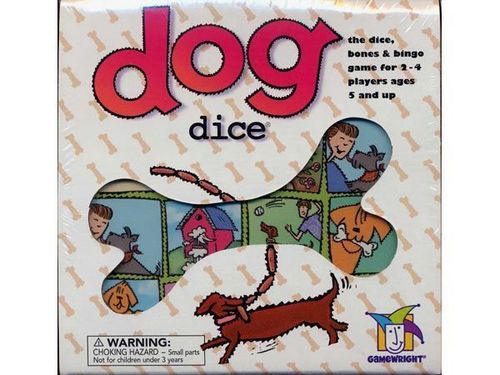
Dog Dice
Dog Dice Rulebook
Table of Contents
Table of Contents
Object
The first player to get bingo and shout "hot dog!" wins the game.
Roll the dice and match the two pictures on the dice to one or more squares on your bingo board. Then mark that square with a bone. Roll "dog gone" and doggonit, you forfeit a bone. The first player to mark four squares in the corners or four squares in a row, in any direction, gets bingo. It's a race to the finish. The first to shout "hot dog!" wins.
Contents
- Two dice: one dog die, one action die
- Four bingo boards
- 48 bones
Set-up
Pick a bingo board and pile the bones in the center of the table, where everyone can reach them.
The first time you play, take a look at the dice.
Meet the dogs. Gigi is the poodle, McDuff is the terrier, Stretch is the "hot dog," and Gizmo, he's the big dog.
Dog Die and Action Die
Dog Die: Gigi, McDuff, Gizmo, Stretch.
Action Die: dish, kid, bone, house, trouble, dog gone.
Check out the pictures on the action die so you'll know what to look for when you make a match. The house on the action die is blue, for instance, but on the boards it can be red, purple, blue, or pink. You wouldn't want it to be too easy, would you?
Then look over the bingo boards to see how one picture from the action die combines with one picture from the dog die to match a square on the board. The rulebook illustrates two examples: a house with Gigi, and a dish with Gizmo.
Game Play
The youngest player goes first. He rolls the two dice together, then calls out the roll, saying, for example, "Stretch and the kid." All players look at their bingo boards to see if they have the square that matches (in this case, the square would show the kid throwing a ball to Stretch). Each player who has a match marks that square with a bone.
Some players may have two squares that match — they get to mark both squares with bones.
Matching the dice to the pictures on the board isn't always easy. As soon as the player calls out the roll, you have to scan your board quickly to find the match and mark it before the next player rolls. If you don't mark the square fast enough, you're out of luck. You can't go back and mark it later.
Each player rolls once on his turn. The first player to roll passes the dice to the person on his left. The game continues with play moving clockwise, to the left.
Dog in Trouble
Some of the dogs on the bingo board are up to mischief!
When you roll any dog and trouble, all players look to see if they have a picture of that dog causing trouble. Each player who has it marks that square with a bone. For example, if you roll McDuff and trouble, mark the square that shows McDuff digging up the garden.
Dog Gone
There's one kind of roll that only applies to the player who rolls it — that's dog gone. Only the player who rolls dog gone has to take a penalty. Everyone else sits out.
Here's how it works: if you roll any dog and dog gone, you have to remove one bone from any of your squares with that dog in the picture. For example, if you roll Gizmo and dog gone, you can remove the bone from Gizmo and his dish or Gizmo in trouble... any Gizmo square that's already marked on your board. There's some strategy here, so choose carefully. If you don't have any Gizmo squares marked with a bone, you're off the hook, and avoid the penalty altogether.
The bone you removed goes back to the pile in the center of the table and play continues.
Ending the Game
The game continues until one player gets bingo and shouts "hot dog!" To get bingo, you mark the four squares in the corners or four squares in a row, in any direction on your board. The first player to shout "hot dog!" wins the game.
These are some of the ways to get bingo:
- Four squares in the four corners of the board.
- Four squares on a diagonal, from one corner to the opposite corner.
- Four squares in a single row.
- Four squares in a single column.