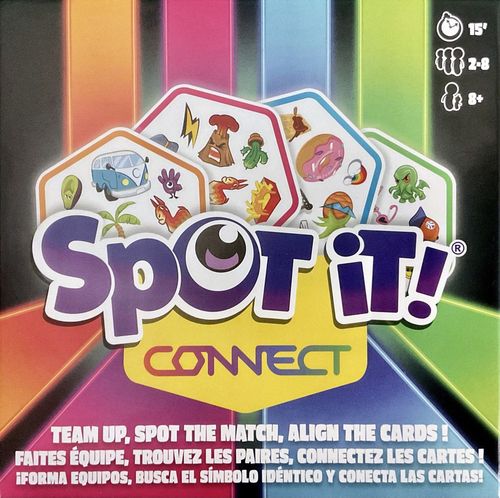
Dobble Connect
Dobble Connect Rulebook
Table of Contents
Table of Contents
Before You Start Playing...
If you've never played Dobble before, familiarize yourself with the game by drawing 2 cards randomly and placing them faceup on the table so everyone can see them. Find the matching symbol between these 2 cards (same shape, same color, only the size may be different).
The first player to spot the matching symbol must call out its name and draw 2 new cards, placing them on the table.
Repeat these steps until all players clearly understand that there is always 1 and only 1 matching symbol between any 2 cards. That's it. Now you're ready to play Spot It!
Object of the Game
Form a line of 4 cards in your color as quickly as possible to win the round! To do this, find the identical symbol between two cards, name it out loud, and place it to start forming a line.
Rules
Dobble Connect can be played by 2 to 8 players.
- In the following rules, we will sometimes use the word "team".
- Teams can include 1, 2 or 3 players.
Depending on the number of players, determine the composition of the teams:
Games as an Only Player (2, 3 or 4 players)
- 2 players
- 3 players
- 4 players
Games as Even-Numbered Teams (4, 6 or 8 players)
- 2 teams
- 3 teams
- 4 teams
Games as Odd-Numbered Teams (5 or 7 players)
- 2 teams (5 players)
- 3 teams (7 players)
Teams may consist of a different number of players when the total number of players does not allow for equitable distribution. Don't hesitate to put the strongest players alone against the others, it's time to dethrone them!
Setup
Sort the cards by color and choose one of the four color decks (pink, orange, green, or blue), this will be your deck throughout the game.
If more than three people are playing, we advise you to form teams. If you are playing as a team, divide the team's deck of cards into equal packs.
Each player takes their deck of cards faces down.
The cards with a black outline are starting cards. Place one of them in the center of the table.
How to Play
Dobble Connect is played simultaneously (all the players play at the same time, there are no turns). At the start of the game, all players turn over the top card of their deck and look for the symbol in common between their card and the starting card. When one of them finds it, they announce the symbol in common between their card and the starting card and place their card along one of the 6 sides of the starting card. Then they turn over their next card to continue playing.
As soon as another card is placed on the table, players may look for a common symbol between their card and any of the cards on the table, if there is available space near the chosen card.
- Players can never skip a card: if the card is on top of their deck, they must play it.
- Players can't place a card on top of another: they must place their card alongside an existing card, in an empty spot.
Winning a Round
As soon as 4 cards of the same color are in a row, column, or diagonal, the round ends. The team whose color it is scores the point! They pick up the starting card and place it face down in front of them, it symbolizes their point.
Depending on the number of teams, a certain number of rounds must be won:
- 2 teams: 5 rounds
- 3 teams: 4 rounds
- 4 teams: 3 rounds
Scoring and Between Rounds
When a team scores their first point - and before the next round - they receive a card from every other team. They then have to shuffle these additional cards into their deck. Teams receive two cards from each opposing team after scoring their second point, three cards after their third point, etc. When a team scores the last point, the game ends immediately.
The cards from the other teams are more inconvenient to place, as the players need to be careful not to help create an opponent's line. These cards must be played as soon as they are drawn, the players cannot put them back under their deck. The only way to get rid of inconvenient cards is to play them.
At the end of the round, each team picks up all the cards in their color that are on the table, regardless of who put them there. Thus, the cards that were in the opponent's deck might go back to the initial team.
Before each round, reshuffle your decks to incorporate the cards received from the other teams with your own.
In the rare event that all players on a team finish their deck of cards before a team is able to win the round, the round ends immediately with no winner. Each team collects all the cards on the table in their color and a new round is started with the same central card with a black outline.
List of Symbols
Cactus, Basketball, Headphones, Skateboard, Heart, Sun, Lightning bolt, Cup of coffee, Llama piñata, Cat, Pineapple, Popcorn, Hammock, Rainbowl, Pizza, Duck, Unicorn, Donut, Computer mouse, Eagle, Avocado, Juice box, Umbrella, Wave, Cap, Flame, Controller, Jack of Spades, Text Message, Palm tree, Smiley, DJ Turntable, Milkshake, Korean heart, Moon crescent, Pool float, Instant camera, Slingshot, Planet, Alien, Water gun, Smartwatch, Dice, Clover, Cthulhu, Cupcake, Ukulele, Cowboy boot, Sneakers, Backpack, Heart-shaped glasses, Lava lamp, Dragon, Bowl of ramen, Mochi skewer, Baseball jacket, Ice cream cone, Waffle, Chess piece, Strawberry, Monstera leaf, Dumbell, Surfboard, Van, Water bottle, Bike, Laptop, Bag of chips, Beach towel, Soda can, Tee shirt, Disco ball, Bucket hat, Roller skates, Stamp, Lemon, Starfish, Watermelon, Fan, Scooter, Fish, Destination sign, Bento, Thumb up, French fries, Angry volcano, Nest, Dobbly, Clapper, Capybara, Peace sign.
A Bit of History
A small bit of history of the creation of Dobble:
DOBBLE is over 50 symbols, 55 cards, 8 symbols per card, and there is always one and only one matching symbol between any two cards. But how does it work? DOBBLE is based on a principle of interaction according to which two lines always have a single point in common. In 1976, Mister Jacques Cottereau had the idea of creating a generalization of a famous "fun mathematic" puzzle, named Kirkman's Schoolgirl Problem, or the Ladies' Problem, which is the following: "15 young ladies from a boarding school go out each day for a walk in rows of three. How can we proceed so that each of them only ends up in the company of each of the others once?". With the help of techniques developed from theories of error correcting codes, he built a few structures which generalized the problem. These structures are well-known by mathematicians under the name of "incomplete balanced blocks." Based on the special properties of these structures (the principles of intersection and of optimization), Mister Jacques Cottereau successively created two games by "dressing them up" in an unconventional way. The first of these games, a "strange retriever" was published in the "Le Petit Archimède" and "Pour la Science" magazines (The Young Archimedes, and For Science, respectively). Mister Jacques Cottereau then created a second game based on a projected plan with a base of 5 in which the lines were replaced with cards, the points with images of insects, and he called it "game of insects," the goal being to find the image of the insect in common between two cards. The ancestor of DOBBLE was born! In the Spring of 2008, Denis Blanchot discovered a few cards from the "game of insects", created decades earlier. He is struck by the genius behind the intersection mechanic and works with Jacques Cottereau to turn it into a "real" game. For Denis Blanchot, the "good points" style patterns must be rethought as they are too complex and prevent a reflex-style party game. The icons must allow for quick identification, and must be more playful and easily understood. Fluidity is required. At the same time, the cards are too few (31) and contain too few figures (6); the game moves on to 57 cards containing 8 figures to finally get the real feeling of play, meaning a projected number of combinations in the seven digits. The rules of the game must still be written … In short, there's an entire extra layer of creation yet to be done. Many prototypes and playtests, notably with children, are done by Denis Blanchot, who also, on his own, takes the additional step of getting in touch with publishers. The Play Factory team would finally end up working with Denis Blanchot to publish the final form of the game. In early Fall 2009, DOBBLE, as it is known today, is launched!