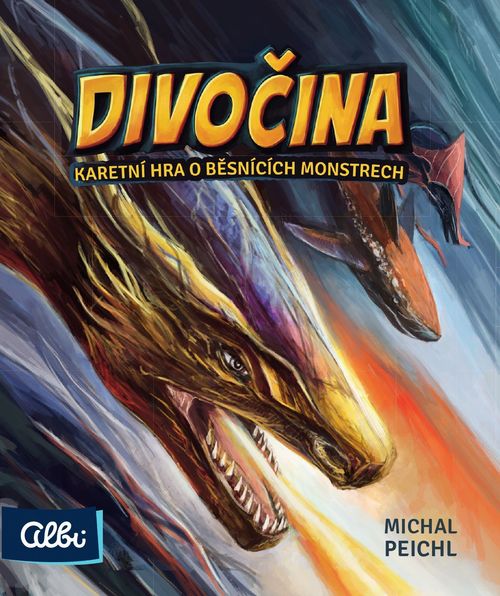
Divočina
Divočina Rulebook
Table of Contents
Table of Contents
Setup
Deal five cards to each player and place the deck of the remaining cards on the table between the players.
Goal and Basic Mechanism
Your goal is to get the most points, which are earned by the cards you have laid out. During the game you lay cards on the table and try to have as many of them as possible at the end of the game, in suitable combinations.
Course of the Game
The player who has the most animals at home starts. On your turn you may either 1) lay a card or a group of cards from your hand onto the table and trigger their effect, or 2) take the top card of the draw deck into your hand. If you have no cards in hand at the start of your turn, take two cards from the draw deck instead of one (your turn then ends). After a turn is played, the next player in clockwise order plays.
Laying Cards
You always lay cards in front of you on the table. On your turn you may lay one card (an individual), two cards (a pair) or three cards (a herd) of the same animal species, and trigger the corresponding effect. There are eight species of monsters, which you recognise by the unique name and the colour of the strip with the name. Each species has a different type of effect (an overview of species and effects is on the back of the rules). Some species let you move cards on the table, join them, separate them, steal, etc. Your aim is to keep as many cards as possible while interfering with your opponents' cards so that theirs do not have a high point value. You may have an unlimited number of cards in hand.
When you lay a pair or a herd, leave the cards overlapping one another. If you already have a card of the species you are laying on the table, do not attach the newly laid cards to those already laid! When laying onto your territory you always bring a new, separate individual, pair or herd. Laid cards can be joined, split or influenced only by means of the effects on the cards.
Each species has its own ability, which is stronger the larger the group of monsters of the same species you lay. The largest group of cards is the herd (3 overlapping cards). You can never join more than three cards! You may play even cards whose effect has no target! For example, if you play a pair of ignicamas, which forces opponents to discard cards from the table, and the opponents have no cards on the table, you simply lay the ignicamas on the table without effect.
(Illustration, shown with Teuthis, Devoraptor and Cranicorn cards: each card lists three effects. An individual triggers the first effect, a pair triggers only the second effect, a herd triggers only the third effect.)
Note: Always resolve only the effect of the laid group. For example, if you lay a herd, you cannot thereby activate the effect of a pair or of an individual!
End of the Game
Players take turns until the cards in the draw deck run out. The player on whose turn the last card is drawn from the deck begins the last round of the game, and this turn is thus their last in this game. Afterwards the other players, in turn order, each have one final turn. For the last round, make a new draw deck from the discarded cards. Beware: it may happen that in the last round you have no cards in hand and must draw the last card from the deck without being able to play it. Ideally, keep at least 1 card for the last round that you can play.
Scoring
Each of the eight card colours is personified by one animal species, which is divided into male, female and alpha. There are 10 cards of each species in the game: three males, three females, three alphas and one card with a crown symbol, which counts as any of these three types (a joker). When laying cards and triggering effects it does not matter whether you lay a male, a female or an alpha. The only condition for triggering an effect is the same species of the laid cards (e.g. ignicama).
At the end of the game you get two points for each laid pair and three points for each herd. For different types of cards (female/male/alpha) in a pair or herd you can get further points (see the following examples).
- Pair - two males / two females / two alphas = 2 points
- Pair - male and female / female and alpha / male and alpha = 3 points
- Herd - three males / three females / three alphas = 3 points
- Herd - any combination of two of the same type and one different = 4 points
- Herd - male, female, alpha = 5 points
(Card types shown in the illustration: female, male, alpha, any.)
For example, for the herd of three ignicamas shown at the top right you would get five points: 3 for it being a herd (three cards), and then a further two points because all three types - female, male and alpha - are represented in the herd.
In case of a tie in points, the player with more individuals on the table wins; if still tied, the player with more cards in hand.
Cancelling a Card Effect
If an opponent triggers an effect that influences your cards, you may discard two cards and cancel the effect of the opponent's card. You may discard two cards from the table, two from your hand, or one from your hand and one from the table. You may also cancel an effect with your laid pair or by discarding two cards from your herd (you would keep the remaining individual on the table). You cannot cancel an effect that does not influence your cards in any way. When you trigger an effect aimed at an opponent, say your intention aloud. It does not matter whether you target one or several opponents. You must always give them a chance to defend themselves before you start interfering with their cards.
Example: You trigger the effect of a pair of ignicamas and announce: "Everyone discard all leviathans from your hand. Does anyone want to cancel this effect?" If nobody speaks up, all opponents must discard their leviathans in hand.
Opponents may agree among themselves who will cancel the effect, but they cannot pool cards. The effect must always be cancelled by one player. Even if the effect targets several opponents, it is enough for one of them to cancel it.
Variant: Multiple Cancelling
If you want to add more defensive options to your game, you can allow multiple cancelling. The effect is not simply cancelled by discarding two cards. The attacker and the defender may add pairs of cards until one of them passes. Only then is it determined whether the effect is triggered or cancelled.
Example: Ema wants to split Olin's pair of altodons by playing a cranicorn. Olin defends and discards two cards from his hand. Ema also discards two cards to overcome Olin's defence. Olin adds another two cards to overcome Ema's attack. Ema does not want to discard another two cards. Olin's pair of altodons therefore stays joined.
Split Card Effects
Most individual effects contain, besides their own action, a second part that allows the player to draw a card. This second part cannot be cancelled. Even if the effect itself is cancelled, the player who played the card still draws the stated number of cards.
Example: You play an individual arca and trigger the effect. Although it is advantageous for the opponents, they may cancel it because it influences their cards. If the effect is cancelled, the first part does not take place, but the drawing of two cards does.
Non-cancellable effects are marked by a coloured tag behind the effect.
Overview of Card Effects
Each species has three effects: the individual (first), the pair (second) and the herd (third).
LEVIATHAN - Summoning (Svolání) / Mimicry (Napodobování)
- Individual: Attach an opponent's laid individual to your laid individual. In addition, draw two cards and keep one of them. Return the other to the bottom of the draw deck.
- Pair: Attach an opponent's laid individual to your laid individual or pair.
- Herd: Attach an opponent's laid individual to your laid individual or pair, or attach an opponent's laid pair to your individual.
TEUTHIS
- Individual: Copy the effect of any of your or your opponents' laid individuals. Copy the entire effect including any card drawing.
- Pair: Copy the effect of any of your or your opponents' laid pairs (not an individual or a herd).
- Herd: Copy the effect of any of your or your opponents' laid herds (not an individual or a pair).
DEVORAPTOR - Theft (Krádež) / Draw Discarded (Táhni odhozené)
- Individual: Two opponents determined by you each give you a card from their hand. Each of these players then draws a random card.
- Pair: Two players determined by you each give you into your hand a card from the table, even if they would have to split their pair or herd. Each of these players then draws a random card.
- Herd: Two players determined by you each give you a card from their hand.
When a player gives cards to an opponent (from the table or from hand), they always choose them themselves.
ALTODON
- Individual: Give an opponent any card from your hand and draw the top 2 cards from the discard pile. If you have no other cards, you cannot play the altodon.
- Pair: Draw the top 2 cards from the discard pile.
- Herd: Give an opponent a card from your hand or from the table (you may split your pair or herd) and draw the top three cards from the discard pile. If you have no other cards, you cannot play the altodon herd.
IGNICAMA - Discarding (Vyhození) / Drawing (Dobrání)
- Individual: Name a card species. Each opponent discards from their hand one card of this species, if they have one. Then draw two cards and keep one. Return the other to the bottom of the deck.
- Pair: Name a card species. Each opponent discards from their hand all cards of this species that they have in it.
- Herd: Name a card species. Each opponent discards from the table one card of this species, if they have one.
ARCA
- Individual: Each opponent draws one random card. Then draw two random cards.
- Pair: From the draw deck lay on the table one card more than there are players. Take 2 cards of them; then the opponents in turn order each take one. (Printed in the Czech overview with a question mark after "players"; transcribed as a statement.)
- Herd: Draw three cards, keep two, and put the third at the bottom of the draw deck.
URSERA - Joining (Spojení) / Splitting (Rozdělení)
- Individual: Join two of your laid individuals or attach a card from your hand to a laid individual. Then draw two cards and keep one. Return the other to the bottom of the draw deck.
- Pair: Join two or three of your laid cards, namely two individuals or an individual and a pair.
- Herd: Join an individual with one or two cards from your hand or from the table, or join a pair with one card from your hand or from the table.
You may also join the individual or pair of ursera that triggered the joining effect. Ursera effects are the only way to join cards that are already laid.
CRANICORN
- Individual: Split any laid pair. Draw two cards and keep one of them. Return the other to the bottom of the draw deck. You may also split your own cards.
- Pair: Split any laid pair or herd into individuals. You may also split your own cards.
- Herd: Split one pair or herd into individuals for each of two different players. You may also split your own cards.
Two-Player Variant
Most rules are the same as for a game with more players. For a two-player game, remove from the game all ten cards with a crown and a white frame. Next to the draw deck lay seven cards face up. This group represents the wild monsters, which you can manipulate in the game like the cards of other players. There must always be exactly seven laid monsters next to the draw deck. During the game, wild monsters will be discarded and taken away. When this happens, always refill new ones from the top of the deck so that you always join the new ones with those already laid.
Example: Among the wild monsters there is one Cranicorn and when refilling you lay a second one. Attach it to the existing one, thereby creating a pair. If there were a pair and an individual of the same species on the table and you laid another card of this species, first make a herd from the pair.
During the game always first carry out the whole effect of a card including actions in which players draw cards, and only afterwards refill to seven cards in the wild monsters area. Do not forget to join newly laid cards of the same species into pairs or herds!
Play the game the same way as with three or more people. Determine the first player, then alternate in actions until the deck is drawn. The player on whose turn the last card was not drawn plays last. Afterwards, points are scored by the same rules as in the base game.
Changes to Individual Species
- LEVIATHAN: You may attach opponent's cards, and also wild monsters.
- DEVORAPTOR: Take 1 card from the opponent and 1 from the wild ones. With both the individual and the pair action, you first receive one card from the opponent, and only then choose one wild monster. Then refill the wild monsters.
- CRANICORN: Split the opponent's cards, or groups of wild monsters.
- IGNICAMA: The opponent discards card(s) as usual. Also discard the targeted wild monsters, as if they belonged to another player whose cards in hand you can see.
- TEUTHIS: You may copy effects of your or your opponent's cards, and also of individuals or groups of wild monsters.
- ALTODON: If you pay for an effect by giving a card, you must always give it to the opponent.
- URSERA: Play the ursera without change.
- ARCA: Only players take the cards.
Cancelling an Effect Aimed at Wild Monsters
You may also block effects aimed at wild monsters - you then treat them as cards that you want to defend, and you must discard two of your cards to block the effect.