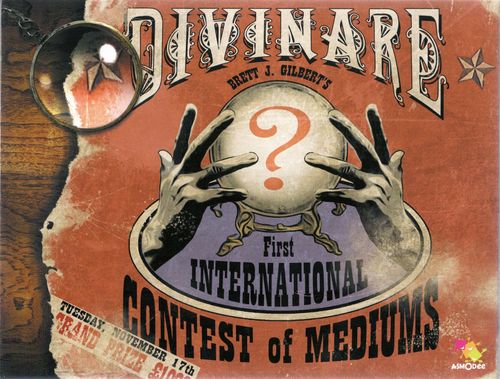
Divinare
Divinare Rulebook
Table of Contents
Table of Contents
Components
- 4 game boards;
- 36 cards;
- 1 character card and 4 prediction tokens per player;
- 16 blue score tokens (3 points);
- 44 yellow score tokens (1 point);
- 20 red score tokens (–1 point);
- 3 action cards.
Aim of the Game
The players play the part of mediums who attempt to divine the cards owned by their opponents. In each round, the cards are revealed little by little, which gives the mediums the possibility of narrowing their predictions. A good guess allows players to win points. The player with the most points after 4 rounds is the winner.
Preparation
- Place the boards in the middle of the play area.
- Each player takes a character card and the 4 corresponding prediction tokens.
- Keep the score tokens close at hand.
- The oldest player takes the 4-player action card and will be the first player. The game can begin.
Below are the rules for 4 players. For games with 2 or 3 players, refer to the modifications on page 6.
Playing the Game
The game takes place over 4 rounds. After each round, pass the action card clockwise so that the next player becomes the first player in the next round. During the game, each player will be the first player once.
Preparation of a Round
Each player places one of their prediction tokens on the central space of each board. Shuffle all the cards and deal 6 cards to each player. Important: Put the 12 remaining cards aside face-down for the round. No one must know what they are. At the start of each new round, all the cards are shuffled again, both those played in the last round and those put aside.
Turn Overview
The first player begins. The players then take turns clockwise. On your turn, perform the following two actions in order:
1. Play a Card
Choose a card from your hand and place it next to the corresponding board. Overlay the cards played next to each board so that at any time all players can see how many cards have been played.
2. Move Your Prediction Token
Now move your prediction token on the board corresponding to the card you have just played. You must move your token, even if you would prefer to leave it where it is. You may place it in any unoccupied space on the corresponding board, or place it back on the central space on that board, which may contain any number of tokens.
This movement should not be random. You should attempt to divine how many cards corresponding to that board will be played during the round. To help you, remember that the deck contains 36 cards:
- 6 red chiromancy cards.
- 8 blue crystallomancy cards.
- 10 green tasseomancy cards.
- 12 yellow astromancy cards.
But be careful, only 24 out of these 36 cards will be played in each round!
Remember: You must play a card each turn and move your corresponding prediction token to an unoccupied space!
Action Card
The action card indicates the special events that will take place during each round. The first player must make sure that these events are resolved before normal play continues.
- At the start of the round, when all players have 6 cards in hand, everyone must choose 3 cards from their hands and pass them anticlockwise. You must pass cards to the player on your right without looking at the cards given to you by the player on your left. Now you know 9 out of the 24 cards that will be played, which should help you make better predictions.
- When all players have 4 cards in hand, everyone must pass 2 cards.
- When all players have 2 cards in hand, everyone must pass 1 card.
Be aware: Passing and receiving cards doesn't only help you know more about what cards will be played. It can also help you get rid of a card you don't want to play because you don't want to move your prediction token.
Scoring
The round ends when everyone has played all of their cards. We now know how many cards are next to each board. Score each board in turn to find out who was the best medium this round. Keep any score tokens you collect face-down in front of you.
The 'perfect prediction' on each board is the space that corresponds to the exact number of cards played next to the board. If your prediction token is on a perfect prediction, take a blue score token (3 points).
The 'incomplete predictions' on each board are the two spaces directly adjacent to the perfect prediction. If your prediction token is on an incomplete prediction, take a yellow score token (1 point).
All the other spaces, other than the central space, are incorrect predictions. If your prediction token is on an incorrect prediction, take a red score token (–1 point). Be careful: The red tokens are penalties! You should try to get as few as possible.
The central space is never considered a perfect, incomplete or incorrect prediction. In all cases, if your prediction token is on the central space, do not take a score token.
In the rare situation when no numbered space on a board corresponds to the number of cards played, no players receive any score tokens for that board.
Bonus Spaces
Each prediction board has a number of bonus spaces. There are single bonus spaces (circle outline) and double bonus spaces (filled circle). If your prediction token is on a bonus space, you take 1 or 2 additional score tokens.
Double Bonus. If a perfect or incomplete prediction is a single bonus space, take 1 additional yellow score token. If it is a double bonus space, take 2 additional yellow tokens.
Single Bonus. If an incorrect prediction is a single bonus space, take 1 additional red score token. If it is a double bonus space, take 2 additional red score tokens. Remember: The red score tokens are penalties!
If the stock of yellow or red score tokens begins to run out, players can 'cancel out' 1 yellow and 1 red score token and return both tokens to the stock.
Next Round
If the game isn't over, pass the action card clockwise so that the first player changes, and then begin the next round.
End of the Game
When all 4 rounds have been played, all players flip over all their score tokens and add up their points. The player with the most points is declared the winner.
Rules for 3 Players
Simply use the 3-player action card. The game takes place over 3 rounds.
Rules for 2 Players
Use the 2-player action card. The games takes place over 2 rounds. With 2 players, the additional special actions described below are performed.
- At the start of the round, when both players have 12 cards in hand, both players must discard 2 cards from their hands. Do not move any prediction tokens during this action. Place the 4 discarded cards face-down in the middle of the play area, and do not look at them again until you resolve the special action at the end of the round.
- At the end of the round, when both players have played all their cards, reveal the 4 cards discarded at the start of the round and place them next to their corresponding boards. Do not move any prediction token during this action. Only score the round after the placing of these cards.
Characters
Rami Sakar
A childhood friend of Edmund, Rami had never before left his small village in India, and Edmund had to deploy all his diplomatic skills to get his friend to take the boat to London. Rami is amused by the tournament but isn't a born competitor. Victory or defeat, it's all the same to him. But his innate and seemingly supernatural talents have allowed him to climb the ladder at the tournament to reach the final table.
Tzciska Parovic
A young gypsy from faraway Moldavia, Tzciska once wandered the streets of London begging people for something to live on. But her chiromancy talents have quickly made her a medium with one of the best reputations in the occult circles of the capital. For her, winning this tournament is above all a question of survival: the grand prize will doubtlessly be enough for her to start a new life.
John-Paul Kramer
A notorious con-man from the Boston area, everyone wonders how John-Paul has managed to get to the final table of the tournament. To him, it's only a question of statistics, but there is a secret reason for his presence: he's working undercover for the Boston Herald and is preparing an article in which he'll attempt to discredit seers and all practising mediums.
Lord Edmund Fischner III
Fascinated with seers since his early childhood, Edmund has travelled the world to be initiated into multiple occult practices. He far prefers astromancy, but his exhaustive knowledge of all possible and imaginable practices makes him a serious opponent. He's financed most of the tournament, and intends to give the money to a charitable cause if he wins.