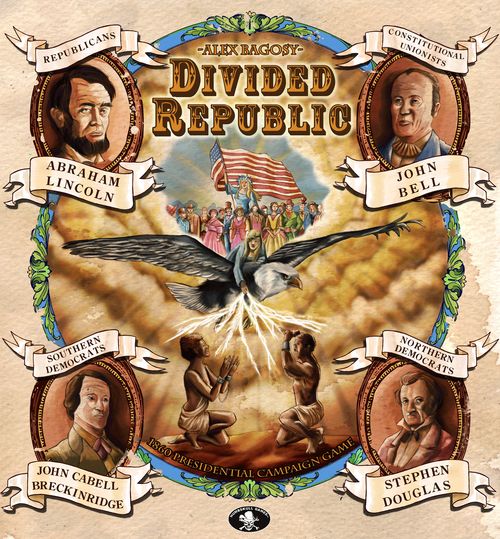
Divided Republic
Divided Republic Rulebook
Table of Contents
Table of Contents
1.0 Components
-
A game board, depicting a map of the Union as of 1860.
-
A set of color-coded markers: blue for the Republicans, green for the Constitutional Unionists, gray for the Southern Democrats, red for the Northern Democrats, and a white marker for use on the turn track.
-
A Campaign Deck of 114 cards.
-
Four sets of 50 small cubes (total 200) in four different colors, for tracking Political Control Factors (worth 1 PCF each).
-
Four sets of 20 large cubes (total 80) in four different colors, for tracking Political Control Factors (worth 5 PCFs each).
-
A deck of 35 State Reference cards, depicting the thirty-three states of the Union as of 1860, plus Kansas and Nevada.
-
Four six-sided dice (d6), one in each Party color.
-
24 Locked Tokens, 6 of each color, 2 Stronghold Tokens of each color, 4 Governor's Endorsement Tokens, 8 Senator's Endorsement Tokens and 4 Republican Ballot Tokens.
-
4 Play Aids containing party and biographical data.
-
This rule booklet.
2.0 The Board
Divided Republic is played on a map of the United States as it was in the year 1860. Represented on the map are thirty-three states, plus the territories of Kansas and Nevada, divided into six geographic regions. Each region represents a specific group of states bound together by geography, politics, and history.
2.1 The Regions
There are six Regions. Each region is represented by a different color. These regions represent the political orientation and regional distinctions present in 1860, and may very well differ from modern regional associations and terminology.
The regions are: Pacific West (PW), Middle West (MW), Northeast (NE), Mid-Atlantic (MA), Upper South (US), and Lower South (LS).
The board also depicts a Momentum Table, a Turn Track, and notes on Kansas/Nevada Statehood, Regional Polling exceptions, and South Carolina's special distinctions.
2.2 The States
There are thirty-three states, plus two possible candidates for statehood: the territories of Kansas and Nevada. Each state is marked with the following information:
The name of the state as of 1860.
A "PCR Box" depicting the state's Political Control Requirement (expressed as PCR), which contains room for the placement of Political Control Factor cubes (expressed as PCFs). A party places its PCF cubes in the PCR Box.
The large number, the state PCR, represents the minimum amount of political influence that a party needs to control the electors from that state.
The small number in parentheses represents the state's Electoral Votes.
Example: In Kentucky, the state electoral vote is twelve, but a party must control at least four (4) points worth of political influence (PCFs) to gain Kentucky's twelve votes in Regional or Final Polling.
Then as now, a state's electoral vote (number of electors) equals the state's two Senators plus the total number of Representatives in Congress. The state of Kentucky, for example, had twelve (12) Electoral Votes in 1860.
2.3 States with Colored Eagles: Strongholds
States with colored eagle head icons are party "Strongholds," the states in which candidates were historically strongest. The color of each icon reflects the color of its political party: (Constitutional Unionists – green; Northern Democrats – red; Southern Democrats – gray; Republicans – blue.)
In three of the four cases, these were the home states, or adopted home states, of the party candidates. Stephen Douglas, however, faced an uphill battle in his home state of Illinois, and so the Stronghold for Douglas is Missouri, which was a stronghold for Northern Democratic sympathies (and was historically the only state Douglas won).
2.4 States with Asterisked PCRs*: Republican Party Not On Ballot
States with the asterisk (*) symbol affixed to their PCR are states in which the Republican Party was unable to secure a place on the ballot during the election of 1860 – though there may have been a handful of write-in votes. The Republican Party may NOT perform any Actions to affect these states except by playing the "Popular Appeal" card.
2.5 The Momentum Table
The Momentum Table is used to track a Party's progress as it gains and loses electoral influence prior to the General Election.
The Momentum Table is comprised of four boxes, numbered one through four, in which the respective party Momentum Markers are placed to indicate turn order. Momentum is calculated after each Regional Polling (see 7.4). The player in the first position on the Momentum Table will draw an extra card each turn after the first Regional Poll has occurred. This is in addition to any extra cards drawn by the player as a result of other game effects, rules, etc.
3.0 The Political Parties
There are four Parties in Divided Republic. Each party has unique strengths and weaknesses based upon its historical performance in terms of the overall political power, geographic distribution of supporters, and major issues upon which it campaigned (see 8.0).
3.1 The Constitutional Unionists
With Senator John Bell and Edward Everett (green). Party Stronghold in Tennessee.
3.2 The Northern Democrats
With Senator Stephen Douglas and Herschel V. Johnson (red). Party Stronghold in Missouri.
3.3 The Republicans
With former Congressman Abraham Lincoln and Hannibal Hamlin (blue). Party Stronghold in Illinois.
3.4 The Southern Democrats
With Vice President John Cabell Breckinridge and Joseph Lane (grey). Party Stronghold in Kentucky.
4.0 The Cards
4.1 The Campaign Deck
The Campaign Deck consists of one hundred and fourteen (114) cards, each including a title, body text, and PCF value.
The title of the card is used as an historical reference. The card entitled "Cuban Revolt," for example, is the name of a card that could potentially be used to reflect the effects of a Cuban revolt against Spain; the Cuban issue was a very important one in the election of 1860. In some cases, this title will be marked with an asterisk (*). This means that the card, if played as a Campaign Event, must be removed from the deck after use. Cards removed from the Campaign Deck do not return to play during a game.
The body text describes the proper use of the card in game, if used as a Campaign Event, Platform Speech, or Regional Poll.
Finally, the PCF value, in the upper left hand corner of the card on a gold background, denotes the value of the card if used to manipulate your political influence in a region and/or build up the party political machine, as represented with the play of PCF cubes. This value will always be between two (2) and four (4).
The deck is reshuffled after turns in which Regional Polls are played (see 7.4). When reshuffled, cards that were removed from the game are not shuffled back in, only the discard pile. Some other cards played as events may also call for a reshuffle.
4.2 The State Reference Deck
The State Reference Deck is a deck of thirty-five (35) cards, one card per state, depicting a state, its Electoral Vote total, and the region in which it is located. Cards should be awarded to parties when they take control of a state during polling. Note that Kansas is considered a part of the Middle West, while Nevada is considered a part of the Pacific West.
5.0 Set-up
Lay out the board. Place the four markers (one of each color) in an opaque container, and have each player draw a marker from the container. The color drawn determines the party that the player will represent in the current session of the game.
The Constitutional Unionists (green) The Northern Democrats (red) The Republicans (blue) The Southern Democrats (grey)
Next, the players should take turns placing their PCF cubes as instructed below, beginning with the Constitutional Unionists and proceeding in clockwise fashion around the table. PCFs may NOT be placed in either Kansas or Nevada during set-up.
(Note: See section 12.0 if playing with fewer than four players.)
5.1 The Constitutional Unionists
4 PCFs in Tennessee 2 PCFs each in Kentucky and Massachusetts 5 PCFs anywhere in the Upper or Lower South
5.2 The Northern Democrats
4 PCFs in Missouri 3 PCFs in Illinois 2 PCFs each in Georgia and New Jersey 6 PCFs anywhere in the Mid-Atlantic, Middle West or Pacific West
5.3 The Republicans
4 PCFs each in Illinois and Massachusetts 2 PCFs each in New York and Ohio 5 PCFs anywhere in the Middle West, Northeast, or Pacific West
5.4 The Southern Democrats
4 PCFs each in Kentucky in South Carolina 2 PCFs in Oregon 7 PCFs anywhere in the Upper or Lower South
(Note: For convenience each party has their PCF set up allocations on their respective play aid.)
5.5 Place Momentum Markers
The player markers are placed on the Momentum Track with the Constitutional Unionists first and the other players' markers following in clockwise order.
For the first turn, the Constitutional Unionists will NOT receive the extra card benefit for being first on the Momentum Track. The same applies to any party leading on the Momentum Track at the start of the game in the case that you are playing with fewer players and the Constitutional Unionists do not appear.
5.6 Deal Cards
Next, shuffle the Campaign Deck, dealing seven (7) cards to each player. On subsequent turns, Parties will receive six (6) cards, but for the first turn only, the parties will receive seven cards.
6.0 Order of Play
The game is divided into six turns, during which the following phases occur. The sixth turn, the General Election, works slightly differently (see 9.0).
6.1 Momentum
Before the first turn, the player markers are placed on the Momentum Track with the Constitutional Unionists first and the other players' markers following in clockwise order. This will be the play order until the first Regional Poll is played in the game. After each turn in which a poll has been played and players have acquired state cards, players will adjust the Momentum Track, ordering the player markers in order from most electoral votes to least, with ties being resolved by die roll.
6.2 Actions
At the start of each turn, the first player plays one card as an Action, followed by the next player in order of Momentum, and so on. Play moves as such until all parties have performed five (5) Actions or have run out of cards.
6.3 End of turn
Players in turn order must choose to keep or discard all remaining cards, the turn marker is advanced on the Turn Track, and order of play is adjusted on the Momentum Track if a Regional Poll was played this turn.
6.4 Draw cards
Players draw until they have six cards in hand. The Republicans and the party at the head of the Momentum track draw one extra card (two extras if the Republicans lead Momentum). This Momentum advantage does not take effect until after the first Regional Poll of the game has been played.
6.5 End of game
There are a total of six (6) turns, with each turn representing approximately one month. While it is not possible (short of conceding) for the game to end with a VICTORY before Turn 6 (the General Election), it is entirely possible that the game could end with a DEFEAT for all players before Turn 6. (See section 11.0, 'Victory and Defeat', for more details). Final Polling will determine the winner after the last turn.
7.0 Actions
During your portion of the Turn, you may perform any one of the following actions:
- Play a card as a "Campaign Action" by using a card for its PCF placement
- Play a card as a "Campaign Event"
- Play a card as a "Platform Speech"
- Play a polling card to initiate "Regional Polling"
In addition, you may:
- Make a Personal Appearance (at any time during the turn, except by the Republican Player).
Generally speaking, these Actions may be performed in any state in which your party appears on the ballot, though Regional effects may still be played regardless of the number of states where you appear on the ballot. Only the Republicans need worry about this, as they do not appear on the ballot in asterisked states.
Example: Scott, the Republican Player, wants to play a "Governor's Endorsement" card for the state of Georgia. However, because he does not appear on the ballot in Georgia, Scott is not permitted to play the card, neither for its Campaign Event nor to place PFCs. Conversely, however, Scott could play a Platform Speech in the Lower South with the hope of reducing the influence of other parties in the state, since Platform Speeches target entire regions, rather than states.
7.1 Campaigning
Every card is rated with a number ranging from 2-4. This represents the amount of Political Control Factors (PCFs) that the card is worth for the purposes of "Campaigning."
Campaigning represents the efforts of your party to build momentum and support in a state by expanding your electoral base, rallying the state's registered party members, or simply building up the state's political machine. You may Campaign with these PCFs in one state or in multiple states, in one region or multiple regions.
The base cost to place a PCF on the map is one (1) point, modified as follows (note that modifiers are cumulative):
-
+1 for each placement this Campaign Action in regions beyond the first.
-
+1 for each placement into a state controlled by another party. A party controls a state if it has achieved, at minimum, the PCR of the state in question and a plurality (more PCFs than any other party) of the overall PCF tally. In the case of a tie, a party does not control a state, unless that party has a state "Stronghold."
Example: Scott, the Republican Player, wishes to place PCFs in Delaware (PCR 2), which is currently controlled by the Northern Democrats (they have two PCFs, and every other party has less). He plays a PCF 4 card. Normally, these points would be used at a cost of one for one, but because the state is currently controlled by the Northern Democrats, the Republican player must spend +1 point for every PCF point he wishes to play within the state, therefore allowing him to play only two (2) points in Delaware with his four point card. However, in doing so, Scott has now tied the Northern Democrats in PCF for Delaware. Both sides possess 2 PCFs, the minimum required for PCR, but neither party has a plurality of votes in the state.
On his next campaign action, Scott plays 1 PCF in Delaware, taking control of the state for himself. He can do this at a cost of one for one, since no single party controls Delaware.
It is entirely possible that the play of PCFs may, in fact, cause the control status of a given state to change. If this is the case, further placements are reduced to the original cost.
Example: Mike, playing the Northern Democrats, wants to get Delaware back. On his turn, Mike plays a 3 PCF card. The current total is 3:2 in favor of the Republicans.
The Northern Democratic PCF cost would be at +1, since the state is controlled by the Republicans. Mike decides that the cost is worth it, and pays two points to place a single PCF in Delaware. Now, the state is once again tied. His third and final PCF will only cost one for one, since the state is now tied with no party controlling. Playing this final point will regain control of Delaware for the Northern Democrats.
7.2 Playing a Campaign Event
Many cards are associated with events. While the effects of the events may vary considerably, no event is mandatory, and an event must be declared if it is to be used for that purpose. A card played as an event may NOT be used for Campaigning, nor may it be played outside of your own Action phase unless the text of the card specifically says otherwise.
Some events, marked with an asterisk, may only be played once, after which they are removed from the deck for the duration of the game.
Example: Alex, playing the Constitutional Unionists, plays the "Cuban Revolt" card as an event. After its effect is resolved, the card must be removed from the deck and plays no further role in the game.*
Some events are party specific, or may otherwise be unavailable to certain players. If this is the case, said cards CANNOT be played as events by the individuals restricted from their use. In addition, certain cards may alter the normal rules of play. In such cases, the text of a card has priority when compared to the text of these rules.
7.3 Playing a Platform Speech
If you currently hold the card in your hand, you may make a Platform Speech. Platform Speeches allow the play of d6 PCFs in ONE region, as modified by the region in which the card is played, indicated on the card.
Example: The Platform Speech card entitled "Abolition" shows a PCF value of 2. This means that the card may be played for two (2) PCFs as a Campaign Action, However, the card may instead be played as a Platform Speech regarding Abolition, with the following die roll modifiers according to region: MA 1; MW 1; NE 2; PW 1; LS 2; US 1
Thus the Abolition Platform Speech is worth d6+1 PCF points when played in the Mid-Atlantic, Middle West, Pacific West, and Upper South, but it is worth D6+2 points if played in the Northeast or Lower South.
You may play this Platform Speech for or against any Party by declaring your target before making the roll for the speech. If the speech is given FOR a party, then the modified PCFs for the region in question are POSITIVE and ignore normal costs; if the speech is given AGAINST a party, then the modified PCFs for the region in question are NEGATIVE, and still ignore all cost modifiers – they must remove that many PCFs.
Example: Platform Speech: Abolition is worth two (2) more points in the Lower South. This means that it can be used to increase your d6 roll by two, bringing it to a value between three (3) and eight (8) points.
You could then use these points to INCREASE your PCF in the Lower South by up to eight points (or to increase the PCF of another party, if you so desire), placing eight PCF blocks without obeying the normal cost modifiers. On the other hand, you could reduce a targeted party by up to eight points, the targeted player removing them at a cost of one for one.
Regardless of intent, PCFs are always removed or added by the target of the Platform Speech, who is not always the speech giver! If you speak on behalf of your own party, you alone decide where the PCFs you have earned will go; if, however, the effects are targeted at another party, that player may add/reduce PCFs as necessary within the affected region.
Example: Jen, playing the Southern Democrats, wishes to play Platform Speech: "Fugitive Slave Act", and to build her case in the Lower South, therefore modifying her die roll by +2. She rolls a '3', earning five PCFs that she can then place in the Lower South.
Later, however, the Constitutional Unionists are disappointed to see that the Southern Democrats are making headway in the Lower South. They play their own Platform Speech: "Abolition" to set the record straight. They roll d6, with a result of 6, plus 2.
Jen must now remove a total of eight PCFs from the Lower South, but she may choose which PCFs she removes.
In either case, normal costs for PCF placement, as per 7.1, do not apply.
Exception: The Northern Democratic player chooses which PCFs are lost whenever a Platform Speech is played by the Northern Democratic player as a NEGATIVE speech targeting another party (see 8.2).
You may play as many Platform Speeches as you have Actions in a given turn, so long as you have the cards required to make those speeches.
7.4 Regional Polling
There are six (6) Regional Polling cards in the deck. Like other cards, these have a PCF rating that can be used for Campaigning, but they can be instead played as a Regional Poll, similar to playing a card as an event.
The play of such a card for its intended purpose immediately initiates a scoring round for the Region in question. States are polled one at a time by determining who controls a given state, then moving onward until all states in the Region have been polled. For convenience, it is recommended that the states be polled in the order listed on the appropriate polling card.
7.5 State Control
State control during a Regional Poll is determined by the state's PCR rating. Should a Party possess enough PCFs in a Region to equal or exceed the local PCR and should the Party achieve a plurality (more PCFs than any other Party), then the Party is said to have State Control. The Party wins this round of state polls, and receives the appropriate State Card from the unclaimed set or from the Party that previously held it. This card will be held as reference for calculating Momentum until someone else wins control of the state during a later poll. A State Card is also lost if during a poll no one has control of the state – the previous controller does not keep control. If a state is tied, no one claims it unless the state is a Stronghold for one of the parties involved in the tie (see 9.3) or the state is New Jersey (see 9.4).
Example: Alex plays the "Regional Poll: Middle West" card, and the Regional poll for the Middle West region begins. Alex begins the polling in Indiana. Indiana's PCR is 4, and each of the political parties has the following totals in the state:
- Constitutional Unionists (Alex): 5
- Northern Democrats (Mike): 2
- Republicans (Scott): 4
- Southern Democrats (Jen): 0
Because the state PCR is 4, both Alex and Scott could potentially qualify to control the state. However, Alex controls a plurality of the PCFs in Indiana, and is therefore declared the winner, awarding him Indiana's prized 13 Electoral Votes. Because this is being scored during the play of a Regional Poll, Alex is awarded the Indiana State Reference Card.
State control can change turn by turn, move by move, but it is only SCORED during Regional Polling. As such, it is important to keep in mind that control matters at all times during the game, not merely during Regional Polls, but that the Momentum Track is ONLY altered at the end of a round where polling occurred.
Regional Polls are concluded when all the states in the region have been polled. Following the turn during which a Regional Poll has been played, the discard pile will be shuffled back into the deck before players draw new hands, and the Momentum order will be adjusted. In case of a tie for electoral votes, positions on the Momentum track are randomized with the use of a die roll.
There are special rules for polling New York, New Jersey, Texas, and South Carolina. (see 9.4-7).
7.6 Locking States
Sometimes, the efforts of a Party within the state political machine are such that they have achieved a virtual monopoly on the politics therein, guaranteeing that they will achieve the majority of popular support in that state come election day.
If, at any time during a Regional Poll, a party has twice as many PCFs in that state as required for PCR (and more PCFs than any other party in the state), the party is said to have locked up the vote in that state, guaranteeing that it will win that state in November. A state which is Locked in this manner may not be targeted by any further Actions. Remove all PCFs from the state and place a Locked token in the color of the winning Party on the appropriate state. No more PCFs can ever be added to the state, and the party that has locked it will automatically win it during any future Regional or Final Polling.
Example: If during a Regional Poll the Constitutional Unionists had a total of eight (8) PCFs in Indiana (PCR4) and no other player had more PCFs, the state would be said to be Locked for Alex's Party. He places a Locked Token on Indiana, removes all PCFs, takes the State card, and on each subsequent Regional Poll, he would automatically receive Indiana's 13 electoral votes.
If more than one party controls the required numbers to Lock a state during a Regional Poll, the state cannot be Locked unless a party has achieved plurality. South Carolina may NEVER be Locked. Remember, a state may only be locked during a Regional Poll!
8.0 Party Advantages
8.1 Republican Advantage: Options
Regardless of the number of cards drawn in any given turn, the Republican Party player will always draw one (1) extra card at the beginning of each turn after the first (in which each party, including the Republicans, will receive an equal hand of seven cards.) While he may still perform only as many Actions as permitted in the turn, this additional card gives the Republican Player slightly more flexibility when determining which Actions he will play for the turn in question. This is in addition to the extra card for being in first place on the Momentum Table, or extra cards received by card play.
8.2 Northern Democratic Advantage: Stephen Douglas
Stephen Douglas was a brilliant orator who, it was once remarked, could charm the Devil. The Northern Democrats benefit from his oratorical ability when playing Platform Speeches.
Normally, when losing PCFs as a result of a Platform Speech, the Party affected loses these PCFs in the states of its own choosing. Douglas is such a powerful speaker, however, that the Northern Democratic player chooses which PCFs are lost whenever a Platform Speech is played by the Northern Democratic player as a NEGATIVE speech regarding another party.
Example: Mike, the Northern Democratic player, plays Platform Speech: Abolition against the Southern Democrats in the Lower South. He generates a loss of 4 PCFs for the Southern Democrats. Normally, Jennifer, the Southern Democratic player, would choose where in the Lower South to remove these PCFs from. Because Mike is playing the Northern Democratic Party, however, he has Stephen Douglas, who allows him to decide where Jennifer must remove her PCFs. He notes that there is a tight race in Georgia, where he could earn much needed Electoral Votes and the Southern Democrats currently control 6 PCFs. As such, Mike requires that Jennifer remove all four PCFs from Georgia, a huge setback for Jennifer in this case.
8.3 Southern Democratic Advantage: Radicalism
The Southern Democrats had pockets of radical support throughout the United States, even in areas where they lacked the numbers to be an electoral threat. As a result, the Southern Democrats are not required to pay the +1 cost when placing PCFs in multiple regions while Campaigning.
Example: Jen, playing the Southern Democrats, plays a four PCF card to campaign in New York. She adds two PCFs to New York, and has two remaining PCFs. She decides to spend these in Maryland. While Maryland is in another region, Jen is playing the Southern Democrats, and therefore pays the normal placement costs for her PCFs as if they were placed within the same region. Of course, if another Party controlled Maryland, she'd still have to pay the extra cost involved for such an action. Another party making the same play would only be able to play one PCF in Maryland, as it would cost 2 for each PCF placed. If Maryland were controlled by another party, the play would be impossible, as the cost would be 3.
8.4 Constitutional Unionist Advantage: Ties in the Mid-Atlantic, Pacific West, and Upper South
At any time during Regional or Final Polling in which a state in the Mid-Atlantic, Pacific West, or Upper South Region is tied, and the Constitutional Unionists have at least one (1) PCF within that state, they AUTOMATICALLY gain enough PCFs to control that state. The only exceptions to this are Kentucky and Missouri, where the State Stronghold rule TRUMPS this advantage, and New Jersey, whose election laws work differently in 1860.
Example: At the beginning of Final Polling, Delaware is tied between the Republicans and the Southern Democrats, who have two (2) PCFs in the state each. The Constitutional Unionists have a single PCF in the state, while the Northern Democrats have none. The Constitutional Unionists automatically win the state of Delaware, since it falls within the Mid-Atlantic Region and is tied between parties.
9.0 The General Election, Final Polling, and Special Cases
Play in Turn 6, the General Election, works a bit differently than in previous turns. During this turn, Regional Polling cards may ONLY be played for PCF value (not for Regional Polling). This is because Turn 6 represents the final, frenetic days of the campaign cycle before the General Election.
At the conclusion of Turn 6, all Regional Polling cards are set aside. One at a time, each Regional Polling card is used to tabulate the Electoral Vote and to determine the overall winner. States where no party has met PCR are simply not won – they could have been won by minor parties, write ins, or simply had no clear winner at the time of the federal deadline.
In the case of Final Polling, control of a state is meant to reflect the actual power in the Electoral College gained through the General Election, achieved by adding the points on the State Cards to determine whether a candidate has achieved victory by attaining at least 152 electoral votes.
It is entirely possible, indeed likely, that none of the parties will receive the necessary majority for election. In order to resolve such circumstances, please see 11.0, Victory and Defeat.
9.1 Special Polling Exceptions
There are a few special exceptions when it comes to resolving who has won a given state. These include tied states, state strongholds, and the unique electoral situations in New York, New Jersey, South Carolina, and Texas during the 1860 election. In addition, the Constitutional Unionists have a special advantage when it comes to certain regions.
9.2 Tied States
Unless otherwise noted, states where multiple parties have met PCR but are tied go to no one during Regional Polls. During Final Polling, however, they go to the tied party that controls the MOST other states within a Region, unless the state is a Stronghold, OR the state is New York, New Jersey, South Carolina, or Texas. States in regions where each party controls the same number of other states are won by no one.
9.3 State Strongholds
Each Party has at least one Stronghold, based upon a particularly strong family or political connection for the party's candidate.
A Party with a Stronghold WINS all ties in its stronghold which it is involved during Regional and Final Polling, AND it wins all Final Polling rounds in which it has achieved the minimum PCR for control of the stronghold state, EVEN if other Parties have achieved more PCFs. (Exception: This does not apply to states that have been Locked by other parties.)
Example: The Southern Democrats under Jen charge back in Tennessee, where they were previously losing, so that by the time of Final Polling, they have six (6) PCFs in Tennessee, while the Constitutional Unionists under Alex have only four (4) PCFs.
Now, under a Regional Poll, this would automatically equate to a Southern Democratic victory in Tennessee, but the General Election is a bit different. Tennessee is the Constitutional Unionist Stronghold, and as such, Alex automatically wins the state in Final Polling assuming that he:
a) Has enough PCFs to qualify for PCR, AND b) That Tennessee in not Locked by another party.
Two Stronghold tokens are included for each party in the event of their play of the Kansas and/or Nevada Statehood cards.
9.4 New Jersey
New Jersey did not operate with a "winner take all" system during the election of 1860. In the case of a tie during Final Polling in the state of New Jersey, the tied parties are awarded an even distribution of the electoral vote. The remainder is awarded to the Republicans if they have any PCFs in the state, then the Northern Democrats if they have any, then the Constitutional Unionists. The Southern Democrats NEVER gain the remainder in New Jersey. Set the card aside, place PCF cubes among the state cards of the recipients of the votes equal to the number they received, and remember to include them in the final tally.
Example: The Republicans and Southern Democrats are tied for control of New Jersey at three (3) PCFs each at the time of Final Polling for the Mid-Atlantic. As such, both parties are awarded three (3) PCFs, an even distribution of the state's 7 Electoral Votes. However, one vote remains. No other parties currently have PCFs in the state, but the rules dictate that the remainder should be go to the next party, in order of priority discussed above, not involved in the tie. As such, since the Republicans are already involved in the tie, the remaining single (1) PCF is awarded to the Northern Democrats. This is, in fact, very similar to what historically happened in the state!
9.5 New York
Radical abolitionist sympathies were incredibly strong in New York, and the Abolitionist Party under Gerrit Smith was extremely influential. As such, in the case of a tie in New York during Regional or Final Polling (or in the case that no player wins), the state of New York is awarded to Gerrit Smith and the Abolitionist Party instead of to the player with the most other states in the region (No player claims the state card).
Example: The Republicans and Northern Democrats are tied in New York, with each controlling 7 PCFs at the time of a poll. Because neither Party controls enough PCFs to claim plurality, the state is automatically awarded to Gerrit Smith (No player claims the state card).
9.6 South Carolina
South Carolina's electoral votes were awarded by the state legislature during this period, usually without consideration of the popular vote. In fact, before the twentieth century, records of the popular vote for presidential candidates in South Carolina were rarely kept! This meant that the state's electors frequently chose candidates based upon their own political inclinations, often with interesting results. To represent this unique arrangement, a few special rules apply.
Only the Southern Democrats may win South Carolina by achieving South Carolina's PCR rating of 3 during Regional or Final Polling. The Constitutional Unionists and the Northern Democrats may only win South Carolina during Regional or Final Polling with a total of 6 PCFs. Remember: South Carolina can never be "Locked!"
The Republican Party MAY win South Carolina, but they must have BOTH a PCF total of at least 6 AND at least two thirds of the total PCF currently placed in the state. However, if the Republicans happen to win South Carolina, there could be a rather unforeseen effect. The Republicans roll 1d6.
Roll 1d6:
- 1-4: No Effect
- 5-6: South Carolina SECEDES
If South Carolina secedes, the Parties have failed to preserve the Union. EVERYONE loses.
Example: During Final Polling, the Northern Democrats have four (4) PCFs in the state of South Carolina, clearly meeting the state PCR. However, the Northern Democrats cannot win South Carolina in this case, because the state's archaic political structure requires that the Northern Democrats have 6 PCFs for PCR rather than the normal PCR of 3.
The Republicans, too, could win with 6 PCFs. However, they would also need to have at least two thirds of the PCFs currently present in the state. If this were the case, fire eaters would likely raise hell, and a check must be made to see if South Carolina secedes in protest. If it does secede... oops! Game over!
9.7 Texas
If there is a tie in Texas during Final Polling (or no player wins), it goes to the great hero of Texas, Sam Houston, who ran on the Texas Unionist ticket during the war. And as a result, to the great shame of his fellow Texans, he was branded as a traitor when the war began! (In this case no player receives the state card).
Example: The Southern and Northern Democrats are tied in Texas, with each controlling 7 PCFs at the time of a poll. Because neither Party controls enough PCFs to claim plurality, the state is automatically awarded to Sam Houston (No player claims the state card).
10.0 Making a Personal Appearance
Generally speaking, one did not "run" for the presidency in the nineteenth century; one "stood" for the office of president, whilst others campaigned for him. Most Parties will be permitted one opportunity to "Make a Personal Appearance" per game. Except for play of the "Speaking Tour" card, the Republicans are not allowed any Personal Appearances, while the other parties are permitted one Personal Appearance.
A Personal Appearance may be used to do one of several things described below. There is no cost for the use of this action, other than its limited commodity; use of a Personal Appearance does NOT count as an Action!
- A Personal Appearance may be used to DOUBLE the value of any card used when using a Campaign Action. This effect may NOT be used to double the effects of Platform Speeches, Events, etc.
Example: Jen wishes to place PCFs in Indiana, which has become a critical battleground for her. She chooses to spend a 4 PCF card in Indiana, and announces that she is using a "Personal Appearance" to increase the effect of building the party machine in Indiana. As such, the card is actually worth eight (8) points, rather than the standard four, making it quite valuable!
- A Personal Appearance may be used to re-roll any card effect or event requiring the roll of a die. This includes Platform Speeches.
Example: Alex plays the card 'Cuban Revolt' and rolls an unfavorable result. He chooses to use his Personal Appearance, in effect representing perhaps a personal mediation or extreme effort exerted to spin the news in a more positive matter, to reroll the effects of the event. He must accept the result of the reroll.
- A Personal Appearance may be used to cancel ONE Action undertaken by an opponent. This includes the playing of asterisked (*) events, which are removed from play as per normal once they have been activated.
Example: Mike has been hit by Jen with a negative Platform Speech, forcing him to remove 4 PCFs from Missouri, a critical state in his campaign. Mike announces that he is using his Personal Appearance to negate the effects of this speech, saving him the potential of a damaging loss in Missouri. The Platform Speech card is discarded even though Mike nullified its effect.
Please be aware that, because Personal Appearances do NOT count as Actions, they cannot be used to cancel other Personal Appearances or to negate their effects! This includes Campaign Actions that have been doubled – once a Personal Appearance has been used to double them, they may not be canceled by another Personal Appearance.
The Constitutional Unionists, Northern Democrats, and Southern Democrats are normally permitted one (1) Personal Appearance per game. Because Abraham Lincoln did not campaign once he had been nominated for the presidency, the Republicans are not, normally, permitted to make Personal Appearances, but the "Speaking Tour" card could change this situation if played for that purpose.
11.0 Victory and Defeat
The United States Constitution is clear on this point: a candidate MUST win a majority in the Electoral College to win the American Presidency. No matter how many Americans vote for you, the vote of your electors is all that really matters.
Every election, there is a "magic number," the number at which a candidate is said to have achieved electoral victory. The number is essentially a simple majority: one more than half the total number of Electoral Votes available.
The "magic number" in 1860 was 152 of the 303 Electoral Votes possible. This means that ANY party achieving 152+ Electoral Votes in Divided Republic has won the game by capturing the White House!
Unfortunately, the situation present at the time of the election of 1860 makes this more difficult than it would be under normal circumstances, even in races with more than two major candidates.
11.1 Electoral Ties
It is possible, indeed likely, given the number of candidates, that no candidate will achieve the minimum number of Electoral Votes (152+) required for victory. In the case of such circumstances, sometimes known as an "Electoral Tie," the election is constitutionally mandated to go to the House of Representatives, where each state receives a single vote which it can cast to vote for any candidate it chooses among the top three receiving votes in the Electoral College, or for no candidate at all. If no one party among the top three in Momentum achieves the required number of Electoral Votes for an outright win, then the presidency is awarded to the party controlling the most states. If even this fails to select a candidate, then the game ends with an Automatic Defeat for every one of the players in the game.
11.2 Automatic Defeat
Though it is not possible for any party to achieve victory before Turn 6, it is possible for EVERY player to lose the game either before Turn 6, or at the conclusion of the General Election.
The most common cause for such a situation would be the lack of a clear winner, as defined by section 11.1 of these rules.
The second occurs if secession arises directly from electoral results. In essence, the "great men" of the political parties have failed to do their job, and everybody loses! This is represented by the possibility of South Carolina seceding from the Union.
11.3 Republican "Coup"
As discussed earlier in these rules (see 9.6), if the Republicans and Abraham Lincoln win South Carolina, there is a chance that the fire-eaters, who dominated South Carolina politics, will cry foul, resulting in the possible secession of South Carolina!
11.4 Kansas and Nevada are Free States
South Carolina may secede if both Kansas and Nevada are admitted as free states. Nevada is always a free state if admitted to the Union, but Kansas is only a free state if the Kansas Statehood card is played by the Republicans or Northern Democrats (play of this card by the Southern Democrats or Constitutional Unionists admits Kansas as a slave state, avoiding this danger entirely). As soon as both of these states are admitted as free states, roll on the following table to see if South Carolina secedes:
- 1-4: If the Republicans are currently leading on the Momentum Table
- 1-3: If the Republicans are currently second on the Momentum Table
- 1-2: If the Republicans are currently third on the Momentum Table
- 1: if the Republicans are dead last on the Momentum Table
If South Carolina secedes, all players are defeated.
12.0 Games with Fewer Players
Following are rules for games involving fewer than four players.
12.1 Two-Player Scenario
The game is played as standard, but there are a few special exceptions. The two players represent the Republican and Southern Democratic Parties. The Constitutional Unionists will set up as normal, with the Republican player determining where their five bonus PCFs are placed. The Northern Democrats, similarly, will set up as standard, with the Southern Democratic player placing the six free set-up PCFs.
All Strongholds remain in place. In addition, Missouri may never be locked, and will always go to the Northern Democrats when no clear winner has been determined, even if the state PCR has not been met by any party (This is identical to the situation already in place with New York and Texas).
Events that benefit the non-player parties, as well as Platform Speeches, may still be used to benefit or detract from the Constitutional Unionists and Northern Democrats as they would be in a standard four player game. In a Two Player Game, play on Turn One will begin with the Republicans.
12.2 Three-Player Scenario
The game is played as standard, but the Constitutional Unionists remain unplayed. All Parties set up as standard, but the placement of Constitutional Unionist PCFs is determined by the Northern Democratic Player. All Strongholds remain in play.
Events that benefit the non-player party, as well as Platform Speeches, may still be used to benefit or detract from the Constitutional Unionists as they would be in a standard four player game. In a three player game, play will begin on Turn One with the Northern Democrats and proceed around the table clockwise.
It is entirely possible that the play of PCFs may, in fact, cause the control status of a given state to change. If this is the case, further placements are reduced to the original cost.
Example: Mike, playing the Northern Democrats, wants to get Delaware back. On his turn, Mike plays a 3 PCF card. The current total is 3:2 in favor of the Republicans.
The Northern Democratic PCF cost would be at +1, since the state is controlled by the Republicans. Mike decides that the cost is worth it, and pays two points to place a single PCF in Delaware. Now, the state is once again tied. His third and final PCF will only cost one for one, since the state is now tied with no party controlling. Playing this final point will regain control of Delaware for the Northern Democrats.