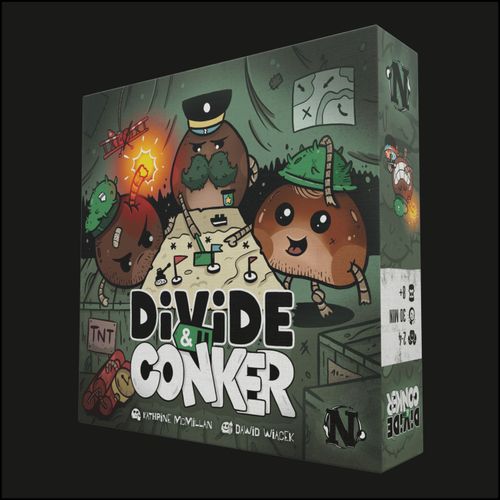
Divide & Conker
Divide & Conker Rulebook
Table of Contents
Table of Contents
Components
Cards - 36 total
- Conker cards, used during battles, each with their own health, victory points and dice access. All conker cards have a black top.
- Hardener cards, used to improve the conker card. All hardener cards have a white top.
- Tricks, used during battles to influence the outcome of a battle.
- Veteran, awarded to conkers that stay in play between round 1 and 2. The Veteran allows access to the black dice and additional 2 health. On the reverse a victory point.
Other card icons:
- -1 victory point
- apply to 2 conker
- plays on own or opponents conker
Tokens - 36 total
There are three different types of tokens:
- String tokens, these are attached to conkers. A conker can only be used in a battle if it has a string attached. Each string has a unique ability and access to dice.
- Crack tokens, used to show the amount of damage a conker has received during battle.
- 1st player token, used to show the first player in round one and round two.
Strings explained
- Cord - after first battle the cord flips to frayed. On frayed, after battle the string is destroyed.
- Shoelace - is reliable and does not break.
- Leather lace - player who gained the leather lace goes first during battle phase. Each Leather Lace has a number corresponding to the round number.
- Bungee cord - the player may alter the result of one own rolled dice.
Dice - 7 total
There are four different dice probabilities: red to yellow to green, red has the highest probability to hit and green the lowest. The black dice is identical to the yellow but has a single face with a double crack icon.
Each dice has a set number of dots corresponding to the colours of the dice. Green – 1 dot, yellow – 2 dots, red – 3 dots and black – 4 dots.
Dice faces:
- miss (plain face)
- hit (crack)
- double hit (double crack)
Damage examples shown in the rulebook: 1 crack (damage), 3 crack (damage), 5 crack (damage).
Trick cards
- Chestnut - The chestnut can be played either offensively or defensively during a battle. When the chestnut is played, replace the chosen conker with this card and return the chosen conker to the owners hand. Any tucked cards remain. All conker damage falls off. If a hardener was in play, place the hardener below this chestnut and continue the battle until either conker or chestnut is destroyed.
- Rebound - The rebound can be played either offensively or defensively during a battle. When the rebound card is played, the player may alter the result of up to any two dice. Tip: also useful to decrease any excess damage.
- Shorten - The shorten can only be played offensively during a battle. When the shorten is played, the opponent would place the card with their conker to decrease the conkers total health. The damage is only temporary for the battle. If the conker with the shorten wins the battle, this card is then discarded.
- 360 Trick - The 360 Trick can only be played defensively during a battle. When the 360 trick is played, the player of this card may reroll up to any two dice.
! Only one trick card from both players may be played during each roll phase.
Set Up
Shuffle the conker, hardener and trick cards into three stacks and then deal out two piles from these three stacks to create two stacks of 15 cards. Place one stack to the side to use in round two. The draft set up differs for two player and three or four player games.
Two player
With the first stack of cards, create a pyramid structure. Build from the top down with one card at the top face up, the two below face down, the three below face up, the four below face down and the five along the bottom face up.
Three or four player
With the first stack, create a snake structure. Build from left to right starting with two cards face up, then one face down, one face up, two face down, three face up and two face down. All these cards should overlap. The remaining four cards are then placed separately as face up, face down and then two face up.
4 player variant set up
On each set up phase give the last player to choose a Shoelace string token. Do not place one on the final face down card on the draft.
Gather the string tokens and remove two leather laces, these should have a number to represent which round they will be drafted in. Randomly select five more strings and create two piles of six strings, each with one leather lace. Place each of the six strings on each of the face down cards within the draft starting with the set of 6 strings containing leather lace number 1.
Place the remaining crack tokens, veteran cards and dice in separate piles to the side. Decide the first player then give that player the first player token. The first player token flips between rounds.
Gameplay
There are two rounds each with three phases and seven battles in total. Round one has three battles and round two has four battles. The first player begins the draft.
After the third battle of round one, move onto round two setting up a new draft with the second stack of 15 cards. The first player token then moves to the player who lost the last battle and any remaining conkers in play gain a veteran card.
! An accessible card is a card that isn't covered by another card, whether it be face up or face down.
! Each conker may only have one hardener card and one string.
Phase one – Draft
On your turn, choose an accessible card from the draft.
Pyramid draft: If a chosen card allows a card that is face down to be accessible, gain the string and turn that card face up.
Snake draft: If a chosen card is a face down card, also gain the string on that card. This card does not need to be revealed. When any card is gained, move along the top card within the snake draft so that five cards are always accessible.
Phase two – Prepare army
Prepare your army by laying out all conkers and applying hardeners and strings. A battle-ready conker must have a string.
! The leather lace allows the player who gained it to go first during the battle phase. Any conker may be played.
Phase three – Battle
The first player (owner of the leather lace) goes into battle first, following steps one and two. A battle ends when one conker is defeated.
! If both conkers are defeated simultaneously, the player who dealt the damage battles next.
Step one - Declaration: The first player chooses an opponent they wish to battle first and with which conker. The opponent then chooses the conker they want to defend with.
Step two - Roll dice: Choose to roll any number of dice you have access to through conkers and strings. Any successful rolls damage the opponent's conker.
If this does not destroy the conker, the opponent may then attempt to damage their opponent's conker starting at step two. Play continues back and forth until at least one conker is destroyed.
After the first battle, the player who won the previous battle declares the next. The player who loses is immune to the next battle if there is another available player to battle against. A battle ends when one conker is defeated.
End of Round 1
At the end of round 1, any drafted cards that have not yet been played remain in hand. All conkers out in play stay in play and all damage stays on the conker. All conkers in play will receive the Veteran card. This card is added to each conker, awarding additional 2 health. Continue to set up the draft for round 2. The first player token gets flipped and is given to the player who lost the last battle.
Battle Resolve
Any dice that has a crack icon is successful. The player then counts the number of successful hits and does that number of damages to the opponent's conker. The opponent places that many crack tokens on the conker. If the amount of damage exceeds that conkers health, the excess damage is dealt back to the attacking conker and the opponent's conker is destroyed.
! If the excess damage means that the attacking conker has enough damage to be destroyed, it is then destroyed discarding all cards and strings.
Winning a Battle
A battle is over when one conker is victorious, destroying the opponent's conker. When a conker is destroyed, the winning player gains the destroyed conker and tucks it face down underneath their battling conker. The player also gains the string and any Veteran that may be applied to the conker. Flip the Veteran over to be awarded an additional victory point. Any strings gained this way may be instantly applied to a conker with or without a string. If the conker already has a string, it may be replaced with the newly gained one. All hardeners and tricks are discarded at the end of a battle.
! Any cards tucked under a conker are also gained to the winning conker if it were to lose a battle.
End Game Scoring
When all seven battles have been played the game ends. Each player totals their victory points from all conker cards within their army including the victory points from any conker cards tucked from won battles and any gained Veteran cards on the victory point face. Include any minus points from hardener cards. The player with the most victory points wins.