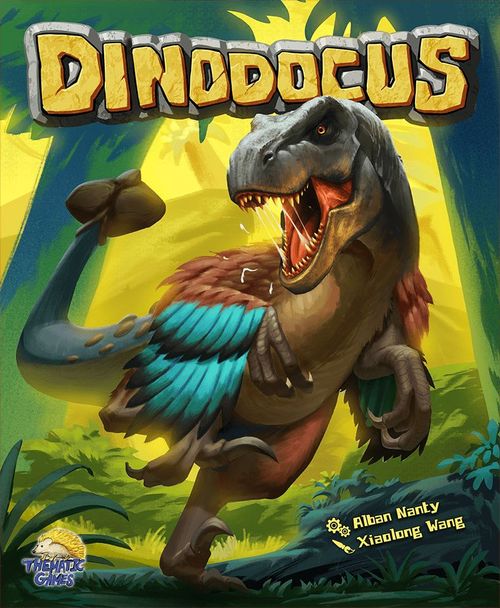
Dinodocus
Dinodocus Rulebook
Table of Contents
Table of Contents
Content
- 80 Dinosaur cards depicting 20 dinosaurs that really existed on Earth
- 37 Period cards
- 6 Permian cards
- 6 Summary cards
- 4 Fern tokens
- This Rule Book
Setup
- Separate and shuffle the Dinosaur cards by category (Head, anterior legs, posterior legs and tail) to form four decks face down in the center of the table. Make sure there is enough space for each of the decks to have their own discard pile.
- Place the four Fern tokens aside to form a pool. Create a Period Card deck with the appropriate number of cards according to the number of players (you don't need to shuffle them):
- 2 Players: 25 cards (remove twelve cards)
- 3 Players: 31 cards (remove six cards)
- 4 Players: 33 cards (remove four cards)
- 5 or 6 Players: use all 37 cards
- Give each player a Summary card of their preferred color that they place in front of them.
- Players will create a timeline of cards during the game. Reserve a place at the side of the table for this. The Permian cards will indicate the start of the timeline for each player.
- Each player flips one card from each Dinosaur deck onto the table in front of them. This is their starting dinosaur. Apart from flipping their starting dinosaur, players do NOT take cards in hand, they start with empty hands.
- Determine the starting player. In this example, the red player will start the game (because they have the weakest dinosaur, sum of all the Attack + Defense values).
Dinosaur Card Anatomy
- Type of the card: the icon in the top left corner represents the type of the card and facilitates the sorting of the cards in your hand. Green heads represent herbivores, and red heads carnivores.
- Syllable of the name
- Dinosaur illustration
- Description of the characteristics: this has no purpose for the game, it is simply here to give thematic information and justify the Attack and Defense Value.
- Attack Value and Defense Value
- Real Dinosaur reference: a number you can use to find the parts from actual dinosaurs. Simply put the four cards with the same number together. The number has no real purpose in the game.
Overview
Dinosaur Strength
To create a valid dinosaur, you must play one head, one anterior legs, one posterior legs and one tail card, by overlapping them so that one complete dinosaur picture can be formed.
Anterior legs means front legs or arms, and posterior legs means back legs.
In the example, this "Typlolorus" has an Attack value of 6 (3+1+2) and a Defense value of 5 (2+2+1). Strength is the greater of these two values, so in this example the strength is 6.
To compare the strength of your dinosaur with the others, you will use the Attack and Defense Values of all cards that make up the full dinosaur. Sum up all the attack values together to know the attack value of your dinosaur. Do the same for the defense values. The Strength value is the highest value of the attack or defense value and is used to resist other dinosaur attacks.
Game Turns
The player with the lowest Attack+Defense Value of the dinosaur drawn randomly during setup starts the game. If there is a tie for lowest, the youngest player goes first.
Your turn is split into 3 phases: the Incubation Phase (draw cards), the Hatching and Mutation Phase (create or modify dinosaurs), and finally the Natural Selection Phase (feed your dinosaurs).
The word "incubation" refers to the development of the embryo within the egg of oviparous (egg-laying) animals, such as dinosaurs.
The summary card lists your turn steps and at the same time indicates your color.
Incubation Phase
Draw Cards
At the beginning of your turn, if you don't have at least one dinosaur in front of you, you must first draw and immediately lay down one dinosaur, just like you did during the setup phase. Then you can take your turn.
To start your turn, you may first discard as many cards as you want from your hand, then replenish your hand with up to 5 Dinosaur Cards by drawing them, one at a time, from any deck you wish. You can look at the card you just drew before deciding from which deck to draw your next one. When a deck is exhausted, shuffle the corresponding discard pile to recreate the deck.
During millions of years, dinosaurs have evolved little by little, thanks to slow genetic mutations. Players will make the dinosaurs evolve slowly, one card at a time to exchange.
Hatching and Mutation Phase
Once you have finished replenishing your hand, you can play any number of Dinosaur Cards, up to the limit of what you have in your hand. There are two ways to play your cards: you can create a new dinosaur by playing 4 cards, and/or you can modify existing dinosaurs by playing one card. You can do both during your turn.
Create a Dinosaur
To create a new dinosaur, play 4 cards, one of each type from your hand. Your dinosaur must be complete, i.e. have a head, the anterior and posterior legs and a tail. Place the cards in front of you in order to recreate the picture of the dinosaur, and proudly read its name out loud.
Baby dinosaurs emerge from their eggs during the "hatching" process.
Modify Dinosaurs
The other option is to play a card from your hand to modify an existing dinosaur by replacing one of its cards with one from your hand. Discard the replaced card face up on the corresponding discard pile for its type.
You are not obliged to play a full dinosaur every turn, instead you can modify several dinosaurs with your 5 cards in hand, and/or keep some cards for your next turn.
You can modify any dinosaur on the table, including the ones of your opponents, and you can modify several dinosaurs during your turn. However when you modify a dinosaur:
- You can only change one card per dinosaur
- You can only replace a card with one of the same type
- You cannot convert a carnivore to an herbivore and vice versa (i.e. a green head can only be replaced by a green head, and a red head only by a red head).
During the Dinosaur Era, various dinosaur species appeared and went extinct (disappeared) often due to a lack of adaptation to the environment (climate change, new predators...). This is called the "Natural Selection", where only the stronger and most adapted animals can survive.
Reaction to Dinosaur Modification
When you modify an opponent's dinosaur, the owner of this dinosaur can react during your turn, and further modify this specific dinosaur if they have a useful card in hand. They can exchange the card you just replaced again, or replace another card of the same dinosaur. This opponent can only replace one card following the normal dinosaur modification rules (i.e. respect the card type, and do not change the head color). If their dinosaur gets modified several times during the turn of the other players, they can react every time, by exchanging one card only each time.
Since you can only modify one card per dinosaur during your turn, you cannot modify this dinosaur again during your turn, after your opponent changes it back as a reaction.
Note that, since the goal of the game is to create long living dinosaurs, it is wise to keep some cards in hand, in order to defend your old dinosaurs from weakening modifications played during the turn of the other players.
Example (the Blue player is changing the Anterior Legs of the Red player's Dikymidon): In reaction, the Red player decides to give the dinosaur a new tail. Its dino, now called a Dinomirus, still has a defense of 5. Later, the Green player changes the Head of the Red player's Dinomirus with the head "Scu". The Red player reacts by changing the Head again with "Para". The dino, now evolved into a Paranomirus, has a defense of 6.
Optional Rule: if at any time you make a dinosaur that has really existed (all the cards have the same real dinosaur reference number), via hatching or mutation, you can immediately add 2 Period cards next to it.
Natural Selection Phase
Feed Your Dinosaurs
Once you finish playing cards from your hand, you must feed your dinosaurs. This phase is mandatory. Once you start to feed your dinosaurs, it is normally forbidden to go back to the previous phase and modify dinosaurs to your advantage. However, if you play with young children, you can allow them a bit more freedom.
There are 2 types of dinosaurs, the herbivores who eat plants, and the carnivores who eat other dinosaurs. You must feed your herbivores first, and then feed your carnivores.
Any of your dinosaurs who cannot find a food source will go extinct and will have to be discarded.
"Herbivore" is derived from the Latin "herba" meaning a small plant or herb, and "vora", to eat or devour. Similarly, "Carnivore" comes from Latin "caro" meaning flesh, and the same "vora".
Feeding an Herbivore
Food from the pool: herbivores eat plants. To do this, simply take a Fern token from the pool and place it next to the head of your dinosaur. If your dinosaur already has a Fern token, it is considered fed.
Food competition: there is a limited number of Fern tokens, so if too many herbivores are on the table and there is no Fern token to simply take, they enter into competition for the food. Herbivores with weak defense won't be able to find food sources, all taken over by stronger herbivores.
You may not steal a Fern token if there is one available in the pool.
Some dinosaurs were massive, weighing up to 40 tons, and ate a lot of plants. Plants grow slowly, so compared to how fast herbivores would put pressure on the plant availability, too many herbivore population would decrease.
Stealing food: you can steal a Fern token from an herbivore if your Defense value is greater (not equal) to its Strength value (highest value of Attack or Defense). Place the stolen Fern token in front of your dinosaur as normal. The dinosaur that has just lost its food source stays on the table, as the owner of that dinosaur may try to improve it during their next turn, in order to steal back a Fern token.
Important Remark: you cannot use the same Fern token to feed several of your herbivores, i.e. you cannot feed your weakest herbivore first, get a Period Card, then steal that Fern token to feed another of your herbivores, and get another Period Card. Feed all your herbivores simultaneously.
Unfed herbivores: during this phase, if your dinosaur cannot get a Fern token from the pool or steal one from another herbivore, you must discard it, scoring any Period cards it might have.
Example of dinosaurs with their attack and defense values and their strength value (best of the two):
- Imelorus cannot steal from any dino (if it had to) with its defense of 3 (3 < 4 and 6).
- Galplolorus can steal from any dino here (6 > 3 and 4).
- Pretronytops cannot steal from any dino with its defense of 2 (2 < 3, 4 and 6).
- Pronosauphale can only steal from Imelorus (4 > 3).
Feeding a Carnivore
Carnivores prey on other dinosaurs, no matter if they are herbivore or carnivore. They have to attack in order to feed.
A carnivore can eat another dinosaur (prey) if its Attack Value is higher (not equal) than the Strength Value of the prey (highest value between Attack and Defense). In this case, discard all cards of the prey, and if it has a Fern token, return that token to the pool.
For each of your carnivores, you must choose a dinosaur to hunt and eat. It is possible to eat your own dinosaurs (however, a carnivore cannot eat itself). If you cannot feed your carnivore, you must discard it, scoring any Period cards it might have.
Like modern herbivore dinosaurs, different dinosaurs had ways of defending themselves. These include herding together, running away, camouflage, as well as the active use of teeth, claws, horns and defensive armour, spikes as well as weapons.
Example of dinosaurs with their attack and defense values and their strength value (best of the two):
- Typlolorus (Atk = 6) can eat any dinosaur here (6 > 3 and 4).
- Disimirus with an attack of 2 cannot eat anybody.
- Dinocephale is an herbivore and doesn't eat dinosaurs.
- Deitrorotor (Atk = 4) can only eat Dinocephale (4 > 3).
Get Your Period Cards
A fed dinosaur will be considered as having survived for several million years. Once you have fed all your dinosaurs, take a 5 Million Years Period card from the Period Card deck and place it next to each remaining dinosaur that you have in front of you on the table. Do not mix the Period Cards between your various dinosaurs; keep them close to their corresponding dinosaurs.
The age of each dinosaur is open information, and each player can count the number of Period cards of any dinosaur at any time.
Spinosaurus lived for 18.5 million years! Can you do better?
Scoring
Scoring Victory Points
When one of your dinosaurs goes extinct (at any time, during your turn, or the turn of the other players), discard it to the discard pile, return the Fern token to the pool (if any), and align its Period Cards on your timeline.
To move Period Cards of one dinosaur to your timeline, place the first card on top of the last card of the timeline, overlapping it by leaving a shift of 1 million years, then place the second card with a shift of 2 million years, the third card with 3 million years shift, the fourth with 4 million years, and for the fifth and all subsequent ones place the cards next to each other without overlapping them.
For the extinction of your first dinosaur, start your timeline by overlapping your Permian card with your player color. For example, if your first extinct dinosaur managed to collect 3 Period cards, you should place them like this.
The order and the orientation of the timeline cards don't matter, only the graduated scale is important for scoring.
For each subsequent dinosaur that you need to discard, continue building your timeline in the same way. For example, if your second dinosaur collected 6 Period Cards, the player has 6 Period cards to add to their timeline. The player places the first card at 1 step from the edge of the last card, then continues to lay down cards by increasing by one step for every card.
If there are more than 5 cards, they continue by placing them side by side.
The modern form of Humans only evolved about 200,000 years ago, whereas some Dinosaurs lived for several million years!
To win the game, you should have the longest timeline. To increase your chance of winning, try to make a few strong dinosaurs that can survive a long time rather than many weak dinosaurs that barely survive one turn.
End of the Game
The game ends immediately when a player takes the last Period Card. It does not matter if there are still dinosaurs that need feeding or not (this player can choose to which dinosaur(s) they allocate the remaining Period Card(s)).
The big meteorite crashes on Earth and kills all the dinosaurs; this is the end of the Dinosaur Era.
Each player must then complete their timeline using the Period Cards stored next to each of their dinosaurs, using the normal rules for completing the timeline. The player with the longest timeline wins the game.
Advanced Game
If you want more player interaction during the game, you can play with advanced rules that give you the possibility to help other players and gain victory points that way.
We don't recommend using the following rules if you play with young players, as it adds a lot of opportunities for bluffing and betrayal, usually difficult to comprehend by them.
Helping Other Players
If you have Dinosaur cards in hand, at any time, you can propose to give one of your cards to:
- The current player, or
- The player that just got one of their dinosaurs modified by the current player
When you offer a card, you must show it publicly to everyone, so that other players may make a better offer to that same player.
The player to whom you offer your card may accept or refuse the card. If they accept your card, you immediately collect one Period Card, and place it under your Summary card.
If you offer a card to a player who got their dinosaur modified, they may use it immediately to react to the modification, but they are not obliged to do so. Most of the time players will accept the card because they want to use it to react.
Example: the current player is the Red player. They need to feed their carnivore, but it is too weak (attack value of 4) and cannot find a weaker dinosaur to eat on the table. The Blue player offers the Red player a card to weaken the Green player's dinosaur (its strength value would become 3). The Red player accepts the card and goes on to modify the Green dinosaur. The Blue player takes a Period card, since their offer got accepted, and places it under their Summary card.
Immediately after the Red player modified the Green dinosaur, the Blue player now offers a card to the Green player, which they can use to react to the modification of the Red player. It is a strong posterior leg that would bring its strength to 5. The Green player accepts the card, and the Blue player takes another Period card to place under their Summary card. The Red player finally cannot eat the Green dinosaur and will have to discard their own dinosaur.
Can I give several cards to the same player? Yes, the only limit is the number of cards in your hand. For each card accepted by the other player, you can collect one Period card.
What if several players offer a card to the same player at the same time? That player can accept all offers, just choose some or refuse them all.
Can I offer a card if I am the current player? Of course, you cannot offer a card to yourself. But you can change one of your opponent's dinosaurs, and then immediately offer a card to that opponent!
Is there any hand limit? No, you may have more than 5 cards in your hand if you have accepted multiple cards from other players. However, during your Incubation phase, you cannot draw cards if you already have 5 or more cards in your hand (unless you discard enough of them before drawing).
Collecting Period Cards for Help Every time a player accepts your card, you immediately collect one Period Card from the Period Card deck, and place it under your Summary card. The number of collected cards this way must stay secret, hence they are hidden under your Summary card.
At the end of the game, score all your collected cards as if it was one single dinosaur.
Example of the Table During a 3 Player Game
The example layout shows: the Blue player's Summary card; the Dinosaur draw decks and discard piles; the Period Card deck; the available Fern tokens; the Fern token of Hypmenylophus with its Period Cards; one Dinosaur owned by the Red player; and the timelines of all players.