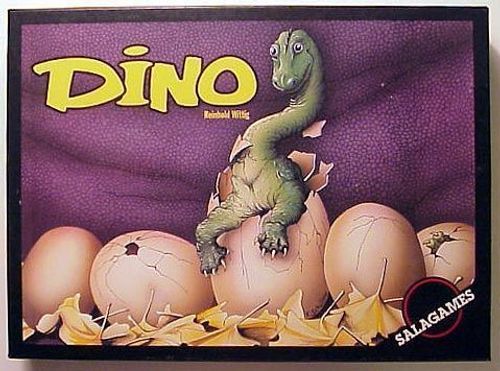
Dino
Dino Rulebook
Table of Contents
Table of Contents
Contents
- 1 playing board
- 5 dinosaurs
- 1 meteorite
- 36 chips (dinosaur eggs)
- 12 counters (two of each colour)
- 1 set of rules
Aim of the Game
Rescue as many eggs as possible and return them to the present.
Playing Board
The playing board is divided into 36 squares with up to 6 spaces. Bushes and trees represent the spaces along which the counters are moved. On opposite sides of the board 6 starting spaces are marked in different colours. These represent the spaces where the players have arrived in their time machines. (see illustration)
The meteorite's track, represented by the rocks around the edge of the board, runs around the squares. According to the number of players the meteorite starts its run at different places and is then moved clockwise along the track. When the meteorite reaches the last stone it means that the meteorite has struck and the game ends.
[Board illustration: the printed board marks the starting spaces, the meteorite track for the 2-, 3-, 4-, 5- and 6-player games, the placed dinos, and the nests with dinosaur eggs.]
Game Preparation
Each player is given two counters of the same colour and places them on the respective starting spaces of the same colour, one on each side of the board. The track of the meteorite down to earth depends on the number of players. The meteorite is placed in accordance with the method described and illustrated above. Experienced players can shorten the length of the track to make the game more difficult.
The players choose together six spaces which will hold the dinosaur nests. Except for the two centre spaces of a square (see illustration), each space may be chosen as a dinosaur nest, however the squares bearing a coloured starting space may not be chosen.
The number of eggs contained in a nest is one more than the players participating. e.g. When there are four players a nest contains five eggs. When there are five players the nest contains six eggs.
A nest chosen is marked by a pile of eggs (= chips) of the same colour.
Each player, except for the one to start, is allowed to place a dinosaur as a blockade. The dinosaur is to be placed on the dotted line separating 2 squares, but may not be placed on the lines separating the starting spaces. A minimum of 3 dinosaurs are to be used. The dinosaur parents stubbornly remain in place throughout the whole game, fascinated by the meteorite moving on its way down to earth. They may, for example, block access to a nest except from one side.
For the first game, it is recommended to start with the set-up shown above, in order to get used to the strategies of placing nests and dinosaurs.
Game Commencement
The oldest player begins and play continues clockwise. Each player during their turn must move four spaces. Where the player is unable to move four spaces the remainder of the moves are made by moving the meteorite accordingly. In the event that a player is unable to move at all then the meteorite is moved all four spaces.
N.B. The four spaces to move are restricted to one counter, and may not be divided among the two counters. It is not allowed to move forwards and backwards in the same move. Dinosaurs and nests containing eggs block moves. Empty nests may be passed through.
Only one counter is allowed to land in each square. It is possible to pass through an occupied square, and it is allowed to jump over any other counter in the square. This rule leads to the possibility of blocking the path of the other players with your own counter, as it will not always be possible for the other players to go four moves in a straight line, or four moves at a right angle and pass through an occupied square.
Collecting Eggs
If a player lands on the space directly in front of the dinosaur nest, he is allowed to take one egg from the nest.
It is prohibited to take two or more eggs from a nest during one turn. The player must first leave the square, but may then return to collect further eggs. To enable control of this rule, a player must always lay the last collected egg open in front of him. The previously collected eggs should be kept hidden from the other players.
Scoring
Each egg scores one point. 5 points is scored for each different colour of egg collected.
e.g. If a player has collected 1 red egg, 1 green egg and two blue eggs the total score is as follows:
- 1 point for each egg = 4 points
- 5 points for each colour = 15 points
- total points = 19 points
It is therefore important that players try to collect eggs from different coloured nests.
End of the Game
The game finishes when the meteorite strikes. This is represented by the counter reaching the end of its track. When it becomes apparent that the stone is about to strike, all players should make for their time machine, moving their counters to any one of the coloured starting spaces. Once they reach their time machine, the counter is taken from the board and may not rejoin the game.
The game may end before the meteorite strikes if all players have arrived back safely in their time machines. If a counter is placed on a coloured starting space it cannot rejoin the game and is taken off the board. If a player has removed both his counters from the game he must continue to take his moves by moving the meteorite four moves.
Players that still have playing pieces on the board when the meteorite strikes have to deduct the total number of spaces needed to return to their time machines from their score achieved in collecting eggs.
The player with the highest total score is the winner of the game.
Variations
-
Reduce the length of the meteorite track.
-
The game is more difficult if the number of eggs equals the number of players, or is less than the number of players.
-
When playing with two or three players it is suggested that players should enter their time machine and return to the present via the space from which they started, i.e. which has the same colour as their counter.
Epilogue
Everybody knows that travel through time, like our expedition back to pre-historic times, is pure utopia. But there is another bit of fiction in this game - the dinosaur models used in the game did not all exist during the chalk age (the period we chose). Three of them existed earlier.
However, we chose them for "Dino" because they are so distinctive and well known. The following table shows the time when they really did exist.
[Table illustration, "Ages in million years": Triceratops and Ankylosaurus against the Cretaceous period at 65 million years; Stegosaurus against the Jura period at 135 million years; Brontosaurus at 205 million years (Trias period); Dimetrodon against the Perm period at 248 million years and the Carbon period at 295 million years. The printed period labels and figures are reproduced here as read from the image; the exact row alignment of the labels is not fully legible in the scan.]