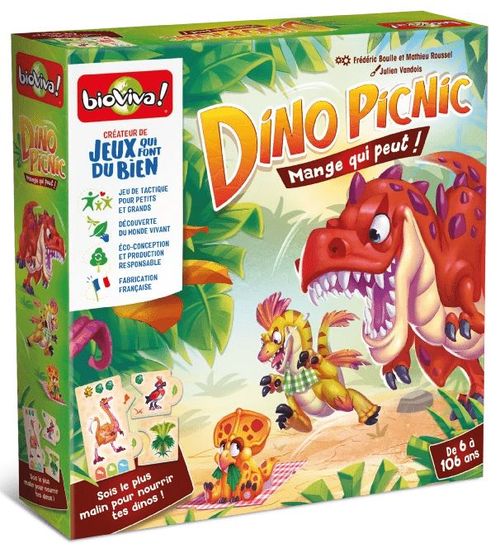
Dino picnic
Dino picnic Rulebook
Table of Contents
Table of Contents
Goal of the Game
Create food chains in order to give birth to the greatest number of baby dinosaurs.
Components
- 1 double-sided game board (two sides, one for 2/4 players and one for 3 players)
- 4 Bonusosaurus tiles
- 56 Egg tokens (14 of each colour)
- 18 Cycad tiles
- 46 Dino tiles:
- 12 carnivores
- 10 herbivores
- 12 flying reptiles
- 12 marine reptiles
- 8 large starting Dino tiles
Setup
- Place the game board in the centre of the table, on the side matching the number of players (2/4 or 3).
- Assemble and arrange the 4 Bonusosaurus tiles next to the board.
- Sort the Egg tokens by colour and shuffle them, shell side up, next to the board.
- Shuffle all the Dino tiles and all the Cycad tiles together, then, as indicated on the board, form tile stacks according to the number of players:
- 2 and 4 players: 8 stacks of 8 tiles.
- 3 players: 6 stacks of 10 tiles.
- Shuffle the 8 large starting Dino tiles and give one to each player, who places it in front of them, face up.
- Spread one stack of tiles over each zone. With 2 and 4 players this leaves 4 stacks of tiles on the table; with 3 players it leaves 3 stacks. These stacks will be used for the second round.
The stacks of tiles are placed on the table, within reach.
Note: with 3 players, the 4 remaining tiles are returned to the box and are not used in this game.
Warning: games with 2 players have a different setup! See "Dino Duel!" on page 6.
Game Flow
Dino Picnic is played over 2 rounds, called "ages". Each age comprises several turns, during which everyone plays at the same time.
Beginning of the First Age
Taking and placing tiles. To start, each player faces one zone of the board. In that zone, each player chooses a tile, then places it in front of them. This tile must be joined to another one when possible.
Assembling a food chain.
- To join two tiles together, you must respect the link shape.
- A food chain always goes from left to right.
- A complete food chain consists of at least:
- A chain start: 1 Dino tile that has no predator. (In this game it cannot be eaten, so its tile has no link shape on the left.)
- A chain end: 1 or more Cycad tiles (a cycad eats neither dino nor cycad...).
IMPORTANT
- On each turn, a player must take a tile and place it in front of them so that it completes a food chain, on the left or on the right, starts another one, or is isolated.
- If a player has several placement options, they choose the one they want.
- As soon as possible, an isolated tile, or several tiles already joined together, must be attached to a tile that completes them.
- Once joined, a tile can no longer be moved from one food chain to another.
Taking Eggs
As soon as a player manages to feed a dino (by joining 2 tiles), that dino immediately lays eggs. The food chain does not need to be completed. The player then takes the number of eggs of the colour shown on the fed dino's tile and places them on it, shell side up. (If there are not enough eggs available, see page 6.)
WARNING
Eggs are turned over to reveal the number of babies only at the end of the game!
Special Tiles
Starting Dino
To collect the eggs of a starting dino, 2 conditions must be met:
- Feed it: complete the food it requests, without necessarily finishing the food chain.
- Have in front of you, either in the food chain of the starting dino or in another chain (complete or incomplete), the types of dinosaurs shown on the starting Dino tile. Note: an isolated tile constitutes an incomplete chain.
Marine Reptile
To collect the eggs of a marine reptile, you must join the two parts of the reptile: a head and a tail. A marine reptile lays eggs when it is assembled; it must not be fed. Marine reptiles are hard to make lay, but their eggs score more points on average!
End of the First Age
Once all players have taken a tile, the board is turned one zone clockwise. Each player takes a tile from the new zone that faces them and places it in their play area. Continue in this way until there are no tiles left in the board's zones, which ends the first age.
Beginning of the Second Age
Spread a stack of tiles prepared at the start of the game over each zone of the board. The game then continues following the same sequence as in the first age.
When Eggs Run Out
Dino Picnic is a simultaneous game, so there is no first player. However, at the end of the game, eggs may run out, and several players may compete for the same egg colours before none are left. To determine which player takes eggs first, look at the board!
The player facing the orange zone takes their eggs first, then the player to their left, and so on. If a player cannot get an egg because there are none left, tough luck: they gain nothing!
End of the Game
The game ends immediately when:
- only one type of egg remains (all egg colours have been taken except one);
- no eggs remain at all because the last ones were taken at the same time (all egg colours have been taken);
- there are no tiles left on the board at the end of the 2nd age.
Variant: Orange Alert!
For more strategic games, you can play in "Orange Alert!" mode. In this mode, a player may, if they wish, say "Orange Alert!" at the start of a turn. Everyone must then choose their tile in turn order, starting with the first player (the player facing the orange zone).
Dino Duel! (2 Players)
For 2-player games, the rules are the same as for 3 or 4 players, with a few small differences:
- Each player takes 2 starting Dino tiles at the start of the game.
- On each turn, each player draws a tile from a single zone, the one facing them. So only two zones are played each turn, but an age always ends when all zones are empty.
- A dino type can only be used to complete the objective of a single starting Dino tile (it does not count twice).
Scoring
Each baby dino = 1 point.
Bonusosaurs
First, players check who gets the Bonusosaurs:
- The player with the most eggs in front of them gets this Bonusosaur.
- The player with the greatest number of Cycad tiles gets this Bonusosaur.
- The player with the greatest number of dinosaurs, fed or not, gets this Bonusosaur (each complete marine reptile counts as a single dinosaur).
- The player with the longest complete food chain gets this Bonusosaur.
Reminder: a complete food chain has, at its start, a dinosaur with no predator (no link on the left) and, at its end, one or more cycads. A starting Dino always counts as a single food chain, even if it has two continuations completing it.
Example of a complete food chain with 2 continuations.
- Each Bonusosaur counts as 3 baby dinos, i.e. 3 points. In case of a tie on a Bonusosaur, every tied player adds 2 baby dinos, i.e. 2 points, to their score.
Eggs
Once the Bonusosaurs have been distributed, each player turns over the eggs they have collected.
- Each baby dino earns 1 victory point.
- Some eggs contain twins: they are worth 2 points.
Each player then adds up the points from their eggs and their Bonusosaurs. The player with the most points wins the game! In case of a tie, the players share the victory.
Notes
The booklet's remaining pages are educational material about the dinosaurs and reptiles of the game (a palaeontology sidebar, creature profiles and a recycling notice). They contain no rules and are not transcribed here.
- Herbivores and cycads: the booklet explains that, so that herbivores can eat in the game, the designers chose to represent a cycad, a genus of tree-like plant, some of whose fossils date from the same period as the animals in the game.