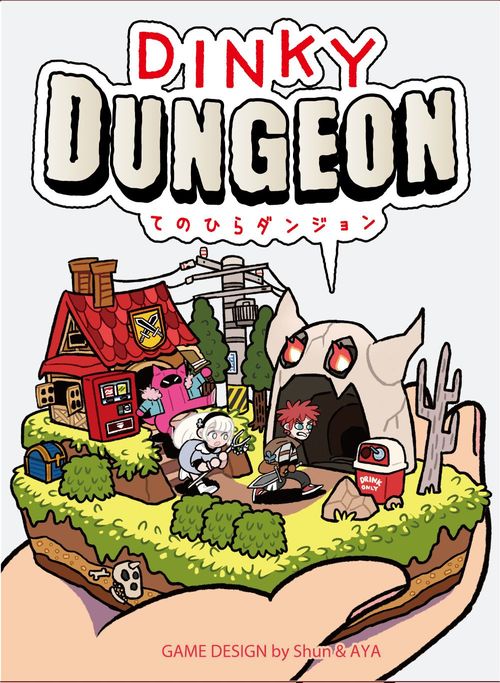
Dinky Dungeon
Dinky Dungeon Rulebook
Table of Contents
Table of Contents
Components
- 18 adventurer cards (57×89mm).
- Name: indicates the role of the adventurer.
- Scapegoat Icon: indicates that the effect of this adventurer card affects other players when played. (Other icons and text are decorative only.)
- Effect Icons and Description: indicate the effect of the adventurer card.
- 36 dungeon cards (rewards) (63×44mm).
- Monster Level: this represents the monster level of the dungeon card when it is either in the deck or in the discard deck. This number is identical to the dungeon card's reward value.
- Monster level distribution: Lv.1 ×20, Lv.2 ×10, Lv.3 ×4, Lv.4 ×2.
- Reward Value: the reward value of the dungeon card when it is earned. The total reward value of all acquired dungeon cards is the player's score. This value is kept secret from other players.
- Flavor text is decorative and serves no gameplay purpose.
- 1 rulebook.
Setup
- Shuffle the 36 dungeon cards and place them facedown in a "dungeon deck" within every player's reach.
- Shuffle the 18 adventurer cards, and deal two face down to each player. Each player chooses one of the two adventurer cards to keep.
- The adventurer cards not chosen by the players are added back to the remaining adventurer cards and shuffled again. These are then placed face down as the "adventurer deck" within every player's reach.
- Draw four cards from the adventurer deck and place them face up in a row on the table.
- Determine which player goes first.
Reminder printed on the sheet: the cards in your hand should always be hidden from other players.
How to Play
Players take turns in clockwise order, starting with the first player.
Turn Overview
Each turn consists of three steps, performed in the following order:
- Choose one of the four available adventurer cards and add it to your hand.
- Play one adventurer from your hand, performing their effect.
- Refill the adventurer row back up to four adventurers from the adventurer deck.
Once these 3 steps are completed, it is the next player's turn.
Playing an Adventurer
The active player selects and reveals an adventurer card from their hand, performing its effect.
- The played adventurer card is placed face up in the adventurer discard area after the effect is performed.
- Any acquired dungeon cards are placed face down in front of you, so other players cannot see their value.
- When a dungeon card is discarded due to the effect of a card, it is placed face up in the dungeon discard area.
- If a card's effect causes you to draw more dungeon cards than remain in the dungeon deck, any missing additional cards are chosen from the dungeon discard deck.
Reminders printed on the sheet: "Announce who you play!" and "These are your rewards!" and "These are the monsters!"
When the Adventurer Deck Is Depleted
If drawing an adventurer card causes the adventurer deck to be empty, the adventurer discard deck is shuffled and turned face down, forming the new adventurer deck.
Game End
The game ends when either of the two conditions is satisfied at the end of a player's turn.
-
A. A player's total reward value reaches the specified number of points. The reward value target depends on the number of players:
- 2 players: 20 points
- 3 players: 18 points
- 4 players: 16 points
If you meet the target value at the end of your turn, declare this to the other players.
-
B. The dungeon deck is depleted.
Winning the Game
The player with the highest total reward value at the end of the game is the winner.
Card List
Each entry gives the printed effect of an adventurer card. Cards marked with the Scapegoat icon are noted as such.
- Necromancer: Select 1 card from the adventurer discard deck and perform its effect.
- Magician (Scapegoat icon): All other players individually choose up to 3 of their rewards to keep, discarding the others.
- Summoner: Select any 3 cards from the dungeon discard deck and gain them.
- Shaman: Select up to 8 "Lv. 1" monsters from the dungeon discard deck and gain them.
- Swordsman: Select up to 4 "Lv. 1" monsters from the dungeon deck and gain them. Then, shuffle the dungeon deck.
- Bard: Draw 3 cards from the adventurer deck, add them to your hand, and then discard 2 cards from your hand. Play 1 of the remaining 2 cards.
- Berserker: Reveal 1 card from the dungeon deck and gain it. You can repeat this as long as you like; however, if you reveal a monster of "Lv. 3" or higher, discard all rewards gained this turn.
- Assassin (Scapegoat icon): All other players discard 3 random reward cards.
- Fighter: If any player has more reward cards than you, draw 3 cards from the dungeon deck and gain them.
- Ninja: Discard up to 1 reward card. Draw cards from the dungeon deck equal to the value of the discarded card + 1 and gain them. If you don't discard, draw 1 dungeon card and gain it.
- Clown: All players, including yourself, reveal their hand. Choose one adventurer card and perform its effect. (No cards are discarded.)
Scapegoat Icon Rules
The Scapegoat adventurer card is the only card that has an additional conditional effect while it is in your hand. If another player targets you with a card that would affect your rewards (an adventurer card with the Scapegoat icon) while you have the Scapegoat in your hand, instead of applying that effect, you discard the Scapegoat and draw the top card from the adventurer deck.
When played, the Scapegoat's effect is "draw two cards from the top of the dungeon deck."
Aside from the Scapegoat adventurer card, there is no way to avoid a Scapegoat icon effect.
If you have the Scapegoat in your hand, the following adventurer effects apply instead of their normal effect:
- The Wizard, The Assassin: You do not have to discard your hand.
- The Monk: You do not have to declare your reward value.
- The Noble: You do not receive rewards from other players.
Transcription note: the sheet prints "The Wizard" and "The Noble" in this list, but no card with those names appears in the card list above. The printed card names there are "Magician" and "Lord". The text is kept as printed; the sheet's naming differs from its card list.