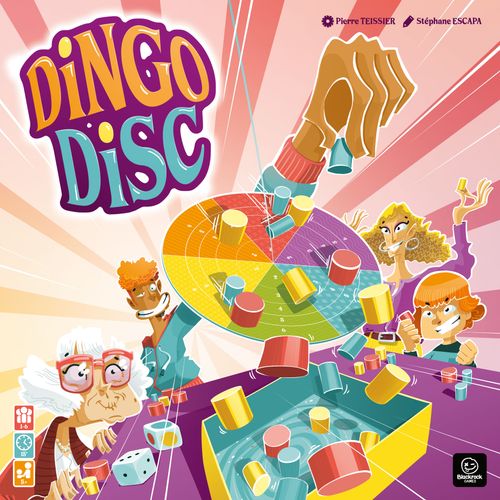
Dingo Disc
Dingo Disc Rulebook
Table of Contents
Table of Contents
Goal of the Game
The player must place all of their pawns on the disc in balance.
Version 1
1. Allocation of Pawns
Each player has the same number of pawns, according to the table below:
| Players | Small pawns | Medium pawns | Large pawns |
|---|---|---|---|
| 2 | 8 | 8 | 8 |
| 3 | 6 | 6 | 6 |
| 4 | 5 | 5 | 5 |
| 5 | 4 | 4 | 4 |
| 6 | 3 | 3 | 3 |
2. Rolling the Dice
The first player (the youngest?) rolls the 2 dice.
3. Result of the Roll
Colour die: the face of the colour die determines the zone of the disc on which the player will place 1 pawn of the size of their choice.
Number die: the face 2, 3, 4, 5 or 6 determines the position where the player places 1 pawn of the size of their choice.
Face 1 (penalty): the player passes their turn without placing a pawn and receives 1 pawn from each of the other players, in the size chosen by each of those players.
- If the pawn placed stays and the disc remains in balance, no pawn falls and the game continues with the next player.
- If the disc tips and all or some of the pawns fall off, the player picks up the fallen pawns and leaves on the disc the pawns that did not fall, even if they have moved. The game continues with the next player.
4. End of the Game
The winner is the player who is first to place all of their pawns on the disc.
The other players continue playing until they have used all of their pawns.
If all players place all of their pawns in the same turn, the game is a DRAW (MATCH NUL).
5. Recommendations
- It is forbidden to hold the disc with your hands.
- Do not place pawns straddling the lines of the disc.
- If, after 2 attempts, the pawn placed by the player falls off the disc, the player keeps their pawn and passes their turn.
- As long as the next player has not taken the dice, any pawns that fall are for the previous player.
Version 2
The goal of the game is the same: the player must place all of their pawns on the disc in balance.
1. Allocation of Pawns
Each player has the same number of pawns, according to the table below:
| Players | Small pawns | Medium pawns | Large pawns |
|---|---|---|---|
| 2 | 8 | 8 | 8 |
| 3 | 6 | 6 | 6 |
| 4 | 5 | 5 | 5 |
| 5 | 4 | 4 | 4 |
| 6 | 3 | 3 | 3 |
2. Rolling the Dice
Rolling the colour die. Each player, in turn, rolls the colour die to find out the zone in which they will play. Note: only one player per colour. If the die gives a colour that has already been assigned, the player rolls the die again to get a free colour.
Rolling the number die. The result of the roll is between 2 and 6. The player places a pawn of their choice on the number given by the die, in their own colour zone.
- If the pawn placed stays and the disc remains in balance, no pawn falls and the game continues with the next player.
- If the disc tips and all or some of the pawns fall off, the player picks up the fallen pawns and leaves on the disc the pawns that did not fall, even if they have moved. The game continues with the next player.
Result 1 (penalty): the player passes their turn without placing a pawn and receives 1 pawn from each of the other players, in the size chosen by each of those players.
3. End of the Game
The winner is the player who is first to place all of their pawns on the disc.
The other players continue playing until they have used all of their pawns.
If all players place all of their pawns in the same turn, the game is a DRAW (MATCH NUL).
4. Recommendations
- It is forbidden to hold the disc with your hands.
- Do not place pawns straddling the lines of the disc.
- If, after 2 attempts, the pawn placed by the player falls off the disc, the player keeps their pawn and passes their turn.
- As long as the next player has not taken the dice, any pawns that fall are for the previous player.