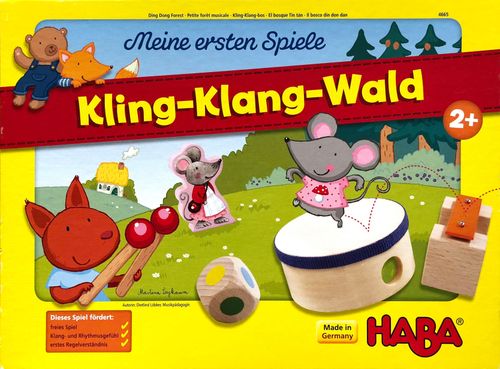
Ding Dong Forest
Ding Dong Forest Rulebook
Table of Contents
Table of Contents
Contents
- 1 Mama Mouse (wooden figure)
- 1 tambourine
- 1 metallophone with mallet
- 1 pair of hardwood percussion sticks
- 1 game board
- 3 forest houses
- 3 Mia Mouse tiles (back side: toadstool)
- 9 animal tiles (back side: toadstool)
- 3 mouse homes
- 1 color die
Before Playing for the First Time
Together with your child take a good look at the game material and the different instruments. Explain what the instruments are called and how they are played. Let your child experiment playing the instruments and assigning them to the animal tiles (squirrel, fox, bear). As a first introduction your child can pick an animal and play the appropriate instrument.
Game 1: Little Mouse, where are you headed?
A first rhythmic listening game.
Game material required: Game board, 3 forest houses, tambourine, metallophone with mallet, 2 wooden sticks, 9 animal tiles, 3 Mia Mouse tiles and Mama Mouse.
Preparation of the Game
Place the game board in the middle of the table. The three round holes are each covered with a forest house, with the animal mama and the instrument facing upwards. Place the rest of the game material ready next to the game board.
How to Play
The adult and the child/children take it in turns. The rhymes spoken by the adult can also obviously be said by the children, when they get to know the game.
You begin and say:
Eyes shut and all ears pricked, Listen to hear which house has been picked!
Cover your eyes with both hands and cup your hands behind your ears. This is the sign for the children to shut their eyes. Carry on talking and hide the Mia Mouse tile under any forest house and then take the instrument shown in the animal mama's hand:
Today the little Mouse gets lost Deep in the Ding Dong Forest. She went to visit some animal friends And cakes and juice are what she finds.
Play the instrument (= "knocking on the door of the forest house"), then afterwards put it down, and carry on with:
Knock, then ring at the fine front door "Oh nice friend let me in once more!" "Oh look, how nice, it's Mia Mouse! Please come in to my little house! Shut the door behind you dear And sit right down, beside me, here."
Now the children can open their eyes. Place Mama Mouse in the middle of the game board and say:
Eyes wide open, but who's that so glum, Look it must be Mia's Mum! "Oh do you know where to find my child? Not knowing is simply driving me wild".
The children think about which animal door Mama Mouse has knocked on. Whoever thinks he knows takes the matching instrument and plays a few notes. Now you can turn over the right forest house and check to see whether the Mia Mouse tile is lying underneath.
Is Mia Mouse there?
-
Yes? Confirm by saying:
Look your little Mia is safe and sound, Mama is so happy she's been found. Everyone's happy and shouts, "Hurray!", Little Mia Mouse has been found today!
As a reward you receive an animal tile.
-
No? In this case you say:
"But no, your little Mia is not there. Oh dear, I have no idea where."
Sadly you receive no animal tile.
Mama Mouse is removed from the game board and a new round begins. The adult hides the Mia Mouse tile once again and the game continues as described before.
Hint: Younger children should be given the opportunity to keep guessing until they find Mia Mouse. Sometimes it helps if during the mouse hunt the children shut their eyes once again and the adult plays the instrument once more.
Notes for the Parents
What for an adult can seem quite simple may be quite difficult for little children: hearing a sound and then later matching it with an instrument. With this game, hearing, concentration, memory and the ability to assign sounds will be trained. Confidence in recognizing the sounds, for example, is an important requirement for the later game variations.
Game 2: Deep in the Ding Dong Forest
A resounding search and collecting game.
Game material required: Game board, 3 forest houses, tambourine, metallophone with mallet, 2 wooden sticks, 3 Mia Mouse tiles, 9 animal tiles, die and a mouse home for each child.
Preparation of the Game
Put the game board in the middle of the table and the three forest houses with their animal mamas face up on top of the holes. Lay out the animal tiles in a grid of 3 x 3 beside the game board. Each child then takes a mouse home. Place Mama Mouse on the game board on any square on the forest path. Get the instruments, the three Mia Mouse tiles and the die ready.
How to Play
Take a good look at the animal tiles with the instruments and carefully memorize them. Then afterwards turn them over one by one. Now you have to close your eyes. The adult hides a Mia Mouse tile under one of the forest houses. Then you open your eyes again.
The child with the smallest feet begins the game and rolls the die. Place Mama Mouse on a square that is the same color as the one shown on the die. What is shown on the forest square?
- An animal child? Mama Mouse now looks for this animal. Try to turn over an animal tile with the same animal child.
- Correct? Great! As a reward you may place an animal tile in your mouse home and play the instrument of this animal child. If you want to, you can play as many notes as are shown on the tile. Watch out: In a mouse home there must always be three different kinds of animal children.
- Wrong? Pity! Turn the tile back over after all the other children have had a good look at it.
- Mia Mouse? Mamma Mouse has forgotten where Mia Mouse is. Which forest house do you think Mia is in? Take the appropriate instrument and "knock at the door" (= play the instrument). Then lift up the forest house. Is Mia Mouse there?
- Yes? Great, as a reward you receive one Mia Mouse tile. Now all the children close their eyes again and the adult hides another Mia Mouse tile under a forest house.
- No? Pity! Place the forest house back in its place. Unfortunately you don't receive a Mia Mouse tile for your mouse home. The Mia Mouse tile is lying under a different forest house but perhaps you will find it the next time.
Then it is the turn of the next child to roll the die.
End of the Game
The first child to place three different animal children in his mouse home is the winner of the game.
Variation
The game becomes harder if the animal tiles are laid out face down and you can't look at them before the game begins.
Game 3: Little Mia Mouse Plays at Home
A melodious musical instrument memory game.
Game material required: Tambourine, metallophone with mallet, 2 wooden sticks, Mama Mouse, 9 animal tiles and a mouse home for each child.
Preparation of the Game
The nine animal tiles are placed in a pile face down in the middle of the table. Each child takes a mouse home and places it in front of him. Get the rest of the game material ready.
How to Play
The child who most recently went walking in the forest begins. He takes three animal tiles and places them face up next to his mouse home. He carefully memorizes which instruments are on which tiles. Then the tiles are turned over so that they show three toadstools.
Place Mama Mouse on any one of the toadstools and think about which instrument the animal child under the toadstool plays. Pick up the corresponding instrument and play it. Then you can turn the tile over. Have you played the right instrument?
- Yes? Great. Now you can place the tile in your mouse home.
- No? Pity! Place the tile back in the box.
Now place Mama Mouse on the next toadstool and think once again about which instrument the animal child plays. Once you have tried all three animal tiles it's then the next child's turn.
End of the Game
When each child has had a turn the game ends. The child with the most animal tiles in his mouse home wins. If there is a draw you win together.
Game 4: Where has the little Mouse just played?
A musical searching game in the whole room.
Game material required: Tambourine, metallophone with mallet, 2 wooden sticks, 3 Mia Mouse tiles, one animal tile of each animal child (squirrel, fox, bear), 3 forest houses.
How to Play
Choose three corners in the room and place a forest house in each with the animal mama face up. Get the instruments ready.
The children sit in the middle of the room and shut their eyes. The adult takes three animal tiles, one Mia Mouse tile and any one of the instruments. He quietly walks to the three corners and places on each forest house an animal tile face down. However, he keeps the tile showing the instrument he is about to play and places instead the Mia Mouse tile face down on the corresponding forest house. He plays the instrument in the corner where he placed the Mia Mouse tile before he tiptoes back to the children and says:
Eyes open! – Where has Mia Mouse just played?
The children then rush off and stand in the corner where they think the instrument was played. As soon as each child is standing in a corner they turn over the animal tile there. Where is Mia Mouse? Who has found her?
The children who are standing in the right place are applauded. Afterwards they collect the other animal tiles and a new round begins. The game ends when the third Mia Mouse tile has been found. If only one child is playing, he can take the Mia Mouse tile.
Notes for the Parents
Both game 3 and game 4 are important exercises exploring what will later, and in a different way, also be taught in music classes at primary school. Locating a sound, that is detecting and determining the exact spot from where a sound comes from or following how a sound source moves only through listening, are important skills that play a vital role, for example, with traffic. The children have to acquire this skill through training just as they have to learn to judge speed.
Hint: Follow Mia Mouse as she goes through Ding Dong Forest
The following game is an excellent exercise for directional hearing:
- The children sit upright, with their eyes shut, in the middle of the room. Sitting upright aids children with directional hearing.
- The adult is Mia Mouse. He plays any one of the instruments and walks with it through the room.
- Suddenly he stops walking and plays. Where is Mia Mouse now?
Without opening their eyes, the children point to where they think the adult is. The game can be repeated with all the different instruments.
Game 5: A birthday song for little Mouse
A cooperative song game.
Game material required: 2 forest houses, tambourine, metallophone with mallet, 2 wooden sticks, 9 animal tiles and Mama Mouse.
Preparation of the Game
Place the two forest houses with the animal mamas face down. Get the instruments and the animal tiles ready.
How to Play
The adult chooses four animal tiles and places two of each under each forest house.
For example: Take your time looking at the animal tiles. Then close your eyes and place your hands over them. The adult turns over the animal tiles and then you can open your eyes again. Then the adult plays one of the two sound sequences of one of the forest houses, for example 3 notes with the sticks and 2 notes on the tambourine. Which "song" have you heard?
Now place Mama Mouse in front of the chosen house. Have you recognized the song correctly? Excellent. Everybody happily claps hands. Have you put Mama Mouse beside the wrong forest house? Pity, try to listen really carefully next time and try again.
The adult immediately sets up another challenge:
- Forest house 1: metallophone (2 notes) and tambourine (1 note)
- Forest house 2: wooden sticks (3 notes) and tambourine (2 notes)
Variation
- You can also play this variation as a competitive variation and take turns to recognize the sequence of sounds. Whoever recognizes it correctly receives one of the two animal tiles as a reward. A new animal tile is then placed in the empty space. Whoever, after the agreed number of rounds (for example: three), has the most animal tiles, wins the game.
- The game will become harder if the children keep their eyes shut even when the adult plays the instrument. They now in addition have to listen which instruments are played how many times. The game will become even harder when 2 x 3 animal tiles are laid down.
Hints
- If there are several children playing, they each choose an instrument and one matching animal tile with any number of notes. Then they play one by one as many notes as are on their animal tiles. In this way a little concert with an alternating sequence of rhythms and sounds will arise.
- The instruments are also suitable for free play. Lay out the animal tiles face up so that the children can play the notes from them.