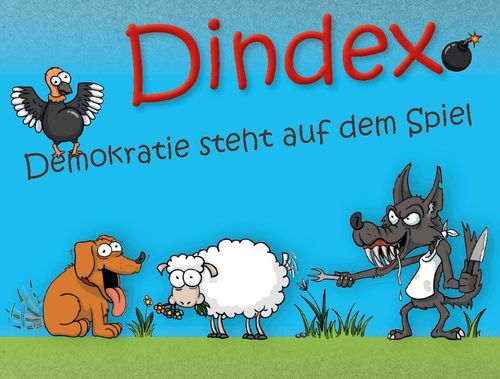
Dindex
Dindex Rulebook
Table of Contents
Table of Contents
§ 1 Introduction
Dindex is a political card game for 2 to 7 players. You slip into different roles without knowing who is on which side. The game is meant to portray the threat to democracy authentically, and it is therefore neither balanced nor fair.
Some of you are Democrats. With your party you scramble for votes to get into government and collect Government Points. That is how you as Democrats can win the game. But how far are you willing to go for it?
Others of you play Oligarchs. Votes are nice, and useful for gaining influence. Government Points are not that important to you either, because in the end your goal is to abolish democracy and seize power. Then all the Democrats at the table have lost.
If you play with at least three, Dindex simulates a multi-party democracy such as exists in Italy, Germany or Austria. To reach an absolute majority, coalitions are usually required. As an Oligarch you have to play skilfully so that the Democrats do not unmask you too early and keep you out of government.
If you play with only two, Dindex resembles the two-party system of the USA. As an Oligarch you can easily reach an absolute majority there and finish off the Democrats.
The harder you play, the more the Democracy Index, or "Dindex" for short, sinks. And the lower the Dindex, the harsher the cards you are allowed to play. Ruthlessness at the table increases noticeably. Whether you join in is up to you alone. Think about it.
The following code of conduct applies to Dindex:
- All players must keep their role card secret, so that it remains hidden who is a Democrat and who is an Oligarch.
- Every player may claim to be a Democrat.
- No player may say that they are an Oligarch.
- If you disagree about how a rule is to be interpreted, you must settle it democratically.
- Otherwise, anything is allowed that the current Dindex permits.
§ 2 Components
Our board games are made of wood. For playing cards that is rather impractical, so we went with cardboard. Dindex is nevertheless "not made of cardboard"!
The game box contains the following:
- Rulebook
- Quick-start guide
- 4 quick reference sheets
- A notepad for entering the players and their parties, the votes and the collected Government Points
- 10 role cards (6 × Democrat, 4 × Oligarch)
- 7 party cards (each with 2 core competencies)
- 6 cards for the government offices (Chancellery and 5 ministries)
- 15 government tasks (3 cards per portfolio)
- 7 random cards
- 15 Dindex cards for the Democracy Index
- 50 voter cards
- 100 action cards, of which
- 30 democratic
- 25 populist
- 20 extremist
- 15 anti-legal (rechtsfeindlich)
- 10 oligarchic
Once you are familiar with these rules, the enclosed quick-start guide is enough to play Dindex. It contains the short version of § 4 Game Setup, § 5 Course of a Legislative Term and § 6 End of the Game.
§ 3 Meaning of the Cards
Look at the cards while you read what they mean below. That makes them easier to understand.
§ 3.1 Role Cards
At the start of the game, draw a role card face down. With the dog you play as a Democrat, with the wolf as an Oligarch. Your role is secret (see the code of conduct under § 1). In some game situations you will be forced to reveal your role card. § 6 governs this in more detail, or it follows from the oligarchic action cards for seizing power.
§ 3.2 Party Cards
Before the game begins, the party cards are drawn. On the cards you see two portfolios each, which represent your party's core competencies. In total there are five portfolios, with the following symbols:
- Finance (piggy bank)
- Environment (fish with tree)
- Social (umbrella)
- Interior (police car)
- Defence (tank)
For each portfolio there is a ministry under § 3.4. During government formation (see § 5.2), you should press in the coalition negotiations to obtain the ministries of your core competencies. Then you can resolve not only problems but also crises with the government tasks (see § 3.5). In addition, you receive more Government Points for these ministries (details are set out in § 5.7).
§ 3.3 Voter Cards
The 50 voter cards represent the eligible voters. Each card therefore stands for 2% of the eligible population. On the front of the cards you see a white sheep standing on four legs, chewing grass and flowers. On the back, by contrast, stands a brown sheep on two legs.
Which sheep you see, and whether the voter card lies in the centre of the table or in front of you, has the following meaning:
- Your voters are white sheep and lie in front of you. On the action cards they appear as small white sheep (not crossed out; see also the short explanation of the symbols in § 8 on the back of the rulebook). The number of your voters may not be kept secret. The cards should therefore lie clearly visible on the table in front of you.
- Non-voters lie as white sheep in the centre of the table. They are not against democracy, but they also do not go to vote. On the action cards and government tasks, non-voters are shown symbolically as small white sheep crossed out in red (see § 8).
- Your core voters are brown sheep and you place them at the edge of the table in front of you. As a symbol they appear as small brown sheep (not crossed out; see § 8). For every full group of three core voters you may draw one additional action card at the start of a legislative term (see the symbolised group of three on the voter card). Drawing action cards is governed by § 5.1. Keep your core voters clearly visible on the table, and always group them in threes for a better overview.
- System opponents are brown sheep in the centre of the table. They are enemies of democracy. As a symbol (see § 8) they appear on the action cards as small brown sheep crossed out in red. For every full group of three system opponents, the Dindex drops by one card (see the symbolised group of three with a bomb on the voter card). If a group of three is broken up, the Dindex rises again by one card. Therefore always group the system opponents in the centre of the table into threes.
Further details on the Dindex are set out in § 3.6.
§ 3.4 Government Offices
There are 6 cards for the following government offices:
- Chancellery (Kanzleramt): If you lead the government, you get the Chancellery. Its symbol is the federal eagle, or rather the vulture.
- Ministries: For the 5 portfolios there are the following ministries: Finance Ministry, Environment Ministry, Social Ministry, Interior Ministry and Defence Ministry.
The symbol of the portfolio is printed on the ministry card.
§ 3.5 Government Tasks
In every legislative term, 5 random government tasks are drawn. These may be problems or even crises that threaten the stability of the country. Crises are more dangerous and harder to deal with. The government must try to solve its tasks with its responsible ministries. The Chancellery can assist in doing so. Details are set out in § 5.3.
Unsolved government tasks have negative consequences for the government and for democracy (see § 5.6 and the description on the cards).
§ 3.6 Democracy Index (Dindex)
The Democracy Index (in our game called the "Dindex") describes the state of democracy. In the game it is divided into 5 stages and simulated by a stack of cards:
| Democracy Index | Abbreviation | Number of cards |
|---|---|---|
| Democratic Consensus (Demokratischer Konsens) | Dindex 5 | 5 |
| Populism (Populismus) | Dindex 4 | 4 |
| Extremism (Extremismus) | Dindex 3 | 3 |
| Breakdown of the Rule of Law (Zerfall der Rechtsordnung) | Dindex 2 | 2 |
| Oligarchy (Oligarchie) | Dindex 1 | 1 |
The stack of Dindex cards, from top to bottom, follows the table, so that the Oligarchy (Dindex 1) lies at the very bottom. The higher the stack, the higher the Dindex. The top card shows the current level.
The cards go on the stack face up, so that the current Dindex and the loading bar beneath it can be seen. The loading bar shows how many cards of the current Dindex are still on the stack. You must therefore sort the cards of one Dindex so that the loading bar decreases from top to bottom within the stack.
When the Dindex is reduced during the game, the cards are taken off the top ("stacked off", abstapeln) and placed face down on a discard pile. If the Democracy Index rises again, take the top card from the discard pile to build the Dindex up again ("stacked on", aufstapeln). For this, place that card face up back on the Dindex stack.
The Dindex is affected by the following factors:
- Action cards (see § 3.8 and the description on the cards)
- The number of system opponents (details are set out in § 3.3)
- Chaos at the end of each legislative term (see § 5.8)
The lower the Dindex, the harsher the action cards that may be played (details are set out in § 3.8). If the Dindex has been stacked down so far that Oligarchy lies as the last card face up, the game ends immediately (see § 6.2).
§ 3.7 Random Cards
The front of the 7 random cards shows the numbers 1 to 7; the back shows a fortune wheel. When something is decided by chance, draw one of the random cards. The stack of random cards should always lie well shuffled on the table so that the game runs smoothly.
When random cards have been drawn (for example for a counter under § 3.8), they must be shuffled back in immediately afterwards. So if, for example, a counter is played against an earlier counter, you must first shuffle all the random cards again for the newly played counter.
§ 3.8 Action Cards
With the action cards you can win voters, influence democracy and act against other parties. When you play a card, you must reveal it and read it aloud. Played, discarded or exchanged cards go face down on a discard pile. At the top right of the action cards it is shown which level the action has. The following levels are possible:
- Democratic (demokratisch)
- Populist (populistisch)
- Extremist (extremistisch)
- Anti-legal (rechtsfeindlich)
- Oligarchic (oligarchisch)
The card shown on the page is an example. It is anti-legal and serves as a first example to explain the rules of the cards to you.
The card example is "Party Raid" (Parteirazzia, anti-legal). Its flavour text reads: "You have the offices of an opposition party searched and find the evidence you brought along. The arrests are really media-effective …" Its effects, in order from top to bottom, are:
- Your party: a non-voter (crossed-out white sheep) becomes a core voter of your party (brown sheep).
- One opposition party of your choice loses 3 action cards. Draw them face down and place them on the discard pile.
On the left edge of the card you see a register. The register numbers show at which Dindex the card may be played. The Democratic Consensus (Dindex 5) is missing from this card's register. The card therefore cannot be played in the Democratic Consensus.
A magnifying glass means that the card at this Dindex cannot be played openly, but only as a secret action (on secret actions see § 5.4). The Party Raid shown above may therefore not be played openly in Populism (Dindex 4).
At the lower register numbers you see no magnifying glass. This means that the card may be played not only as a secret action but also as an open action under § 5.5. The Party Raid can therefore be carried out both secretly and openly in Extremism (Dindex 3) and in the Breakdown of the Rule of Law (Dindex 2).
At the top left of the cards there may be sticker notes. These mean that additional conditions for playing the action card must be met beyond the Dindex:
- A vulture and a portfolio mean that the card may be used both by the Chancellery and by the responsible ministry. The example card can therefore be played by the Chancellery or (in this case) by the Environment Ministry. Nobody else may use the card. If the vulture alone is on the sticker, the card may only be used by the Chancellery.
- A hare means that the card may only be played by the Opposition. The government parties therefore cannot use the card.
- A hand on a sign means that it is a counter against a previously played action card (explanations further below).
- A sticker with a wolf means that you may play the card only as an Oligarch. If the wolf sticker is next to a sticker showing a government office, both stickers are conditions to be met. The Military Coup shown here as an example can therefore only be carried out by an Oligarch who sits in the Chancellery or in the Defence Ministry. Its printed text reads in part: "As an Oligarch you control the Chancellery or the Defence Ministry. You deploy the military and, with a little luck, bring final calm …" Its outcome is decided by a random card (see § 3.7). The printed outcome text reads: for 1 to 5, "Your seizure of power succeeds and all suspects disappear. The game is over!"; for 6 or 7, "Your action fails, but the Dindex suffers (see the bombs in the register)." The printed example shows only these parts of the card.
Destabilising effect of undemocratic actions. On undemocratic action cards you see bombs beneath the register numbers. The bombs symbolise that the action impairs the Democracy Index if it is carried out at the Dindex concerned. The number of bombs shows how many cards are stacked off the Dindex.
Example: On the left you see the register of an anti-legal card. If it is played in Populism (Dindex 4) – which for this card is only possible as a secret action because of the magnifying glass – two bombs take effect and the Dindex is reduced by two cards. In Extremism (Dindex 3) only one bomb goes off and the Dindex is reduced by one card. In the Breakdown of the Rule of Law (Dindex 2), anti-legal actions instead belong to the usual politics and the Dindex is no longer reduced.
Further effect of your actions. The further effect of your actions is found on the cards at the bottom right. The symbols are explained in the overview in § 8 on the back of the rulebook. The effect shown must be carried out in order from top to bottom. Example:
- First, a non-voter becomes a system opponent.
- Then all government parties lose two voters to the non-voters.
- Finally, a non-voter becomes a core voter of the party that played the card.
Lapsed effect. Sometimes the effect of a played card cannot unfold, or only partly. The card may nevertheless be played. In the example above it is stated that first a non-voter becomes a system opponent. If there is no non-voter at that moment, no system opponent arises. That part of the effect lapses. Only then do all government parties lose voters to the non-voters. If a government party has no voter at that moment, it cannot lose one. That part of the effect also lapses.
Counter. A counter is directed against an action card that has just been played. The condition for using a counter is therefore that an action card has previously been played. The Dindex given in the register of the counter card must of course be observed and respected as a condition. Whether counters succeed is decided by the random cards (see § 3.7). If a counter succeeds, the countered action card is repelled and has no effect at all. The bombs in the register of the repelled card are then also without effect. If the counter fails, the counter card goes to the discard pile without effect. Then the bombs in the register of the counter card are without effect.
§ 4 Game Setup
§ 4.1 Overview
The following table gives you an overview of how to begin the game. The table takes into account the number of players and the desired game length. Each of you plays one party, so the number of players equals the number of parties at the table. Of course you may deviate from the table, since it contains only recommendations. After all, we are not slaves to bureaucracy. Details of the setup are set out in § 4.2 ff.
| Players (parties) | Democrats | Oligarchs | Dindex 3 | Dindex 4 | Dindex 5 |
|---|---|---|---|---|---|
| 2 | 1 | 1 | 20 RP | 30 RP | 40 RP |
| 3 | 2 | 1 | 18 RP | 25 RP | 32 RP |
| 4 | 3 | 1 | 14 RP | 19 RP | 24 RP |
| 5 | 3 | 2 | 11 RP | 15 RP | 19 RP |
| 6 |
RP = Government Points (Regierungspunkte). The table's column headings give the starting Dindex, and the cells give the number of Government Points needed to win.
§ 4.2 Note-taker and Setting the Dindex
First decide who will be your note-taker (Schriftführer). This person takes the notepad, makes the necessary entries and keeps order at the table.
Then agree on the Dindex with which you enter the game (recommendation: see the table in § 4.1). Sort the Dindex stack according to § 3.6 and stack off as far as you wish.
If you follow the table in § 4.1 and choose a short game, you start in the beginning Extremism (Dindex 3). Stack off the Democratic Consensus and the Populism so that you are in Extremism and the orange loading bar of the top card is still full.
For a medium game length you are in advanced Populism (Dindex 4). Only 2 cards of Populism then lie on top of the stack, so that the loading bar of the top card shows 2 yellow fields. For this, you must stack off all cards of the Democratic Consensus and 2 cards of Populism.
If you want a long game, you start in the narrow Democratic Consensus. Only one card of Dindex 5 then lies on the stack (the loading bar shows 1 green field). For this, you must stack off the top 4 cards of the Democratic Consensus.
The following table shows democracies from different periods that you can replay. Feel free to pick one and try your luck.
| Democracy | Democracy Index |
|---|---|
| French Republic, 1790s | Extremism |
| Kingdom of Italy, 1920 | Extremism |
| Weimar Republic, 1920s | Extremism |
| Sweden, 1990s | Democratic Consensus |
| FRG (West Germany), 2020s | Populism |
| USA, 2020s | Extremism |
Of course the democracies of past times had no state television and no social media. The action cards belonging to them therefore do not fit the period. But the basic principle has not changed.
§ 4.3 Setting the Government Points (RP)
Before the game begins, decide how many Government Points a Democratic party must reach in order to win the game under § 6.1. A recommendation can be found in the table in § 4.1. The note-taker enters the required number of points (RP) on the notepad.
§ 4.4 Drawing Role Cards and Party Cards
Role distribution. First decide which role cards are in the game and which distribution of Democrats and Oligarchs is possible at all. You have the following alternatives:
- You choose the role distribution according to the table in § 4.1. The surplus cards are set aside before the roles are drawn.
- Alternatively, you may change the role distribution, for example by increasing the number of Oligarchs and reducing the number of Democrats accordingly. Before drawing, sort out the surplus cards.
- As a third option, you may leave more role cards in the stack than there are parties at the table. You may even decide not to remove any role card before drawing. The number of Democrats and Oligarchs at the table is then unknown, and the game becomes even more unpredictable.
Once you have settled the role distribution, shuffle the card stack thoroughly. Then draw your role face down and keep it secret (see the code of conduct under § 1).
Party cards. Then shuffle the stack of party cards and draw the core competencies of your party. Lay your party cards face up on the table so that the other players can see your core competencies. The number of cards each of you draws for your party depends on the number of players:
- With 3 to 7 players, each draws only one party card. Your party therefore has only 2 core competencies.
- If you play with only two, each of you draws two party cards for your party, which increases the number of your competencies. You will then have either 4 core competencies or only 3 (if the cards overlap). In the two-party system this is necessary, because the governing party always governs alone and so has no coalition partners with other core competencies in the government.
§ 4.5 Entering Party Names and Party Leadership
Now think of a name and an abbreviation for your party and enter them on the notepad. Alternatively, the note-taker may simply note the core competencies of your party.
You hold the party leadership in your party. The note-taker therefore enters your name under party leadership on the notepad.
§ 4.6 Distributing Voter Cards
The distribution of the voter cards at the start of the game is as follows:
- Each party draws one random card. Whoever draws the highest card receives three voters (white sheep).
- All other parties receive two voters (white sheep).
- Each party receives three core voters (brown sheep).
- Two system opponents (brown sheep) go into the centre of the table.
- All remaining voter cards are placed as non-voters (white sheep) in the centre of the table.
§ 5 Course of a Legislative Term
Each legislative term corresponds to one round of play, which runs through 8 phases as follows.
§ 5.1 Drawing Action Cards
First shuffle the stack of action cards thoroughly. All cards that were played in the last legislative term and went to the discard pile must be shuffled back in, so that they are in play again. Then you may draw action cards face down. The permitted number of your hand cards is limited as follows:
5 cards + 1 card per group of three core voters
You may only draw cards until you have reached this number. If you still hold action cards from the last legislative term, you may draw correspondingly fewer cards.
Example: You have 8 core voters. That gives you two full groups of three, so you may hold 5 + 2 = 7 cards. If you still have one action card in hand from the last legislative term, you may draw only 6 action cards.
Note: If during the legislative term you receive additional action cards by playing action cards, no limit applies to the number of your hand cards in that case.
§ 5.2 Government Formation
First the note-taker has the votes counted. For this, you add together the voters and core voters of your party. These are the votes (Wahlstimmen), which the note-taker enters on the notepad for your party.
Then the note-taker adds together the votes of all parties and enters the result as the total number of votes at the bottom of the notepad. Non-voters and system opponents play no part here, since they did not vote.
Below that, the note-taker notes the votes required for an absolute majority, that is, more than 50% of the total of all votes.
Examples: The parties have 36 votes in total. For an absolute majority, at least 19 votes are then required (more than 50%, that is, more than 18). If all parties together have 37 votes, 19 votes are likewise needed for an absolute majority (more than 50%, that is, more than 18.5).
The party with the most votes receives the mandate to form the government. That party receives the Chancellery and takes the corresponding card.
If several parties have the most votes, that is, if they are tied, they must draw a random card. Whoever draws the higher number receives the government mandate.
The newly formed government must now achieve the absolute majority of votes. Usually the strongest party will not have an absolute majority on its own and must find coalition partners. Open negotiations between the parties are the rule, but secret negotiations are also permitted. You are welcome to leave the room to confer.
When a coalition government is formed, the ministries must be divided among the governing parties. The coalition partners may negotiate freely which party receives how many and which ministries. You should try to obtain the ministries for your core competencies, in order to be able to solve crises during the government tasks (see § 5.3) and to receive more Government Points (details are set out in § 5.7). In addition, some action cards may only be played if you hold a particular government office (see § 3.8).
When the coalition parties agree, government formation is complete. For each ministry that your party receives, you take the corresponding ministry card and place it in front of you at the table's edge.
If government formation fails because no coalition comes about, the Dindex is stacked off by 1 card.
Then the second-strongest party takes over government formation. It receives the Chancellery and 2 ministries.
The remaining 3 ministries go to the coalition partners required for the absolute majority. Which 3 ministries go to which coalition partners must be negotiated until a government stands. Since you must reach agreement, government formation cannot fail a second time in the same round.
§ 5.3 Solving Government Tasks
After government formation, five government tasks are put on the table in every legislative term. The procedure is as follows:
- First, the government tasks of the last legislative term are thoroughly shuffled back in, so that they can come into play again.
- Then you draw 5 government tasks and reveal them.
- The tasks go to the responsible ministries. Finance problems and financial crises, for example, go to the Finance Ministry. See the corresponding symbols on the stickers of the government tasks and of the ministries.
- To show that your ministry or the Chancellery solves a task, you cover the government task card with the responsible ministry card or with the Chancellery card. Each government office can solve only one task, that is, it can cover only one government task.
- Your ministry must, if possible, solve the government tasks of its portfolio, but as said, it can cover only one card. A crisis can only be covered by your ministry if the portfolio belongs to your party's core competencies, or if the Chancellery supports you (see the example below). Other ministries cannot support you.
- The Chancellery may cover an unsolved task, but it does not have to. A crisis can only be covered by the Chancellery if the portfolio belongs to its core competencies, or if it supports a ministry in solving the crisis (see the example below).
Example: The Finance Ministry cannot solve a financial crisis, because the portfolio is not among the core competencies of the party concerned. The party of the Chancellery does not have this core competency either, but it supports the ministry. Together, the Ministry and the Chancellery cover the crisis. They can then no longer deal with other government tasks.
When you have distributed your government offices across the government tasks, the phase ends. If necessary, you may still reposition your government offices later, for example when additional government tasks come into play through action cards.
The unsolved government tasks are evaluated shortly before the end of the legislative term and only then take effect (see § 5.6).
§ 5.4 Secret Actions
In this phase you launch secret actions without being sure which way they will go or whether they will prevail. This illustrates that your parties do not have everything under control, and it gives the Oligarchs in particular the opportunity to attack democracy unrecognised.
The procedure is as follows:
- All parties choose from their hand an action card that is to become a secret action, and place it face down in the centre of the table on a common stack. You may freely choose which card to use. The conditions on the cards play no role at this point.
- The stack is thoroughly shuffled and each party draws one of the secret actions face down. The Chancellery begins with its secret action. The other parties follow clockwise.
- You must carry out your secret action, whether you want to or not. The card then goes to the discard pile.
- If the conditions for playing an action card are not met, you must reveal it and discard it without effect (place it on the discard pile).
- When all parties have played or discarded their secret action, the open actions under § 5.5 follow.
You must observe the following notes for the secret actions:
- If you draw your secret action, you may not take it into your remaining action cards, so that the cards do not get mixed up.
- Secret actions may only be played if all conditions of the cards are met. For extremist, anti-legal and oligarchic secret actions, the Dindex may be one level higher (the register number with the magnifying glass is permitted, see § 3.8).
- If it is your turn and the conditions of your card are not met, you cannot play it, and must discard it openly without effect.
- Counters may not be used at will in the phase of secret actions, and unlike open actions (see § 5.5) they cannot be played at any time. You may only play a counter if you hold it as a secret action and it is your turn. Your counter always targets the action card of the party that was before you. You therefore cannot play your counter, and must discard it without effect (onto the discard pile), in the following circumstances:
- If the previous party could not play its secret action (because the conditions of its action card were not met), your counter has no target any more.
- If the preceding action card was a counter that remained without effect because of the random card drawn, your counter has no target any more.
- The Chancellor always plays the first secret action. If it is a counter, there is no previous secret action against which the counter could be played.
§ 5.5 Open Actions
The party of the Chancellery begins; then play goes clockwise. When it is your turn, you may choose one of the following options:
- You may play an action card openly, if all conditions of the card are met (see § 3.8). The card then goes to the discard pile, unless the card states otherwise.
- or exchange an action card (place it face down on the discard pile and draw a new one in its place),
- or simply pass (do nothing).
Then the next party in turn is on the move.
Counters may be played against an earlier action at any time. You therefore do not play a counter when it is your turn, but when you want to counter another action card.
The open actions usually last several rounds, so that you may come up for your turn several times. However, the phase ends immediately when all players have, one after another, been on turn and during that time no action card was played, that is, only cards were exchanged or passed. Keep an eye on this together.
Example: Three players are in the game. Player A is on turn and exchanges an action card. Player B passes. If Player C also does not play an action card, but exchanges a card or simply passes, the phase of open actions ends.
Note: Counters have no influence on when the phase ends, since they are not played as open actions when it is your turn.
When the phase ends, you may no longer play action cards in this legislative term, but may only use them for the election campaign (see § 5.8).
Printing note: the paragraph above is printed twice in succession on page 24 of the German rulebook; it is transcribed here as printed.
When the phase ends, you may no longer play action cards in this legislative term, but may only use them for the election campaign (see § 5.8).
Counter as an open action (§ 5.5). In the phase of open actions you may play a counter card at any time against a previously played action card. For playing a counter it is enough to call out. Whoever calls first must also counter first. If a counter fails, you may play a further counter to try again.
You must carry out your counter in good time, before the party that is next on turn carries out its turn, that is, plays an action card, exchanges one, or passes. Otherwise your counter comes too late. A counter should ideally be played before the effect of an action card has been resolved, because otherwise the effect of the countered action must be reversed again, which slows the flow of play. You may also use your counter card to counter the counter of another party. But first wait to see whether the other counter succeeds at all (wait for the random card).
Counter as a secret action (§ 5.4). In the phase of secret actions you may use a counter only if you hold it as a secret action. You must not play it at will; you must play it exactly when it is your turn. The counter is directed against the secret action of the party that was on turn before you. You therefore have no influence over which action card your counter is directed against. Further details on secret actions are set out in § 5.4.
Action cards in the election campaign. At the end of a legislative term you can no longer play your remaining action cards, but you can still use them for the election campaign. With every action card you discard to the discard pile you can influence the voters. Further details are set out in § 5.8.
Discard pile. All action cards that you play, exchange or use in the election campaign go face down on the discard pile. As a result the other parties cannot see which cards you exchange or discard, and your role as Oligarch or Democrat remains better hidden.
§ 5.6 Unsolved Government Tasks
Now check which government tasks have not been solved, that is, have not been covered by a government office. The government now has its last opportunity to reposition its government offices, for example because a minister has been shot or because additional government tasks have come onto the table through action cards. The rules for solving government tasks remain unchanged (see § 5.3).
All tasks that were not solved now unfold their negative effect (see the description on the relevant cards).
Tasks that were covered by the government have no effect. Incidentally, under Dindex there are no Government Points for solving government tasks, only for government offices (see § 5.7). We could not resist this little dig ...
§ 5.7 Settling the Government Offices
Your governing parties now receive Government Points (RP) for their offices. The note-taker enters them on the notepad. First the party of the Chancellery receives its points, then the other governing parties follow clockwise. If it gets close, this order may decide which of you wins the game under § 6.1.
The government offices bring the following numbers of points:
- The Chancellery gives 2 Government Points (2 RP).
- Each ministry gives you 1 RP.
- If a ministry matches your core competencies, you receive 1 RP additionally. The ministry then brings 2 RP instead of only 1 RP. For the core competencies see § 3.2.
§ 5.8 Chaos and Election Campaign
When the legislative term ends, things become chaotic and the existing system is called into question. Before the actual election campaign begins, the following happens:
- The Dindex is stacked off by 1 card. For each of you, 1 core voter becomes a voter. If you have no core voter, of course you lose none.
- After that you may use your remaining action cards for the election campaign as follows.
- The party of the Chancellery begins; then the remaining parties follow clockwise.
- Each party may once use any number of its remaining action cards for the election campaign. You select the relevant hand cards and place them face down on the discard pile. You keep the remaining cards in hand for the next legislative term.
- For each action card used, you may choose which effect it is to have:
- Win voters: You sharpen the profile of your party and win a non-voter as a voter. If no non-voters are present, this option lapses.
- Scare off voters: You expose the shortcomings of the other parties, and each of them loses a voter to the non-voters. If a party has no voters, it does not lose any. Core voters cannot be influenced in this way.
After the election campaign, the new legislative term begins under § 5.1. If you have not used action cards for strategic reasons, but kept them in hand, you may then draw correspondingly fewer cards.
§ 6 End of the Game
There are the following 3 ways in which the game can end:
§ 6.1 Government Points (RP) Reached
When setting up the game (see § 4.3) you decided how many Government Points are required for a democratic victory, and the note-taker has noted this on the notepad.
When a Democrat reaches these Government Points, the game ends immediately. The government offices (see § 5.7) are no longer settled.
The democratic parties enforce a fundamental state reform and strengthen the constitution. Democracy has won. The placings among the Democrats follow from their Government Points.
All oligarchic parties are banned on the basis of the new constitution and have therefore lost.
The Oligarchs cannot win the game with Government Points. But if an Oligarch reaches the points, they gain considerably in influence and polarise the country. The following happens:
- The Oligarch must reveal their role card and now openly tries to abolish democracy.
- Their party gains 3 non-voters as core voters.
- Hostility to the system becomes socially acceptable, and the Dindex is immediately stacked off by 2 cards. If the Dindex sinks as far as Oligarchy in doing so, the game ends under § 6.2.
- Otherwise the game continues.
§ 6.2 Dindex 1 – Oligarchy
If the Dindex is stacked off so far that only the bottom card is visible, you have arrived in Oligarchy. The game ends immediately and all Oligarchs at the table have won.
Democracy has lost. The democratic parties are banned or brought into line. All unwelcome opponents and their surroundings are systematically intimidated, imprisoned or, if necessary, eliminated.
§ 6.3 Seizure of Power
Some action cards enable an Oligarch to seize power directly. If you manage this as an Oligarch, your party has won the game alone.
All others at the table lose. The oligarchic parties are brought into line. What happens to the Democrats is left to the victorious Oligarch.
§ 7 Background
Drive for Votes
Political parties usually try to get into government in order to shape the country in their own sense. Who wants to stay in opposition forever?
To simulate this, you are rewarded with Government Points (RP) when you are in government (see § 5.7). As Democrats you can only win the game with Government Points (winning condition under § 6.1). But for the Oligarchs too it is tempting to reach the points and thereby dominate the country (see likewise § 6.1).
In addition, you can use many action cards only if you hold the necessary government offices. This is attractive to all parties, because a large part of the power does lie with the government.
The drive to win voters over in order to get into government is therefore great for all parties. You decide which means you use to do so.
In the game it often brings you as Democrats advantages if you yourselves act anti-democratically. But you will notice how the mood tips and the game therefore becomes ever harder. As in real life, you therefore have the choice of whether you only pursue your own advantage or cooperate in consensus with others.
Democracy Index
The Democracy Index (Dindex) categorises which political manner prevails in a state and its society. A high Democracy Index means that free and democratic values are deeply anchored in society and that a stable democratic legal order exists. The further the Democracy Index sinks, the more anti-democratic the social and political manner becomes. The path leads from the Democratic Consensus through Populism into Extremism, until the legal order breaks down and the hollowed-out democracy is finally replaced by an Oligarchy.
There is no universally valid definition of the term "Oligarchy". In the game it means a corrupt and lawless rule of the few, in which the rulers stand above the law and the citizens are robbed of their rights. Oligarchy thus resembles a dictatorship. The separation of powers between legislature (through parliament), judiciary (in court) and executive (government, public prosecution, police, tax authorities, etc.) is abolished, so that no mutual control takes place any more and state power is no longer limited. The consequences are as a rule arbitrary state action, rule by violence, the disenfranchisement of citizens and the disregard of human rights. Political opponents and dissenters are persecuted and have no legal protection to defend themselves.
Anti-democratic Actions
The action cards state how they are to be classified and how low the Dindex must be in order to carry out the actions. The following principle applies:
- In the Democratic Consensus (Dindex 5), populist actions can be carried out openly, but are not socially accepted and therefore impair the Dindex (see the bomb in the register of the populist cards). Extremist actions can only be carried out secretly and harm the Dindex twice (shown by 2 bombs in the register of the extremist cards). Anti-legal and oligarchic actions are prevented by the stable democracy.
- Once Populism (Dindex 4) has established itself, populist actions belong to the usual social manner and change nothing about the level of the Dindex. Extremist actions can now be carried out openly. Anti-legal actions are now possible as secret actions.
- When democracy has arrived in Extremism (Dindex 3), extremist actions belong to everyday life and change nothing about the current Democracy Index. Anti-legal actions are now possible openly, oligarchic actions as secret actions. The Oligarchs can therefore now carry out the seizure of power as a secret action.
- If the Dindex then slides into the Breakdown of the Rule of Law (Dindex 2) through anti-legal or oligarchic actions, the game is nearly over for the Democrats. Anti-legal actions now belong to the agenda, and oligarchic actions can be carried out openly.
- If the Dindex sinks further, we arrive in Oligarchy (Dindex 1) and the game is over.
Gendered Language
With Dindex we expressly want to address all people, equally, of every origin and worldview and of all gender identities.
We are aware that the process of language development in which we find ourselves can be improved. If the debate about gender-fair language is conducted not in a populist way but in a democratic consensus, we see this as an opportunity for a good democratisation process.
To show this, we have built the development of a gender-fair language into the game as a democratic action, which raises the Democracy Index but at the same time also creates a system opponent. Avoiding system opponents, or winning them back, is the task of all Democrats in Dindex.
Politics and Paragraphs
Since politics also always has to do with paragraphs, we allowed ourselves the fun of giving the chapter numbers, as in a statutory text, the section sign §, and of wording the cross-references similarly (details rarely regulate themselves).
Colour Blindness
We designed the cards in colour to make the overview easier for you. The colours are not needed, however, since we have made all mechanisms on the cards clear also through symbols, numbers and texts. This is important to us, so that people with colour blindness can also play Dindex well.
Game Notepad
When you have used up the game notepad, you can download a corresponding PDF from our website. You can use it as a master for copying for personal use, or pull it onto a tablet and make the entries there directly. The address of our website is: www.adverunde.de
Quotes on the Cards of the Democracy Index
On the backs of the Democracy Index cards you will find quotations that fit the theme of Dindex. The questionable thing about quotations is always whether they are correct and whether the quoted persons really said them in that form. There, populism opens doors wide.
Many of the quotations printed cannot be reliably checked by us (we were not there). In addition, through the naming of a supposed author you are probably already prejudiced. So let us set the authors aside for now. Read the quotations and listen inwardly to what they stir in you.
Quotation printed on page 31 of the rulebook: "The only means of avoiding error is ignorance." Jean-Jacques Rousseau (probably)
§ 8 Symbols on the Game Cards (Legend)
Here is a short explanation of the symbols on the action cards and government tasks. Details on all cards are set out in § 3.
| Symbol | Meaning |
|---|---|
| Voter of a party (white sheep) | Voter of a party |
| Non-voter (white sheep crossed out in red) | Non-voter (in the centre of the table) |
| Core voter of a party (brown sheep) | Core voter of a party |
| System opponent (brown sheep crossed out in red) | System opponent (in the centre of the table) |
| Action card | Action card |
| Action card with an X | Discard the action card to the discard pile |
| Dindex card with an upward arrow | Dindex rises by one card (stacked on) |
| Action card with a magnifying glass and the number 5 | Action at this Dindex possible only as a secret action |
| Bomb | Dindex falls by one card (stacked off) |
| Larger bomb (two-card version) | Dindex falls by two cards (stacked off) |