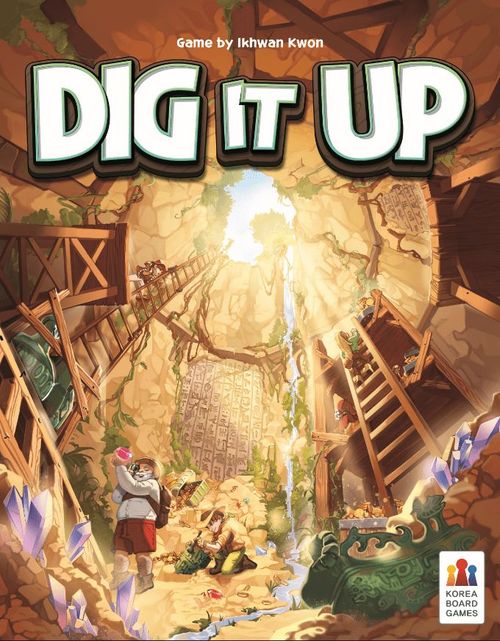
DIG IT UP
DIG IT UP Rulebook
Table of Contents
Table of Contents
Components
- 2 game boards
- 70 tiles: 60 treasure tiles (6 types) and 10 stone tiles
- 10 pickaxes
- 1 die
- 15 mission cards
- 50 chance cards
- 45 money tokens
- 5 personal scoreboards
- 1 rulebook
Game set-up
※ The following explanation is for a standard 4-5 player game. The 2-3 player game variation is included on the back page of this rulebook.
-
Flip all 70 tiles up-side-down so that the letters (A-J) on the backside are showing. Then sort the tiles according to the letters on the back of each tile. (There should be 10 piles of 7 tiles).
-
Lay out the two game boards in the middle of the table. Starting from the first dig site (Amazon) and working your way down, randomly place all 7 tiles with common letters face-up. Last, swap the stone tile from each dig site with the leftmost treasure tile located in that same dig site. This ensures that stone tiles are always arranged to come first in every dig site.
-
Place pickaxes on the starting picture label of each of the dig sites.
-
Place one personal scoreboard in front of each player.
-
Shuffle all the chance cards and lay them in a face-down pile next to the game board.
-
Shuffle all the mission cards and deal 3 mission cards to each player face-down. Each player must choose only 1 of the 3 mission cards to keep and discard the remaining 2 mission cards. These mission cards are kept secret until the end of the game. Put unused and discarded mission cards back in the box. These cards will not be used in this game.
※ All tiles on the game board need to be flipped face-up and each stone tile needs to be swapped with the leftmost treasure tile before the game can start.
How to play
The oldest player goes first and turns move clockwise around the table.
On your turn, choose and audibly call out the name of the dig site where you are planning to dig and then roll the die. The result of the die roll will determine how many tiles to move the pickax within the dig site. After rolling the die, move the pickax from the selected dig site to the right and collect the tile that you land on. This tile is then kept on your personal scoreboard.
※ Even if a tile category on your scoreboard is completely full, you can continue to collect tiles of that type.
When moving the pickax, always skip empty spaces and move from tile to tile like stepping stones. If there are no more tiles to your right, use your remaining moves by continuing from the leftmost side of the dig site.
After collecting the tile from the dig site, receive and play any relevant cards or money tokens. After that, your turn is over and the player to your left begins their turn.
After being moved, a pickax must occupy the vacant space left by the collected tile until it is moved again. All players move the same pickax when digging at a particular dig site. Once moved away from the dig site's starting picture label, the pickax is never placed there again until the dig site is abandoned. (See "Abandoning a dig site.")
e.g.) It's Joseph's turn. He calls out "Amazon" and rolls the die. It's a 3. He then moves the Amazon pickax 3 tiles and lands on a crystal treasure tile. Joseph then collects this crystal treasure tile and places it on his personal scoreboard in front of him. The pickax remains in the vacant space left by the crystal treasure tile until it is moved again.
Special tiles and money tokens
Some tiles have a special notation on them, such as a "★" or a "+2" mark. If you dig up a tile with a star, draw a chance card (see below). If you dig up a tile with a "+2" mark, take a corresponding money token.
※ When taking new money tokens, limit the number of coins you have by exchanging small coins for bigger ones. This allows other players to acquire new money tokens.
※ If there are no more money tokens available on the table, continue to keep track via a substitute material or by recording on paper.
Chance cards
When digging, if you collect a tile with a star on it, you draw a chance card in addition to the collected treasure tile. Reveal it and read the text aloud for all players to hear.
"GRAY" cards must be used immediately when drawn and "ORANGE" cards can be stored for use later in the game. Keep orange cards beside your scoreboard. You may use orange cards starting from your next turn. Once a chance card is used, place it face-down in front of your personal scoreboard. Any monetary effects from chance cards are represented by corresponding money tokens, take them immediately and place them near your personal scoreboard.
※ The "Strike Gold" and "Hazardous Area" chance cards require money tokens be placed on tiles on the game board. When doing this, you cannot put additional money tokens on a tile that already has a money token.
※ Certain chance cards can be considered a tile.
e.g.) Joseph chose the mission card "Jack of All Trades" at the start of the game. He already gathered all the needed treasure tiles except a diamond. He drew a chance card on his final turn and the chance card was a "Pink Diamond". He was then able to accomplish his mission because the Pink Diamond chance card is considered to be a diamond tile.
Abandoning a dig site
If only one tile remains in a given dig site, that dig site must be abandoned immediately. No one may dig in an abandoned dig site.
When a dig site becomes abandoned, indicate this by placing the last remaining tile face-down on the dig site's starting picture label and lay that dig site's pickax on top of this tile.
Game end
Once the 8th dig site is abandoned, the game ends after the current player's turn. This may result in some players getting an unfair additional turn. The player who earns the most money will be the winner.
Mission achievement
When the game ends, all players reveal their mission cards to show whether or not they achieved their mission. All mission cards are resolved first, before calculating money.
※ "Closing Shop" is the only mission card that is achieved during game play (see details on the Closing Shop mission card).
Calculating money
All players begin calculating the money they have earned. Money should be calculated in the following order:
- Mission bonus
- Chance cards
- Face-value of money tokens
- Set bonuses (see "Set bonuses")
- Bundle bonuses (see "Bundle bonuses")
1) Mission bonus
If you achieved your mission, add the money to your final money calculation. If you failed to achieve the mission, just keep the mission card face-down.
2) Chance card check
If you have any orange chance cards that affect your money calculation, add them in this step.
3) Face-value of money tokens
Simply add their value to your final money calculation.
4) Set bonuses
Collect many tiles of a single type and you might receive a set bonus.
※ Sets cannot be broken into multiple smaller sets. For example, a set of 8 tiles must never be broken into two smaller sets of 5 and 3 tiles to make money twice.
Gold set
- 3 tile set: 3 ₩
- 4 tile set: 8 ₩
- 5 tile set: 15 ₩
- 6 tile set: 24 ₩
- 7 tile set: 35 ₩
- 8 tile set: 50 ₩
- 9 tile set: 100 ₩
- 10 tile set: 200 ₩
Bronzeware set
- 3-4 tile set: 6 ₩
- 5+ tile set: 12 ₩
- Trinity Prize: 10 ₩
※ Trinity Prize: If you collect one of each of the three different bronzeware types (incense burner, statue, knife) you have made a trinity. Receive an additional 10 ₩ per trinity.
e.g.) Joseph has collected 4 bronzeware tiles: 1 incense burners, 2 statue, and 1 knife. He earns 6 ₩ for the set of 4 tiles, plus an additional 10 ₩ for collecting all three types of bronzeware. Joseph's total bronzeware set bonus is 16 ₩.
Ancient scroll set
- 3-4 tile set: 6 ₩
- 5+ tile set: 14 ₩
※ All ancient scrolls have a ★ marked on them.
Crystal set
- 4-5 tile set: 14 ₩
- 6+ tile set: 28 ₩
Ruby set
- 5-6 tile set: 30 ₩
- 7+ tile set: 50 ₩
Diamond set
- 5-6 tile set: 34 ₩
- 7+ tile set: 60 ₩
※ Diamonds are NOT used in a 2-3 player game.
Stone set
- 3 tile set: -2 ₩
- 4 tile set: -4 ₩
- 5+ tile set: -6 ₩
※ Be careful! A stone set bonus will negatively affect your money!
5) Bundle bonuses
Any treasure tiles not included in a set may be bundled together to create a bundle bonus. Multiple bundles can be made to receive multiple bundle bonuses. Bundle bonuses are calculated after all set bonuses. Certain chance cards (Gold, Pink Diamond, etc.) can be bundled with tiles to create a bundle bonus as well.
※ Stones are not a treasure so they cannot be bundled.
How to bundle: Three non-set forming treasure tiles can be bundled together. Each bundle of tiles receives a bundle bonus of 5 ₩. If any tiles remain (less than 3) they are not counted toward the bundle bonus.
e.g.) After calculating his set bonuses, Ivan has 2 bronzeware tiles, 3 crystal tiles, 1 ruby tile, and 1 diamond tile. When bundled together, these 7 tiles form 2 separate bundles of 3 tiles each. Each bundle is worth 5 ₩ so Ivan's bundle bonus is 10 ₩.
Final money calculation example
The game has ended and Joseph looks down at his personal scoreboard in front of him. He then begins to calculate the amount of money he received.
- Mission Bonus: 20
- Chance card: The Pink Diamond card is considered an additional diamond tile.
- Face-value of money tokens: 8
- Set bonuses: (Gold: 3) + (Bronzeware: 16 *) + (Stone: -2) = 17
- * Bronzeware calculation includes the Trinity Prize.
- Bundle bonuses: 5 (There are four left-over tiles. 1 crystal, 1 ruby, 1 ancient scroll, and 1 Pink Diamond chance card. Joseph is able to make one bundle.)
Joseph earned 50 ₩.
2-3 Player game variation
When playing a 2-3 player game, the following changes are applied to game play. Outside of these changes, all rules are the same as a 4-5 player standard game.
- Game board: Only the large game board with 6 dig sites (Amazon to Siberia) is used in game play.
- Tiles: Only tiles marked A-F (42 total) are used.
- Mission and chance cards: Remove any cards labeled with the pictogram shown in the source (a single figure symbol) from the game play decks.
- Game End: Once 5th dig site is abandoned, the game ends after current player's turn.
Simplified variation
When playing with young children, mission and chance cards may be removed from the game in order to simplify game play and money calculation. Also as part of this variation, all sets of 4 or more of a common color receive a set bonus of 10 ₩. Lastly, "+2" tiles keep their value and any non-set forming tiles receive a value of 1 ₩.
Translation/transcription notes: the money unit is printed as a won sign (₩) in the source. The mission/chance card icon on page 8 is a pictogram that the text layer does not carry; it is described in words above. Figure callout letters (A, B, C...) and the illustrated tile/board diagrams are not reproduced.