Diferencio
Diferencio Rulebook
Table of Contents
Table of Contents
Overview
- Players: 2–6
- Ages: 5+ / 8+
- Time: 10 / 15 minutes
Components
- 54 cards
- 1 board (optional)
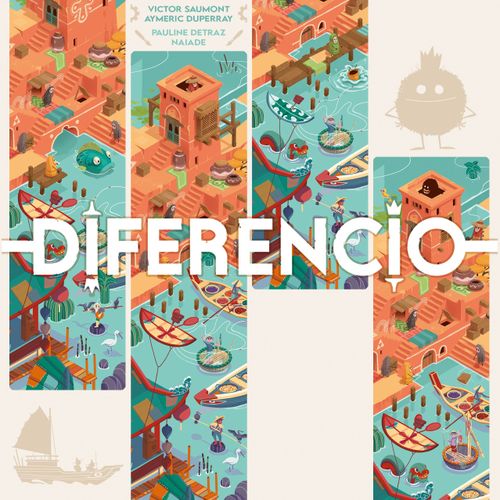
The illustration of the game is divided into 9 parts. For each part, there are 6 different cards showing small changes that the players must spot.
Setup
- On each space of the board, place at random a card that matches that part of the illustration, making sure the drawings line up well. (Without the board, the 9 cards are laid out to rebuild the illustration.)
- Shuffle the remaining cards to form a draw pile and deal three to each player. These are the cards the players will use to transform the castle.
Game Turn
- While the other players close their eyes, the active player transforms the castle. To do so, they remove one card from the board and replace it with a card from their hand.
- Once the action is done, the active player announces "Déglingo," and the other players open their eyes. They observe the castle and look for the differences.
- The first player who spots the replaced card points to it with a finger.
- If they are correct, they score 1 point and end the round.
- If they are wrong, the other players may propose their answer.
- If nobody finds it, the active player scores 1 point.
End of Turn
At the end of their turn, the active player completes their hand to 3 cards. Then the next player becomes the active player and transforms the castle.
Whenever a player scores a point, they take a card from the discard pile (or from the draw pile) and place it face down in front of them.
End of Game
As soon as a player has scored 5 points, they win the game.
2-Player Variant
With two players, each player takes turns being the active player and being the "Observer."
The active player may, as they choose, replace 1 to 3 cards on the board with cards from their hand.
The Observer does not know how many cards have been replaced. They look for the solution with a "Stop or Encore" system (in the original: "Stop ou Encore"). As long as they are right, they may keep looking for another card that has been replaced.
The Observer can end the round in two different ways:
- They are wrong: they score nothing, and the active player scores 1 point per replaced card.
- They decide to stop: they score 1 point per card found, and the active player scores 1 point per card not found.
As soon as a player has won 12 cards, they win the game.
Players who are experienced may also limit the time for the Observer with a 30-second timer.
Variations (Declinations)
The game can be re-themed with other illustrations, in different worlds and styles, for all tastes and all ages. The sheet shows four examples:
- Licensed illustrations
- More complex, for older players
- Simpler, for younger players
- Only 6 spaces, for the very youngest players
Possible Formats
Box format
- 2 card decks, for 2 different versions.
- A double-sided board with the 2 illustrations.
Card game format
- A single 54-card deck. The illustration is rebuilt with the cards.
- Inexpensive, so it can be bought like a Happy Families game: for each child, the version that suits them best.