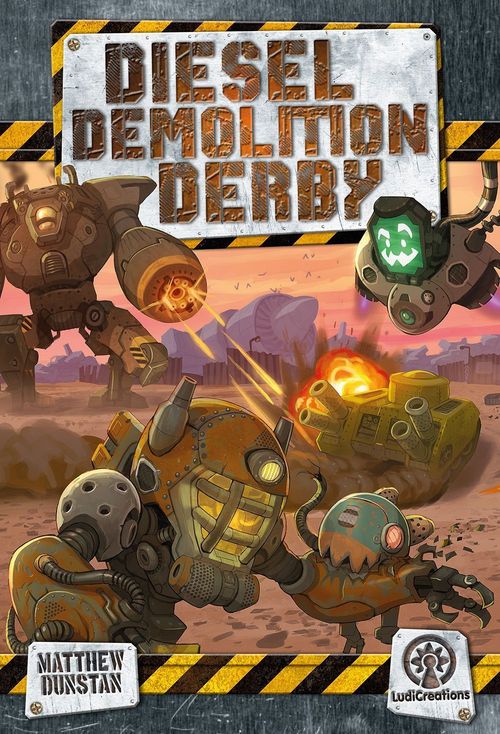
Diesel Demolition Derby
Diesel Demolition Derby Rulebook
Table of Contents
Table of Contents
Overview
The game is divided into a series of Derbies.
At the end of each Derby, the player who controls the Combatants with the highest combined Strength is the winner, and the first player to win 3 Derbies is declared the champion.
A Derby is played over several turns. In each turn, players simultaneously deploy a card from their hand and then pass the rest of their cards to the player to their left. The key to winning is choosing which Combatant to deploy while gathering information for later turns.
Components
- 52 Combatant cards:
- 9× Strength 0
- 11× Strength 1
- 12× Strength 2
- 11× Strength 3
- 9× Strength 4
- 3 Reference cards
- 13 Derby Victory tokens
Setup
-
When playing with fewer than 6 players, remove the appropriate Combatant cards according to the number of players. For example, in a game for 3 players, remove all cards marked with 4+, 5+, and 6+.
The total number of cards in a game should be as follows:
2 Players 3 Players 4 Players 5 Players 6 Players 17 Cards 17 Cards 27 Cards 37 Cards 52 Cards -
At the beginning of each Derby, shuffle all the cards being used and deal a number of cards to each player equal to the number of players plus two. So, in a game for 3 players, each player is dealt 5 cards; in a game for 4 players, each player is dealt 6 cards; and so on.
Note: For a 2-player game, deal each player 7 cards instead.
-
Place any cards that are not dealt to the side of the playing area face down; they will not be used in this Derby. You are now ready to begin your quest to win 3 Derbies!
Combatants
Anatomy of a Card
There are 52 Combatants in the game: they all have a Name, Strength, Type, and Special Ability (there are multiple copies of some Combatants).
A Combatant's type is always tied to its Strength.
| # | Type | Strength |
|---|---|---|
| 9 | Contraption | 0 |
| 11 | Ravager | 1 |
| 12 | Tank | 2 |
| 11 | Battlemekk | 3 |
| 9 | Wunderwaffe | 4 |
Finally, a Combatant may also have an ability that is triggered at the appropriate time (see icons reference).
Note: Any text in italics is flavor text, and does not have any effect in the game.
Icons
- Ongoing: This ability is an ongoing, permanent effect that applies from the moment the card is revealed and for as long as the card is face up and controlled by a player, even if control of the card changes.
- Turn: This ability applies from the moment the card is revealed but only lasts until the end of the current turn, even if the card itself is discarded.
- Instant: This ability is applied (in order) after deployed cards are revealed. Each instant ability is only triggered once during the game, even if the card would come back into play later in the game as the result of another ability.
- Derby: This ability only applies at the end of the Derby.
Note: Only the effects of abilities which state 'may' are optional. All other effects are mandatory.
Keywords
Control: You control a Combatant that you select in the current turn, as well as any other Combatants in front of you from previous turns.
Gain: A card is gained by taking it and placing it face up in front of you. You now control this Combatant.
Swap: To swap a Combatant with another, take another player's Combatant and replace it with one of yours. You now control the one you took.
Gameplay
Each Derby is played over several turns. Each turn, every player simultaneously deploys a Combatant by choosing a card from their hand and placing it face down in front of them.
Once every player has chosen a Combatant, they are all revealed simultaneously. Any Ongoing and Turn abilities are immediately applied (the order does not matter).
Then, any Instant special abilities are resolved, starting with Combatants with the highest Strength and proceeding in descending order to those with the lowest Strength. Combatants with equal Strength are activated simultaneously.
If a game effect causes a Combatant to be discarded before it has resolved its instant ability, that ability is not resolved.
Any Combatant cards discarded as a result of a Combatant ability are placed face down in a common discard pile in the middle of the playing area.
Once this is done, the chosen Combatants that are still in play stay in front of the player who deployed them (joining any previously chosen Combatants).
Finally, each player passes the rest of the cards in their hand to the player on their left, and a new turn begins.
This process is repeated until players only have 1 card remaining in their hand. That card is discarded and then the winner of the Derby is determined.
Note: Special rules for 2 players – on each turn, players choose 2 cards that they will deploy that turn, instead of 1. Once they have chosen, the cards are revealed and abilities resolved in the normal way. After 3 turns, each player will have played 6 cards. The final card is discarded.
End of a Derby
The Derby is concluded once each player has only 1 card remaining in their hand. This card is then discarded, and the current turn is concluded as noted in the Gameplay section above.
At the end of each Derby, any Derby abilities are applied, and then players add up the total Strength of all of their controlled Combatants (including any that are face down).
The player with the highest total Strength wins that Derby and takes a Derby Victory token.
If there is a tie for highest total Strength, then the tied player with the most Combatants wins.
If it is still a tie, then all tied players are considered to have won the Derby and each takes a Derby Victory token.
In the unlikely case that there are no more Derby tokens, players may use any other token to represent them.
Note: If a player controls the Commander and/or Underdog at the end of the Derby and has fulfilled the winning condition listed, they win the Derby instead, even if another player has a higher total Strength.
If two different players would each win with the Commander and Underdog at the same time, they both win the Derby.
Editor's note: this rulebook refers to an "Underdog" in the note above, but no Underdog Combatant or winning condition is described anywhere in the printed text. The text is transcribed as printed.
After determining the winner and awarding them a Derby Victory token, all cards are discarded and shuffled together.
Players are then ready to begin the next Derby, starting with the Setup procedure.
End of a Game
Once one player has won 3 Derby tokens, they have won the game.
If two players are tied with 3 Derby wins each, keep playing until any one player has won more Derbies than any other.
Mekk Mania
A variant for games with fewer than 6 players.
For a more chaotic game suited for experienced players, remove the Liaison Unit card and separate the rest of the cards into decks, each of a different type of Combatant (i.e. Contraptions, Ravagers, Tanks, Battlemekks and Wunderwaffe).
Shuffle each deck separately, then draw cards from each deck according to the number of each type that should be in the game depending on the number of players (see table below).
Return all other cards to the box, and shuffle all the drawn cards together to form the deck used in this Derby.
Then, deal out the cards to the players and play the game as you normally would.
| Rank | Type | 2-3 Players | 4 Players | 5 Players | 6 Players |
|---|---|---|---|---|---|
| 0 | Contraptions | 2 | 4 | 6 | 9 |
| 1 | Ravagers | 4 | 6 | 8 | 11 |
| 2 | Tanks | 5 | 7 | 9 | 12 |
| 3 | Battlemekks | 4 | 6 | 8 | 11 |
| 4 |
Notes on Specific Combatants
Avenger (0) – For the whole of this turn, any time a Combatant would be discarded, you gain it instead.
Commander (0) – You win the Derby if you either have more Combatants than every other player, or you have fewer Combatants than every other player.
Brawler (1) – The Combatant controlled by another player can include a Combatant deployed in the current turn.
Heavy (1) – If the Heavy itself is the Combatant with the lowest Strength, it is discarded.
Hunter (1) – If multiple Combatants with the same highest Strength are deployed in this turn, they are all discarded. If multiple Hunters are deployed in the same turn, they all target the same Combatant(s). If the Hunters themselves have the highest Strength, they are discarded instead.
Ironclaw (1) – You can discard Combatants controlled by yourself or other players.
Leveller (1) – If a player controls multiple Combatants with the same highest Strength, they can choose which one is discarded.
Chameleon (2) – If you choose to swap the Chameleon with a Combatant of lower Strength, you will resolve the target Combatant's ability when it is time to do so.
Guard (2) – The Guard can flip itself face down.
Lookout (2) – Discards all face up Ravagers, including ones deployed this turn.
Scout (2) – If the card you choose with the Scout has an instant ability, it is not resolved. However the effects of all other types of abilities still apply.
Editor's note: the Mekk Mania variant refers to a "Liaison Unit" card, and the End of a Derby note refers to an "Underdog". Neither card's text appears in this printed rulebook, so both are transcribed as printed.
Gameplay Quick Reference
Number of cards in a game
| 2 Players | 3 Players | 4 Players | 5 Players | 6 Players |
|---|---|---|---|---|
| 17 Cards | 17 Cards | 27 Cards | 37 Cards | 52 Cards |
3 Derbies are needed to win the game.
At the beginning of each Derby, deal new cards to each player.
In each turn of the Derby:
- Secretly choose one Combatant. All players deploy all chosen Combatants simultaneously.
- Resolve instant abilities of Combatants starting from the ones with the highest strength, proceeding to the lowest strength.
- Pass remaining Combatants to the left.
The Derby ends when all players are left with one Combatant in hand, which is discarded.
The player with highest total strength of Combatants wins the Derby!