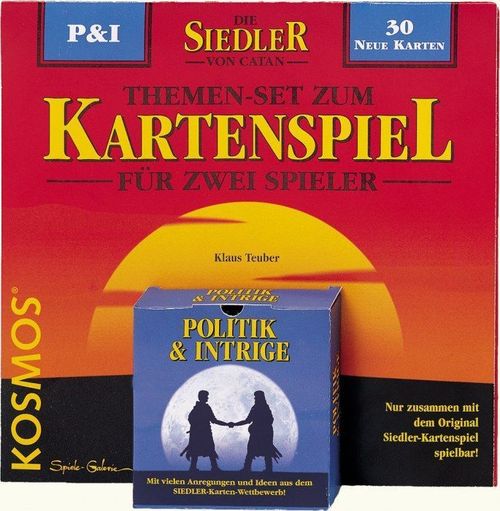
Die Siedler von Catan: Kartenspiel – Politik & Intrige
Die Siedler von Catan: Kartenspiel – Politik & Intrige Rulebook
Table of Contents
Table of Contents
Expanded Game Rules
To play the Expanded Game, you will need the Basic Game and an Expansion Set Theme Deck. All rules from the basic Catan Card Game are used, except where changed below.
Game Components: 205 cards; 5 blank cards (for inventing your own!); Game Rules; Card Almanac (at the end of these rules).
Setting Up the Game
-
First, decide which Theme Deck you want to use. There are six Themes. Sort out all the cards from the Theme you have chosen to play. You can identify the Theme by the small hexagonal icon on each card. Place the five Themes you are not using aside.
Politics and Intrigue: This Theme features the shady side of running a principality: Secret Societies, bribed Knights, and clever diplomats. Or you can align yourself with the Church in this Theme.
-
Each player sets up his starting principalities as described on page 3 of the Basic Game rules. You may want to consider the rules changes when you set up your principality.
-
Separate the Event Cards for this Theme Deck from the rest of the Theme. Shuffle them together with the Event Cards from the Basic Set. This expanded event deck is placed in the middle of the table as usual.
-
Depending on the Theme Deck you have chosen, you will need to pull out some cards before you shuffle the deck. Except for the Inquisition cards from Knights and Merchants, these "set aside" cards are placed in a stack face-up next to the Event Cards:
Politics and Intrigue: Remove and set aside both Town Hall cards and both Church cards from the Basic Set. You do not need to remove any cards from the Expansion Set.
-
Arrange the rest of the Development Cards (roads, cities, etc.) and place them between the two players as normal.
-
Shuffle the remaining Expansion Cards from the Basic Set together. Instead of the usual five expansion stacks you make in the Basic Game, these cards are used to create four piles. These four expansion stacks are placed in a row between the two players.
-
Shuffle the remaining cards from the Theme Deck together and split them into two roughly equal-sized expansion stacks. Place these stacks near the Development Cards. This way you can tell which stacks are cards from the Basic Game, and which are from the Theme Deck.
New Rules for the Expanded Game
The rules are the same as the Basic Game, except for the changes described below:
-
Before the game, you pulled some cards out of the deck and set them aside to create a new development stack. There are always two copies of each card in this stack. (Exception: Citadels. See "Special Rules for Wizards and Dragons" on page 6.) The cards for each Theme are:
- Knights and Merchants: None;
- Science and Progress: 2 University cards;
- Wizards and Dragons: 5 Citadel cards;
- Barbarians and Traders: 2 Harbor cards and 2 Triumphal Arch cards;
- Politics and Intrigue: 2 Town Hall cards and 2 Church cards; and
- Trade and Change: 2 Counting House cards.
You can purchase these cards just like other Development Cards. Simply pay the cost shown on the card and place it in a legal building site in your principality.
Example: You want to build the University. You pay 2 lumber, 2 grain, and 1 brick. Then you take a University card from the stack and place it in an empty building site next to one of your cities.
But, there is a special restriction: each player may only build one of each type of card in this stack. If one of these cards leaves play for any reason, return it to this special development card stack (this card can be rebuilt by the player who lost it).
-
Whenever you draw cards from an expansion stack, you may choose any of the six stacks. You may choose each time you draw whether you want to draw from the four stacks from the Basic Game or the two stacks from the Expansion Set. If you pay the two resources to search a stack, you may choose to search one of the stacks from the Theme Deck if you wish. The two stacks from the Expansion Set are treated in all ways the same as the four stacks from the Basic Game.
-
The "Brigand Attack" event has no effect during the first two rounds of play (until both players have played two full turns). Ignore the Brigand Attack if it is rolled on the Event Die during those turns. Do not re-roll the Event Die if a Brigand Attack is rolled.
The End of the Game
Because there are so many more ways to earn points when playing the Expanded Game, you have to earn a total of 13 or more Victory Points on your turn to win the game!
Hint: Before you play your first Expanded Game, we recommend that you look at all of the new types of cards in the Expansion Set. If you have questions about any card during the game, there is a complete explanation of each card in the "Card Almanac" at the back of this book.
Tournament Game Rules
The Tournament Game rules apply to any Theme Deck, including Politics and Intrigue. They are reproduced here because Politics and Intrigue cards are played under them.
When you play the Tournament Game, you get to build your own deck of Expansion Cards! During the game you will have your own expansion stacks. You will be able to design your own unique strategy for victory!
To play the Tournament Game, each player will need his own copy of the Catan Card Game. You should also have your own copy of the Expansion Set. You may only use cards from one copy of the Basic Game and one copy of the Expansion Set.
All of the rules from the Basic Game and the Expanded Game are used, except for the following changes:
Setting Up the Game
-
One player supplies all these cards from his copy of the Catan Card Game:
- The 18 cards from both starting principalities;
- The development cards:
- 7 roads;
- 5 settlements;
- 7 cities; and
- 11 Region Cards.
-
You set up your starting principality using the 9 starting cards with your chosen icon on the back.
-
Place the Development Cards (roads, settlements, cities, and regions) between the two principalities. Don't forget to shuffle the Region Cards.
-
If either player is using any of the cards from the Wizards and Dragons Theme, you need to place the five Citadel cards next to the other Development Cards.
Important: Any cards that were pulled out and set aside in the Expanded Game are not removed. They are included with the rest of the Expansion Cards.
-
Now you build the Event Card deck as described below. Shuffle the Event Cards and place them near the development stacks.
-
Choose any three Expansion Cards from your deck. These three cards will form your starting hand.
-
Shuffle your 30 remaining cards. Separate your cards into four expansion stacks. Two stacks will have seven cards each, and the other two will have eight cards. Place your expansion stacks near your principality.
-
Determine which player will go first and begin the game!
Building the Event Card Deck
The Event Card deck must contain exactly 13 cards:
- Both players contribute a Civil War and a Plague card from their copy of the Basic Game. One player also adds a Year End card.
- Now you choose any 4 more Event Cards to add to the deck. These events can be taken from the Basic Set or any of the Theme Decks. But, you may not add a second Year End card!
- You should not let your opponent see the events you have chosen before they are added to the deck. That way, he won't know what to expect!
- Once both players have added their four cards, the event deck is complete. Shuffle all 13 cards together and place them face-down next to the development stacks.
- Make a note of which Event Cards you added to the deck. At the end of the game, each player takes his own Event Cards back. You should also note which Theme Deck you selected cards from, since some cards appear in more than one set!
Arranging Your Own "Deck"
You get to design your own deck of cards when you play the Tournament Game! Before you play, you secretly choose 33 cards that you want to use. These cards will form your "deck." There are some restrictions on which cards you can choose:
- You may not choose any cards that have symbols on the back—only Buildings, Units, Wizards, Magic Books, and Action Cards may be used.
- You may use any cards from one copy of the Catan Card Game and one copy of the Expansion Set.
- You may not use more copies of any card than there are in those sets. For example, you may not add a fourth Spy card to your deck because there are only three Spy cards in one complete set.
- You do not have to tell your opponent which cards you are using! However, it might be a good idea to write down a list of your cards so you can get them all back at the end of the game.
- At the beginning of the game, you will choose three of your cards to form your starting hand. Shuffle the other 30 cards together, then use them to create your four expansion stacks at the beginning of the game.
- During the game, you can only draw cards from these four stacks! You may not draw cards from your opponent's stacks. If you draw all of the cards from a stack, you can still discard cards to the empty "stack," creating a new one.
New Rules for the Tournament Game
-
Each player forms his own discard pile for any Action Cards he plays or Buildings that he removes from his principality, or for cards that are "removed from play" (by cards like Lady Imelda).
-
When a card or rule states that a card is discarded under a stack, it is always the players' own (personal) stacks. Unless an Action Card says otherwise, you may never search through your opponent's stacks, and you may not draw cards from there.
-
Units with names, such as Knights, Dragons, and Wizards, are all unique! There may never be two Units or Wizards with the same name in play at the same time. If a "unique Unit" is removed from a principality because of an Action Card or event, then both players again have the chance to play that Unit.
Example: If your opponent has played Siegfried in his principality, you may not play Siegfried in your principality. If you play a "Black Knight" and Siegfried is removed, then you can play your own copy of the card.
Note: Cannons are not unique! Both players can have Cannons in their principalities.
-
When you play a Spy and steal one of your opponent's cards, you should make a note of which card was stolen so you can return it to its rightful owner at the end of the game.
End of the Game (Tournament Game)
The first player to collect 13 or more Victory Points on his turn is the winner!
Politics and Intrigue Almanac
The Almanac lists each card by its category. The Politics and Intrigue entries begin on page 19 of the printed Almanac. Each card's type and copies in the deck are given in parentheses, as printed. The base-game Church and Town Hall are explained in the Catan Card Game Almanac, not here.
Special Card
Metropolis (City Improvement; 2 in deck)
You may only play this card if you have at least one Church or Town Hall in your principality. The Metropolis is free. Play the Metropolis card from your hand on any of your cities. You may not place it on a settlement or Citadel. You may only have one Metropolis in play.
All cards that refer to cities also apply to the Metropolis. Like a city, a Metropolis has four building sites that can be used for any green or red cards.
In addition, the Metropolis has four special building sites, one above or below each of the four adjacent Region Cards. Only Units (such as Knights and fleets) may be played in these building sites, and are considered to be part of the Metropolis, not part of any nearby city, settlement, or Citadel. There can only be one card in each of these spaces, so if there is already a region improvement or Wizard, you may not place a Unit there (unless the other card is removed first).
If there is a Church in that Metropolis, Units in these special spaces are also protected from the Civil War event.
Special Cards: Foreign Cards
Bordello (Building; 2 in deck)
You may only build the Bordello in your opponent's city. There must be an empty building site available in the city. Every Knight in your opponent's principality has his strength reduced by one point. The Bordello does not affect Cannons or Dragons, and Knights that have no strength points (such as Walter the Minstrel) are not affected. Your opponent may not remove the Bordello, but he may try to destroy it with an Arsonist card if there is no Fire Brigade in that city. If your Bordello is destroyed by the Arsonist, it is returned to your hand.
Action Cards
Archivist (Action–Neutral; 1 in deck)
When you play this Action Card, you may draw up to six cards from the top of any one expansion stack and examine them. If there are less than six cards in the stack, you draw all of them. Then, you must place all six of those cards back on top of the stack. You may place them in any order. You may only play this card if you have a Town Hall in your principality.
Bribery (Action–Attack; 2 in deck)
You may pay three gold to take any one Knight from your opponent's principality and place it in your own. You must be able to place the Knight in a legal position, or you may not play this card. If you are playing the Tournament Game, make sure to make a note of who owns the Knight so that it can be returned at the end of the game.
Chancellor (Action–Neutral; 2 in deck)
When you play this card you may draw the top three cards from any one expansion stack and add them to your hand. You may have more cards than your hand limit until the end of your turn. Then, if you still have too many cards, you must discard down to your hand limit by placing cards under any expansion stack.
Council Meeting (Action–Neutral; 2 in deck)
Discard one card from your hand and place it under any expansion stack of your choice. Then, you may search that stack and select any two cards and add them to your hand. You may have more cards than your hand limit until the end of your turn. You may only play this card if you have a Town Hall in your principality. You may not play this card if you have no other cards in your hand to discard.
Diplomat (Action–Neutral; 1 in deck)
You may search the discard pile and select any one card there to put in your hand (you may only draw from your own discard pile when playing the Tournament Game). You may not use this card if there is an Excommunication card on the discard pile. You may only play this card if you have a Town Hall in your principality.
Doctor (Action–Defense; 2 in deck)
Play this card when the Plague Event Card is drawn. The Plague has no effect on your cities. Your opponent still loses resources normally. You may play this card even when it is not your turn.
Excommunication (Action–Attack; 2 in deck)
Play this card face-up on top of any expansion stack or discard pile of your choice. Your opponent may not access that stack in any way, including drawing cards from or discarding to that stack (exception: your opponent may still discard cards to the discard pile even when the Excommunication is played on it). You may continue to use that stack normally. Your opponent may pay 3 gold "to the bank" to remove the Excommunication card and discard it. If an Inquisition card is played, the stack under the Excommunication is not included, and the Excommunication remains in effect.
You may only play this card if you have a Church or a Cathedral in your principality. This card may be played on your opponent's expansion stack or discard pile when playing the Tournament Game. When the Excommunication leaves play, it is returned to the discard pile of the player who played it.
Wedding (Action–Attack; 2 in deck)
Your opponent must give you as much gold as you can store in your gold fields. If you have space for all of his gold, he must give you all of his gold. If you cannot store all of his gold, then he may keep the remainder. Your opponent does not have to give you any gold he has stored in a Treasure Vault. You can only play this card if you have a Church or a Cathedral in your principality.
Event Cards
Begging Monk (Event; 1 in deck)
The player who has the Windmill Token must give 2 resources to his opponent. The owner of the Windmill Token decides which resources to give. If you only have one resource, you only give one. If your opponent does not have space to store the resources, they are lost. You must choose resources that your opponent is able to store, if possible.
Good Neighbors (Event; 1 in deck)
The top card of every expansion stack is turned face-up, unless there is an Excommunication card on top of that stack. These cards remain face-up until drawn. This event affects both players.
Religious Festival (Event; 1 in deck)
This event applies to both players. If a player has at least one Church, he may choose 2 resources of his choice. If a player has at least one Cathedral, he may choose 4 resources of his choice. If a player has both a Church and a Cathedral, then he may choose 6 resources of his choice. There is no additional bonus if a player has two or more Churches.
Regional Expansion Cards
Church Domain (Building; 1 in deck)
If you roll the Production Die, you may take one additional resource of your choice. If your opponent rolls the "?" on the Event Die, you must lose all of the Wool and Ore in your principality (except any safely stored in Treasure Vault or Produce Storehouse). In addition, you must discard the Church Domain and place it on the bottom of an expansion stack of your choice.
You may not build a Church Domain if you have the Capital of the Republic in your principality, even if the Capital is covered by a Witch or Pawnbroker card. If there is a Witch covering the Church Domain when your opponent rolls a "?" on the Event Die, both the Witch and the Church Domain are discarded to the appropriate places.
Holy Place (Building; 1 in deck)
After you draw cards to refill your hand at the end of your turn, you may discard one card you drew to the bottom of an expansion stack of your choice, and draw a replacement card from that stack. As normal, you can draw the top card or pay to search the stack. You may only play the Holy Place if you have a Church in your principality.
Mission (Building; 1 in deck)
When you have a Mission in your principality, you may reduce the construction cost of any of the following when you build them: Abbey, Archdiocese, Church, Cathedral, or Templar Fortress. You choose which resource to reduce. The Holy Place is not considered a "sacred Building."
Templar Fortress (Building; 1 in deck)
All of the Knights in your principality (not Dragons or Cannons, only Knights), who have a base cost of more than 3 resources (not counting any reductions), are immune to all of these Actions and Events: Lady Imelda, Civil War, and Bribery. These Knights are still vulnerable to the Black Knight normally.
City Expansion Cards
Archdiocese (Building; 1 in deck)
It is worth one Victory Point.
Every time your opponent plays any Action Card or Magic Spell, you receive 1 gold. You must store that gold in one of your Region Cards immediately or it is lost. This gold comes from the "bank," not your opponent. This includes Magic Spells cast from a Magic Book. You do not receive the gold if the spell is cancelled by Countermagic.
Your opponent may not play the Arsonist on the Archdiocese. You must have an Abbey or a Church in your principality in order to play this card.
Brewery (Building; 1 in deck)
This card provides either 2 Commerce Points or 2 Strength Points. The symbol on the left of the card indicates which type of points the Brewery provides. When you build the Brewery, choose which way to orient the card (Commerce Points or Strength Points). On your turn, you may pay 1 gold to rotate the card so the other type of Points are provided. It remains that way until you again pay 1 gold to rotate it back. You may only use this ability once per turn. You can count the two Strength Points from the Brewery even if you have no Knights.
Capital of the Republic (Building; 1 in deck)
It is worth one Victory Point.
Both regions adjacent to this Building produce 3 resources when the number on the region matches the Production Die roll. If there is not enough room in the region to store all 3 resources, the excess is lost. You may only build this Building if you have a Town Hall in your principality. You may not build the Capital of the Republic if you have a Church Domain in your principality, even if a Witch or a Pawnbroker card is covering the Church Domain.
Court of Justice (Building; 2 in deck)
It is worth one Victory Point.
If the Brigand Attack is rolled on the Event Die, you only lose your wool and ore if you have more than 10 (unprotected) resources instead of more than 7 resources.
Secret Society (Building; 1 in deck)
This card can imitate a city Expansion in your opponent's principality. When you build the Secret Society, you must choose one of the following Buildings: Church, Library, Town Hall, or University. The type of Building you choose must be in your opponent's principality. You gain all of the advantages of the Building except Victory Points. You may use this Building as a prerequisite for playing other cards. You may also benefit from an event as if you had that type of Building. If the Building you choose is removed from play, you must immediately change the target of the Secret Society. You may play the Secret Society even if your opponent does not have any of the required Buildings, but it will immediately imitate the first of those Buildings your opponent builds. All aspects of the imitated Building except Victory Points are copied. The Secret Society keeps its benefits even if the copied Building is covered with a Witch, Dogma, or Pawnbroker card.
Example: When you build the Secret Society, you chose your opponent's Church as your target. Now your Knights and Trade fleets in the same city as the Secret Society are protected from the Civil War, and you can build a Metropolis. You do not get the Victory Point, however. Later, you play an Arsonist and destroy your opponent's Church. You then choose to have your Secret Society imitate his Library.
Theater (Building; 1 in deck)
It is worth one Victory Point.
Your hand size is increased by two when you have a Theater in your principality. This increase is added to any increases you receive from other cards, such as an Abbey. You must have a Library in your principality to build a Theater.
Changes to the Catan Card Game
The printed "Changes" section also lists changes for the Trade & Change, Science & Progress and Wizards & Dragons sets, and the Special Thanks credits. Those are not Politics and Intrigue content and are not reproduced here.
General Changes
To eliminate certain misunderstandings and ambiguities of some rules, each card has been assigned a clear type. For example, a Knight card is classified as "Unit–Knight" while the Cannon and the Peasants are only marked "Unit." So, without requiring a lengthy rule, the cards Lady Imelda (Knights and Merchants Set) and Bribery (Politics and Intrigue Set) cannot be used against a Cannon, and having a Castle (Knights and Merchants) will not reduce the cost to play a Peasant.
- Region Improvement Cards are now easy to recognize as they have a brown text box. These cards are not placed in a settlement or city. Instead they are played on a suitable Region Card, if their conditions are met.
- Wizards may still only be placed above or below a Region Card that is next to a Citadel. Since Wizards are played like Region Expansion cards, they are also given a brown text box.
- Road Improvements are not treated like Regional Expansions, so the green text box was removed.
- Action cards are now marked "attack," "neutral," or "defense."
- Action cards marked "attack" or "neutral" may only be played when the combined score of both players is at least 7. "Defense" Action Cards may always be played—from the start of the game.
- Buildings, Wizards, and spellbooks cannot be stolen with the Spy! You may only steal Action Cards and Units from your opponent when you play this card.
- If you exchange a card at the end of your turn (because you played no cards that turn), then you must discard the card to the bottom of the same stack you draw the replacement card from.
Basic Set
- The Civil War event only affects Knights, Trade Fleets, and Cannons. The Church and the Cathedral (from Science & Progress) protect all Knights, Trade Fleets, and Cannons from this event.
Politics & Intrigue Set
- The Chancellor action card can only be played if you have a Town Hall built in your principality.
- When you play the Council Meeting Action Card, you must discard the card to the bottom of one of the stacks you draw from.