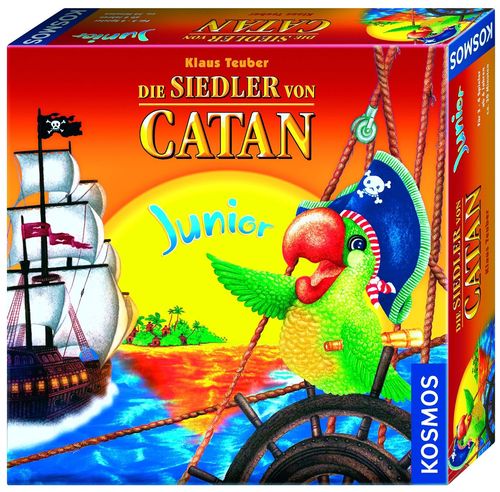
Die Siedler von Catan: Junior
Die Siedler von Catan: Junior Rulebook
Table of Contents
Table of Contents
Components
- 1 double-sided printed board
- 1 die
- 28 pirate lairs in 4 colors (7 each)
- 32 pirate ships in 4 colors (8 each)
- 1 Ghost Pirate
- 24 "Coco Helps" cards
- 95 equipment cards (5 types: saber, wool, wood, rum, gold sack)
- 1 marketplace
- 4 harbor tiles
- 4 building-cost cards
Before the First Game
Carefully punch out all the parts from the die-cut cardboard sheets.
Setup
Place the board in the middle of the table. If you are playing with four, use the side showing four pirates in barrels in the upper right corner of the water. If you are playing with three, use the side showing three pirates in barrels in the upper right corner.
Place the die next to the board.
Each of you chooses a color and takes the seven pirate lairs and eight ships in that color. If you are playing with three, the white pieces are not needed and go back in the box.
Some circles on the board are marked in color — these are the starting spaces. Place one of your pirate lairs on each of the two pirate-lair building spaces marked in your color. Place your remaining five pirate lairs and your ships in front of you as your supply.
Place the Ghost Pirate on the Ghost Fortress.
Shuffle the "Coco Helps" cards thoroughly and place them in a stack next to the board, gray side up.
Sort the equipment cards by the five types — saber, wool, wood, rum, and gold sack — and lay them out in five separate stacks, colored side up, next to the board.
Place the marketplace next to the board. Take one card from each of the five equipment-card stacks and place it face up on one of the five spaces of the marketplace.
Shuffle the harbor tiles as well and place them next to the board as a face-down stack, gray side up.
Each of you takes a building-cost card and places it face up in front of yourself.
Then each of you receives one "wood" equipment card and one "rum" equipment card from the corresponding stacks. Hold these two cards face down in your hand so that only you can see them.
What Is It About?
The goal of the game is to be the first to build all seven of your pirate lairs. You may build on any free pirate-lair building space, provided one of your ships travels there — that is, you have built a ship on an adjacent ship-building space.
To build ships and pirate lairs you need equipment cards. Which ones you need is shown on the building-cost card lying in front of each of you. You get equipment cards from the terrain spaces on the board where you already have pirate lairs. Each terrain space shows a number from 1 to 5. Whoever's turn it is rolls first.
Whoever has a pirate lair at a terrain space whose number is rolled receives one equipment card of that terrain — for example, a wood card if the number of a forest is rolled, or a saber if the number of a treasure cave is rolled.
Since you rolled the die, it is best if one of you takes over distributing the equipment cards to the other players.
How this works exactly will be explained in a moment.
Board diagram key: the board shows each color's starting pirate lair and ship, an example pirate-lair building space and ship-building space, and the resource produced by each terrain — forest (wood), gold river (gold sack), treasure cave (saber), pasture (wool, from the sheep grazing there), and sugar cane field (rum). A pirate-lair building space marked with a harbor (anchor symbol) lets you use harbor trading once you build there. The Ghost Pirate starts on the Ghost Fortress.
For example, in the picture, player White rolls a "4." Player White and player Red each have a pirate lair at the sugar cane field with the number "4," so they each get a rum equipment card. But the forest space also shows a "4," so player Blue and player Orange each receive a wood equipment card.
Sequence of a Turn
Overview
The youngest of you starts the game. Whoever's turn it is rolls the die, and all players receive new equipment cards. Afterward, the player who rolled may build and trade in any order they like. Once that player has ended their turn, the next player clockwise takes their turn.
Roll the Die
Only the player whose turn it is rolls the die. But every one of you may now receive equipment cards: each of you receives, for every pirate lair you have at a terrain space showing the number rolled, the matching equipment card. It is best if one of you takes over distributing the equipment cards to the other players.
If you roll a "6," no one receives equipment cards. Instead, whoever rolled the "6" moves the Ghost Pirate onto any other terrain of their choice. As long as the Ghost Pirate stands on a terrain, you receive no equipment cards for your pirate lairs at that terrain, even when its number is rolled.
"If you roll the number '6,' no equipment cards are given out. Instead, the player who rolled the '6' may move the Ghost Pirate to a different space. It's naturally best to place the Ghost Pirate on a space where only your opponents have built pirate lairs."
Build
Whoever's turn it is may build one or more pirate lairs and ships, or buy "Coco Helps" cards.
A pirate lair costs one equipment card each of rum, saber, wool, and wood.
A ship costs one equipment card each of wool and wood.
A "Coco Helps" card costs one equipment card each of rum, saber, and gold.
You may always check your building-cost card to remind yourself what you can build.
You may only build a pirate lair on a pirate-lair building space if one of your own ships travels to that space. You may only build a ship on a ship-building space if it lies next to one of your own pirate lairs. That means, starting from both of your starting pirate lairs, you must always build alternately in the order: ship, pirate lair, ship, pirate lair, ship, pirate lair, and so on — you may never build two ships directly next to each other; you must always build a pirate lair in between first.
Only one ship may ever be built on each ship-building space, and only one pirate lair on each pirate-lair building space.
Two small examples from the board: at one ship-building space, player Orange may build a ship there, because one of Orange's own ships already travels to it — but at the pirate-lair building space next to it, Orange may not yet build a lair, because none of Orange's ships travel there. Likewise, at one pirate-lair building space, Orange may build a lair, but at the ship-building space next to it, Orange may not yet build a ship, because there is no pirate lair of Orange's next to that space.
"Have you noticed? At the start there are no equipment cards yet for the number '5,' because no pirate lair yet stands at a terrain with a '5.' And there is no '6' on the board at all — because when a '6' is rolled, something quite different happens ... If one of you rolls the number '6,' you receive no equipment cards. Instead, whoever rolled the '6' moves the Ghost Pirate onto any other terrain."
Buying "Coco Helps" Cards
If one of you has bought a "Coco Helps" card, turn it face up right away and carry out the instruction. Bought cards stay face up in front of the player who bought them.
"The 'Coco Helps' cards can be very useful. Either you get equipment cards, an entire ship, or a pirate lair as a gift — or sometimes you can annoy your fellow players a little, because you get to plant the Ghost Pirate right in front of them, or they have to give you equipment cards."
A Pirate Lair in the Fortress
Whichever of you is the first to reveal a "Coco Helps" card that lets you move the Ghost Pirate, places one of your pirate lairs (from your own supply) on the Ghost Fortress. If later a fellow player has just as many revealed Ghost-Pirate-moving cards face up in front of them, you must remove your pirate lair from the fortress again. As soon as there is once again a single player with the most such revealed cards in front of them, that player may place a pirate lair in the fortress.
"Whoever is brave enough to drive off the Ghost Pirate may, as a reward, place a pirate lair in the Ghost Fortress. But of course only one of you can be the bravest — so you have to remove your pirate lair from the fortress again once another player has revealed just as many of these cards. A pirate lair in the Ghost Fortress doesn't bring extra equipment cards, but the goal is to build all seven pirate lairs as quickly as possible, and being allowed to place one in the fortress is very helpful for that."
Trade
Often it will happen that it's your turn and you would like to build, but you don't have the right equipment cards. That's why there are three different ways to trade equipment cards. You can trade with your fellow players, at the marketplace, or with the stockpiles — as many times as you like, and if you want, also several times in a row: first with a fellow player, then with the marketplace, then with a fellow player again, and then with the stockpiles too — all in whatever order you like.
Trading with Fellow Players
Whoever's turn it is may trade equipment cards with the other players. For example, a player wants to build a ship. For that they need a wood equipment card and a wool equipment card. The player already has a wool equipment card, but unfortunately no wood equipment card. However, they still have a saber equipment card they don't currently need. Now they can ask the other players whether someone wants to trade a wood card for a saber card. If one of the fellow players wants to trade, the two cards are exchanged. How many equipment cards are traded is entirely up to you.
"It's important, though, that trading is only ever allowed with the player whose turn it is. Two players who are not taking their turn may not trade with each other."
Marketplace
Whoever's turn it is may also trade with the marketplace during their turn — but only exactly once. To do this, the player takes any card lying on the marketplace into their hand. In exchange, they must place a different card of their own on the marketplace. This way there are always five cards lying face up on the marketplace.
"As soon as five matching cards are lying on the marketplace, all the cards are taken from the marketplace and returned to the stockpile. Then, just as at the start of the game, exactly one card of each equipment type is placed on the marketplace again."
Trading with the Stockpiles
3:1 trade: A player may also trade with the stockpiles — three matching equipment cards for any other one.
"For example, you can place three wool equipment cards on the wool stockpile and take one wood equipment card from the wood stockpile in exchange."
Harbor 2:1 trade: Whoever has built a pirate lair on a pirate-lair building space with a harbor (anchor symbol) takes the top harbor tile from the face-down stack. From then on, whenever it is their turn, they may trade two of the equipment cards shown on the tile for any other one (from the stockpile) as often as they like.
"In your first few games, you can also trade only with the marketplace. Simply leave out trading with fellow players, the 3:1 trade, and the harbor tiles. The pirate-lair building spaces with the anchor symbols are then used just like ordinary pirate-lair building spaces."
End of the Game
As soon as one of you has built all seven pirate lairs (a pirate lair on the Ghost Fortress counts too, of course), the game ends immediately and that player wins.