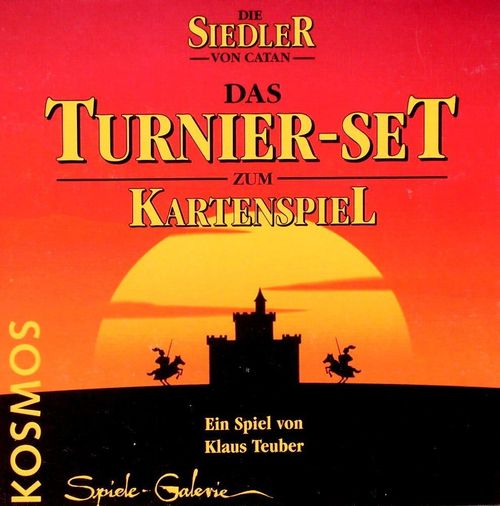
Die Siedler von Catan: Das Turnier-Set zum Kartenspiel
Die Siedler von Catan: Das Turnier-Set zum Kartenspiel Rulebook
Table of Contents
Table of Contents
Contents
- 60 cards (including 3 blanks)
- 1 victory flagpole and flag
- 1 sticker sheet
Building the Flagpole
Stick the two long strips on to the two sides of the pole, and insert the pole into the base.
4 flags can also be found on the sticker sheet, along with a blank on which your own design can be drawn. Select one and stick it to the plastic flag piece, folding it so that it can be stuck to both sides.
The other stickers on the sheet are to help you design your own cards using the blank stock.
Place the flag onto the pole from the top. Use the flag and flagpole to display your current victory point total.
Preparations
To play the game, each player will need a basic card game set and a copy of the expansion. In this game, you don't select cards from shared piles but instead have four piles of your own from which you make up your hand during the game. Each player compiles his own deck of cards from those available before the game starts. He can adopt his own strategy and can incorporate appropriate cards in his deck. Each player also influences the composition of the event card deck, selecting 4 cards for the pile.
The rules used with the basic set are maintained. Additions will be explained in the following pages.
Setup
Each player lays out his 9 start cards (from one basic set) as usual.
The event deck is created by both players.
Roads, villages, cities, land tile cards and event cards should be placed in piles between the two players.
Each player stands his flagpole on one of his villages. The flag should be at level 2.
Deck Creation
Both players should take the action and development cards out of separate card game and expansion sets.
Each player selects 33 cards and so creates his deck.
Choice of cards is the player's alone. He is limited only by cards available - he may not take an extra card from his opponent's sets.
Each player selects 3 of his 33 cards to form his hand.
Each player shuffles his remaining 30 cards and deals them face down to form 4 piles, 2 of 8 cards, and 2 of 7.
These piles are placed to the left or right of the player's display.
Creation of an Event Deck
Each player contributes a civil war and a plague card, (i.e. 2 cards each), and then 1 new year card is added.
Each player then chooses a further four event cards in secret.
The resultant deck of 13 cards should be shuffled and placed face down between the players' displays.
At the end of the game, each player should take back the cards he contributed to the deck. It is advisable to make a note of cards contributed.
Course of the Game
Additional Rules
With the exception of scout cards, action cards can first be played once both players have at least 3 victory points.
Buildings are safe from spies - only action and unit (knights and fleets) cards can be stolen from an opponent.
Note down stolen cards so they can be returned to their rightful owner at game end.
You are allowed to remove buildings or units from your principality to make room for more important cards. Such removal costs nothing. You have a choice as to whether to take the card back into your hand or discard it. You cannot however place a removed card at the bottom of one of your four piles.
Errata note (Franckh-Kosmos, see the last section): the sentence above allowing the removed card to be taken back into the hand is wrong. A removed card must be placed on the discard pile. Taking it back into the hand is possible only with the "Successful Year" dice result while a "Palace" lies in your own principality (see The New Cards in Detail, Palace). The German sheet also forbids placing a removed card under one of the four piles, which agrees with the sentence above.
If you remove a card from your principality which has previously allowed you to lay an additional card, (e.g. a library allows you to build a university), removal of the base card (i.e. the library), does not mean you have to remove the card that entitled you to play (i.e. the university).
Whoever exchanges a card at the end of his turn, must place his rejected card under the same pile from which he draws his replacement.
Each knight is unique! Any knight appearing in your opponent's layout cannot appear in yours at the same time. You can of course remove his card by playing a black knight card, and so facilitate the playing of your own copy of that particular knight.
End of the Game
As in the basic game, as soon as a player achieves 12 victory points the game ends.
Advanced Version
This version involves a longer preparation phase. Each player chooses one of the six listed characters and must incorporate the 10 prescribed cards into his deck. The additional 2 cards must form part of his layout from the start.
Preparations
The same game rules are followed, but players choose a character. There are two options:
- Both players throw a die and take an appropriate character (even if both players take on the same character).
- Both players write their wishes on paper in secret and then reveal them simultaneously.
Players add the prescribed cards to their start layouts and then assemble 31 card decks, 10 of which are also prescribed. Choice of cards is as described in the basic version. You may of course like to use the idea of your character to help your selections.
The New Cards in Detail
Watchtower
If your opponent plays a spy, throw the die. If you roll a 1 or 2, the spy has no effect. Your opponent must then discard his spy.
Great Wall
If your opponent plays a spy, throw the die. If you roll a 3, 4, 5 or 6, the spy has no effect and must be discarded.
Castle
Whenever you place a new knight or cannon in your principality, it will cost one resource less than stated. With two castles, such cards cost two resources less, making some of them free.
Customs Post
Each time a bumper harvest card appears, you will receive, as an addition, two gold resources - assuming you have the spare capacity.
Battle Fleet
If placed in your principality, you can destroy one of your opponent's fleets (of any type). You choose which fleet is destroyed. The destroyed fleet goes on your opponent's discard pile. A bumper harvest event card will also provide you with one gold. A battle fleet receives no extra trade points if a harbour is built.
Cannon
Can be built if you have a university. If the university is destroyed, you do not have to remove a cannon. A cannon is dealt with like a knight, with a few exceptions: a cannon can be attacked by a black knight and be protected by a herbalist. A castle reduces the cost of a cannon by one resource. A smithy provides a cannon with an extra strength point.
Exceptions: a Lady Imelda of the Castle has no effect on a cannon, and the Tournament Site does not provide the cannon with any tournament points.
Walther the Singer
This troubadour is a knight of a special type against which a black knight cannot be played. Walther has no strength points, but gains one if a smithy is in the principality.
8, 9, & 10. - 3 named knights to add to those in the basic set.
Tournament Site
Each knight receives an additional tournament point. A cannon receives nothing.
Fire Station
Protects all buildings against a fire raiser. The station itself cannot be set on fire either.
People's Hall
A town hall is a pre-requisite. Allows you to search through one of your 4 piles for free, but you must select a card from that pile. If you can draw 2 cards, they can come from the same pile or two different piles.
Palace
Allows you to take a card back from your discard pile instead of gaining a resource when a bumper harvest card appears. You can search through the discard pile, but if taking a card leads you to have too many cards in your hand, you must place one card beneath one of your four piles! You can take an action card, a destroyed fleet or knight seduced by Lady Imelda of the Castle.
Great Trade Fleet
Both resources to left and right can be traded at a 2 to 1 exchange rate. Combined with a harbour, the great trade fleet is worth 3 trade points.
Banking House
If you own the windmill, you can take two resources when the windmill appears on the die. You can choose both resources.
Cathedral
A monastery is a pre-requisite. Protects all fleets and knights against civil war.
University
A library or monastery is a pre-requisite. Enables you to build a building crane and a cannon, and to play certain action cards. If removed, cranes and cannons do not have to go as well.
Great Harbour
Doubles trade points of markets, trade accounts and professional traders.
Envoy's Residence
A town hall is a pre-requisite. Placed in opponent's principality, forcing him to show all cards in his hand each turn, and reducing his space for development. Opponent can destroy the residence with a fire raiser card, if he has no fire station present.
Building Crane
A university is a pre-requisite. Reduces costs of buildings by one resource, but does not reduce cost of cities. Loss of university does not necessitate loss of crane.
Attack
If you have the knight tile, take three of your opponent's buildings. Your opponent must take one of these back into his hand. If he owns less than three buildings, he loses all those available.
Border Conflict
Knight tile is a pre-requisite. Exchange one land card with your opponent. Important: you can only take from your opponent a land card of which he has two examples. If the taken tile was under the influence of a doubling card, the doubling card may well cease to be of benefit because it is land-type specific.
Printing
A university is a pre-requisite. You receive any two resources.
Three Field Economics
A university is a pre-requisite. Turn one of your wheat fields to 3. It is possible to spend wheat, then make the wheat back up to 3 by playing the card.
Spice Caravan
If you have the windmill tile, you can steal two resources from your opponent.
Land Reform
You can change over the positions of two of your land cards - numbers stay the same.
Lady Imelda of the Castle
What knight can resist her beauty? None! Your opponent must remove a knight of his choice and put it on his discard pile. The cannon is of course immune to her charms.
Inventor
A university is a pre-requisite. Turn one of your ore cards up to three, even if you have just spent ore.
Inquisition
A church or a monastery is a pre-requisite. Your opponent must shuffle cards in hand and his four draw piles together. He then forms 4 roughly equal piles again, and draws cards from the tops of them to re-form his hand.
31, 32, 33. - Blank cards for the competition.
NB: Send ideas for new cards using the blank cards and stickers to the Franckh-Kosmos company. A special set will be produced at the Essen fair containing competition winners' ideas.
Beginner Tournament Variant (Zusatzregel: Turnierspiel für Einsteiger)
Franckh-Kosmos supplementary sheet, "Das Siedler Kartenspiel - Zusatzregel: Turnierspiel für Einsteiger", transcribed from the scan of the German original and translated into English. The sheet's own heading is kept in the title above.
Components
60 cards, 1 victory flag.
Introduction
The beginner tournament game is played with a basic game and a Turnier-Set according to the rules of the basic game. Above all, you learn the meaning of the new cards.
The new and exciting aspect of the "real" tournament game is the possibility of putting together your own card selection and so competing against the selection of your fellow player. For this you need a fellow player who also owns a basic game and a Turnier-Set.
Setup of the Beginner Tournament Game
- From the cards of the Turnier-Set, take out the two city buildings "University" and all event cards (blue frame).
- To the event cards of the basic game, add one card "Überfall". The remaining event cards of the Turnier-Set and the 2 cards "Inquisition" (yellow frame) are not needed for the beginner version and are set aside.
Translator's note: the German sheet names this card "Überfall" and gives no English name for it. The name is kept as printed and the card is not identified against the English card list above.
- Set up the game according to the rules of the basic game. Build the playing area.
- The remaining cards of the Turnier-Set are shuffled and placed face down as about three equal draw piles next to the draw piles of the basic game.
- Then place the two "University" cards face up next to these draw piles.
- Before the first game, assemble the victory flag (see page 2 of the Regelheft).
- Set the victory flag to the value "2" and place it next to the "Windmill" and "Knight" pieces.
Course of Play
With a few exceptions, the rules of the basic game apply!
Rule Changes
- With the exception of the spy (scout), action cards may only be played once both players have at least 3 victory points.
- Buildings are safe from spies! A spy can therefore only steal action cards and units (knights and fleets) from an opponent.
- It is allowed to remove buildings or units from your principality (tear them down), e.g. to make room for more important cards. Removal costs nothing. The player must place the card he wants to remove on the discard pile! It is not allowed to take a "removed" card into the hand or to push it under one of the draw piles. The only way to get such a card back into the hand is the dice result "Erfolgreiches Jahr" (Successful Year) combined with a "Palace" lying in your own principality. A freed building site may be built on again in the same round, but does not have to be.
- Some cards in a principality have a condition attached. For example, you may build a university only if you have previously built a library or a monastery. If the condition card (library) has to be removed from a principality, the card linked to the condition (university) does not need to be removed.
- Whoever exchanges a card at the end of his turn must place the discarded card beneath the draw pile from which he draws his new card.
End of the Game
As in the basic game, the game ends as soon as a player reaches 12 victory points.
The exact meaning of the new cards can be looked up during play on pages 6 to 11 of the Regelheft (see "The New Cards in Detail" above).
The University
If a player has the necessary resources for building a university together, he may build this card in a city. He pays the resources, takes a university from the layout and places it like a normal city building above or below one of his cities.
Attention: each player may build only one university!
If a fire raiser is played against the university, the player does not take the card into his hand, but places it face up again next to the building cards. He may build the university again later, when he has the required resources.
The Victory Flag
At the start, the victory flag is set to the value "2" and placed next to the "Knight" and "Windmill" pieces. As soon as the first player has reached 3 victory points, he sets this on the victory flag and places the flag in front of himself. If he gains further victory points, he sets the flag to the respectively higher value.
Whenever a player achieves a higher victory point total than the current holder of the flag, this player receives the flag and sets his point total. With the flag you always have an overview of which player leads and what point total that player has.
Errata to the Regelheft
The sheet is headed "Attention: errata in the Regelheft!" and lists three corrections to the pages of this set's own Regelheft (the rulebook transcribed above; the page numbers refer to it):
- On page 4, under "Die Regeländerungen", at the fourth bulleted point, it says that the player may take a removed card back into his hand. This rule is wrong. The correct rule is that a removed card must be placed on the discard pile (see also the third bulleted point under "Die Regeländerungen" on this sheet).
- On page 5, under the character "Der Barbar" (The Barbarian), 2 Spy cards and 3 Fire Raiser cards are listed. This is wrong. The correct numbers are 3 Spy cards and 2 Fire Raiser cards.
- On page 5, under the character "Der Weise" (The Wise One), a "Troubadour" is named. This is the knight "Walther, der Sänger" (Walther the Singer).
The sheet's copyright line is not transcribed.