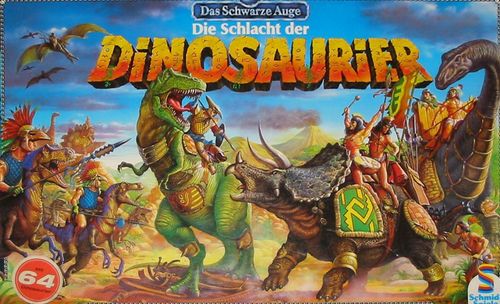
Die Schlacht der Dinosaurier
Die Schlacht der Dinosaurier Rulebook
Table of Contents
Table of Contents
- Game Contents
- 1. Assembling the Figures
- 2. Description of the Dinosaurs
- 3. Object of the Game
- 4. Setup
- 5. Course of the Game
- 6. The Action Cards
- 7. The Dinosaur Cards
- 8. Movement
- 9. Attack
- 10. The Course of a Battle
- 11. The Other Action Cards
- 12. Using Lava Chunks
- 13. The General
- 14. End of the Game
- 15. Two-Player Variant
- 16. Example of a Turn
Game Contents
- 1 game board
- 64 detailed dinosaur figures
- 84 riders in 4 different colours
- 1 volcano
- 14 lava chunks
- 4 combat dice
- 8 Pteranodon bases
- 12 banners in 4 different colours
- 61 action cards
- 4 combat cards
- 1 rulebook
1. Assembling the Figures
Only for the first game must the riders and banners be attached to the dinosaurs (see the figures in the original manual). Each dinosaur army consists of the following figures, with riders and banners in the same colour:
- 1 Plateosaurus with three riders and banner
- 1 General in a chariot drawn by two mounted Velociraptors
- 4 Velociraptors with rider and banner
- 2 Tyrannosaurus Rex with rider
- 3 Stegosaurus with rider
- 2 Pteranodons with rider
- 2 Triceratops with two riders and banner
2. Description of the Dinosaurs
For about 150 million years the dinosaurs ruled the earth. They managed to adapt to the climate changes that took place at that time. Humans find it hard to grasp the enormous span of time in which the dinosaurs dominated the world. But about 65 million years ago the domination of these animals came to an abrupt end and this successful animal species died out. The dinosaurs were the largest and most terrible animals that ever lived on earth. Some dinosaurs weighed more than a blue whale of 130 tons, while others were only as big as a chicken.
In this game the best-known dinosaurs come to life again. Dangerous meat-eaters and innocent plant-eaters will fight a last battle.
The Plateosaurus
This dinosaur is one of the largest of its kind. Even the wildest and most dangerous dinosaurs are discouraged by the size and determination of this colossal plant-eater and do not dare to attack this enormous animal. With a tremendous blow of his gigantic tail he defeats all his opponents. This mighty Plateosaurus can be regarded as the Goliath of the battlefield.
Tyrannosaurus Rex
Gigantic, powerful and dangerous, the T-Rex is rightly regarded as the king of the dinosaurs. This mighty meat-eater is often involved in fights. After a successful attack the T-Rex devours his opponent. In doing so he tears his victim open, so that the ground is strewn with body parts in a minimum of time.
General in Chariot
Courage and skill are needed to lead such a large and wild dinosaur band. The General is the right person for this heavy task. He is worshipped by his subordinates as a living God. In every battle he fights in the front line and achieves one triumph after another, which increases his prestige each time.
Velociraptor
Raptors are nasty robbers, who are fast, cunning and intelligent. They attack their prey unexpectedly. With a sudden and lightning-fast attack they outwit their victim every time. These agile robbers throw themselves on their prey in a wild frenzy and use both their pointed teeth and their razor-sharp claws.
Triceratops
This tremendously large and strong horned dinosaur is a dangerous opponent. Protected by his massive neck shield, he impales his enemies on his three horns. Moreover, this plant-eating dinosaur has a great deal of perseverance, so that many hostile and aggressive meat-eaters prefer to avoid him.
Stegosaurus
This corpulent plant-eater is an indomitable opponent. The double row of spiked plates on his back protect him against many mighty enemies. Moreover he defends himself by swinging his spiked tail powerfully.
Pteranodon
High in the air, searching for prey, this flying dinosaur surveys his territory. In a dive and with fully opened wings this flying dinosaur plunges lightning-fast onto his prey. Moreover, during his attack this animal screams so horribly that his prey is paralysed. The attack happens at lightning speed and with a powerful swing of his sharp claws he kills his victim. He holds his prey firmly in his claws and calmly flies on after this dive.
3. Object of the Game
Each player has a dinosaur army with which he will attack an enemy army. As soon as one (first) enemy army has been defeated, the game ends. The player who at that moment still has the most dinosaurs wins the game.
4. Setup
-
First the game board is laid open in the middle of the table. The volcano is placed in the centre of the board.
-
Each player takes 3 lava chunks. The remaining chunks are laid in the lava lake.
-
Each player receives a combat card and lays it face up in front of him. This card states with how many combat dice each dinosaur fights.
-
The action cards are shuffled well and each player receives 6 cards face down. The remaining cards are laid face down next to the board as a draw pile.
Because the action cards determine which dinosaurs will come into action, it is advisable to study the cards well and only then place the dinosaur army on the board. The cards dealt will influence the arrangement of the army.
-
Each player is assigned a dinosaur army. Each army has its own colour (recognisable by the riders and banners). Each dinosaur army consists of the following figures:
- 1 General in a chariot drawn by two mounted Velociraptors
- 1 Plateosaurus with three riders and banner
- 2 Tyrannosaurus Rex with rider
- 2 Triceratops with two riders and banner
- 2 Pteranodons with rider
- 3 Stegosaurus with rider
- 4 Velociraptors with rider and banner
The arrangement of the armies on the board depends on the number of participants (see figure in the original rules).
- With four players: the 4 corners.
- With three players: the two players on the same side in the corners, the other player in the middle on the opposite side.
- With two players there are two possibilities: lengthwise or crosswise arrangement, but always opposite each other.
5. Course of the Game
-
When it is his turn, a player must play three action cards one after the other. Each card is played separately. The actions of different cards are not carried out simultaneously. The worked-out example of a turn (further in the text) shows how the cards can be used.
Each player is obliged to play three cards during his turn. One cannot refrain from carrying out an action card. As soon as an army loses its general, the player concerned must play two cards.
-
During his turn the player may decide to use lava chunks.
-
The played cards are laid face up on a discard pile. Then the player draws new action cards from the face-down pile until he again has six cards in hand. When the face-down pile is exhausted, the discard pile is shuffled thoroughly and laid face down so that a new supply pile arises.
-
After taking the new action cards the player ends his turn and the next player, in clockwise direction, takes his turn.
6. The Action Cards
There are four different kinds of action cards:
- dinosaur cards
- joker cards
- lava chunk cards
- extinction cards
| Number of action cards | Numerical values of the cards |
|---|---|
| 5 x Plateosaurus | 5, 2, 2, 2, 1 |
| 6 x Tyrannosaurus Rex | 5, 5, 5, 5, 5, 2 |
| 6 x Triceratops | 10, 5, 5, 5, 2, 2 |
| 5 x Pteranodon | 10, 10, 10, 5, 5 |
| 7 x Stegosaurus | 10, 5, 5, 2, 2, 2, 2 |
| 8 x Velociraptor | 10, 10, 5, 5, 5, 5, 2, 2 |
| 13 x Joker | 10, 6, 6, 6, 6, 3, 3, 3, 3, 3, 3, 3, 3 |
| 6 x Extinction | not applicable |
| 5 x Lava chunks | not applicable |
7. The Dinosaur Cards
Each dinosaur card contains the following information:
- The name and the picture of a dinosaur
- A number (from 1 up to and including 10)
- One or more dice (= the number of combat dice one is entitled to in a battle)
-
On a dinosaur card is one of the following saurians: Plateosaurus, Stegosaurus, Tyrannosaurus Rex, Triceratops, Pteranodon and Velociraptor.
Remark: There is no card showing the General. Special rules apply to the General (see below).
-
Each dinosaur card played describes which dinosaur species comes into action. The player determines himself the order in which he moves his corresponding game figures.
-
An action card can have two different consequences:
- Movement: Each dinosaur of the depicted species may be moved at most as many squares as the number on the card.
- Attack: Attacking an enemy saurian on an adjacent square.
Attention: Each game figure may carry out only one of the two actions!
For example the Triceratops card - 2 dice - value 5. With this card a player may move one Triceratops 5 squares and carry out an attack with the other. Or the player may decide to move both figures without attacking, or to attack with both Triceratops and not move. It is even permitted to activate only one game figure (attack or move) and leave the other standing.
Attention: When a player plays a card, he must activate at least one saurian!
-
When a player plays a dinosaur card showing a game figure of which he no longer has any, he may choose to bring another dinosaur species into action. In fact this card then takes on the function of a joker card.
Attention: First the movements are carried out. Only afterwards are the attacks handled.
8. Movement
-
Game figures may only be moved vertically and horizontally on the board. Diagonal moves are forbidden.
-
The number on the dinosaur card indicates the maximum movement. Players are not obliged to carry out the maximum movement. One may leave part of the movement possibilities unused.
-
Game figures of one's own army can jump over own saurians (that square is counted as movement, though!). One may not move over enemy dinosaurs!
Exception: The Pteranodon may fly over enemy game figures.
-
The volcano cannot be entered by any game figure. In other words, no saurian can carry out movements over the volcano.
-
The movement of a game figure must end on an empty square.
9. Attack
-
Game figures may only carry out vertical or horizontal attacks on neighbouring enemy saurians. Diagonal attacks are forbidden.
-
The number of dice on the dinosaur card indicates with how many dice the attacker fights.
For example: A Tyrannosaurus Rex attacks with three dice.
10. The Course of a Battle
-
The attacker rolls first. This player then has the possibility (and only opportunity) to re-roll a number of dice. He determines how many dice he wishes to roll again. For each die that he rolls again he must however use one lava chunk (see further).
The attacker's combat result is obtained by adding the die result to the value of the dinosaur card.
-
Then the defender rolls. The number of dice he rolls depends on the dinosaur that was attacked (consult the combat card).
But the defender also has the possibility (and only opportunity) to re-roll a number of dice. He too must hand in one lava chunk for each die he rolls again.
The defender's combat result is equal to the die result.
A defender is thus at a disadvantage because he cannot count on the bonus of the dinosaur card.
-
The player with the highest combat result wins. The loser removes his game figure from the board. With an equal result both saurians remain on the board.
For example: A Tyrannosaurus Rex (with value 5) attacks an enemy Triceratops with three dice. The attacker rolls 0, 1 and 10. The player thinks the roll is too bad and decides to roll the dice with 0 and 1 again. This costs him two lava chunks. The new roll yields twice 2. The die result is then 10 + 2 + 2 = 14. The attacker's combat result is in this case 14 + 5 (value of the card) = 19.
The opponent rolls for the Triceratops with 2 dice (cf. the combat card) and gets 1 and 10. He too decides to use a lava chunk. He rolls the die again and gets a 15. His combat result is then 10 + 15 = 25. He thereby wins the battle and the Tyrannosaurus Rex is removed from the board.
-
When a player uses a dinosaur card as a joker (because he no longer has the stated dinosaur species), the stated number on the card does not apply. The player must in that case apply the value of the combat card.
11. The Other Action Cards
Joker Cards
With this card one may choose a dinosaur species to activate. The card is played as one would use a card of the species concerned.
Extinction Cards
In this game too the dinosaurs are threatened with extinction. When one plays this card, all saurians (including the saurians of the player who plays the card!) of the species on this card must roll once. On a 0 the saurian dies and is removed from the board. This card is best played when one no longer has this dinosaur species oneself.
For example: The Stegosaurus are threatened with extinction. A player still has two Stegosaurus. He indicates one game figure and rolls for this animal. He does not roll a 0 and so is lucky: the figure concerned remains standing. Then he rolls for his second Stegosaurus. This time he is less lucky and rolls a 0, and the affected game figure is removed.
Lava Chunk Cards
With these cards one can take used lava chunks from the lava lake at the foot of the volcano. Beginning with the player who played the card, each player in clockwise direction may take a lava chunk from the lake as long as there are still chunks in the lake. When this card is played when there are no lava chunks available in the lake, the card is simply laid on the discard pile. The card does count as one of the three cards played by the player.
12. Using Lava Chunks
-
All lava chunks used are thrown into the volcano. Quite a few chunks will end up in the lava lake via the volcano, while others remain trapped in the volcano. The lava chunks in the lake can later come into play again (by playing a lava card).
-
The number of lava chunks a player may have is unlimited. Moreover the players may use as many lava chunks as they consider necessary.
-
Ways of using them:
The use whereby one may re-roll a combat die by sacrificing a lava chunk has already been dealt with in detail.
The second use allows one, at the payment of one lava chunk, to play an action card just played a second time. When a player sacrifices a lava chunk in this way, the card just played (in the same turn and immediately after playing the card one wishes to play again) is played once more. The actions of these cards are then carried out once more.
For example: A player plays a Plateosaurus card and places his game figure next to an enemy dinosaur. Subsequently he uses a lava chunk in order to play the Plateosaurus card again. Subsequently he may move the Plateosaurus again or attack the enemy game figure.
-
Each action card may be "doubled" only once per turn.
13. The General
-
For moving the General the game contains no specific action cards. The General may however, as an extra, move or fight with each dinosaur or joker card played. The maximum movement is then the value of the card used. In battle the General always has 3 combat dice.
For example: A player plays a Stegosaurus card with value 5. The player may thereby move the General as well as the Stegosaurus up to 5 squares. Alternatively the General can enter a battle with an enemy saurian on a neighbouring square. He always attacks with 3 dice. The value of the card (in this case 5) is added to the die result in order to obtain the General's combat result.
Attention: The General always comes into action together with other dinosaurs. It is not permitted to let the General move or fight alone. In other words, with a card it is not permitted to let only the General carry out an action.
Attention: As a reminder! As soon as a player loses his General, he may use only 2 action cards per turn!
14. End of the Game
When a player has lost all his game figures, the game ends immediately. The player who at that moment still has the most dinosaurs in his army wins the game. Although the General's chariot is drawn by two Velociraptors, this game figure counts for only one dinosaur.
If two or more players have an equal number of figures, the fight must continue. At that moment fighting continues until one player gains the upper hand.
15. Two-Player Variant
When the game is played with two players, each player is assigned two dinosaur armies. When a player is then on turn, all his game figures (of both armies) of the dinosaur card played come into action. The other rules remain unchanged.
16. Example of a Turn
Two players (An and Marc) play the game and fight against each other.
An still has two lava chunks and has the following cards in hand:
- Stegosaurus - 5 - 1D6
- Plateosaurus - 2 - 3D6
- Velociraptor 10 - 1D6
- Tyrannosaurus Rex 5 - 3D6
- lava chunk card
- extinction card for the Velociraptor
Note: D6 = six-sided die
Because An still has her General, she must play three action cards.
The first action card
An plays the Tyrannosaurus Rex card. Because she no longer has a Tyrannosaurus Rex figure, she may use this card as a joker. She decides to use this card for the Triceratops figures. She first moves one figure four squares and ends the movement by placing it next to Marc's Plateosaurus. The second Triceratops stands next to Marc's Tyrannosaurus and attacks this figure.
For this attack An may (according to the combat card) roll two combat dice. She gets twice 10. The die result and the value of the card give a combat result of 10 + 10 + 5 = 25.
Marc's Tyrannosaurus Rex may defend itself with 3 combat dice. The die result yields a combat result of 10 + 10 + 2 = 22. This is not enough to win the battle. Therefore Marc uses a lava chunk to roll again. He gets a 10 instead of a 2. He thereby obtains a combat result of 30, so that he wins the battle. An's Triceratops loses the battle and is taken from the board.
The second action card
As her second card An plays a Velociraptor. She still has three game figures of this type on the board. She decides to move them all. She places two figures next to Marc's Tyrannosaurus Rex and one figure next to Marc's General.
Subsequently An sacrifices a lava chunk. This allows her to carry out the card just played a second time. Now she lets the three Velociraptors attack. Each game figure attacks with one combat die.
The first figure attacks the Tyrannosaurus Rex. An gets a die roll of 5, so she obtains a combat result of 5 + 10 = 15. Marc defends his figure with three dice and obtains a combat result of 15 + 1 + 5 = 21. He wins the battle, so An's Velociraptor is removed.
An's second Velociraptor now attacks the Tyrannosaurus Rex. An gets a roll of 10 and thereby obtains a combat result of 10 + 10 = 20. Marc defends his figure and obtains a combat result of 0 + 10 + 5 = 15. He finds this a bad result and sacrifices two lava chunks to roll the dice with 0 and 5 again. He achieves a better combat result of 10 + 10 + 5 = 25. He wins the battle again and An removes the second Velociraptor.
An's third Velociraptor now attacks Marc's General. She rolls a 2, so she obtains a combat result of 2 + 10 = 12. An finds this not enough and decides to use a lava chunk. She rolls again and rolls 5. The new combat result is now 5 + 10 = 15. Marc defends his General with three dice and achieves a combat result of 10 + 1 + 0 = 11. Because Marc has no lava chunks left, he cannot roll again. Marc's General is therefore defeated and the figure is taken from the board. Because Marc has lost his General, for the rest of the game he may use only 2 action cards each time it is his turn.
The third action card
As her last card An plays a lava chunk card because she has no lava chunks left. She is the first to take a lava chunk from the lava lake. Then Marc takes a lava chunk, after which An removes a lava chunk again, etc., until all lava chunks have been taken from the lake. In this way An obtains three lava chunks while Marc received only two.
The three action cards played are laid on the discard pile and An draws three new cards face down from the supply pile. Then it is Marc's turn.