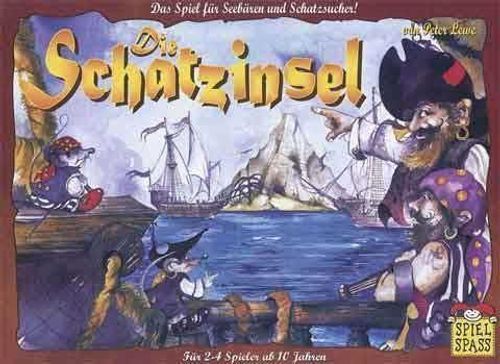
Die Schatzinsel
Die Schatzinsel Rulebook
Table of Contents
Table of Contents
Components
- 1 board
- 4 pirate ships as sight barriers
- 4 landing boats
- 9 treasure chests
- 10 coordinate stones
- 25 treasure map tiles
- 8 guards
- 1 game manual
Objective
Players receive points for placing map tiles, revealing buried treasures, guarding the treasure once discovered, and for ending the game. Points are noted by moving the landing boats on the score track.
The game ends when at least one player has used all of their map tiles, treasure chests, and guard pawns. Whoever is most advanced on the scoring track wins. The game can be played according to two different rules: those of the shady John Silver or those for the carefree Jim Hawkins. The game setup is same for both rules. The game is first explained according to the rules of John Silver.
Setup
- Place the board in the middle of the table. Each player gets a sight barrier which he constructs before himself, and a landing boat of the same color which is placed on the start spot of the scoring track.
- The map tiles are mixed face-down, and an arbitrary card is put face-up on an arbitrary field of the game board. The card is oriented so that the two numbers each point to one of the sides of the board with the holes. Based on this tile, the coordinate stones are populated onto each side. First place the number corresponding to the tile, then fill in the rest of the side using numbers one through five consecutively. "One" follows "Five", so use the arrows on the side to determine the order. For example, if the initial tile showed a "5" and it was placed on the center row for the side, the side's coordinates would be set at 3-4-5-1-2.
- Next, distribute the opening pieces based on the following table:
| Players | Map Tiles | Treasure Chests | Guards | Extra Guards |
|---|---|---|---|---|
| 2 | 5 | 4 | 1 | 1 |
| 3 | 3 | 3 | 1 | 2 |
| 4 | 2 | 2 | 1 | 3 |
Players put their treasure chests, map tiles and guards behind their sight screen. The remaining map tiles are placed face up next to the board, along with the specified number of extra guards. Guards and Chests that will not be needed are placed back into the box. It is best for each player to place the tiles behind their screens in the orientation that they will be placed on the board. It is also easiest if the face-up tiles are placed this way.
(a) John Silver's Rules
Playing the Game
The most bearded player begins. Players take turns clockwise.
Each player has one of the following possibilities during his turn:
- Take another map tile and place it behind their screen;
- Take another guard and place it behind their screen;
- Place a map tile or tiles on the board;
- Place Treasure Chests on the board;
- Place Guards on the board.
Each player must execute one of these possibilities. Passing is not allowed. The only exception is if there are no map tiles to be taken, and the player has only treasure chests or guards which cannot be legally placed. He proves this by removing his screen for all to confirm.
The Moves in Particular
Take Another Map Tile: The player takes one of the unassigned map tiles from beside the game board and places it behind their screen. It is helpful to take tiles that connect with tiles already behind the screen. As long as there are unassigned map tiles on display, the game cannot be finished.
Take Another Guard: The player takes one of the extra guards by the game board and places it behind their screen. Once the final extra guard is taken, this action is no longer available.
Place Map Tiles on the Board: On a player's turn, they can lay out one or more map tiles on the board. The tiles are always placed according to the coordinate stones. The first tile placed can be in any location. Other tiles played in the same turn must each orthogonally connect to the last tile placed. Placing tiles on the board causes an immediate scoring:
- A map tile which is placed touching no other tiles scores points equal to the total number of consecutive empty spaces in all directions orthogonal from the placed tile. The first example on page three of the German rules shows an example of this: the black squares represent previously-placed tiles and the dark grey square represents the tile being placed. This tile scores five points, one for each of the light-grey colored squares. Tiles placed this way will score from two to eight points.
- A map tile which is placed adjacent to a previously-placed tile scores one point for each of the connected tiles in all directions orthogonal to the placed tile, including one point for the tile placed. The second example on page three of the German rules shows an example of this: The grey tile is placed, and it scores six points.
The points are credited immediately after each tile is placed in a turn.
Place Treasure Chests: In a turn, a player can place one or more treasure chests. Treasure is only discovered on the tiles with a red "X", and only one treasure is placed per such tile. Placing treasure chests also scores points: Each chest scores one point for each chest on the board after its placement. So, the first chest placed scores one point, the next two, then three, etc. The points are scored immediately after placing each chest. Altogether there are eight positions on the completed treasure map for treasure chests, so treasure chests will score from one to eight points.
Place Guards: On a turn, a player can place one or more guards. Guards can only be set next to a treasure chest, and each chest can accommodate only a single guard. Placing guards scores points: the guard scores one point for each treasure chest and guard on the board after its placement. Guards will thus score between two and 16 points. Points are scored immediately after placing each guard.
Game End
The game ends when a player has nothing behind their screen at the beginning of their turn. It cannot end if there are any map tiles or extra guards still to be taken, since the player would have to choose one of these as his action. They remove their screen to show the others that the game has ended. This player scores seven points immediately for ending the game.
Winner
The winner is the player whose landing boat at the end of the game is furthest advanced on the score chart.
John Silver's Advice
Most map victory points are achieved by placing tiles early onto empty spots or late onto connected spots. Patient collecting and observing the behavior of the fellow players is necessary for the success.
(b) Jim Hawkins' Rules
Play follows the same as for John Silver's rules with the following differences:
- Each player takes one guard behind their screen at the beginning, then place extra guards by the game board equal to the number of players.
- Each player can execute any or all of the possibilities on each turn.