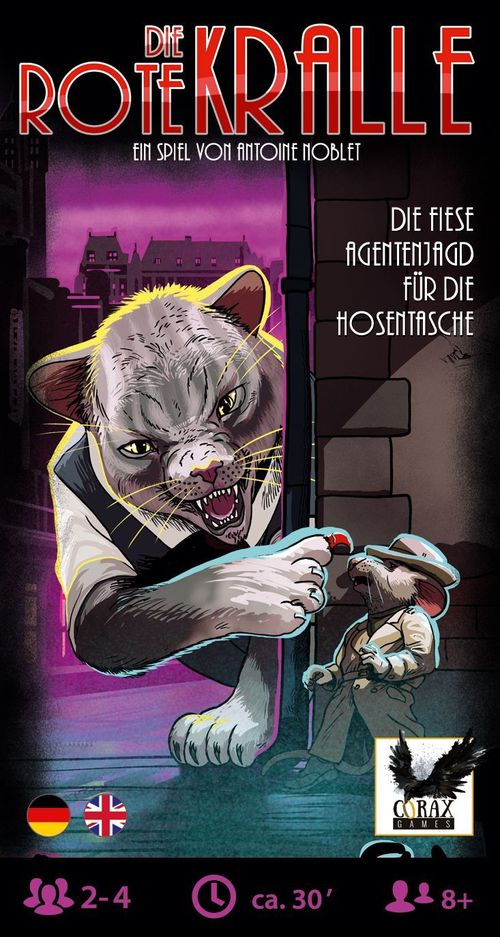
Die rote Kralle
Die rote Kralle Rulebook
Table of Contents
Table of Contents
Contents
- 56 hunt cards, 14 per color
- 40 incrimination tokens
- 10 capture row cards
- 1 "Red Claw" cat figure
- 4 mouse player figures (white, black, gray, and brown)
Hunt cards show an escape symbol, a hunt symbol and a value; incrimination tokens show their incrimination level.
Setup
Lay the 10 capture row cards out on the table in numerical order and place each player's mouse figure next to the "1" card. Divide the hunt cards by color, shuffle each separately, and then randomly deal 7 cards of each color into 4 rows as pictured. The remaining cards form discard piles (one for each color). Randomly draw 8 incrimination tokens (you can shake them in the closed box to mix them), and lay 2 out next to each color row as pictured. If two identical tokens are drawn for a row, redraw until each row has 2 unique tokens. Draw the top two hunt cards from each color's discard pile. If any cards with value 12 or 13 are drawn, randomly trade them for other cards of the same color. Shuffle these 8 cards together, deal 2 to each player, and return the rest to the discard piles. Players lay their cards out face up in front of them (visible to all players).
Setup picture: the Red Claw cat figure; the hunt card rows (face up), each ending with its last card next to its first and second incrimination tokens; the discard piles (face up); the capture row with the player figures; players 1-4 around the table.
Gameplay
The most suspicious player begins, with play continuing clockwise.
Play a Hunt Card
The active player selects one of their hunt cards, and plays it to the matching discard pile. The chosen card will determine how many cards the player must take from the card rows, and from which row the cards will be taken. For each escape symbol on the chosen card, the player must take the last card from the hunt card row matching the color and escape symbol played. For each "?" symbol, the player may choose the row themselves. For each red claw symbol, the next player in turn order selects the color row. Cards are taken from the end of the rows, and placed face up in front of the active player.
Special Case
If the active player has only 1 hunt card remaining, they may choose to skip their card play and instead complete their turn as if they had played a card with 1 red claw symbol. (No card is played, but they must take 1 card from the end of a row of the next player's choice.)
If the active player has no cards to play, they instead take one card from the end of the longest row (active player chooses in case of tie), and an additional card of a different color from the top of one of the discard piles. This player then takes the Red Claw figure, and immediately moves their player marker up 1 card on the capture row (see "Incrimination" below). If the token was taken from another player, this player moves their marker back 1 space.
If a hunt card with 2 of the same symbol is played when the matching color row has only 1 card remaining, the player is only required to take the 1 card.
Hunt Resolution
When a color row becomes empty, the Red Claw discovers incriminating evidence against the agents. The player with the most hunt cards of this color must discard all the matching cards, and take the first incrimination token (they may not choose a different one). Next, the second token is assigned in the same way to the player with the next most cards of that color. If no other player has cards of this color, the second incrimination token is not assigned. In case of a tie, the token is given to the player with the highest numbered matching card. All other players who have cards of this color keep them and do not take an incrimination token. After resolving an empty color row, shuffle that color's discard pile and rebuild the row as it was at the beginning of the game. Randomly draw and replace the missing incrimination tokens at the end of the row. Remember that there may not be 2 identical tokens in the same row.
Finally, all players move their markers on the capture row to reflect their new incrimination total.
Incrimination
- 1, 2, 3: Number of incrimination points against the player.
- Wrong Track: Cancels a single incrimination point token of the identical value. The other token is still kept, but its value is not counted against the player (their figure is moved backwards on the capture row).
- Fake Evidence: This token is immediately given to an opponent. That player must advance their figure 1 additional space on the capture row.
If at the end of a turn any player has 10 or more incrimination points on the track, the game ends immediately. The player with the most incrimination points is caught by the Red Claw and loses. The player with the fewest incrimination points wins the game and gains the title of Super Agent. In case of a tie, the tied player with the fewest incrimination tokens wins.
Capture Row
As the incriminating evidence against an agent rises, so does their focus and adrenaline – granting them additional skills. Before playing a hunt card, the active player may perform exactly one of the purple card abilities on the capture row which is at or below their incrimination level. Green card abilities are passive and are always in effect after a player meets or exceeds the appropriate incrimination level.
The descriptions of all the abilities can be found on the capture row cards.
Ability Notes
- 2. When playing a 13 (2 x "?"), both cards must still be taken from the same color row as usual.
- 6. Other players must still be able to see the number of cards you have remaining.
- 7. If the player has only 1 card of a color and decides to ignore it, they are treated as though they had no cards of that color (can not receive an incrimination token and keep the card).
Background
The Red Claw was inspired by real life events: In 1979, Werner Stiller pulled off perhaps the most spectacular counter-intelligence coup of the Cold War. An official with the East German intelligence agency known as the Stasi, Stiller used forged papers and fled to West Germany. He took with him numerous incriminating documents, which unmasked many undercover Stasi agents. The agents were forced to desperately flee the West in an attempt to avoid capture.