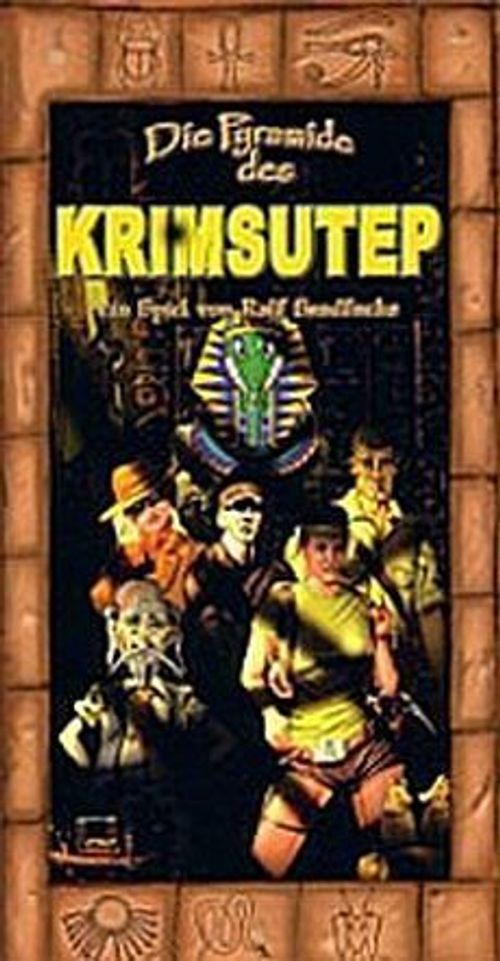
Die Pyramide des Krimsutep
Die Pyramide des Krimsutep Rulebook
Table of Contents
Table of Contents
Contents
Included for play of the game:
- 110 cards:
- 1 base camp
- 15 path cards with bright backs
- 20 path cards with dark backs
- 1 grave chamber
- 5 canopic jar cards
- 5 treasure cards
- 40 excavation cards
- 5 researcher cards
- 5 rules cards
- 5 cards with researcher pawns
- 1 card with mummy pawn
- 5 Ankh indicator cards
- 1 card with building instructions for the pawns
- 1 card with additional information
- rules page
Preparation
1. The pyramid is built
- The base camp is placed face up on the table.
- Then the bright-backed path cards are shuffled. Five cards are placed face down extending out to the right of the base camp, the line above that will be four cards, then three, two, one. That way a triangle with an edge length of five cards is created (see also following diagram).
- For each participating player one canopic jar and a treasure with the same god symbol is taken from each stack. (The remaining canopic jars and treasures are put aside, they are no longer needed in the is game.)
- For each canopic jar, one dark-backed path card with the same god symbol is removed from the deck and replaced by said canopic jar card. The removed path cards are placed face down in a line near the pyramid, beside them the face up treaure with the same god symbol. The places where the cards are to be placed are marked by "D" (dark cards) and "S" ("Schatz" or treasures).
- The deck of dark-backed cards just created is shuffled. Afterwards these cards are laid out so that together with the cards already laid out a six by six square is created, which is finally locked by the grave chamber.
- The excavation cards are shuffled to form a deck. The uppermost card is turned over and placed beside the drawing stack to form the beginning of the discard stack.
- Finally, the mummy is placed in the grave chamber and the pyramid of Krimsutep is ready for play.
The accompanying diagram shows the structure of the completed pyramid.
2. Deployment of the researchers
Each player selects a researcher card and receives the corresponding pawn as well as an Ankh arrow. The Ankh arrow is placed beside the researcher card so that the point of the arrow indicates the "0" of the Ankh counter. All players place their pawn on the base camp. Each player receives four excavation cards in hand. The player whose face will soonest resemble that of a mummy begins play.
The Game
1. The excavation begins!
The researchers successively enter the pyramid looking for the canopic jars of Krimsutep. Along the way researchers find magic Ankhs which make it possible to influence the paths of the labyrinth. As soon as the first canopic jar is discovered, the mummy of the Pharaoh is recalled to life and goes on the hunt for the intruders. The researchers must get the discovered jars out of the pyramid and then search for the actual treasures. Whom manages to get a canopic jar and then a treasure from the pyramid wins the game.
2. The course of a turn
- The players take their turns one after another.
- In each turn the player can move through the pyramid.
- In addition he can play as many as excavation cards as desired, in order to carry out the special features of any one symbol illustrated on them. A player can never use more than one symbol from any given card.
- Additionally, a player may use as many Ankhs as are available to him by combining the Ankh counter on his researcher card with the Ankh symbols on the excavation cards he has played.
- At the end of his turn he can draw up to two excavation cards from the deck. A player may discard an excavation card before drawing. By use of Ankhs he can draw an additional excavation card. However, at no time may he hold more than five excavation cards in hand.
- If the excavation cards are ever depleted, the discard deck is shuffled and used to form a new deck.
3. Researcher Movement
Each excavation card shows three different symbols. Among them is always at least one symbol of the five main Egyptian gods: Anubis, Bastet, Horus, Osiris and Sobek. The path cards show likewise these symbols, normally the same on front and back.
Five points of movement are at the player's disposal. The cost for each step depends upon the square the researcher wants to move to:
- Stepping onto a path card lying face open costs one point, stepping on a card lying face down costs two points.
- An open card can be entered from any direction, but must be left using one of the depicted paths. Diagonal moves are not allowed.
In order to move, the player must play an excavation card and choose one of the god symbols illustrated on it. His movement must end on a space which likewise shows this symbol. The move must be possible according to the rules and it must be possible to reach the target square with the available movement points.
The researcher pawn now follows his path, adhering to the following rules:
- The chosen path must not be changed.
- A researcher may not stop out of his own volition; he has to follow the chosen path as long as it is possible.
- When a researcher comes to a point when he can no longer walk the chosen path (for example after he has uncovered a card which shows a different path than he has chosen), he must stay where he is; any remaining movement points are lost.
- It is up to the player whether he wants to reveal a card he is stepping on or leave it face down. If a researcher wants to turn a path card face up during his turn, it counts as an open card in terms of his movement, but he must live with the paths that are shown on it, even if that means he has to stop on that card.
- A card is turned over by taking it by the edge with the god symbol and then turning it over in one move, with out looking at it or turning it. By turning over the card the researcher steps onto it and is not allowed to turn it by using Ankhs.
- A card may not be turned over if a pawn is standing on it.
- There can be as many pawns on one card as desired.
- A card cannot be stepped upon if the mummy is standing on it.
- No researcher is allowed to enter the grave chamber.
- The base camp always counts as an open square; it can be entered using any god symbol.
- If a pawn leaves the pyramid cards without stepping onto the base camp it is placed in the base camp at once. However, any canopic jar or treasure in his backpack is lost immediately.
- Moving onto the base camp, onto a canopic jar or a treasure ends the move at once.
- A player can forfeit part or the whole of his movement if he likes.
4. A Canopic Jar is Discovered
In Krimsutep's pyramid are hidden as many canopic jars as there are participating players. When they are uncovered, they are considered found by the researchers.
- In order to pick up a canopic jar, it must lie face up or be revealed by a researcher during his turn.
- If a researcher turns up a canopic jar, he can pick it up and place it (face up) in his backpack (i.e. the area left of his researcher card).
- A canopic jar with a pawn on it cannot be picked up.
- A researcher does not have to pick up a canopic jar which he steps upon.
If a player picks up a canopic jar, he takes the path card with the same god symbol from its place beside the game board and places it face down (without first examining its front side) on the vacated pyramid space. The researcher pawn is placed on this face down card.
5. The Pharaoh Awakes
As soon as the first canopic jar is discovered, Krimsutep's mummy leaves the grave chamber. The player who revealed the canopic jar places the mummy pawn on one of the spaces adjoining the grave chamber. From now on each player whose pawn is at some point during its turn in a square diagonal to the mummy's can move the mummy one or two spaces; however, there must not be any other researcher in his "line of sight".
The accompanying diagram shows, on which spaces (darkly-colored) a pawn must stand to be allowed to move the mummy (indicated by the white "M"). The black square represents the grave chamber.
Additional rules are:
- A player may move the mummy at most once per turn, even if he is more than once in an appropriate position.
- A player is not required to move the mummy.
- The mummy cannot be moved from the base camp.
- The mummy may move over open and face down cards as it likes; in the case of open squares it may ignore the paths shown and leave it in any direction.
- The mummy never moves diagonally.
- It ignores the effects of secret chambers and pitfalls.
- The player, who moves the mummy, decides whether or not it applies the effects of a ramp or a king's pyramid or not. (These special path cards are described later.)
- The mummy may never move to the base camp and is not allowed to leave the pyramid. It also must never move to the square beside the base camp.
6. The Mummy Attacks
When the mummy is moved onto a space containing a researcher, the mummy attacks.
- The player must immediately flip over his researcher card; he loses all of Ankhs he has collected, the same for canopic jars and/or a treasure from the backpack.
- The player who moved the mummy to the researcher's space afterwards displaces the affected researcher three spaces in any direction. The researcher may not end up on an open canopic jar or treasure because of that move.
- The mummy remains in the spacee where it attacked the researcher.
- An attacked researcher first turns his researcher card face up on his next turn and resets the Ankh arrow at zero; he may not perform any further actions on this turn!
- No player may move his pawn onto the mummy's space, and no player may move the mummy onto his space.
7. A Canopic Jar Is Placed Anew
There are several reasons why a canopic jar or a treasure must be placed face down again:
- A researcher has picked up a second canopic jar (for example, via a gun attack; see below); a researcher can carry only one canopic jar.
- The mummy attacks the researcher.
- The researcher uses a ramp or a king's pyramid with a canopic jar or a treasure in the backpack.
- The reasercher leaves the pyramid with a canopic jar or a treasure in his backpack.
The card to be put down is passed on to the next player. He takes the path card of his choice which shows the same god symbol as the card to be put down and places it face down with the path cards beside the display. This must be a path card not occupied by a pawn. The card to be placed down is placed face up in the open space.
A canopic jar is placed just like a treasure and must be placed within the range of the display formed by cards having dark backs.
8. A Treasure Emerges
A canopic jar which has been picked up must be brought to the base camp; if a researcher succeeds in doing this, he takes the card from the backpack and puts it into his camp (below the researcher card). Then, he brings the treasure with the same god symbol as the canopic jar into play. For this purpose he takes any face down card from the pyramid which bears the same god symbol as the treasure and places it beside the pyramid in the same space where the treasure was taken from. Additionally each player picks up one face down path card with the same god symbol from the pyramid. (With two players, every player draws two cards.) If there are insufficient cards face down cards, then face up cards bearing this symbol or cards with different symbols may also be picked up. The rule that no card containing a pawn can be picked up also applies here. Also, light-backed cards may not be picked up.
The cards are shuffled and placed face down (without examining them) on the vacant spaces in the display.
Every researcher arriving at the base camp with a canopic jar brings another treasure into play.
Treasures follow all the rules for canopic jars, with one exception: each researcher can uncover a treasure; however, only a researcher already having a canopic jar in his camp can also pick up the treasure then.
End of Play
The game ends as soon as a researcher brings a treasure into the base camp. This player wins the game and may immediately call himself "Conqueror of the pyramid of Krimsutep".
If they wish, the other players may continue to determine the runners-up, until there is opnly one researcher remaining in the pyramid.
The Ankhs
How does one earn Ankhs?
- Ankh symbols can be found on various path cards. If a researcher turns up or walks over such a card, he increases his Ankh counter by 1.
- By playing an excavation card containing an Ankh symbol the researcher can likewise increase the Ankh counter by 1 (he can play this card in addition, only then, if he really wants to use the Ankhs).
A researcher can have at most nine Ankhs at any time (Ankhs on unplayed excavation cards do not count against this limit).
When can Ankhs be used?
In a turn, each player can perform one or more actions, for which he can use the special power of his Ankhs. Certain actions are possible even outside of the player's own turn.
What can be done with Ankhs?
Ankhs can be used for various special actions:
- For 1 Ankh one can...
- reveal a face down path card
- turn a face up path card face down
- receive an additional movement point (usable only once per turn, not cumulatively)
- at the end of the turn draw an additional excavation card (only once per turn, not cumulatively)
- For 2 Ankhs one can...
- turn a face up path card by 90°
- move the mummy one space in one's own turn, even if the researcher pawn is not on the appropriate position
- immediately exit from a secret chamber (see below)
- ignore the effect of a ramp (see below)
- For 3 Ankhs one can...
- exchange two light- or dark-backed path cards
- turn a face up path card by 180°
- move the mummy one space during another player's turn, even if none of the researchers are in the appropriate position
- escape the effect of a pitfall or a king's pyramid (see below)
If you want to gain a sixth movement point
- You can do so before or during your movement.
- If the player has six movement points before his move, he can plan his move accordingly.
- During your move you can get an additional movement point, but just to "save" a chosen path not to change or prolong it.
Rules for exchanging path cards
- If you want to exchange path cards, open cards remain open, face down cards remain face down.
- Light- and dark-backed cards may not be exchanged with one another!
- Path cards beside the pyramid may not be used!
- Cards with a researcher or mummy on them may not be rotated, flipped or exchanged.
The Excavation Cards
Each excavation card shows - as previously mentioned up to three different symbols. In addition to the gods already mentioned there are still the following symbols:.
Ankh
This symbol can be used like a collected Ankh or played out, in order to increase the Ankh counter of the player by one.
Eyeglasses
A researcher who plays eyeglasses may look under any one covered path card without permitting another researcher to see the card. He must then place the card face down again in the same place. The position of the god symbol on the card may not be changed.
Torch
As soon as a mummy wants to make the last step to reach the researcher, he can play this symbol, and the mummy may not enter his space; it remains in the space where it is. The torch burns until the researcher makes his next turn; therefore, an open torch is dicarded at the beginning of player's next turn.
Secret Passage
A researcher who plays this symbol, can leave a face up path card in any direction, even if no path is pointing in this direction. A Secret Passage must be played in advance if a player needs it to walk his chosen path. It may also be played when a bad path card was flipped over during the player's turn.
This symbol also helps in immediately finding the way out of a secret chamber.
Gun Jam
If a researcher is attacked with a gun, he can defend himself with a Gun Jam; both cards are immediately discarded.
Revolver
If a researcher plays the gun on a researcher in the same space and this researcher is carrying a treasure or canopic jar in his backpack, he can relieve the researcher of this burden and take it on himself. Canopic jars from the camp may not be taken.
Such an attack can always take place if two researchers are on the same space, even outside of one's own turn.
If the researcher steals a treasure, but still lacks a canopic jar in his camp, then the treasure is re-placed according to the rules above.
The attacked researcher can defend himself using a Gun Jam.
Shovel
A researcher who plays this symbol can turn a path card face up or face down without spending any movement points or Ankhs.
Special Path Cards
There are some path cards with special characteristics. A researcher experiences the effect of these cards even if he flips the card open during his turn.
Pitfall
A researcher who enters this card falls into a camouflaged pit; in order to work himself out again requires he loses his entire next turn. To symbolize this, the researchers pawn is placed flat on the card; on his next turn he only sets the pawn upright again and cannot perform any movement (other actions are permitted however). A researcher in a pit cannot be attacked by the mummy. If desired a researcher can pass on freeing himself (for example, to evade the mummy).
Secret Chamber
This path card apparently has no exit. A researcher who steps onto an open secret chamber terminates his turn immediately. At the start of his next turn he can leave the secret chamber in any direction.
King's Pyramid
A King's Pyramid transports a researcher within seconds from one part of the pyramid to another. However, any canopic jar or treasure the researcher was carrying in his backpack is lost and will have to be placed anew.
There are three king's pyramids in the game. How these behave depends on how many of them are revealed:
- If only one king pyramid is revealed, then each researcher who enters the appropriate space is transported to the base camp; his turn ends there.
- If two or three king pyramids are revealed, then the researcher, who enters a face up king's pyramid may decide whether he wants to be transported on another face up pyramid space or to the base camp.
Ramp
If a researcher enters a face up ramp, he immediately slips a space, as if he made a further step in the same direction. Any canopic jar or treasure the researcher was carrying is lost and will have to be placed anew.
Buried Path
This card shows a god symbol on both the front and the back. Thus it always follows all rules for face down cards.