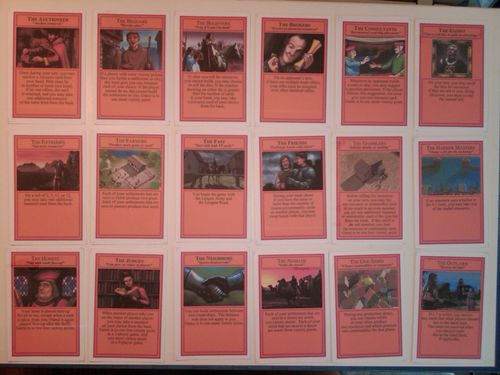
Die Pioniere (fan expansion for The Settlers of Catan)
Die Pioniere (fan expansion for The Settlers of Catan) Rulebook
Table of Contents
Table of Contents
- Setup
- Pioneers Cards
- The Auctioneer
- The Beggars
- The Believers
- The Brokers
- The Consultants
- The Egoist
- The Extremes
- The Farmers
- The Fast
- The Friends
- The Gamblers
- The Harbor Masters
- The Honest
- The Judges
- The Neighbors
- The Nomads
- The One-Sided
- The Outlaws
- The Peacekeepers
- The Poor
- The Port Managers
- The Researchers
- The Rich
- The Road Builders
- The Sailors
- The Shepherds
- The Shipyard Workers
- The Teamsters
- The Townsfolk
- The Traders
- The Traffic Planners
- The Transporters
Setup
Each player is given three random "Pioneers" cards before the game begins and chooses one to keep. The effects of the chosen card last throughout the entire game for the particular player who chose the card.
The Pioneers card a player chooses can be a two-edged sword. The card can be anything from "The Sailors", where the player is only able to build ships but victory is 2 victory points less than the game's usual number, to being able to control your opponents for a cost. "The Beggars" can extort a resource of their choice from any player who wishes to build a settlement or city; if the builder refuses (or can't) pay the owner of "The Beggars", the builder cannot build the settlement or city. In exchange for this power, "The Beggars" victory is 1 point more than usual.
Pioneers Cards
The 32 cards are listed in alphabetical order by title. Each entry gives the card's title, its printed subtitle in quotation marks, and its printed effect text. A card marked "(Seafarers required)" needs the Seafarers expansion; a card marked "(Cities & Knights required)" needs the Cities & Knights expansion.
The Auctioneer
"Auction resources"
Once during your turn, you may auction a resource card from your hand. Bids must be in number of cards (not kind). If no one offers, the card is returned and you may take one additional resource of the same kind from the bank.
The Beggars
"Receive alms"
If a player with more victory points than you builds a settlement or city, they must give you one resource card of your choice. If the player cannot do so, they cannot build the settlement or city. Game is to one more victory point.
The Believers
"Pray if it can't be built"
If, after you roll for resources, you cannot build, you may choose to roll the dice. If the number showing on either die is greater than the number of cards in your hand, you may take a resource card of your choice from the bank.
The Brokers
"Receive preferential treatment"
On an opponent's turn, if there are multiple trade offers, your offer must be accepted over other identical offers.
The Consultants
"Recommend road/ship placement"
Whenever an opponent builds a road or ship, you may suggest a possible placement. If the player follows the suggestions, they must give you one resource card. Game is to one more victory point.
The Egoist
"Can re-roll the dice to gain an advantage"
On your turn, you may reroll the dice for resources if they are not to your liking. However, you must accept the second roll.
The Extremes
"Get more resources"
On a roll of 2, 3, 11 or 12, you may take one additional resource from the bank.
The Farmers
"Produce more grain or wool"
Each of your settlements that are next to a field produce two grain. Each of your settlements next to a pasture produce two wool.
The Fast
"Start with both VP cards"
You begin the game with the Largest Army and the Longest Road.
The Friends
"Exchange hands with others"
During your trade phase, if you have the same or more than the number of resource/commodity cards as another player, you may swap hands with that player.
The Gamblers
"Roll for double or nothing"
Before rolling for resources on your turn, you may bet one resource or commodity card. If the result is an even number, you get an additional card of the type you bet from the bank. If the result is an odd number, you lose the resource or commodity card. Game is to one less victory point.
The Harbor Masters
"Charge a fee for the exchange"
If an opponent uses a harbor or the 4:1 trade, you may take one of the traded resources.
The Honest
"Play with cards face-up"
Your hand is placed face up for all to see, except when a card is taken from you (hand is again placed face-up after the theft). Game is to two less victory points.
The Judges
"Can pass special abilities to other players"
A player may ask you to use another players special ability for one turn. If you agree, you may select a resource of your choice from the bank. Game is to one less victory point in a 3-player game and one more victory point in a 6-player game.
The Neighbors
"Ignore distance rule"
You can build settlements between two roads/ships. The distance rule does not apply to you. Game is to one more victory point.
The Nomads
"Settle the desert"
Each of your settlements that are next to a desert are worth two victory points. Each of your cities that are next to a desert are worth three victory points.
The One-Sided
"Choose commodities or resources"
During any production phase, you can choose which of your cities produce two standard resources and which produce two commodities for that phase.
(Cities & Knights required)
The Outlaws
"Receive the loot"
If a 7 is rolled, you receive any cards that other players discard due to the hand limit. The cards are received after you discard cards due to the hand limit, if applicable.
The Peacekeepers
"Serve and protect"
Players may not steal resources from you with the robber or pirate. Your ships may be built next to, moved away from or moved next to the pirate.
The Poor
"Receive welfare"
If, on a roll of any number other than 7, you produce no resources, you may take a resource card of your choice from the bank. Game is to one more victory point in 3-player and 4-player games, and to two more victory points in 5-player and 6-player games.
The Port Managers
"Use ports during any trade phase"
You may use harbors on your opponent's turns. Game is to one more victory point in 5-player and 6-player games.
The Researchers
"Direct Development and Progress Programs"
When you draw a Development or Progress Card, draw three cards instead of one. Choose one card to keep and place the other two at the bottom of their piles.
The Rich
"Increase hand limit"
Your hand limit is increased to 10 cards. Game is to one less victory point in 5-player and 6-player games.
The Road Builders
"Get the longest road easier"
For you, the Longest Road consists of the number of connected roads in a network (does not have to be in a line), ignoring opposing settlements, cities, and knights.
The Sailors
"Build no roads"
You may not build roads. Game is to two less victory points.
(Seafarers required)
The Shepherds
"Will trade for wool"
During your trade phase, wool may be traded 2:1.
The Shipyard Workers
"Build ships easier"
You may build ships with two wool resource cards or two wood resource cards.
(Seafarers required)
The Teamsters
"Build roads/ships parallel to each other"
You may build roads or ships where other players have placed roads or ships. Other players may build roads or ships where you have placed roads or ships. You may also build past opposing settlements, cities and knights.
The Townsfolk
"Produce more in cities"
Each of your cities produces three resources (two resources and one commodity where applicable). Game is to one more victory point.
The Traders
"Force resource/commodity trade"
Once per turn, you may trade one resource/commodity card in your hand for one of an opponent's resource/commodity card in their hand (of their choosing).
The Traffic Planners
"Place roads/ships later"
You may defer the placement of any built roads and ships to a later turn.
The Transporters
"Support player trade"
On a trade between any two players, you may take one resource or commodity card of the type(s) being traded from the bank. Game is to one less victory point in a 3-player game, one more victory point in a 5-player game, and two more victory points in a 6-player game.