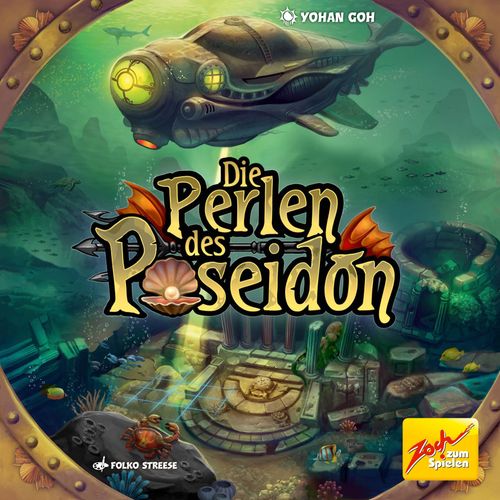
Die Perlen des Poseidon
Die Perlen des Poseidon Rulebook
Table of Contents
Table of Contents
The Object of the Game
In turn, players stamp so that the outlines of 4 objects become visible. As soon as you recognize an object, you look at the treasure maps to figure out where the corresponding pearl is hiding. Each of you wants to be the first to discover it and to name it after the object next to which it was found. The player who is particularly resourceful in detecting pearls and names will be rewarded with the most Poseidon coins and win the game.
The Contents
- 1 Nautograph (frame with a "view" of Poseidon's Rift)
- 36 stencils – you will need only one of them per game!
- 60 stamp grids (on a tear-off pad) – you will need only one of them per game!
- 2 cover sheets
- 2 treasure maps
- 48 name cards
- 1 stamp stick
- 1 stamp pad
- 32 Poseidon coins (values 1 and 3)
- 8 pearls
The Set-Up
- Put the Nautograph in the middle of the table.
- Place one stencil – unseen and completely covered by a stamp grid – inside the frame.
- ATTENTION: To do so, follow the instructions of the two (identical) cover sheets precisely. Be especially careful never to look under the cover sheets and the stamp grid, in order that the stencil you are using remains unseen and secret until the end of the game.
- Keep all remaining stencils – hidden under the two cover sheets – in the box. Plus, put the tear-off pad with the remaining stamp grids back in there as well.
- Everybody takes the 12 name cards with his chosen color on the back, face down.
- Lay out both treasure maps, well visible to all players.
- Put the pearls and the Poseidon coins within reach as a supply.
- Hand the stamp stick and the stamp pad to the player who has lifted the secret of this game – i.e., opened the box. He begins the game.
Tips:
- Stamps that have not been used for quite a while can sometimes dry out and then initially release (too) little ink. In this case, moisten the stamp pad with a bit of water or ink before you start playing – and it will work again … Try to stamp on a piece of scrap paper and just keep doing so until the ink applies well.
- The stamp consists of wood. Once you have started using it, it will color by itself and always have a smooth surface that is perfectly "prepared" for stamping.
- In order to avoid getting dirty unnecessarily, you should always stamp with the same side and use only the surface on the opposite side of the stamp stick for holding the stamp.
- Press the stamp stick firmly. This is the best way to make the outlines of hidden objects visible. But don't use the stamp pad with too much force; otherwise, the material will wear out.
Poseidon's Rift
On the stencil you play with, 4 pearls are hidden in Poseidon's Rift. Poseidon has hidden each pearl next to an object and named the pearl after this object.
Each stencil shows 4 objects and 4 pearls (circles). The objects can be arranged there in any way.
Each treasure map shows all 12 existing objects – each of them mirroring the other treasure map. On every dive, you will come across 4 of these objects in Poseidon's Rift. Which 4? Figure it out!
Example: This is how you see the Lukaros amulet on treasure map A – and on treasure map B, you see the mirror image. If you find the amulet in Poseidon's Rift later on, it will appear there in one of these two views. It can be positioned there "somehow turned around."
A pearl is depicted next to each object. Its position tells you where exactly this pearl lies next to "its" object (in the rift). It bears the name of this object.
Example: If the Lukaros amulet – as shown here – is lying in Poseidon's Rift, "its" pearl is located to the left of it – exactly where it is depicted on the treasure map. Any other pearl tells you by its "wrong" position that it does not belong to Lukaros.
Each pearl is positioned in such a way that it can belong to only one object!
This is how the treasure maps help you during the course of the game:
- If you recognize a "stamped" object by its outlines, the treasure maps show you where you have to stamp next to it in order to find "its" pearl.
- If you find a pearl without knowing the object it belongs to, you can, based on its position and some already-existing outlines, decipher which object shown on the treasure map gives this pearl its name.
The Game Is On …
You play clockwise, in turn. Until you find the first pearl, everybody who has his turn uses the stamp stick to stamp any one space on the stamp grid so it becomes colored.
Avoid stamping over the lines of the grid.
This way, you gradually make the objects in Poseidon's Rift visible and get more and more information about the position of the pearls.
- Stamped correctly.
- Not like this!
Pearl Found!
- If you manage to make a circle visible, you have discovered a pearl! If you "stamp" a pearl, you recognize it by the circle that is (always) completely in one space of the stamp grid.
- Super! For your astuteness, you immediately earn 3 Poseidon coins.
- Now choose a pearl from the supply and put it on the place of discovery. This way, you determine its color.
- Then put the other pearl of this color next to the Nautograph. There it waits to see whether you will be able to decipher its name.
The Name Round
Right after one player has discovered a pearl, all the other players conduct a name round. Only after that will you continue with your regular game turns.
The finder of the pearl does not participate in the name round!
All players taking part in the name round may (in any order) place a name card of their choice face down next to the just-found pearl at the Nautograph. Every name card played is a secret guess for the pearl's name.
- Don't show anybody what card you are playing!
- Put the name cards next to one another so that they overlap and the colors of the card backs can be seen.
- If you don't want to play a name card, you can do this later during the course of the game.
- Keep in mind that you have only one card for each name and can't change your guess later on.
After each name round, the player to the left of the pearl finder has his turn.
Playing a Name Card
Once you have found the first pearl, you may from now on choose either one of these 2 options on each turn:
- Stamp (as described above) or
- Play a name card instead (this is not a name round; it is a game turn where you don't stamp).
If you want to play a name card, you place it face down next to any already-found pearl for which you haven't yet made a guess. If there are already name cards by other players there, you add your card with some distance.
Example: From the already-stamped outlines, you think that you recognize Saphoris. The white and the purple pearls were found near it. But only the white pearl is lying where the treasure map shows the finding place next to this object. Therefore, you lay your name card – Saphoris – next to the white pearl.
Example: You were wrong! As additional stamp prints make the outlines clearer, you realize that it is not Saphoris that appears here, but Monopus. However, the situation remains mysterious: Neither the white pearl nor the purple one are lying at the finding place that the treasure map indicates. It becomes clear to you that you haven't yet found the pearl for this object! Only on your next game turn do you stamp at this spot and find the Monopus pearl (see "Pearl found!").
How the Game Ends
Once one of you has discovered the fourth pearl, the other players conduct a name round – just as after each finding of a pearl.
After that, each player, in turn, has one last turn stamping and playing a name card. You may forgo one or both of these actions, if you want.
The player who has found the last pearl also may carry out this last turn. After that, the game ends with the Evaluation of the name cards.
Evaluation of the Name Cards
Reveal the secret of Poseidon's Rift by removing the stamp grid. Put the pearls from there on the stencil so that they maintain their original position on the finding places. Now you can see on the stencil which pearl belongs to which object.
Then reveal your name cards next to the pearls. Keep their existing distances and don't change the positions.
Now Poseidon coins are distributed for each pearl:
- The first player to name the pearl correctly gets 2 Poseidon coins. If more than one player has made the correct guess in the name round, all these players get 2 Poseidon coins.
- Every other player who has named the pearl correctly gets 1 Poseidon coin.
Scoring Example
Example: The orange pearl – found by YELLOW – is called Monopus. BLUE and RED both have made guesses in the name round, but only RED has laid out the correct name card and consequently gets 2 Poseidon coins. Later in the game, YELLOW has also been able to name the pearl correctly and therefore gets 1 Poseidon coin.
Example: The purple pearl – found by RED – is called Hyperos. GREEN and YELLOW have made guesses in the name round, but they were both wrong. Only later in the game has BLUE made the first correct guess and now gets 2 Poseidon coins. RED gets 1 Poseidon coin.
Example: Lukaros, the white pearl, was immediately named by YELLOW, RED, and BLUE and gets each of them 2 Poseidon coins. GREEN had discovered the pearl and therefore was not allowed to play a card in the name round; but for a guess later on, he also gets 1 Poseidon coin.
Example: GREEN was the first to correctly identify the pink pearl as Pyragis and gets 2 Poseidon coins. YELLOW, the pearl finder, and BLUE both get 1 Poseidon coin for their later guesses.
Final score:
- RED: 3 for pearls found + 5 for name cards = 8 Poseidon coins
- BLUE: 0 for pearls found + 5 for name cards = 5 Poseidon coins
- GREEN: 3 for pearls found + 3 for name cards = 6 Poseidon coins
- YELLOW: 6 for pearls found + 4 for name cards = 10 Poseidon coins
Your expedition was successful. For thousands of years, no human being has ever set eyes on them, but you have managed to discover Poseidon's pearls – thanks to your finding skills and to modern stamping technology. However, only one of you will go down in history as their discoverer. Now count your Poseidon coins. The player who has accumulated the most coins wins and will still be known in a hundred years as the world's most resourceful treasure seeker. There can be multiple winners.
After the Game
Now take the stencil you have played with in this game, turn it upside down and put it under all the other stencils inside the box. This way, you can first play with the 36 stencils one after another, and then with their mirror-image backs. In order to prevent anybody from remembering which stencil will follow in the next game, you can occasionally restack them a bit. However, never shuffle the stencils (as you would with playing cards), and be very careful not to tear them.