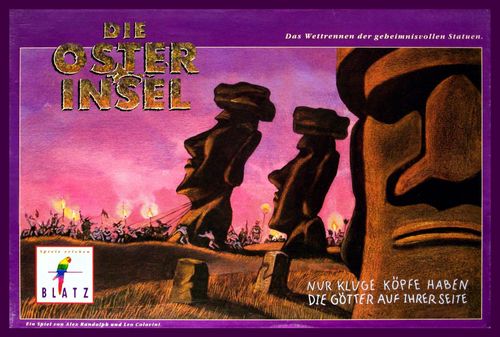
Die Osterinsel
Die Osterinsel Rulebook
Table of Contents
Table of Contents
The Pieces
- 1 game board, that shows a straight route with a temple and 13 fields
- 4 giant statues in four colors
- 8 rock obelisks
- 1 pouch with approximately 120 rocks
- 17 cards. There are 3 cards each with 1, 2, 3, and 4 stones, and two cards with 5 and 6 stones. There is also a spell card with the image of the statue of Hoa Hakananaia (from the British Museum in London).
Game Preparation
Open the board. At one end is a stone platform called the temple. At the other end of the game board, put the rocks. This part of the board is called the quarry.
Put the statues on the first space out from the temple. Each player chooses a statue to race. All players receive a reserve of 10 stones out of the quarry and put the pile before them.
Place the 8 rock obelisks beside any fields of the speedway: four go on the left side for the first leg of the race and four on the right side for the return journey. Two obelisks may not be placed opposite one another.
Object of the Game
The game is a race with two contrary goals: First, the statues must go forward as fast as possible. Secondly, they must be filled with stones so that they get heavier. The problem is that you have to weigh down other statues in order to move.
The game ends as soon as a statue has reached the goal. It only wins, however, if it is heavier than the statue in second place. Otherwise, the 2nd place statue wins.
Game Play
The Stone Cards
Shuffle the cards, and deal them around until someone gets the Spell card. That person becomes the First Player. The First Player shuffles the cards again. The cards are not to be reshuffled at any time during the game. The First Player then turns up one more card than the number of players. (Therefore, if four play, 5 cards; if three play, 4 cards.)
The First Player chooses one of the uncovered cards, plays it (explained below) and puts his card under the draw pile. Then the next player to his left takes a turn. That player takes one of the remaining cards, takes his turn, and places that card under the draw pile.
Because there is one more card than players, the First Player will get to go twice. (This is not really an advantage, because the leftover card is always the worst of the respective round.)
The round is then over. The First Player gives the cards to his left neighbor, who is First Player for the next round.
Each card taken, with the exception of the spell card, shows the number of stones that the player must use in the round. You have two choices:
- Take that many stones from the quarry, and add them to your reserves.
- Move statues, pulling that many stones from your reserve pile.
You always must use exactly as many stones as are depicted on the card. If you have fewer stones in your quarry than on the card, you have no choice:
- You have to pull stones from the quarry.
- If you get the spell card, you can use it like a normal turn, choosing to use 1-6 stones, or you may steal the whole reserve of any player!
Moving Statues
You can move your own or another player's statue. Ever after, if he progresses or heavier wants to become. [Garbled in the machine-aided source translation.]
The main rule: For each space that you move a statue forward, you have to put a stone into a different statue. So, if you want to move your statue forward one, you have to toss one stone in an opponent's statue. And if you want to put a stone into your statue, you have to move an opponent forward.
A statue can EITHER be made heavier or moved, never both in the same player's turn.
Example: A player has picked a card with 5 stones. He therefore takes the 5 stones out of his reserve, throws them into his own statue and then moves any opponents' statues a total of 5 spaces. For example: a statue 1 field and two statues 2 fields.
Or, he can take the 5 stones, throw them into any opponents' statues and move his own statue 5 spaces.
So that nobody gets confused: Do all of your stone dropping after movement.
The Obelisks
If you move your own statue onto a field with an obelisk, you move the obelisk back to the temple. The player then receives some stones from the quarry. These may be dumped into your own statue.
Take: 1 stone for the first cleared obelisk, 2 for the second, 3 for the third, and 8 for the last!
If you move an opponent's statue onto an obelisk, then the obelisk is cleared, but you receive no award.
Once all statues have passed an obelisk, move it to the temple with no one receiving an award.
The Route
The statues move into the quarry, turn around (this is free) and race back toward the temple.
Game End
The game ends as soon as a statue has reached the last space before the temple. Count the stones in that statue, and the second place statue. If there is a tie, then the lead statue wins. Move the winning statue to the temple and bask in its glory.