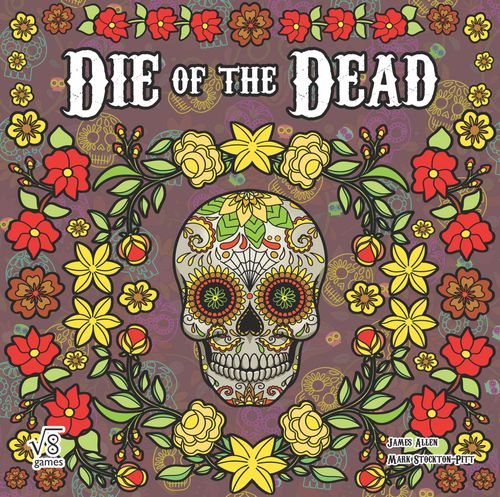
Die of the Dead
Die of the Dead Rulebook
Table of Contents
Table of Contents
Objective
It's the Day of the Dead, and players play as friendly spirits, helping guide souls up the marigold steps, back to the land of the living. The first player to have one of their souls reach the village wins!
Contents
- 4 Dia de Muertos Caskets
- 1 3D marigold steps
- 4 Papel picado casket boards
- 4 Papel picado token boards
- 1 City of the Dead board
- 12 Tokens (3 x candle, 3 x marigold, 3 x incense, 3 x bread)
- 5 player boards
- 60 normal 6-sided dice (12 x red, 12 x blue, 12 x white, 12 x yellow, 12 x black)
- 15 custom dice (3 x red, 3 x blue, 3 x white, 3 x yellow, 3 x black)
Setup
- Place the marigold steps at one end of the table with the steps facing the players.
- In front of it place the 4 caskets in a horizontal line. The lids of the caskets are larger than the bases, and have the skulls printed on them – don't place them upside down!
- In front of each casket place the casket boards, in ascending numerical order from left to right. Remove the lid of casket 1 and place it next to the casket.
- Choose which side up to have each of the token boards and place them within reach of all players. For the first game we recommend playing on the 'A' sides. Put the tokens on the corresponding boards (2 tokens in a 2/3 player game, 3 tokens in a 4/5 player game).
- Place the City of the Dead board within reach of all players.
- Each player takes a player board and all the corresponding dice of that colour. These dice are the players' souls.
- Three of each players' souls (dice) are Power Souls: dice with skulls in place of the '3' and '4'. Place these Power Souls on the City of the Dead board.
- The other ten souls (dice) should be placed next to the player board. This is each players' supply.
- Choose whether all players will play with asymmetric abilities (we recommend playing without these for your first game) and turn the player board to the corresponding side.
- Each player rolls two souls, the player who rolls the highest total is the start player and takes the first turn.
Before the game begins, each player adds souls (dice) to the caskets and/or player board, from the supply, beginning with the start player and going clockwise around the table:
- Player 1 add one soul to casket 1 and one soul to casket 2.
- Player 2 add one soul to casket 1, one soul to casket 2, and place one soul on their player board.
- Player 3 add one soul to casket 1 and one soul to casket 3.
- Player 4 add one soul to casket 1, one soul to casket 3 and place one soul on their player board.
- Player 5 add one soul to casket 1, one soul to casket 2 and one soul to casket 3.
(A 5-player example setup: the marigold steps stand at one end of the table with the 4 caskets in a row in front of them, casket boards 1-4 laid out left to right with the lid removed from casket 1. Each player has their own coloured dice, a player board, and a coffin-shaped starting-player marker. The token boards for Candle, Marigold, Incense and Bread sit nearby with the City of the Dead board and its Power Souls.)
How To Play
Beginning with the start player, each player will choose a casket and perform the actions described on the card in front of it. Each casket will have a main action and secondary action, both of which are performed by the current player. After they have performed both actions it is the next player's turn, going around the table clockwise.
Objective
Be the first player to have one of their souls at the top of the steps.
Terms Used
Here is an explanation for some of the terms used in the casket descriptions:
Free souls
All dice represent souls. Dice in a player's supply are referred to as 'Free Souls'. This does not include souls on the player board, City of the Dead board, in caskets or on the steps. Players should keep their supply of free souls by their player board.
Prepared Souls
Any souls on the player board are prepared souls. There are only three spaces for souls on each player board, so each player can have up to three prepared souls.
When a player prepares a soul they place a free soul on an unoccupied space on their player board.
Power Souls
The dice with a skull in place of the '3' and '4' are power souls. They begin the game on the City of the Dead board. The skull side is wild, if a soul ever shows the skull when rolled, the owner can decide what value it represents that turn, choosing an integer between '1' and '6' inclusive.
When a player gains a power soul they take it from the City of the Dead board and add it to their supply of free souls. They can only take a power soul of their colour.
Move the caskets
When the caskets are moved, they all move one space in ascending numerical order: the casket in position 1 moves to position 2, the casket in position 2 moves to position 3 etc. The casket in position 4 loops back around to position 1. After the caskets have been moved, remove the lid from the casket in position 1, and ensure all other caskets have their lids on.
Ascending souls
Casket 4 requires players to ascend souls. To ascend souls, they are taken from casket 4 and placed on the steps. Each player's first soul goes on the first step, then the second on the second step, up until their ninth soul is placed on the ninth and final step showing the Land of the Living (at which point that player wins the game). The soul can be placed on any uncovered space on that step, chosen by the current player. If the space shows a bonus they will gain that bonus, provided they haven't gained any other step bonuses that turn (see Bonuses).
Compare Souls
Caskets 2 and 4 require players to compare souls to find a winner. The winner is the player who has the most souls showing the highest number in that casket. If that's a tie, the winner is whoever amongst the tied players has the most souls showing the next highest number, and so on. If players are completely tied, then all tied players are considered the winner. The winner will receive a benefit depending upon the casket.
Examples:
- With this roll: Blue shows a '4', Blue shows a '4', White shows a '6', Red shows a '5'. '6' is the highest number and White has the most souls showing a '6', so White is the winner.
- With this roll: Blue shows a '6', Blue shows a '4', White shows a '4', White shows a '5', White shows a '5', White shows a '1', White shows a '1', Red shows a '6', Red shows a '3'. '6' is the highest number, and both Blue and Red are tied for '6's, so they compare their next highest number which is a '4'. Blue wins because they have the most '4's. White's '5's are ignored because they did not tie for '6's.
- With this roll: Blue shows a '1', White shows a '1', White shows a '1'. The highest number is '1'. White has the most souls showing '1', so White is the winner.
Casket Descriptions
In these descriptions 'you' refers to the current player.
Casket 1
Unlike other caskets, whichever casket is in position 1 stays open so players can always see the contents.
Main action: Add up to three of your prepared souls, or one free soul, to the casket. You can choose to add no souls.
Secondary action: If there are at least two players' souls in the casket then shake and open the casket. If at least one of the souls has a value of '1', move the caskets.
Casket 2
Main action: Prepare up to two souls, by adding up to two free souls to your player board. You can choose to prepare no souls.
Secondary action: Shake and open the casket and compare the souls. The winner prepares a soul. If at least one of the souls has a value of '1', move the caskets.
Casket 3
Main action: Shake and open the casket. Remove souls of the same colour showing the same number. They go back to being free souls. If this would remove all a player's souls from the casket, leave one of their souls in the casket.
E.g. If the following were rolled: Blue shows a '1', Blue shows a '2', White shows a '6', White shows a '5', White shows a '5', White shows a '1', White shows a '1', Red shows a '3', Red shows a '3'.
You would remove none of Blue's souls, one of Red's souls (both souls show a '3', but one red soul must remain), and White's double '5' and double '1' from the casket. The following souls would be left in the casket: Blue showing '1', Blue showing '2', White showing '6', Red showing '3'.
Secondary action: You gain a token of your choice from the supply (Incense, Candle, Marigold, or Bread). If this takes you to three tokens you must immediately discard one.
Casket 4
Main action: Shake and open the casket and compare souls. You ascend two of the winner's souls. If there are not enough of the winner's souls in the casket, you only ascend one soul. If multiple players win the roll, you choose the order they are ascended. The ascended souls do not have to be those with the highest value showing. The player(s) whose souls are ascended may gain a bonus (see Bonuses), but you choose which bonus they get.
Secondary action: Either move the caskets, ascend a soul (possibly gaining a bonus), or gain a power soul. The power soul must be in your colour and goes into your free soul supply.
Tokens
A player may gain a token as the secondary action of casket 3, or as a bonus from having a soul ascended. A player can only have two tokens, if they gain a third, they must immediately discard one back to the supply. Tokens can be played at different times, as described on the token board.
Each token board is double sided, agree which side to play on for each token before the game begins. Tokens are all single use and return to the supply when used. Multiple tokens may be used on the same turn, including the same token type multiple times, and from the same player. If two players want to play a token at the same time, whoever announced they were playing it first goes first. If they were both announced at the same time, the player closest clockwise to the current player goes first.
Candle
A — Play at the start of any player's turn, before they have chosen a casket. Move the caskets.
B — Play at the start of any player's turn, before they have chosen a casket. Swap two adjacent caskets. Note: Caskets 1 and 4 are not adjacent. If caskets 1 & 2 are swapped remember to remove the lid on 1 and place the lid on 2.
Marigold
A — Play at the start of your turn, before you have chosen a casket. Privately look in a casket. If a player has multiple souls in the casket remove one, it goes back to their supply. If multiple players have multiple souls you choose which one to remove. If you are the only player with multiple souls in the casket you must remove one of your own.
B — Play at the start of your turn, before you have chosen a casket. Add one soul, either free or prepared, to casket 1. If there are any opponents' souls in casket 1 remove one of them (in total, not per opponent). It goes back to its owner's supply of free souls.
Incense
A — Play after a casket has been opened. Adjust the value of any soul up or down by 1, to a minimum of '1' and maximum of '6'. This can be any soul, not just the owners, and works on power souls after their owner has declared their value. A '1' cannot be changed to a '6' or a '6' to a '1'.
B — Play after a casket has been opened. Shake the casket again.
Bread
A — Play after another player has chosen a casket, before they shake it. Add one of your prepared souls to that chosen casket. You cannot play this token on your turn.
B — Play before another player chooses a casket. Add up to two prepared souls to an empty casket. You can choose any of the four caskets, but there must be no souls in the chosen casket for you to play this. If multiple players want to play this at the same time, only the player nearest clockwise to the current player, does so. You can shake caskets to check if they are empty before playing the token. You cannot play this token on your turn.
Bonuses
When a player's soul is ascended from casket 4, the owner gains a bonus corresponding to where the soul was placed. There is one space on each step which is blank – this space has no bonus. If a player has more than one of their souls ascended in a single turn they only gain a bonus for their first soul ascended. Tokens are taken from the supply, and Power Souls from the City of the Dead board. If none of the corresponding bonus remain then no bonus is gained. The bonuses are:
- Prepare up to one soul.
- Gain a Power Soul.
- Gain a Bread token.
- Gain a Candle token.
- Gain an Incense token.
- Gain a Marigold token.
Game End
As soon as a player's soul is placed on the ninth step showing the land of the living, the game is over and the owner of that soul wins! It doesn't matter who places the soul, only who owns it, so it's possible to win on another player's turn!
Two Player Game
In a two player game place an unused player board between the players, with all its corresponding souls including power souls next to it. This shall be referred to as the 'ghost player'.
At the end of each player's turn do the following:
- If there are two souls on the ghost player's board, place them in casket 1 and shake the casket, moving the caskets if a '1' is rolled.
- Otherwise, place one soul on the ghost player's board.
If casket 3 is rolled, and the ghost player's souls show the same value, remove them as you would a normal player.
If casket 4 is rolled, and the ghost player is the winner when souls are compared, ascend them as you would a normal player. This way it is possible for the ghost player to win!
The ghost player never gains bonuses from the steps, or the bonus from winning casket 2 (although they can still win casket 2, they don't prepare a soul when doing so).
Alternative Player Boards
The player boards can be turned over to their other side. These show asymmetric starting bonuses and permanent abilities for the players. The starting bonus is shown in the top right of the board, and the permanent ability show in the top left.
White
Ability: You have an additional space for a prepared soul.
Starting Bonus: Begin with an extra prepared soul from your supply.
Red
Ability: Before any player's turn you may remove one of your prepared souls to take a Candle token from the supply.
Starting Bonus: Begin with a Candle Token from the supply.
Yellow
Ability: Before you choose a casket you may peek into any casket.
Starting Bonus: Begin with an extra soul in Casket 1 from your supply.
Blue
Ability: When you gain a power soul you may remove up to two souls from the steps instead. These are added to your supply. You cannot remove your highest placed soul. You continue placing souls on the steps from your highest placed soul.
Starting Bonus: During setup only 2 of your power souls start on the City of the Dead board. The third begins in your supply. This soul cannot be prepared or placed in a casket during setup.
Black
Ability: At the start of your turn you may swap one of your tokens for a different token. Either with the supply or another player.
Starting Bonus: Begin with a token of your choice.
Open Casket Variant
If players want a more tactical variant they may play with all caskets open. Simply place the lids to one side and only cover up the caskets when shaking them. If using this variant do not use Marigold A or the alternative side of the player boards.
Playtesting
Many thanks to Jim Marshall, Paul Rhodes, Fiona Jackson, Judith Elliott, Tom Coldron, Peter Barnes, Nigel Kershaw, Lucinda Stiff, Chris Stiff, Jason Toop, Sean Hickey, Will Wood, Nathanael Young, Ángel Cataño Flores, Tyler Lipchen, Andy Lefter, Chris Barnard, Robert Dane, anybody else in Playtesting UK, Protospiel Nottingham or BM York who I've missed, the HGS boardgame club, and everyone who took time out to playtest it at conventions, at a distance, or even just gave feedback on the rulebook or components. We're grateful to all of you.
And from James, special thanks to Milayna and Edward Allen.